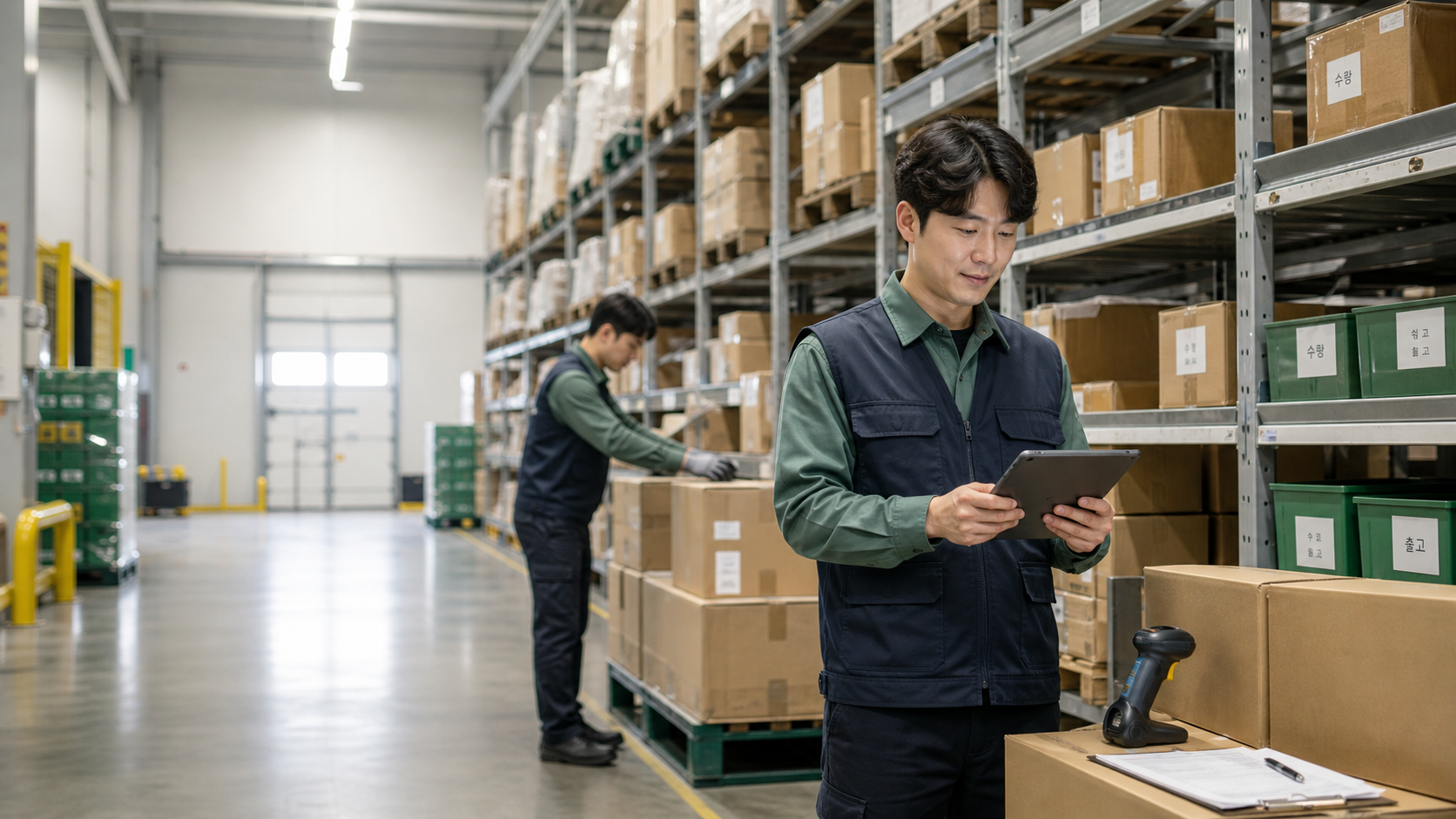
You are working in a Korean warehouse. A supervisor points to boxes on a pallet and says the items need inspection before release. Another worker talks about stock, packaging material, and a forklift caution area. The words are short, but if you misunderstand them, the work can slow down or become unsafe.
This lesson teaches Korean warehouse inventory words for foreign workers. The focus is not memorizing a random list. You will learn the basic flow of warehouse work in Korea: items come in, workers inspect them, stock is managed, products are packaged, and some items are released from the warehouse.
Key Vocabulary
| Korean | Romanization | English | Level | Usage Note |
|---|---|---|---|---|
| 창고 | changgo | warehouse | Beginner | The basic word for warehouse or storage area. |
| 창고관리 | changgo gwalli | warehouse management | Intermediate | Used for managing storage, stock, and warehouse rules. |
| 입고 | ipgo | warehousing / receiving | Intermediate | Items entering the warehouse system. |
| 출고 | chulgo | release from warehouse | Intermediate | Items leaving the warehouse for delivery or use. |
| 검수 | geomsu | inspection | Intermediate | Checking quantity, condition, or quality. |
| 검수기준 | geomsu gijun | inspection criteria | Intermediate | The rule for deciding if an item passes inspection. |
| 재고 | jaego | inventory / stock | Beginner | Products or materials currently available. |
| 재고관리 | jaego gwalli | inventory management | Beginner | Tracking and controlling stock. |
| 재고조사 | jaego josa | inventory inspection | Intermediate | Counting or checking stock records. |
| 포장 | pojang | packaging | Beginner | Packing products for storage, sale, or delivery. |
| 포장재 | pojangjae | packaging material | Intermediate | Boxes, wrap, tape, padding, or other materials. |
| 운반중 | unban jung | transport in progress | Intermediate | Seen on notices or during moving work. |
| 운반주의 | unban juui | transport caution | Intermediate | A safety warning when moving items. |
| 적재주의 | jeokjae juui | loading caution | Intermediate | A warning about stacking or loading items. |
| 지게차주의 | jigecha juui | forklift caution | Intermediate | An important safety sign in warehouses. |
Real Warehouse Phrases
| Korean Sentence | English Meaning | When to Use |
|---|---|---|
| 입고된 물건을 확인해 주세요. | Please check the received items. | When items arrive at the warehouse. |
| 출고 전에 검수해 주세요. | Please inspect it before release. | Before items leave the warehouse. |
| 재고를 다시 확인해 주세요. | Please check the inventory again. | When stock quantity may be wrong. |
| 포장재가 부족합니다. | Packaging material is not enough. | When boxes, tape, or wrap are missing. |
| 검수기준을 확인하겠습니다. | I will check the inspection criteria. | When you are unsure if an item passes. |
| 지게차주의 구역입니다. | This is a forklift caution area. | When warning someone near forklift traffic. |
| 운반중이라 잠시 기다려 주세요. | Transport is in progress, so please wait a moment. | When items are being moved. |
| 창고관리 담당자에게 보고하겠습니다. | I will report it to the warehouse management person. | When a stock or safety issue needs reporting. |
How the Warehouse Flow Works
A simple Korean warehouse workflow often moves in this order: 입고, 검수, 재고관리, 포장, and 출고. This order is useful because many Korean instructions are very short. A supervisor may not explain every step in a long sentence. Instead, you may hear a short instruction like 입고 물건 검수해 주세요 or 출고 전에 재고 확인해 주세요.
When you hear 입고, think about items coming into the warehouse. When you hear 검수, check the item before it moves to the next step. When you hear 재고, think about quantity and records. When you hear 포장 or 포장재, think about preparing the item safely. When you hear 출고, think about items leaving the warehouse, often for delivery, shipment, or use at another site.
For foreign workers, the safest habit is to repeat the key word and confirm the action. For example, you can say 입고 물건을 검수하면 되나요? This means “Should I inspect the received items?” You do not need complex Korean to work clearly. You need the right warehouse word, a simple action, and confirmation from the supervisor.
Usage Notes
입고 and 출고 are opposite workflow words. 입고 means goods enter the warehouse record. 출고 means goods leave the warehouse record. Beginners often think these words only mean physical movement, but in real work they are also connected to inventory data.
검수 means inspection. In a warehouse, it can include checking quantity, product condition, labels, packaging, or damage. If someone says 검수해 주세요, they are asking you to check the item before the next step.
재고 is stock or inventory. 재고관리 means inventory management, and 재고조사 means an inventory count or inspection. These words are common in warehouses, stores, marts, factories, and online-shopping businesses.
Safety words such as 지게차주의, 운반주의, and 적재주의 are not just vocabulary. They tell you where to be careful. In a warehouse, these warnings can help prevent injury, product damage, or blocked work paths.
Mini Dialogue
Supervisor: 입고된 물건 먼저 검수해 주세요.
Ipgo-doen mulgeon meonjeo geomsuhae juseyo.
Please inspect the received items first.
Worker: 네, 검수기준을 확인하겠습니다.
Ne, geomsu gijuneul hwaginhagetsseumnida.
Yes, I will check the inspection criteria.
Supervisor: 포장재가 부족하면 바로 보고해 주세요.
Pojangjaega bujokhamyeon baro bogohae juseyo.
If packaging material is not enough, report it right away.
Worker: 알겠습니다. 재고도 다시 확인하겠습니다.
Algetsseumnida. Jaegodo dasi hwaginhagetsseumnida.
Understood. I will check the inventory again too.
Common Mistakes
Mistake 1: Confusing 입고 and 출고.
입고 is receiving into the warehouse. 출고 is release from the warehouse. If you confuse them, inventory records can become wrong.
Mistake 2: Thinking 검수 only means counting.
검수 can include quantity, damage, labels, packaging, and quality. Ask for the 검수기준 if you are not sure what to check.
Mistake 3: Ignoring safety notice words.
Words like 지게차주의 and 적재주의 are work instructions, not decoration. Stop, look around, and follow the work path carefully.
Step-by-Step Practice
- Find the workflow word: 입고, 검수, 포장, or 출고.
- Check the object: product, box, packaging material, or stock record.
- Use a clear report phrase: 재고를 다시 확인하겠습니다.
- If there is a shortage, say: 포장재가 부족합니다.
- If there is a safety warning, slow down and check the area first.
Quick Quiz
- What does 입고 mean?
Answer: Receiving or warehousing items into the warehouse system. - What is the opposite of 입고 in warehouse work?
Answer: 출고. - Which word means inspection?
Answer: 검수. - You do not have enough boxes or tape. Which word is useful?
Answer: 포장재. - What does 지게차주의 warn about?
Answer: Forklift caution.
Review Table
| Korean | Meaning | Best Situation | Beginner Tip |
|---|---|---|---|
| 창고 | warehouse | Storage area | Basic place word. |
| 입고 | receiving | Items coming in | Think “into warehouse records.” |
| 출고 | release | Items going out | Check before shipment or delivery. |
| 검수 | inspection | Checking items | Check criteria first. |
| 재고 | inventory | Stock count | Quantity matters. |
| 포장재 | packaging material | Boxes, tape, wrap | Report shortage early. |
| 지게차주의 | forklift caution | Safety areas | Look around before moving. |
Related Lessons
- Korean Work Schedule Phrases for Foreign Workers
- Korean Customer Complaint Phrases for Service Workers
- Field Korean Construction Site Safety Instructions
- BSKorean Practice App
Practice More
Practice this word list in Learn Korean or in the upcoming BS3001 app. Start with 입고, 출고, 검수, 재고, and 포장재. These words help foreign workers understand the basic movement of goods inside a Korean warehouse.