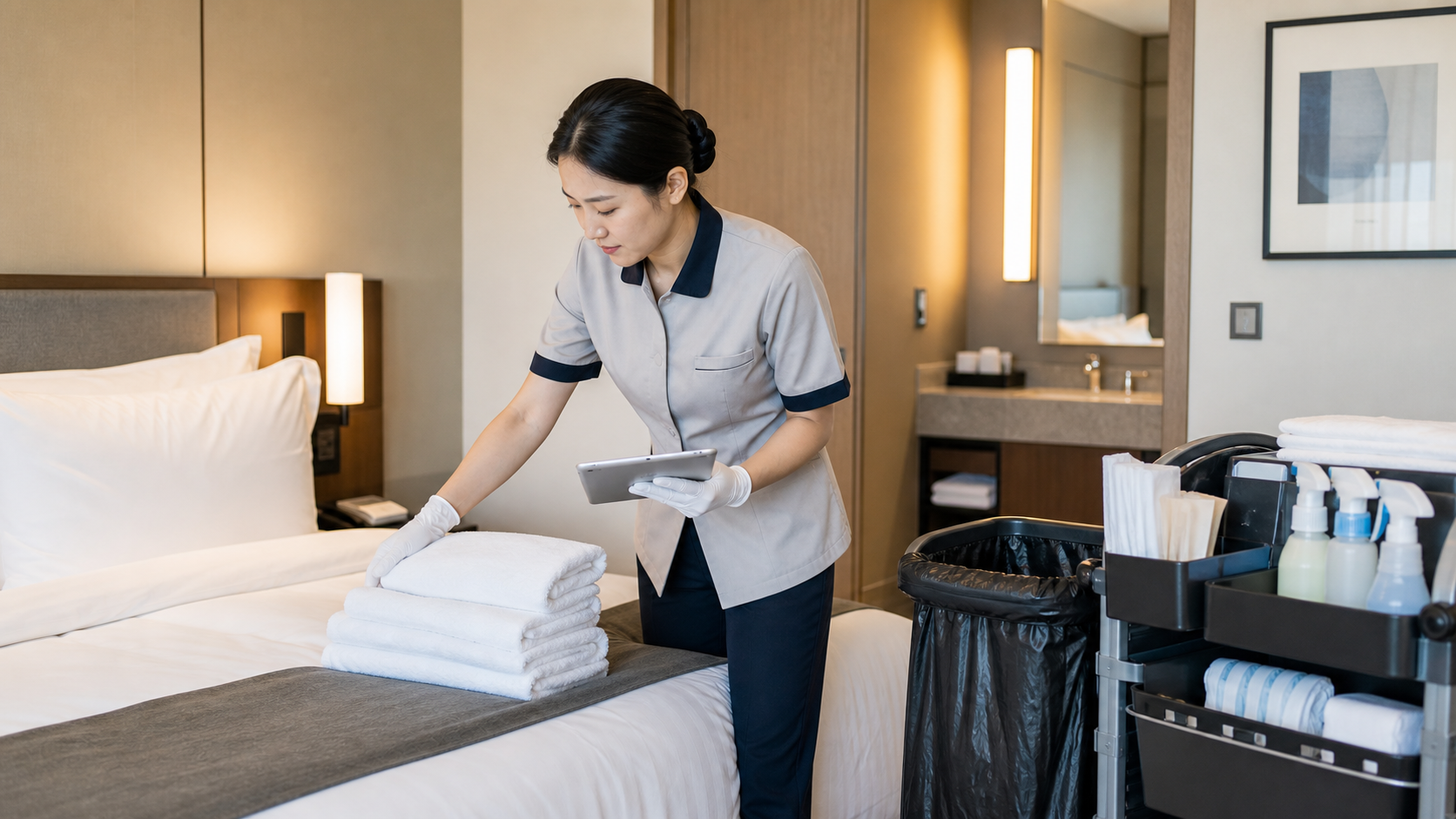
You are working in a Korean hotel. A supervisor points to the housekeeping cart and says which rooms need cleaning, which towels need replacement, and which room condition must be checked before the guest arrives. The Korean words may sound simple, but in hotel work they connect directly to speed, guest satisfaction, and team communication.
This lesson teaches Korean hotel cleaning words for foreign workers. It is useful for housekeeping, guest-room cleaning, hotel service, cleaning jobs, and apartment-style accommodation work in Korea. The focus is practical: understand the room task, check supplies, replace towels, handle trash, disinfect surfaces, and report problems to a manager.
Key Vocabulary
| Korean | Romanization | English | Level | Usage Note |
|---|---|---|---|---|
| 호텔 | hotel | hotel | Beginner | Used for hotel and accommodation work. |
| 객실 | gaeksil | guest room | Beginner | The room where the guest stays. |
| 객실번호 | gaeksil beonho | room number | Beginner | Used when assigning or checking rooms. |
| 객실상태 | gaeksil sangtae | room condition | Intermediate | Used when checking if the room is ready. |
| 객실청소 | gaeksil cheongso | room cleaning | Intermediate | A hotel-specific cleaning task. |
| 청소 | cheongso | cleaning | Intermediate | General cleaning work. |
| 청소하다 | cheongsohada | to clean | Beginner | Verb form used in instructions. |
| 수건 | sugeon | towel | Beginner | Common hotel supply word. |
| 수건교체 | sugeon gyoche | towel replacement | Intermediate | Replacing used towels with clean towels. |
| 침대 | chimdae | bed | Beginner | Used when checking or preparing the room. |
| 쓰레기 | sseuregi | trash | Beginner | Trash inside the room. |
| 쓰레기통 | sseuregitong | trash can | Beginner | Check and empty it during cleaning. |
| 교체 | gyoche | replacement | Beginner | Changing used items to clean/new items. |
| 세제 | seje | detergent | Beginner | Cleaning product or detergent. |
| 소독 | sodok | disinfection | Intermediate | Important for bathrooms, handles, and surfaces. |
| 정리 | jeongni | organization | Beginner | Arranging or tidying items. |
| 관리자 | gwallija | manager / supervisor | Intermediate | The person to report room problems to. |
| 보고 | bogo | report | Beginner | Used when telling the manager about a problem. |
Real Hotel Cleaning Phrases
| Korean Sentence | English Meaning | When to Use |
|---|---|---|
| 객실청소를 시작하겠습니다. | I will start room cleaning. | When beginning assigned rooms. |
| 객실번호를 확인해 주세요. | Please check the room number. | When the assigned room is unclear. |
| 수건을 교체해 주세요. | Please replace the towels. | Common housekeeping instruction. |
| 쓰레기통을 비워 주세요. | Please empty the trash can. | During room cleaning. |
| 욕실을 소독해 주세요. | Please disinfect the bathroom. | When cleaning bathroom surfaces. |
| 세제가 부족합니다. | Detergent is not enough. | When supplies are low. |
| 객실상태를 다시 확인하겠습니다. | I will check the room condition again. | Before marking a room ready. |
| 문제가 있으면 관리자에게 보고하겠습니다. | If there is a problem, I will report it to the manager. | When damage, missing items, or guest issues appear. |
How Hotel Cleaning Work Usually Flows
A simple hotel cleaning workflow often starts with 객실번호. First, check which room you are assigned. Then check the 객실상태. Some rooms may be checked out, some may be occupied, and some may already be cleaned. After that, you clean the room, replace towels, handle trash, disinfect the bathroom, and report anything unusual.
In Korean, many instructions are short. A supervisor may say 수건교체 먼저 해 주세요 or 객실상태 확인해 주세요. You do not need a long reply. A clear answer like 네, 확인하겠습니다 or 관리자에게 보고하겠습니다 is enough in many workplace situations.
Room Check Pattern
Hotel cleaning work is easier when you read Korean instructions as a checklist. Start with the room number, then check the room condition, then clean, replace, disinfect, and report. This pattern helps you avoid missing small but important tasks.
| Step | Korean Word | What You Do |
|---|---|---|
| 1 | 객실번호 | Check which room you are assigned. |
| 2 | 객실상태 | Check if the room is dirty, ready, occupied, or has a problem. |
| 3 | 객실청소 | Clean the guest room. |
| 4 | 수건교체 | Replace used towels with clean towels. |
| 5 | 소독 | Disinfect bathroom and touch surfaces. |
| 6 | 보고 | Report damage, missing items, or unusual situations. |
If you are unsure, use a confirmation phrase. 이 객실 청소하면 되나요? means “Should I clean this room?” 수건도 교체하면 되나요? means “Should I replace the towels too?” These short questions are very practical in hotel work because they reduce mistakes without needing complex grammar.
Usage Notes
청소 is the general word for cleaning, but 객실청소 is more specific. It means cleaning a guest room. In hotel work, this can include the bed, trash, towels, bathroom, floor, supplies, and room condition.
교체 means replacement. It is useful with many hotel items: 수건교체, bedding replacement, amenity replacement, or cleaning supply replacement. If you are not sure what to replace, ask with 무엇을 교체하면 되나요?, meaning “What should I replace?”
소독 is stronger than simple cleaning. It means disinfection. In hotels, it is especially important for bathrooms, door handles, remote controls, desks, and shared surfaces.
Mini Dialogue
Supervisor: 305호 객실청소 부탁드립니다.
Samgong-o ho gaeksil cheongso butakdeurimnida.
Please clean room 305.
Worker: 네, 객실상태를 먼저 확인하겠습니다.
Ne, gaeksil sangtaereul meonjeo hwaginhagetsseumnida.
Yes, I will check the room condition first.
Supervisor: 수건교체하고 쓰레기통도 비워 주세요.
Sugeon gyochehago sseuregitongdo biwo juseyo.
Please replace the towels and empty the trash can too.
Worker: 알겠습니다. 문제가 있으면 관리자에게 보고하겠습니다.
Algetsseumnida. Munjega isseumyeon gwallijaege bogohagetsseumnida.
Understood. If there is a problem, I will report it to the manager.
Common Mistakes
Mistake 1: Using 청소 for every hotel task.
청소 is useful, but hotel work often needs more specific words like 객실청소, 수건교체, 소독, and 객실상태.
Mistake 2: Confusing 교체 and 정리.
교체 means replacing something. 정리 means organizing or tidying. Replacing towels and organizing supplies are different tasks.
Mistake 3: Not reporting room problems.
If something is broken, missing, dirty beyond normal cleaning, or unsafe, do not only clean around it. Use 관리자에게 보고하겠습니다.
Step-by-Step Practice
- Check the room: 객실번호를 확인해 주세요.
- Check the condition: 객실상태를 확인하겠습니다.
- Clean the room: 객실청소를 시작하겠습니다.
- Replace items: 수건을 교체해 주세요.
- Report problems: 관리자에게 보고하겠습니다.
Quick Quiz
- What does 객실 mean?
Answer: Guest room. - Which word means towel replacement?
Answer: 수건교체. - What is stronger than simple cleaning and means disinfection?
Answer: 소독. - You need to empty the trash can. Which word helps?
Answer: 쓰레기통. - You find a problem in the room. What should you say?
Answer: 관리자에게 보고하겠습니다.
Review Table
| Korean | Meaning | Best Situation | Beginner Tip |
|---|---|---|---|
| 객실 | guest room | Hotel room work | Check the room number first. |
| 객실청소 | room cleaning | Housekeeping | More specific than 청소. |
| 수건교체 | towel replacement | Bathroom and room setup | 교체 means replacement. |
| 쓰레기통 | trash can | Trash handling | 비워 주세요 means empty it. |
| 세제 | detergent | Cleaning supplies | Report when it is low. |
| 소독 | disinfection | Bathroom and surfaces | Stronger than cleaning. |
| 보고 | report | Problems or damage | Report to the manager. |
Related Lessons
- Korean Customer Complaint Phrases for Service Workers
- Korean Work Schedule Phrases for Foreign Workers
- Korean Emergency Report Phrases for Foreign Workers
- BSKorean Practice App
Practice More
Practice this word list in Learn Korean or in the upcoming BS3001 app. Start with 객실청소, 수건교체, 쓰레기통, 소독, and 보고. These words help foreign workers handle hotel cleaning tasks more clearly in Korea.