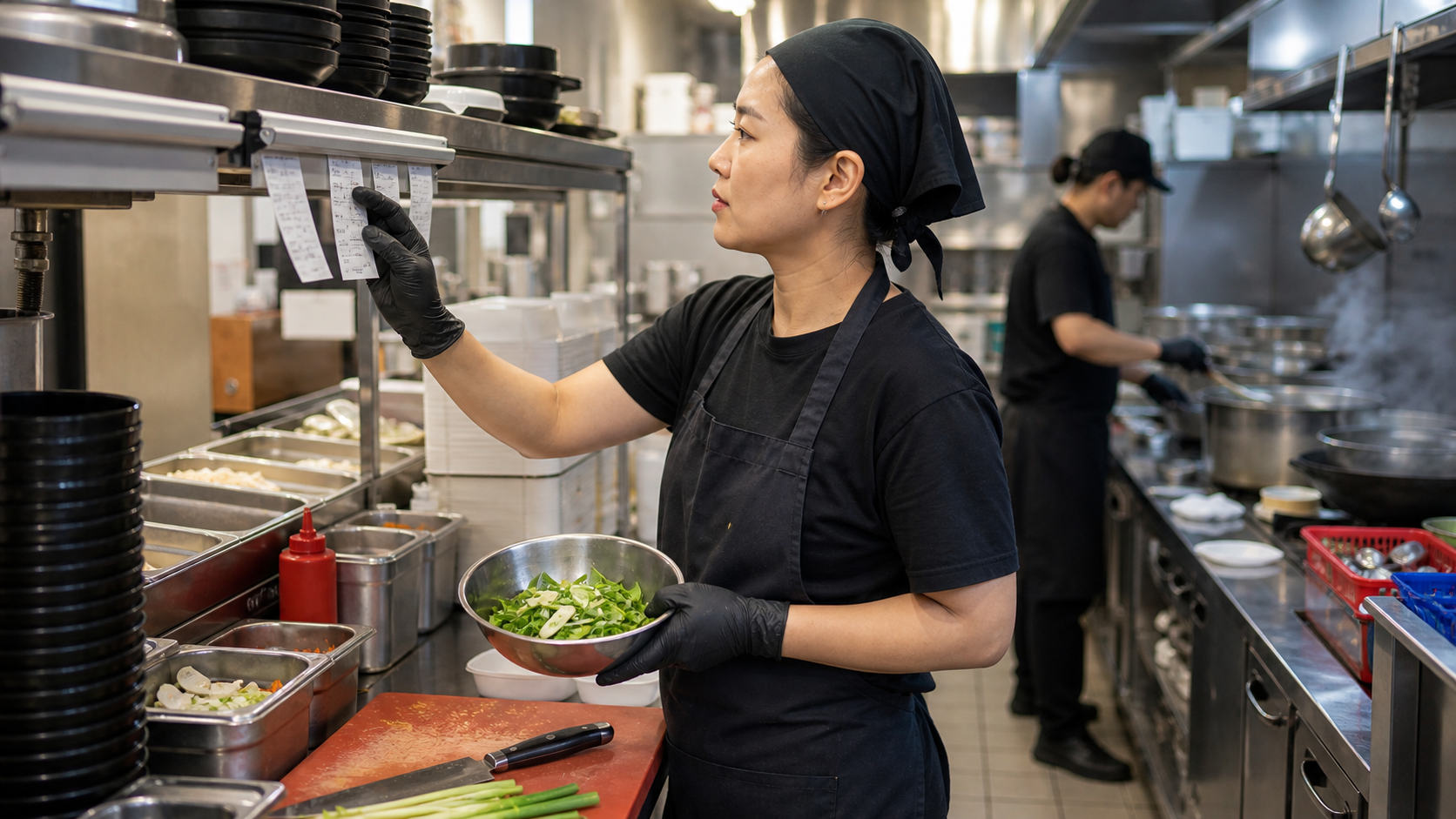
You are working in a Korean restaurant kitchen. Orders come in quickly, ingredients must be prepared, cold items must stay refrigerated, dishes pile up, and the supervisor asks you to check hygiene before service gets busy. In this setting, Korean restaurant kitchen words are not just vocabulary. They are work instructions.
This lesson teaches practical Korean restaurant kitchen words for foreign workers. The focus is on words already useful across service jobs: order, ingredient, packaging, refrigerated storage, dishwashing, knife, cutting board, hygiene, disinfection, and reporting to a manager.
Key Vocabulary
| Korean | Romanization | English | Level | Usage Note |
|---|---|---|---|---|
| 주문 | jumun | order | Beginner | Used for food orders and kitchen workflow. |
| 주문하다 | jumunhada | to order | Beginner | Verb form for ordering. |
| 주문서 | jumunseo | purchase order / order form | Beginner | Can mean an order sheet in work contexts. |
| 재료 | jaeryo | ingredient | Intermediate | Food materials used for cooking. |
| 원재료명 | wonjaeryomyeong | ingredient name | Advanced | Often seen on labels and food information. |
| 냉장고 | naengjanggo | refrigerator | Beginner | Common kitchen equipment. |
| 냉장하다 | naengjanghada | to refrigerate | Beginner | Action word for keeping food cold. |
| 냉장보관 | naengjang bogwan | refrigerated storage | Intermediate | Important for food safety. |
| 포장 | pojang | packaging / takeout | Beginner | Used for packing food or takeout. |
| 포장재 | pojangjae | packaging material | Intermediate | Containers, bags, wrap, or boxes. |
| 설거지하다 | seolgeoji-hada | to wash dishes | Beginner | Useful in kitchens, cafes, and restaurants. |
| 칼 | kal | knife | Beginner | Basic kitchen tool. |
| 도마 | doma | cutting board | Beginner | Used for prep work. |
| 위생 | wisaeng | hygiene | Intermediate | Important in food service work. |
| 식품위생 | sikpum wisaeng | food hygiene | Advanced | More formal food-safety term. |
| 소독 | sodok | disinfection | Intermediate | Used for hands, tools, counters, and surfaces. |
| 손소독 | son sodok | hand sanitizing | Intermediate | Common hygiene instruction. |
| 관리자 | gwallija | manager / supervisor | Intermediate | The person to report kitchen issues to. |
| 보고 | bogo | report | Beginner | Used when telling a manager about a problem. |
Real Kitchen Phrases
| Korean Sentence | English Meaning | When to Use |
|---|---|---|
| 주문을 확인해 주세요. | Please check the order. | Before preparing food. |
| 재료가 부족합니다. | Ingredients are not enough. | When food materials are low. |
| 이 재료는 냉장보관해 주세요. | Please keep this ingredient refrigerated. | For cold food safety. |
| 포장재가 부족합니다. | Packaging material is not enough. | When containers or bags are low. |
| 설거지 먼저 하겠습니다. | I will wash dishes first. | When handling dishwashing tasks. |
| 칼과 도마를 소독해 주세요. | Please disinfect the knife and cutting board. | Food hygiene instruction. |
| 손소독하고 시작하겠습니다. | I will sanitize my hands and start. | Before prep or service. |
| 문제가 있으면 관리자에게 보고하겠습니다. | If there is a problem, I will report it to the manager. | For shortage, hygiene, or order problems. |
Kitchen Workflow Pattern
A basic restaurant kitchen workflow can be read as a sequence: 주문 확인, 재료 준비, 냉장보관 확인, 조리 또는 포장, 설거지, and 위생 확인. Even when you do not know every Korean sentence, recognizing these key words helps you understand what step is happening.
| Step | Key Korean | Action |
|---|---|---|
| 1 | 주문 | Check what the customer ordered. |
| 2 | 재료 | Prepare ingredients. |
| 3 | 냉장보관 | Keep cold ingredients safe. |
| 4 | 포장 | Pack takeout or delivery food. |
| 5 | 설거지 | Wash used dishes and tools. |
| 6 | 위생 | Check hygiene before continuing work. |
Usage Notes
포장 can mean packaging, but in restaurants and cafes it often means takeout. If a customer says 포장해 주세요, they want the food or drink to go. In the kitchen, 포장 may also refer to preparing containers and packaging materials.
냉장보관 is important because it is a food-safety word. It means the item should be stored cold. If a label, supervisor, or coworker says 냉장보관, do not leave the item outside at room temperature.
위생, 식품위생, 소독, and 손소독 are serious service-work words. They are not only classroom vocabulary. They affect customer safety and workplace rules.
Kitchen Safety and Reporting Flow
Restaurant kitchen work is fast, but you should not ignore food-safety words. If ingredients are not stored correctly, if packaging material is missing, or if a tool is not clean, report it early. In Korean, a simple report can be enough: 재료가 부족합니다, 포장재가 부족합니다, or 관리자에게 보고하겠습니다.
When you hear 소독, think about reducing risk. It can apply to hands, knives, cutting boards, counters, and other surfaces. When you hear 냉장보관, think about temperature control. When you hear 위생, think about the full work habit: clean hands, clean tools, clean surfaces, and safe food storage.
| Problem | Useful Korean | Simple Report |
|---|---|---|
| Ingredients are low. | 재료 | 재료가 부족합니다. |
| Cold food is outside. | 냉장보관 | 냉장보관해야 합니다. |
| Takeout containers are low. | 포장재 | 포장재가 부족합니다. |
| Tools need cleaning. | 소독 | 칼과 도마를 소독하겠습니다. |
| You are unsure. | 관리자 | 관리자에게 확인하겠습니다. |
Mini Dialogue
Supervisor: 주문 먼저 확인해 주세요.
Jumun meonjeo hwaginhae juseyo.
Please check the order first.
Worker: 네, 그런데 재료가 조금 부족합니다.
Ne, geureonde jaeryoga jogeum bujokhamnida.
Yes, but ingredients are a little short.
Supervisor: 관리자에게 보고하고, 냉장보관 재료도 확인해 주세요.
Gwallijaege bogohago, naengjang bogwan jaeryodo hwaginhae juseyo.
Report it to the manager and check the refrigerated ingredients too.
Worker: 알겠습니다. 손소독하고 시작하겠습니다.
Algetsseumnida. Son sodokhago sijakhagetsseumnida.
Understood. I will sanitize my hands and start.
Common Mistakes
Mistake 1: Thinking 포장 only means packaging material.
In food service, 포장 often means takeout. Context tells you whether it means packing material or food to go.
Mistake 2: Ignoring 냉장보관.
냉장보관 is a food-safety instruction. If you miss this word, ingredients may be stored incorrectly.
Mistake 3: Treating 위생 as a general idea only.
위생 is practical in a kitchen. It connects to hand sanitizing, tool disinfection, food storage, and clean surfaces.
Step-by-Step Practice
- Check the order: 주문을 확인해 주세요.
- Check ingredients: 재료가 부족합니다.
- Store cold items: 냉장보관해 주세요.
- Handle takeout: 포장재가 부족합니다.
- Report problems: 관리자에게 보고하겠습니다.
Quick Quiz
- What does 재료 mean?
Answer: Ingredient. - Which word means refrigerated storage?
Answer: 냉장보관. - What does 설거지하다 mean?
Answer: To wash dishes. - Which two words mean knife and cutting board?
Answer: 칼 and 도마. - You notice a hygiene problem. What should you do?
Answer: Report it to the manager: 관리자에게 보고하겠습니다.
Review Table
| Korean | Meaning | Best Situation | Beginner Tip |
|---|---|---|---|
| 주문 | order | Before prep | Check this first. |
| 재료 | ingredient | Food preparation | Report shortages early. |
| 냉장보관 | refrigerated storage | Cold food safety | Do not leave outside. |
| 포장 | packaging / takeout | Takeout or delivery | Context matters. |
| 설거지하다 | wash dishes | Dishwashing | Action verb. |
| 위생 | hygiene | Kitchen safety | More than general cleanliness. |
| 소독 | disinfection | Tools and surfaces | Use for knife, board, hands, counters. |
Related Lessons
- Korean Customer Complaint Phrases for Service Workers
- Korean Hotel Cleaning Words for Foreign Workers
- Korean Emergency Report Phrases for Foreign Workers
- BSKorean Practice App
Practice More
Practice this word list in Learn Korean or in the upcoming BS3001 app. Start with 주문, 재료, 냉장보관, 포장, 설거지하다, and 위생. These words help foreign workers understand basic Korean restaurant kitchen instructions.