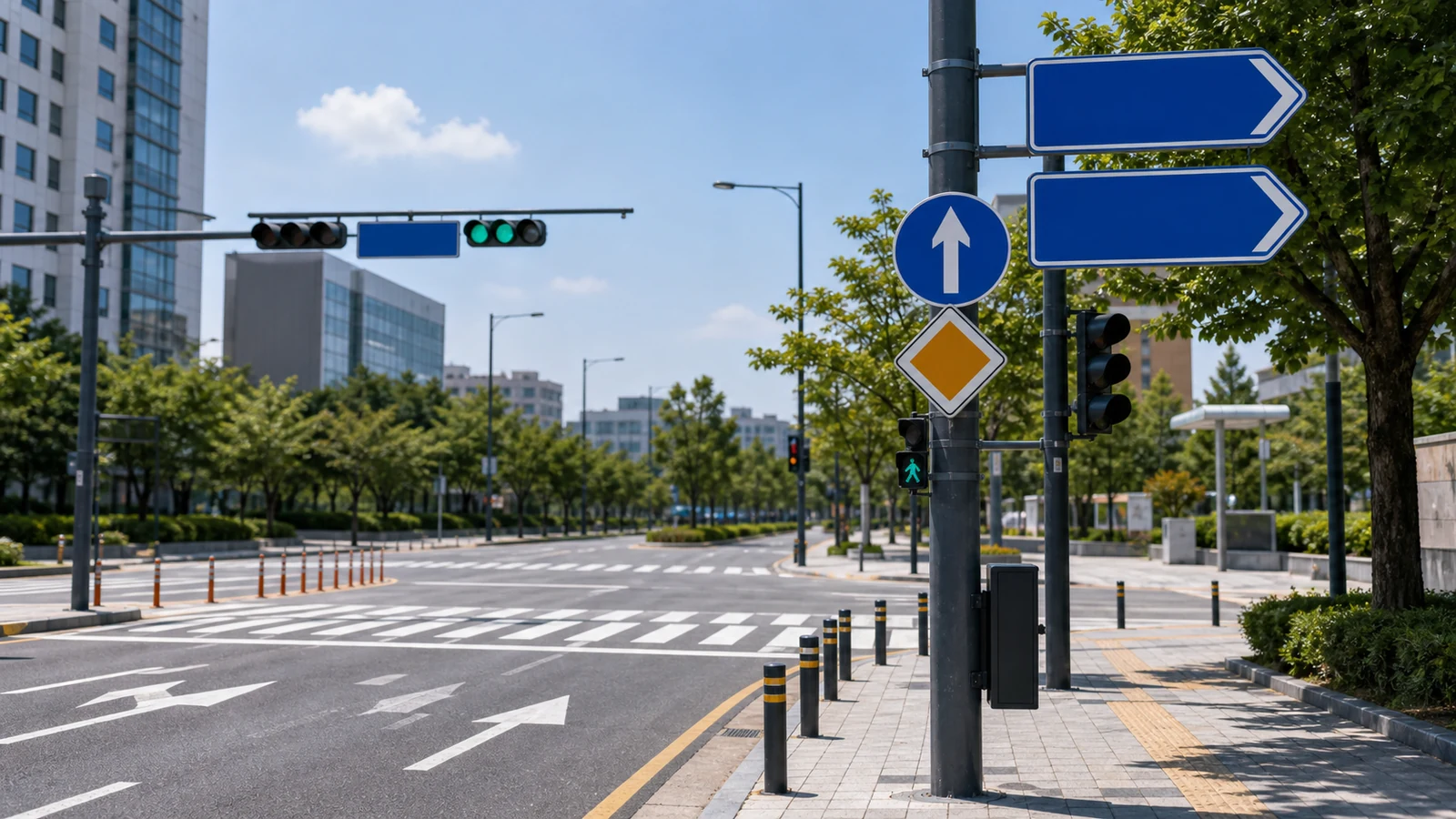
Korean Street Sign Words: A Briefing-Style Lesson
Learn Korean street sign words for practical life in Korea with Korean examples, key meanings, review tables, and BSKorean app practice.
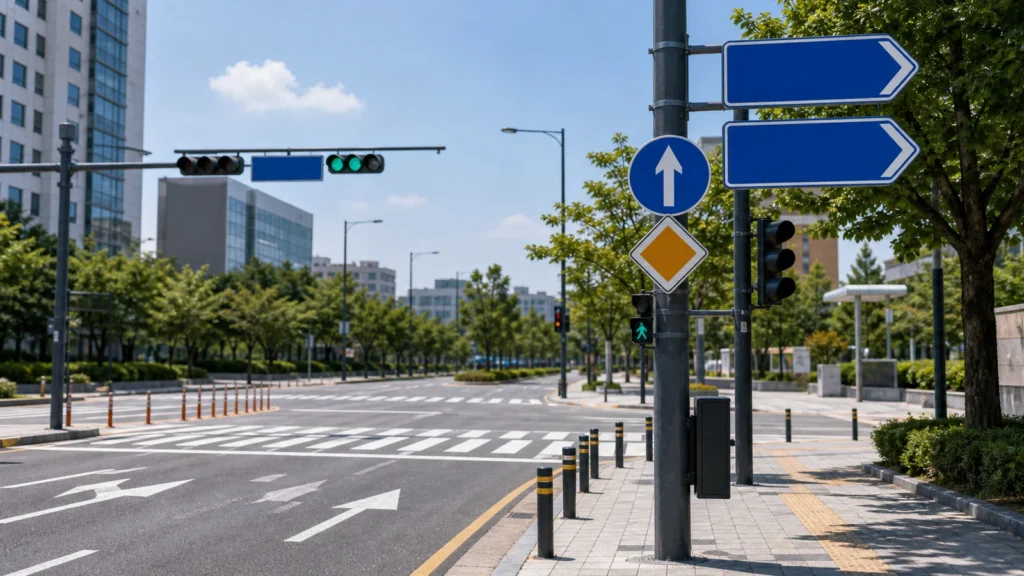
1. When to use these phrases
Use this street sign lesson first
When a Korean street sign is unclear, ask one useful question first: 이 표지 무슨 뜻이에요?, “what does this sign mean?” Then learn signs that affect movement: 출입 금지, 주차 금지, 횡단보도, and 주의.
| Street moment | Korean | Meaning |
|---|---|---|
| Ask meaning | 이 표지 무슨 뜻이에요? | What does this sign mean? |
| No entry | 출입 금지예요? | Is entry prohibited? |
| No parking | 주차 금지예요? | Is parking prohibited? |
| Crossing | 길을 건너도 돼요? | Can I cross the street? |
If you are driving or walking with someone, say 천천히 가 주세요. Related transport lessons: subway sign vocabulary and bus stop sign vocabulary.
Korean street sign words guide
Korean street sign words helps learners practice Korean words in real situations. This BSKorean post keeps the lesson clear, scannable, and connected to app practice.
Related lessons
Korean street sign words help you understand directions, entrances, exits, warning signs, and simple public notices while walking around Korea. This lesson teaches the words by the action you need to take.
Korean Street Sign Words by Action

Download the updated Korean street sign words PPT briefing
Opening Situation
You are walking in a Korean neighborhood and see several short signs: 입구, 출구, 주차금지, and 공사중. None of them are long sentences, but each one tells you what you can do or should avoid.
This lesson teaches Korean street sign words as practical movement and warning language. You will learn how to read entrance, exit, parking, prohibition, construction, crosswalk, and bus-stop signs without translating every small word.
Learning Snapshot
Level: Beginner
Best for: Travelers, pedestrians, drivers, new residents
Main skill: Understanding Korean street signs as action signals
Study time: 8-10 minutes
This briefing lesson focuses on a real situation rather than a memorized word list. Use the tables, patterns, examples, mistakes, and practice steps together so the Korean words become practical actions.
Why This Topic Matters
Street signs in Korea often combine a place word with an action word. A learner may know 주차 means parking, but still miss the difference between 주차장 and 주차금지. One is a place; the other is a prohibition.
These words appear around apartment complexes, small stores, hospitals, schools, bus stops, public offices, and construction areas. They help you choose where to enter, where to wait, where not to park, and where to be careful.
Core Vocabulary Table
주차장 입구
주차금지
공사중
보행자 통로
Read the action word. 입구 means this is where cars or people enter. 금지 means parking is not allowed. 공사중 means construction is happening. 보행자 통로 means a pedestrian passage, often a safer temporary route.
The key is to decide what the Korean is asking you to do. In daily life, the best reading is usually a short action: answer yes, choose a direction, pay with a card, wait for pickup, ask the office, or avoid a restricted area.
Common Mistakes
Common Mistake 1: Confusing 주차장 and 주차금지
Why it happens: Both signs contain 주차, so beginners may focus only on the shared word.
Correct understanding: 장 is a place marker in 주차장, while 금지 means not allowed.
Example: 주차장 is a parking lot. 주차금지 means no parking.
Common Mistake 2: Thinking 출입금지 only means private property
Why it happens: Some signs appear at gates, so learners connect them only with private spaces.
Correct understanding: 출입금지 means entry is prohibited for the marked area, including construction zones, restricted rooms, or unsafe passages.
Example: 외부인 출입금지 means outsiders may not enter.
Common Mistake 3: Ignoring 주의 because it is not a full stop sign
Why it happens: Caution signs can look less strict than prohibition signs.
Correct understanding: 주의 still matters because it points to a real risk.
Example: 미끄럼 주의 means watch out for slippery ground.
Step-by-Step Practice
- Step 1. Find the action word: 입구, 출구, 금지, 주의, or 중.
- Step 2. Check the noun before or after it to know the subject.
- Step 3. Decide whether the sign tells a route, a prohibition, a warning, or a status.
- Step 4. Turn the sign into a real action: enter, exit, do not park, slow down, or use another passage.
Practice slowly at first. After a few repetitions, try to reduce the Korean into one practical decision. This is how the vocabulary becomes usable outside a lesson page.
For one week, choose three words from this lesson whenever you see a similar place in Korea or in a photo. Say the Korean word first, then say the real action in English. For example, do not only say “this word means exit.” Say “출구 tells me where to leave.” That small habit trains you to connect Korean with movement, payment, access, warning, or choice.
If you are studying outside Korea, use maps, street-view images, apartment listing screenshots, cafe menus, or transportation photos. The goal is not to memorize perfect sentences in isolation. The goal is to recognize the Korean word fast enough to make a simple decision when the situation appears.
Mini Quiz
Question 1
What does 주차금지 mean?
Answer: No parking.
Explanation: 금지 means prohibited.
Question 2
What is the difference between 입구 and 출구?
Answer: 입구 is entrance, 출구 is exit.
Explanation: They tell opposite movement directions.
Question 3
You see 공사중. What should you expect?
Answer: Construction work is happening.
Explanation: 중 means in progress here.
Question 4
What does 보행자 통로 mean?
Answer: Pedestrian passage.
Explanation: 보행자 is pedestrian and 통로 is passage.
Review Table
| Korean | Meaning | Best Situation | Beginner Tip |
|---|---|---|---|
| 입구 | entrance | entering a place | Look for this when going in. |
| 출구 | exit | leaving a place | Often paired with arrows. |
| 금지 | prohibited | rules and restrictions | The word before it is not allowed. |
| 주의 | caution | hazards and warnings | Slow down and check the risk. |
| 공사중 | under construction | roads and buildings | Use another route if needed. |
Practice these words again in Korean Learn Korean so you can connect the Korean word to the real situation.
For official Korea travel and daily-life context, check Visit Korea.
Related Lessons
- Korean Subway Sign Vocabulary: A Briefing-Style Lesson
- Korean Apartment Words: A Briefing-Style Lesson
- Korean Housing Words: A Briefing-Style Lesson
Conclusion
These Korean words become easier when you read them through the situation. Start with the purpose word, check the detail next to it, and turn the whole expression into a simple action. That habit is more useful than translating every word slowly.
2. Key vocabulary
crosswalk
Beginnerslowly
Beginnerparking lot
Beginnerconstruction work
Beginnercaution
Beginner3. Essential phrases
7. Related practical Korean lessons
Practice this lesson in the app
Review these words with multiple-choice questions and weak-Learn Korean.
Practice this lesson →