[태그:] Korean cafe order number

  • Cụm từ tiếng Hàn về nhận đồ uống và số đơn ở quán cà phê

    Cụm từ tiếng Hàn về nhận đồ uống và số đơn ở quán cà phê

    Tiếng Hàn dịch vụ cho nhân viên quán cà phê

    Cụm từ tiếng Hàn về nhận đồ uống và số đơn ở quán cà phê

    Học cụm từ tiếng Hàn ở quán cà phê cho số đơn, chuông rung, quầy nhận đồ uống và cách đưa đồ uống lịch sự.
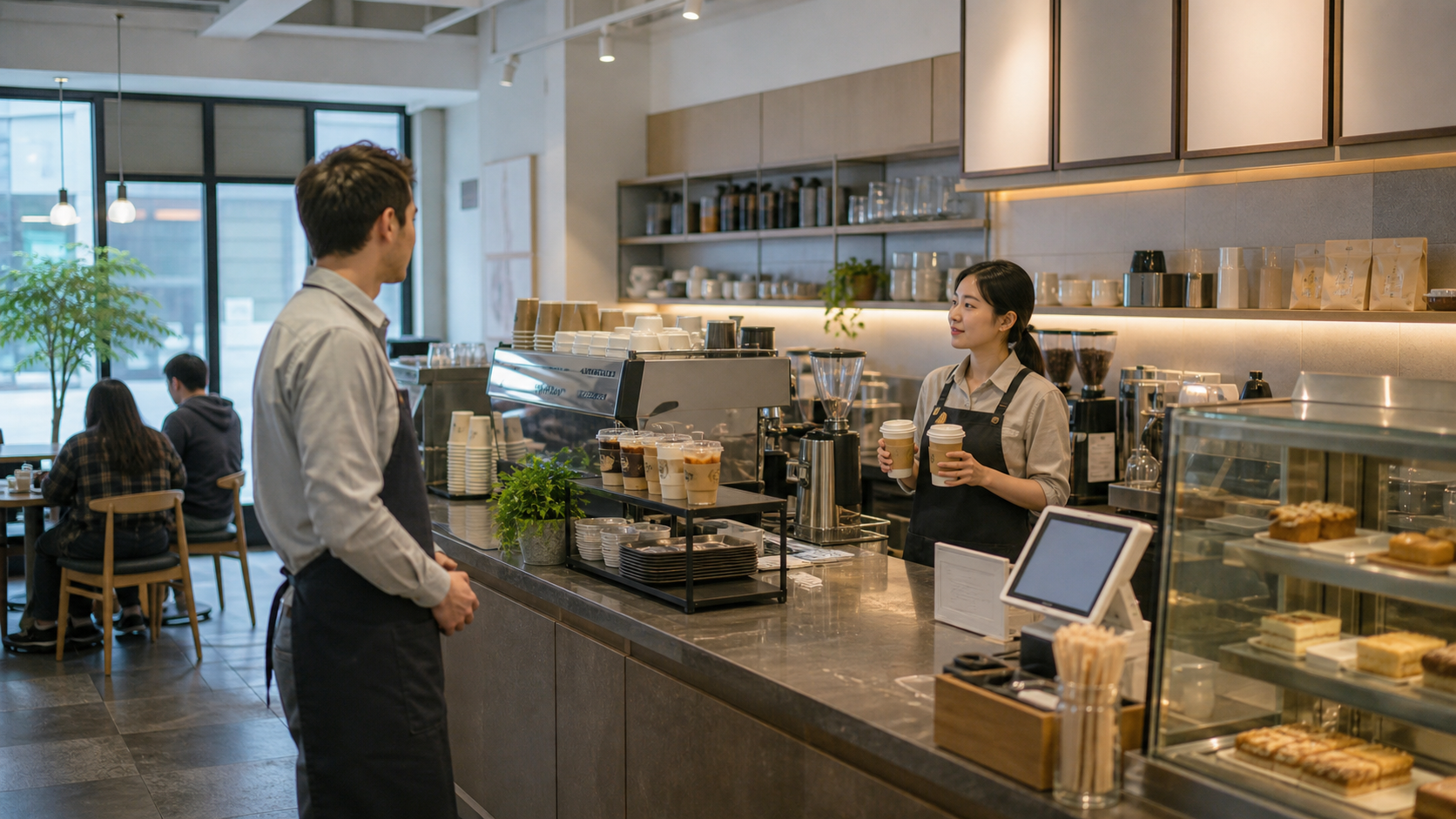
    Korean cafe pickup and order number training scene for service workers
    Korean cafe pickup and order number phrases for service workers.

    Download the PPT briefing for this lesson.

    Ghi chú tiếng Việt: Bài học này giúp nhân viên quán cà phê hiểu các cụm từ như 주문번호 확인해 주세요, 진동벨 울리면 와 주세요, 픽업대, và 음료 나왔습니다 trong ca làm thật.

    Short Introduction

    You are working behind the counter at a Korean cafe. A customer has already paid, but the drink is not ready yet. The pickup shelf is full, the order screen is changing, and several vibration pagers are beside the POS counter.

    The hard part is matching the right drink to the right customer without slowing the line. You may need to say 주문번호가 몇 번이세요?, give a pager, call 24번 고객님, or explain that the order is still being prepared.

    This lesson teaches Korean cafe pickup phrases for service workers: order number, vibration pager, pickup counter, waiting, ready status, and polite handover phrases. These phrases repeat many times during one shift, so a small set of clear patterns can prevent handover mistakes.

    Key Vocabulary

    Korean Romanization English Meaning Level Usage Note Where You See It Example
    주문 jumun order Beginner Customer order. Cafe counter, POS screen 주문 확인해 주세요.
    주문번호 jumun beonho order number Beginner Number used to match a drink. Order screen, receipt, pickup counter 주문번호가 몇 번이세요?
    번호 beonho number Beginner Number for waiting or order checking. Cafe, clinic, public office 24번 고객님
    진동벨 jindongbel vibrating pager Beginner Pager that alerts the customer. Cafe, food court 진동벨 울리면 와 주세요.
    픽업 pikeop pickup Beginner Receiving prepared food or drink. Cafe pickup area 픽업하시면 됩니다.
    픽업대 pikeopdae pickup counter Beginner Counter for finished drinks. Cafe counter 픽업대에서 받아 주세요.
    음료 eumnyo drink; beverage Beginner Prepared drink. Cafe, restaurant 음료 나왔습니다.
    준비 완료 junbi wallyo ready; complete Intermediate Order is ready. Order status screen 24번 준비 완료입니다.
    대기 daegi waiting Intermediate Waiting status. Order screen, waiting area 잠시 대기해 주세요.
    호출 hochul call; paging Intermediate Calling a customer. Pickup counter 번호를 호출해 주세요.
    포장 pojang takeout; to go Beginner Takeout order. Cafe, restaurant 포장 주문입니다.
    매장 maejang in-store; for here Beginner Inside the store. Cafe counter 매장에서 드시나요?
    영수증 yeongsujeung receipt Beginner Receipt after payment. Cafe, store 영수증 필요하세요?
    확인 hwagin check; confirmation Beginner Checking an order or number. Counter, POS, pickup area 주문번호 확인해 주세요.
    손님 sonnim customer; guest Beginner Polite word for customer. Service jobs 24번 손님, 음료 나왔습니다.
    카페 kape cafe Beginner Coffee shop. Workplace, street signs 카페에서 일해요.
    커피 keopi coffee Beginner Coffee drink. Cafe menu 커피 두 잔 나왔습니다.
    결제 gyeolje payment; checkout Beginner Payment before pickup. POS counter 결제 완료되었습니다.
    직원 jigwon staff; employee Beginner Worker or staff member. Workplace 직원에게 문의해 주세요.
    기다리다 gidarida to wait Beginner Waiting for an order. Cafe, clinic, service counter 잠시만 기다려 주세요.

    Real Situation

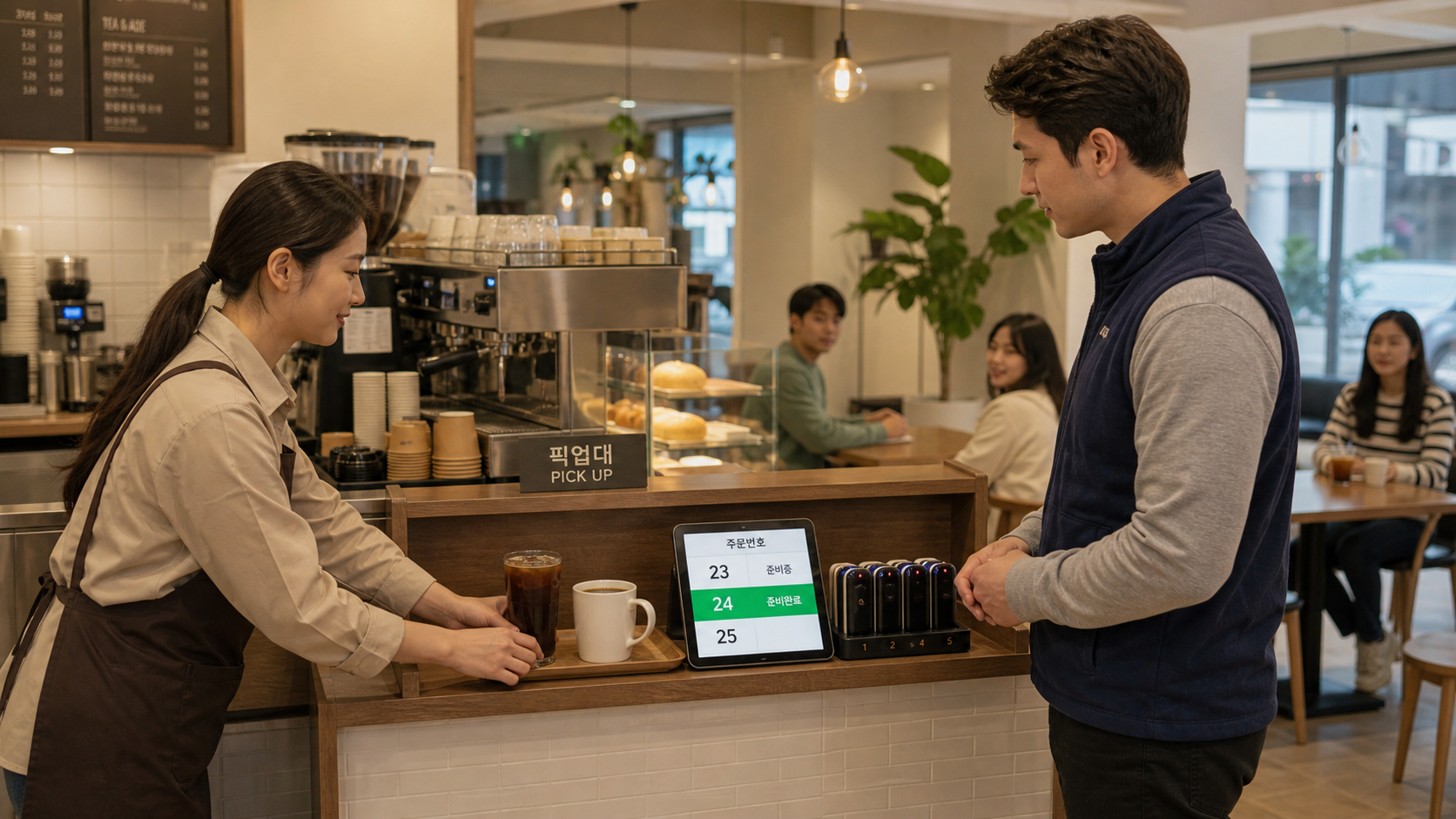
    Korean cafe pickup counter with order number screen and vibration pagers
    The pickup step depends on order number, pager, and customer confirmation.

    In many Korean cafes, customers order and pay first. After payment, the customer waits nearby, sits down, or holds a vibration pager. When the drink is ready, staff call the order number, update the screen, or wait for the pager to bring the customer back.

    주문번호 means order number. It is safer than using only the drink name because several customers may order the same iced Americano or latte. If two similar drinks are ready, the order number prevents a wrong handover.

    진동벨 means vibrating pager. 진동벨 울리면 와 주세요 means “Please come when the pager rings.” The customer does not need every grammar detail. The practical meaning is simple: wait until the pager alerts you.

    픽업대 means pickup counter, where finished drinks are received. 픽업대에서 받아 주세요 is polite, short, and clear. Also remember 매장 means for here, and 포장 means to go.

    Common Expressions

    Korean Expression Romanization English Meaning Level When to Use
    주문번호 확인해 주세요. Jumun beonho hwagin-hae juseyo. Please check your order number. Intermediate When matching a customer to a drink.
    주문번호가 몇 번이세요? Jumun beonho-ga myeot beon-iseyo? What is your order number? Beginner When the customer comes to the pickup counter.
    진동벨 울리면 와 주세요. Jindongbel ullimyeon wa juseyo. Please come when the pager rings. Intermediate After giving a vibration pager.
    음료 나왔습니다. Eumnyo nawatsseumnida. Your drink is ready. Beginner When handing over the drink.
    24번 고객님, 음료 나왔습니다. Isipsa-beon gogaengnim, eumnyo nawatsseumnida. Customer number 24, your drink is ready. Intermediate When calling an order number.
    픽업대에서 받아 주세요. Pikeopdae-eseo bada juseyo. Please pick it up at the pickup counter. Beginner When guiding the pickup location.
    잠시만 기다려 주세요. Jamsiman gidaryeo juseyo. Please wait a moment. Beginner When the drink is not ready yet.
    매장 주문이세요, 포장 주문이세요? Maejang jumun-iseyo, pojang jumun-iseyo? Is it for here or to go? Intermediate When confirming the order type.
    영수증 필요하세요? Yeongsujeung piryo-haseyo? Do you need a receipt? Beginner After payment.
    주문이 지연되고 있습니다. Jumun-i jiyeon-doego itseumnida. The order is being delayed. Advanced When you need a polite delay explanation.

    Usage Notes

    The main pickup pattern is Number + 번 고객님. 24번 고객님 means “customer number 24.” This is clearer than calling only a menu item.

    Another useful pattern is N 확인해 주세요. 주문번호 확인해 주세요 means “Please check your order number.” Use it when the customer comes to the pickup counter before you are sure which order is theirs.

    For a finished drink, use 음료 나왔습니다. Literally, it means “the drink came out,” but the natural meaning is “Your drink is ready.” You may hear the same pattern in restaurants: 음식 나왔습니다.

    When the drink is not ready, keep the sentence short. 잠시만 기다려 주세요 means “Please wait a moment.” For a real delay, use 주문이 지연되고 있습니다. Staff-to-customer language should stay polite: 받아 주세요, 와 주세요, and 기다려 주세요.

    Mini Dialogue

    Staff: 주문번호가 몇 번이세요?
    Jumun beonho-ga myeot beon-iseyo?
    What is your order number?

    Customer: 24번이에요.
    Isipsa-beon-ieyo.
    It is number 24.

    Staff: 네, 확인했습니다. 잠시만 기다려 주세요.
    Ne, hwagin-haetsseumnida. Jamsiman gidaryeo juseyo.
    Yes, I checked it. Please wait a moment.

    Staff: 24번 고객님, 음료 나왔습니다.
    Isipsa-beon gogaengnim, eumnyo nawatsseumnida.
    Customer number 24, your drink is ready.

    Customer: 감사합니다.
    Gamsahamnida.
    Thank you.

    Staff: 맛있게 드세요.
    Masitge deuseyo.
    Please enjoy it.

    Real cafe pickup conversations are short. The staff confirms the order number, asks the customer to wait, calls the number, and hands over the drink. 맛있게 드세요 is a friendly closing phrase.

    Common Mistakes

    1. Calling only the drink name
      Use the order number first. “24번 고객님, 음료 나왔습니다” is safer than calling only “iced latte.”
    2. Confusing 매장 and 포장
      매장 means for here. 포장 means to go. This changes cups, lids, trays, and bags.
    3. Using 가져가요 with customers
      Use 가져가세요 or 받아 주세요. They sound more polite in a service role.
    4. Not checking the order number
      Check 주문번호 before handover, especially when several similar drinks are ready.
    5. Explaining delays with a long sentence
      Use one clear sentence first: 주문이 지연되고 있습니다. 잠시만 기다려 주세요.

    Practice Steps

    1. Check the pickup situation. Is the customer waiting, asking about an order, or receiving a finished drink?
    2. Find the key word. Use 주문번호 for order number, 진동벨 for pager, 픽업대 for pickup counter, and 음료 for drink.
    3. Confirm before handing over. Ask 주문번호가 몇 번이세요? or 주문번호 확인해 주세요.
    4. Give one clear instruction. Say 진동벨 울리면 와 주세요, 픽업대에서 받아 주세요, or 잠시만 기다려 주세요.
    5. Close politely. After handover, say 감사합니다 or 맛있게 드세요.

    Quick Quiz

    1. Question 1. A customer comes to the pickup counter. What should you ask first if you need to match the drink?
      Answer: 주문번호가 몇 번이세요?
      This asks for the order number. It is safer than guessing from the drink name.
    2. Question 2. What does 진동벨 울리면 와 주세요 mean?
      Answer: Please come when the pager rings.
      진동벨 is a vibrating pager. 울리면 means when it rings or vibrates.
    3. Question 3. You want to say “Your drink is ready.” Which phrase is best?
      Answer: 음료 나왔습니다.
      This is a common cafe phrase for handing over a prepared drink.
    4. Question 4. A customer asks where to receive the drink. What can you say?
      Answer: 픽업대에서 받아 주세요.
      픽업대 means pickup counter. 받아 주세요 is polite and practical.
    5. Question 5. Which pair means “for here / to go”?
      Answer: 매장 / 포장
      매장 is in-store. 포장 is takeout or to go.

    Review Table

    Korean Meaning Best Situation Beginner Tip
    주문번호 order number Checking the correct drink Use number before drink name.
    진동벨 vibrating pager Customer waits after payment Say 울리면 와 주세요.
    픽업대 pickup counter Where customers receive drinks Use 받아 주세요 for polite guidance.
    음료 나왔습니다 Your drink is ready Finished drink handover Natural cafe phrase, not a literal sentence.
    매장 / 포장 for here / to go Order type confirmation Cup, lid, tray, and bag can change.
    잠시만 기다려 주세요 Please wait a moment Short delay Simple and polite.

    Related Lessons

    Practice More

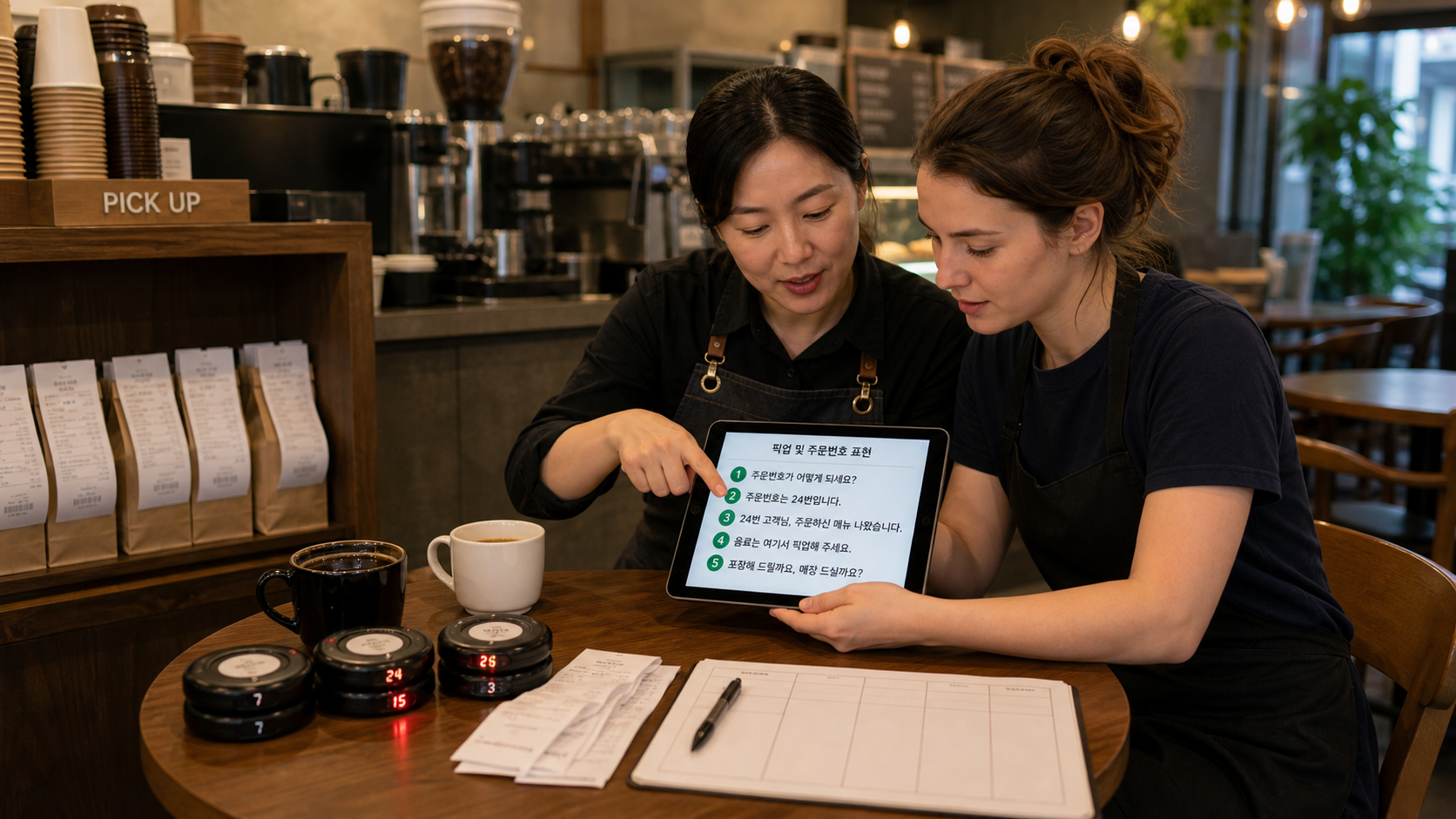
    Cafe manager and foreign worker reviewing Korean pickup phrases after a shift
    Review pickup phrases after a cafe shift so the expressions become automatic.

    Practice this word list in Learn Korean or in the upcoming BSKorean app. Start with 주문번호, 진동벨, 픽업대, 음료 나왔습니다, 잠시만 기다려 주세요, 매장, and 포장.

    Conclusion

    Korean cafe pickup phrases become easier when you treat them as counter actions. First, confirm the order number. Then explain the pager or waiting step. When the drink is ready, call the number and hand over the drink politely.

    You do not need long Korean sentences to work well at a cafe pickup counter. You need a few accurate words, a clear order number check, and polite service endings such as 와 주세요, 받아 주세요, and 기다려 주세요.

  • วลีภาษาเกาหลีสำหรับรับเครื่องดื่มและเลขออเดอร์ในคาเฟ่

    วลีภาษาเกาหลีสำหรับรับเครื่องดื่มและเลขออเดอร์ในคาเฟ่

    ภาษาเกาหลีงานบริการสำหรับพนักงานคาเฟ่

    วลีภาษาเกาหลีสำหรับรับเครื่องดื่มและเลขออเดอร์ในคาเฟ่

    เรียนวลีภาษาเกาหลีสำหรับพนักงานคาเฟ่ เช่น เลขออเดอร์ เพจเจอร์สั่น เคาน์เตอร์รับเครื่องดื่ม และประโยคส่งเครื่องดื่ม.

    Korean cafe pickup and order number training scene for service workers
    Korean cafe pickup and order number phrases for service workers.

    Download the PPT briefing for this lesson.

    หมายเหตุภาษาไทย: บทเรียนนี้เหมาะกับพนักงานคาเฟ่ที่ต้องเข้าใจคำเกาหลีอย่าง 주문번호, 진동벨, 픽업대 และ 음료 나왔습니다 ในสถานการณ์จริงที่เคาน์เตอร์รับเครื่องดื่ม.

    Short Introduction

    You are working behind the counter at a Korean cafe. A customer has already paid, but the drink is not ready yet. The pickup shelf is full, the order screen is changing, and several vibration pagers are beside the POS counter.

    The hard part is matching the right drink to the right customer without slowing the line. You may need to say 주문번호가 몇 번이세요?, give a pager, call 24번 고객님, or explain that the order is still being prepared.

    This lesson teaches Korean cafe pickup phrases for service workers: order number, vibration pager, pickup counter, waiting, ready status, and polite handover phrases. These phrases repeat many times during one shift, so a small set of clear patterns can prevent handover mistakes.

    Key Vocabulary

    Korean Romanization English Meaning Level Usage Note Where You See It Example
    주문 jumun order Beginner Customer order. Cafe counter, POS screen 주문 확인해 주세요.
    주문번호 jumun beonho order number Beginner Number used to match a drink. Order screen, receipt, pickup counter 주문번호가 몇 번이세요?
    번호 beonho number Beginner Number for waiting or order checking. Cafe, clinic, public office 24번 고객님
    진동벨 jindongbel vibrating pager Beginner Pager that alerts the customer. Cafe, food court 진동벨 울리면 와 주세요.
    픽업 pikeop pickup Beginner Receiving prepared food or drink. Cafe pickup area 픽업하시면 됩니다.
    픽업대 pikeopdae pickup counter Beginner Counter for finished drinks. Cafe counter 픽업대에서 받아 주세요.
    음료 eumnyo drink; beverage Beginner Prepared drink. Cafe, restaurant 음료 나왔습니다.
    준비 완료 junbi wallyo ready; complete Intermediate Order is ready. Order status screen 24번 준비 완료입니다.
    대기 daegi waiting Intermediate Waiting status. Order screen, waiting area 잠시 대기해 주세요.
    호출 hochul call; paging Intermediate Calling a customer. Pickup counter 번호를 호출해 주세요.
    포장 pojang takeout; to go Beginner Takeout order. Cafe, restaurant 포장 주문입니다.
    매장 maejang in-store; for here Beginner Inside the store. Cafe counter 매장에서 드시나요?
    영수증 yeongsujeung receipt Beginner Receipt after payment. Cafe, store 영수증 필요하세요?
    확인 hwagin check; confirmation Beginner Checking an order or number. Counter, POS, pickup area 주문번호 확인해 주세요.
    손님 sonnim customer; guest Beginner Polite word for customer. Service jobs 24번 손님, 음료 나왔습니다.
    카페 kape cafe Beginner Coffee shop. Workplace, street signs 카페에서 일해요.
    커피 keopi coffee Beginner Coffee drink. Cafe menu 커피 두 잔 나왔습니다.
    결제 gyeolje payment; checkout Beginner Payment before pickup. POS counter 결제 완료되었습니다.
    직원 jigwon staff; employee Beginner Worker or staff member. Workplace 직원에게 문의해 주세요.
    기다리다 gidarida to wait Beginner Waiting for an order. Cafe, clinic, service counter 잠시만 기다려 주세요.

    Real Situation

    Korean cafe pickup counter with order number screen and vibration pagers
    The pickup step depends on order number, pager, and customer confirmation.

    In many Korean cafes, customers order and pay first. After payment, the customer waits nearby, sits down, or holds a vibration pager. When the drink is ready, staff call the order number, update the screen, or wait for the pager to bring the customer back.

    주문번호 means order number. It is safer than using only the drink name because several customers may order the same iced Americano or latte. If two similar drinks are ready, the order number prevents a wrong handover.

    진동벨 means vibrating pager. 진동벨 울리면 와 주세요 means “Please come when the pager rings.” The customer does not need every grammar detail. The practical meaning is simple: wait until the pager alerts you.

    픽업대 means pickup counter, where finished drinks are received. 픽업대에서 받아 주세요 is polite, short, and clear. Also remember 매장 means for here, and 포장 means to go.

    Common Expressions

    Korean Expression Romanization English Meaning Level When to Use
    주문번호 확인해 주세요. Jumun beonho hwagin-hae juseyo. Please check your order number. Intermediate When matching a customer to a drink.
    주문번호가 몇 번이세요? Jumun beonho-ga myeot beon-iseyo? What is your order number? Beginner When the customer comes to the pickup counter.
    진동벨 울리면 와 주세요. Jindongbel ullimyeon wa juseyo. Please come when the pager rings. Intermediate After giving a vibration pager.
    음료 나왔습니다. Eumnyo nawatsseumnida. Your drink is ready. Beginner When handing over the drink.
    24번 고객님, 음료 나왔습니다. Isipsa-beon gogaengnim, eumnyo nawatsseumnida. Customer number 24, your drink is ready. Intermediate When calling an order number.
    픽업대에서 받아 주세요. Pikeopdae-eseo bada juseyo. Please pick it up at the pickup counter. Beginner When guiding the pickup location.
    잠시만 기다려 주세요. Jamsiman gidaryeo juseyo. Please wait a moment. Beginner When the drink is not ready yet.
    매장 주문이세요, 포장 주문이세요? Maejang jumun-iseyo, pojang jumun-iseyo? Is it for here or to go? Intermediate When confirming the order type.
    영수증 필요하세요? Yeongsujeung piryo-haseyo? Do you need a receipt? Beginner After payment.
    주문이 지연되고 있습니다. Jumun-i jiyeon-doego itseumnida. The order is being delayed. Advanced When you need a polite delay explanation.

    Usage Notes

    The main pickup pattern is Number + 번 고객님. 24번 고객님 means “customer number 24.” This is clearer than calling only a menu item.

    Another useful pattern is N 확인해 주세요. 주문번호 확인해 주세요 means “Please check your order number.” Use it when the customer comes to the pickup counter before you are sure which order is theirs.

    For a finished drink, use 음료 나왔습니다. Literally, it means “the drink came out,” but the natural meaning is “Your drink is ready.” You may hear the same pattern in restaurants: 음식 나왔습니다.

    When the drink is not ready, keep the sentence short. 잠시만 기다려 주세요 means “Please wait a moment.” For a real delay, use 주문이 지연되고 있습니다. Staff-to-customer language should stay polite: 받아 주세요, 와 주세요, and 기다려 주세요.

    Mini Dialogue

    Staff: 주문번호가 몇 번이세요?
    Jumun beonho-ga myeot beon-iseyo?
    What is your order number?

    Customer: 24번이에요.
    Isipsa-beon-ieyo.
    It is number 24.

    Staff: 네, 확인했습니다. 잠시만 기다려 주세요.
    Ne, hwagin-haetsseumnida. Jamsiman gidaryeo juseyo.
    Yes, I checked it. Please wait a moment.

    Staff: 24번 고객님, 음료 나왔습니다.
    Isipsa-beon gogaengnim, eumnyo nawatsseumnida.
    Customer number 24, your drink is ready.

    Customer: 감사합니다.
    Gamsahamnida.
    Thank you.

    Staff: 맛있게 드세요.
    Masitge deuseyo.
    Please enjoy it.

    Real cafe pickup conversations are short. The staff confirms the order number, asks the customer to wait, calls the number, and hands over the drink. 맛있게 드세요 is a friendly closing phrase.

    Common Mistakes

    1. Calling only the drink name
      Use the order number first. “24번 고객님, 음료 나왔습니다” is safer than calling only “iced latte.”
    2. Confusing 매장 and 포장
      매장 means for here. 포장 means to go. This changes cups, lids, trays, and bags.
    3. Using 가져가요 with customers
      Use 가져가세요 or 받아 주세요. They sound more polite in a service role.
    4. Not checking the order number
      Check 주문번호 before handover, especially when several similar drinks are ready.
    5. Explaining delays with a long sentence
      Use one clear sentence first: 주문이 지연되고 있습니다. 잠시만 기다려 주세요.

    Practice Steps

    1. Check the pickup situation. Is the customer waiting, asking about an order, or receiving a finished drink?
    2. Find the key word. Use 주문번호 for order number, 진동벨 for pager, 픽업대 for pickup counter, and 음료 for drink.
    3. Confirm before handing over. Ask 주문번호가 몇 번이세요? or 주문번호 확인해 주세요.
    4. Give one clear instruction. Say 진동벨 울리면 와 주세요, 픽업대에서 받아 주세요, or 잠시만 기다려 주세요.
    5. Close politely. After handover, say 감사합니다 or 맛있게 드세요.

    Quick Quiz

    1. Question 1. A customer comes to the pickup counter. What should you ask first if you need to match the drink?
      Answer: 주문번호가 몇 번이세요?
      This asks for the order number. It is safer than guessing from the drink name.
    2. Question 2. What does 진동벨 울리면 와 주세요 mean?
      Answer: Please come when the pager rings.
      진동벨 is a vibrating pager. 울리면 means when it rings or vibrates.
    3. Question 3. You want to say “Your drink is ready.” Which phrase is best?
      Answer: 음료 나왔습니다.
      This is a common cafe phrase for handing over a prepared drink.
    4. Question 4. A customer asks where to receive the drink. What can you say?
      Answer: 픽업대에서 받아 주세요.
      픽업대 means pickup counter. 받아 주세요 is polite and practical.
    5. Question 5. Which pair means “for here / to go”?
      Answer: 매장 / 포장
      매장 is in-store. 포장 is takeout or to go.

    Review Table

    Korean Meaning Best Situation Beginner Tip
    주문번호 order number Checking the correct drink Use number before drink name.
    진동벨 vibrating pager Customer waits after payment Say 울리면 와 주세요.
    픽업대 pickup counter Where customers receive drinks Use 받아 주세요 for polite guidance.
    음료 나왔습니다 Your drink is ready Finished drink handover Natural cafe phrase, not a literal sentence.
    매장 / 포장 for here / to go Order type confirmation Cup, lid, tray, and bag can change.
    잠시만 기다려 주세요 Please wait a moment Short delay Simple and polite.

    Related Lessons

    Practice More

    Cafe manager and foreign worker reviewing Korean pickup phrases after a shift
    Review pickup phrases after a cafe shift so the expressions become automatic.

    Practice this word list in Learn Korean or in the upcoming BSKorean app. Start with 주문번호, 진동벨, 픽업대, 음료 나왔습니다, 잠시만 기다려 주세요, 매장, and 포장.

    Conclusion

    Korean cafe pickup phrases become easier when you treat them as counter actions. First, confirm the order number. Then explain the pager or waiting step. When the drink is ready, call the number and hand over the drink politely.

    You do not need long Korean sentences to work well at a cafe pickup counter. You need a few accurate words, a clear order number check, and polite service endings such as 와 주세요, 받아 주세요, and 기다려 주세요.

  • カフェの受け取りと注文番号で使う韓国語フレーズ

    カフェの受け取りと注文番号で使う韓国語フレーズ

    カフェ勤務者のためのサービス韓国語

    カフェの受け取りと注文番号で使う韓国語フレーズ

    韓国のカフェで使う注文番号、振動ベル、受け取りカウンター、飲み物の受け渡し表現を学びます。

    Korean cafe pickup and order number training scene for service workers
    Korean cafe pickup and order number phrases for service workers.

    Download the PPT briefing for this lesson.

    日本語メモ: このレッスンでは、韓国のカフェで働く人がよく聞く注文番号、진동벨、픽업대、음료 나왔습니다 などの表現を扱います。本文の例文は現場でそのまま確認できるようにハングルを中心にしています。

    Short Introduction

    You are working behind the counter at a Korean cafe. A customer has already paid, but the drink is not ready yet. The pickup shelf is full, the order screen is changing, and several vibration pagers are beside the POS counter.

    The hard part is matching the right drink to the right customer without slowing the line. You may need to say 주문번호가 몇 번이세요?, give a pager, call 24번 고객님, or explain that the order is still being prepared.

    This lesson teaches Korean cafe pickup phrases for service workers: order number, vibration pager, pickup counter, waiting, ready status, and polite handover phrases. These phrases repeat many times during one shift, so a small set of clear patterns can prevent handover mistakes.

    Key Vocabulary

    Korean Romanization English Meaning Level Usage Note Where You See It Example
    주문 jumun order Beginner Customer order. Cafe counter, POS screen 주문 확인해 주세요.
    주문번호 jumun beonho order number Beginner Number used to match a drink. Order screen, receipt, pickup counter 주문번호가 몇 번이세요?
    번호 beonho number Beginner Number for waiting or order checking. Cafe, clinic, public office 24번 고객님
    진동벨 jindongbel vibrating pager Beginner Pager that alerts the customer. Cafe, food court 진동벨 울리면 와 주세요.
    픽업 pikeop pickup Beginner Receiving prepared food or drink. Cafe pickup area 픽업하시면 됩니다.
    픽업대 pikeopdae pickup counter Beginner Counter for finished drinks. Cafe counter 픽업대에서 받아 주세요.
    음료 eumnyo drink; beverage Beginner Prepared drink. Cafe, restaurant 음료 나왔습니다.
    준비 완료 junbi wallyo ready; complete Intermediate Order is ready. Order status screen 24번 준비 완료입니다.
    대기 daegi waiting Intermediate Waiting status. Order screen, waiting area 잠시 대기해 주세요.
    호출 hochul call; paging Intermediate Calling a customer. Pickup counter 번호를 호출해 주세요.
    포장 pojang takeout; to go Beginner Takeout order. Cafe, restaurant 포장 주문입니다.
    매장 maejang in-store; for here Beginner Inside the store. Cafe counter 매장에서 드시나요?
    영수증 yeongsujeung receipt Beginner Receipt after payment. Cafe, store 영수증 필요하세요?
    확인 hwagin check; confirmation Beginner Checking an order or number. Counter, POS, pickup area 주문번호 확인해 주세요.
    손님 sonnim customer; guest Beginner Polite word for customer. Service jobs 24번 손님, 음료 나왔습니다.
    카페 kape cafe Beginner Coffee shop. Workplace, street signs 카페에서 일해요.
    커피 keopi coffee Beginner Coffee drink. Cafe menu 커피 두 잔 나왔습니다.
    결제 gyeolje payment; checkout Beginner Payment before pickup. POS counter 결제 완료되었습니다.
    직원 jigwon staff; employee Beginner Worker or staff member. Workplace 직원에게 문의해 주세요.
    기다리다 gidarida to wait Beginner Waiting for an order. Cafe, clinic, service counter 잠시만 기다려 주세요.

    Real Situation

    Korean cafe pickup counter with order number screen and vibration pagers
    The pickup step depends on order number, pager, and customer confirmation.

    In many Korean cafes, customers order and pay first. After payment, the customer waits nearby, sits down, or holds a vibration pager. When the drink is ready, staff call the order number, update the screen, or wait for the pager to bring the customer back.

    주문번호 means order number. It is safer than using only the drink name because several customers may order the same iced Americano or latte. If two similar drinks are ready, the order number prevents a wrong handover.

    진동벨 means vibrating pager. 진동벨 울리면 와 주세요 means “Please come when the pager rings.” The customer does not need every grammar detail. The practical meaning is simple: wait until the pager alerts you.

    픽업대 means pickup counter, where finished drinks are received. 픽업대에서 받아 주세요 is polite, short, and clear. Also remember 매장 means for here, and 포장 means to go.

    Common Expressions

    Korean Expression Romanization English Meaning Level When to Use
    주문번호 확인해 주세요. Jumun beonho hwagin-hae juseyo. Please check your order number. Intermediate When matching a customer to a drink.
    주문번호가 몇 번이세요? Jumun beonho-ga myeot beon-iseyo? What is your order number? Beginner When the customer comes to the pickup counter.
    진동벨 울리면 와 주세요. Jindongbel ullimyeon wa juseyo. Please come when the pager rings. Intermediate After giving a vibration pager.
    음료 나왔습니다. Eumnyo nawatsseumnida. Your drink is ready. Beginner When handing over the drink.
    24번 고객님, 음료 나왔습니다. Isipsa-beon gogaengnim, eumnyo nawatsseumnida. Customer number 24, your drink is ready. Intermediate When calling an order number.
    픽업대에서 받아 주세요. Pikeopdae-eseo bada juseyo. Please pick it up at the pickup counter. Beginner When guiding the pickup location.
    잠시만 기다려 주세요. Jamsiman gidaryeo juseyo. Please wait a moment. Beginner When the drink is not ready yet.
    매장 주문이세요, 포장 주문이세요? Maejang jumun-iseyo, pojang jumun-iseyo? Is it for here or to go? Intermediate When confirming the order type.
    영수증 필요하세요? Yeongsujeung piryo-haseyo? Do you need a receipt? Beginner After payment.
    주문이 지연되고 있습니다. Jumun-i jiyeon-doego itseumnida. The order is being delayed. Advanced When you need a polite delay explanation.

    Usage Notes

    The main pickup pattern is Number + 번 고객님. 24번 고객님 means “customer number 24.” This is clearer than calling only a menu item.

    Another useful pattern is N 확인해 주세요. 주문번호 확인해 주세요 means “Please check your order number.” Use it when the customer comes to the pickup counter before you are sure which order is theirs.

    For a finished drink, use 음료 나왔습니다. Literally, it means “the drink came out,” but the natural meaning is “Your drink is ready.” You may hear the same pattern in restaurants: 음식 나왔습니다.

    When the drink is not ready, keep the sentence short. 잠시만 기다려 주세요 means “Please wait a moment.” For a real delay, use 주문이 지연되고 있습니다. Staff-to-customer language should stay polite: 받아 주세요, 와 주세요, and 기다려 주세요.

    Mini Dialogue

    Staff: 주문번호가 몇 번이세요?
    Jumun beonho-ga myeot beon-iseyo?
    What is your order number?

    Customer: 24번이에요.
    Isipsa-beon-ieyo.
    It is number 24.

    Staff: 네, 확인했습니다. 잠시만 기다려 주세요.
    Ne, hwagin-haetsseumnida. Jamsiman gidaryeo juseyo.
    Yes, I checked it. Please wait a moment.

    Staff: 24번 고객님, 음료 나왔습니다.
    Isipsa-beon gogaengnim, eumnyo nawatsseumnida.
    Customer number 24, your drink is ready.

    Customer: 감사합니다.
    Gamsahamnida.
    Thank you.

    Staff: 맛있게 드세요.
    Masitge deuseyo.
    Please enjoy it.

    Real cafe pickup conversations are short. The staff confirms the order number, asks the customer to wait, calls the number, and hands over the drink. 맛있게 드세요 is a friendly closing phrase.

    Common Mistakes

    1. Calling only the drink name
      Use the order number first. “24번 고객님, 음료 나왔습니다” is safer than calling only “iced latte.”
    2. Confusing 매장 and 포장
      매장 means for here. 포장 means to go. This changes cups, lids, trays, and bags.
    3. Using 가져가요 with customers
      Use 가져가세요 or 받아 주세요. They sound more polite in a service role.
    4. Not checking the order number
      Check 주문번호 before handover, especially when several similar drinks are ready.
    5. Explaining delays with a long sentence
      Use one clear sentence first: 주문이 지연되고 있습니다. 잠시만 기다려 주세요.

    Practice Steps

    1. Check the pickup situation. Is the customer waiting, asking about an order, or receiving a finished drink?
    2. Find the key word. Use 주문번호 for order number, 진동벨 for pager, 픽업대 for pickup counter, and 음료 for drink.
    3. Confirm before handing over. Ask 주문번호가 몇 번이세요? or 주문번호 확인해 주세요.
    4. Give one clear instruction. Say 진동벨 울리면 와 주세요, 픽업대에서 받아 주세요, or 잠시만 기다려 주세요.
    5. Close politely. After handover, say 감사합니다 or 맛있게 드세요.

    Quick Quiz

    1. Question 1. A customer comes to the pickup counter. What should you ask first if you need to match the drink?
      Answer: 주문번호가 몇 번이세요?
      This asks for the order number. It is safer than guessing from the drink name.
    2. Question 2. What does 진동벨 울리면 와 주세요 mean?
      Answer: Please come when the pager rings.
      진동벨 is a vibrating pager. 울리면 means when it rings or vibrates.
    3. Question 3. You want to say “Your drink is ready.” Which phrase is best?
      Answer: 음료 나왔습니다.
      This is a common cafe phrase for handing over a prepared drink.
    4. Question 4. A customer asks where to receive the drink. What can you say?
      Answer: 픽업대에서 받아 주세요.
      픽업대 means pickup counter. 받아 주세요 is polite and practical.
    5. Question 5. Which pair means “for here / to go”?
      Answer: 매장 / 포장
      매장 is in-store. 포장 is takeout or to go.

    Review Table

    Korean Meaning Best Situation Beginner Tip
    주문번호 order number Checking the correct drink Use number before drink name.
    진동벨 vibrating pager Customer waits after payment Say 울리면 와 주세요.
    픽업대 pickup counter Where customers receive drinks Use 받아 주세요 for polite guidance.
    음료 나왔습니다 Your drink is ready Finished drink handover Natural cafe phrase, not a literal sentence.
    매장 / 포장 for here / to go Order type confirmation Cup, lid, tray, and bag can change.
    잠시만 기다려 주세요 Please wait a moment Short delay Simple and polite.

    Related Lessons

    Practice More

    Cafe manager and foreign worker reviewing Korean pickup phrases after a shift
    Review pickup phrases after a cafe shift so the expressions become automatic.

    Practice this word list in Learn Korean or in the upcoming BSKorean app. Start with 주문번호, 진동벨, 픽업대, 음료 나왔습니다, 잠시만 기다려 주세요, 매장, and 포장.

    Conclusion

    Korean cafe pickup phrases become easier when you treat them as counter actions. First, confirm the order number. Then explain the pager or waiting step. When the drink is ready, call the number and hand over the drink politely.

    You do not need long Korean sentences to work well at a cafe pickup counter. You need a few accurate words, a clear order number check, and polite service endings such as 와 주세요, 받아 주세요, and 기다려 주세요.

  • Frasa Bahasa Korea untuk Pickup dan Nomor Pesanan di Kafe

    Frasa Bahasa Korea untuk Pickup dan Nomor Pesanan di Kafe

    Bahasa Korea layanan untuk pekerja kafe

    Frasa Bahasa Korea untuk Pickup dan Nomor Pesanan di Kafe

    Pelajari frasa bahasa Korea untuk pickup kafe, nomor pesanan, pager getar, dan cara menyerahkan minuman dengan sopan.

    Korean cafe pickup and order number training scene for service workers
    Korean cafe pickup and order number phrases for service workers.

    Download the PPT briefing for this lesson.

    Catatan bahasa Indonesia: Pelajaran ini membantu pekerja kafe memahami frasa Korea seperti 주문번호 확인해 주세요, 진동벨 울리면 와 주세요, dan 음료 나왔습니다. Contoh utama tetap ditulis dalam hangul agar bisa langsung dipakai di tempat kerja.

    Short Introduction

    You are working behind the counter at a Korean cafe. A customer has already paid, but the drink is not ready yet. The pickup shelf is full, the order screen is changing, and several vibration pagers are beside the POS counter.

    The hard part is matching the right drink to the right customer without slowing the line. You may need to say 주문번호가 몇 번이세요?, give a pager, call 24번 고객님, or explain that the order is still being prepared.

    This lesson teaches Korean cafe pickup phrases for service workers: order number, vibration pager, pickup counter, waiting, ready status, and polite handover phrases. These phrases repeat many times during one shift, so a small set of clear patterns can prevent handover mistakes.

    Key Vocabulary

    Korean Romanization English Meaning Level Usage Note Where You See It Example
    주문 jumun order Beginner Customer order. Cafe counter, POS screen 주문 확인해 주세요.
    주문번호 jumun beonho order number Beginner Number used to match a drink. Order screen, receipt, pickup counter 주문번호가 몇 번이세요?
    번호 beonho number Beginner Number for waiting or order checking. Cafe, clinic, public office 24번 고객님
    진동벨 jindongbel vibrating pager Beginner Pager that alerts the customer. Cafe, food court 진동벨 울리면 와 주세요.
    픽업 pikeop pickup Beginner Receiving prepared food or drink. Cafe pickup area 픽업하시면 됩니다.
    픽업대 pikeopdae pickup counter Beginner Counter for finished drinks. Cafe counter 픽업대에서 받아 주세요.
    음료 eumnyo drink; beverage Beginner Prepared drink. Cafe, restaurant 음료 나왔습니다.
    준비 완료 junbi wallyo ready; complete Intermediate Order is ready. Order status screen 24번 준비 완료입니다.
    대기 daegi waiting Intermediate Waiting status. Order screen, waiting area 잠시 대기해 주세요.
    호출 hochul call; paging Intermediate Calling a customer. Pickup counter 번호를 호출해 주세요.
    포장 pojang takeout; to go Beginner Takeout order. Cafe, restaurant 포장 주문입니다.
    매장 maejang in-store; for here Beginner Inside the store. Cafe counter 매장에서 드시나요?
    영수증 yeongsujeung receipt Beginner Receipt after payment. Cafe, store 영수증 필요하세요?
    확인 hwagin check; confirmation Beginner Checking an order or number. Counter, POS, pickup area 주문번호 확인해 주세요.
    손님 sonnim customer; guest Beginner Polite word for customer. Service jobs 24번 손님, 음료 나왔습니다.
    카페 kape cafe Beginner Coffee shop. Workplace, street signs 카페에서 일해요.
    커피 keopi coffee Beginner Coffee drink. Cafe menu 커피 두 잔 나왔습니다.
    결제 gyeolje payment; checkout Beginner Payment before pickup. POS counter 결제 완료되었습니다.
    직원 jigwon staff; employee Beginner Worker or staff member. Workplace 직원에게 문의해 주세요.
    기다리다 gidarida to wait Beginner Waiting for an order. Cafe, clinic, service counter 잠시만 기다려 주세요.

    Real Situation

    Korean cafe pickup counter with order number screen and vibration pagers
    The pickup step depends on order number, pager, and customer confirmation.

    In many Korean cafes, customers order and pay first. After payment, the customer waits nearby, sits down, or holds a vibration pager. When the drink is ready, staff call the order number, update the screen, or wait for the pager to bring the customer back.

    주문번호 means order number. It is safer than using only the drink name because several customers may order the same iced Americano or latte. If two similar drinks are ready, the order number prevents a wrong handover.

    진동벨 means vibrating pager. 진동벨 울리면 와 주세요 means “Please come when the pager rings.” The customer does not need every grammar detail. The practical meaning is simple: wait until the pager alerts you.

    픽업대 means pickup counter, where finished drinks are received. 픽업대에서 받아 주세요 is polite, short, and clear. Also remember 매장 means for here, and 포장 means to go.

    Common Expressions

    Korean Expression Romanization English Meaning Level When to Use
    주문번호 확인해 주세요. Jumun beonho hwagin-hae juseyo. Please check your order number. Intermediate When matching a customer to a drink.
    주문번호가 몇 번이세요? Jumun beonho-ga myeot beon-iseyo? What is your order number? Beginner When the customer comes to the pickup counter.
    진동벨 울리면 와 주세요. Jindongbel ullimyeon wa juseyo. Please come when the pager rings. Intermediate After giving a vibration pager.
    음료 나왔습니다. Eumnyo nawatsseumnida. Your drink is ready. Beginner When handing over the drink.
    24번 고객님, 음료 나왔습니다. Isipsa-beon gogaengnim, eumnyo nawatsseumnida. Customer number 24, your drink is ready. Intermediate When calling an order number.
    픽업대에서 받아 주세요. Pikeopdae-eseo bada juseyo. Please pick it up at the pickup counter. Beginner When guiding the pickup location.
    잠시만 기다려 주세요. Jamsiman gidaryeo juseyo. Please wait a moment. Beginner When the drink is not ready yet.
    매장 주문이세요, 포장 주문이세요? Maejang jumun-iseyo, pojang jumun-iseyo? Is it for here or to go? Intermediate When confirming the order type.
    영수증 필요하세요? Yeongsujeung piryo-haseyo? Do you need a receipt? Beginner After payment.
    주문이 지연되고 있습니다. Jumun-i jiyeon-doego itseumnida. The order is being delayed. Advanced When you need a polite delay explanation.

    Usage Notes

    The main pickup pattern is Number + 번 고객님. 24번 고객님 means “customer number 24.” This is clearer than calling only a menu item.

    Another useful pattern is N 확인해 주세요. 주문번호 확인해 주세요 means “Please check your order number.” Use it when the customer comes to the pickup counter before you are sure which order is theirs.

    For a finished drink, use 음료 나왔습니다. Literally, it means “the drink came out,” but the natural meaning is “Your drink is ready.” You may hear the same pattern in restaurants: 음식 나왔습니다.

    When the drink is not ready, keep the sentence short. 잠시만 기다려 주세요 means “Please wait a moment.” For a real delay, use 주문이 지연되고 있습니다. Staff-to-customer language should stay polite: 받아 주세요, 와 주세요, and 기다려 주세요.

    Mini Dialogue

    Staff: 주문번호가 몇 번이세요?
    Jumun beonho-ga myeot beon-iseyo?
    What is your order number?

    Customer: 24번이에요.
    Isipsa-beon-ieyo.
    It is number 24.

    Staff: 네, 확인했습니다. 잠시만 기다려 주세요.
    Ne, hwagin-haetsseumnida. Jamsiman gidaryeo juseyo.
    Yes, I checked it. Please wait a moment.

    Staff: 24번 고객님, 음료 나왔습니다.
    Isipsa-beon gogaengnim, eumnyo nawatsseumnida.
    Customer number 24, your drink is ready.

    Customer: 감사합니다.
    Gamsahamnida.
    Thank you.

    Staff: 맛있게 드세요.
    Masitge deuseyo.
    Please enjoy it.

    Real cafe pickup conversations are short. The staff confirms the order number, asks the customer to wait, calls the number, and hands over the drink. 맛있게 드세요 is a friendly closing phrase.

    Common Mistakes

    1. Calling only the drink name
      Use the order number first. “24번 고객님, 음료 나왔습니다” is safer than calling only “iced latte.”
    2. Confusing 매장 and 포장
      매장 means for here. 포장 means to go. This changes cups, lids, trays, and bags.
    3. Using 가져가요 with customers
      Use 가져가세요 or 받아 주세요. They sound more polite in a service role.
    4. Not checking the order number
      Check 주문번호 before handover, especially when several similar drinks are ready.
    5. Explaining delays with a long sentence
      Use one clear sentence first: 주문이 지연되고 있습니다. 잠시만 기다려 주세요.

    Practice Steps

    1. Check the pickup situation. Is the customer waiting, asking about an order, or receiving a finished drink?
    2. Find the key word. Use 주문번호 for order number, 진동벨 for pager, 픽업대 for pickup counter, and 음료 for drink.
    3. Confirm before handing over. Ask 주문번호가 몇 번이세요? or 주문번호 확인해 주세요.
    4. Give one clear instruction. Say 진동벨 울리면 와 주세요, 픽업대에서 받아 주세요, or 잠시만 기다려 주세요.
    5. Close politely. After handover, say 감사합니다 or 맛있게 드세요.

    Quick Quiz

    1. Question 1. A customer comes to the pickup counter. What should you ask first if you need to match the drink?
      Answer: 주문번호가 몇 번이세요?
      This asks for the order number. It is safer than guessing from the drink name.
    2. Question 2. What does 진동벨 울리면 와 주세요 mean?
      Answer: Please come when the pager rings.
      진동벨 is a vibrating pager. 울리면 means when it rings or vibrates.
    3. Question 3. You want to say “Your drink is ready.” Which phrase is best?
      Answer: 음료 나왔습니다.
      This is a common cafe phrase for handing over a prepared drink.
    4. Question 4. A customer asks where to receive the drink. What can you say?
      Answer: 픽업대에서 받아 주세요.
      픽업대 means pickup counter. 받아 주세요 is polite and practical.
    5. Question 5. Which pair means “for here / to go”?
      Answer: 매장 / 포장
      매장 is in-store. 포장 is takeout or to go.

    Review Table

    Korean Meaning Best Situation Beginner Tip
    주문번호 order number Checking the correct drink Use number before drink name.
    진동벨 vibrating pager Customer waits after payment Say 울리면 와 주세요.
    픽업대 pickup counter Where customers receive drinks Use 받아 주세요 for polite guidance.
    음료 나왔습니다 Your drink is ready Finished drink handover Natural cafe phrase, not a literal sentence.
    매장 / 포장 for here / to go Order type confirmation Cup, lid, tray, and bag can change.
    잠시만 기다려 주세요 Please wait a moment Short delay Simple and polite.

    Related Lessons

    Practice More

    Cafe manager and foreign worker reviewing Korean pickup phrases after a shift
    Review pickup phrases after a cafe shift so the expressions become automatic.

    Practice this word list in Learn Korean or in the upcoming BSKorean app. Start with 주문번호, 진동벨, 픽업대, 음료 나왔습니다, 잠시만 기다려 주세요, 매장, and 포장.

    Conclusion

    Korean cafe pickup phrases become easier when you treat them as counter actions. First, confirm the order number. Then explain the pager or waiting step. When the drink is ready, call the number and hand over the drink politely.

    You do not need long Korean sentences to work well at a cafe pickup counter. You need a few accurate words, a clear order number check, and polite service endings such as 와 주세요, 받아 주세요, and 기다려 주세요.

  • Korean Cafe Pickup and Order Number Phrases for Service Workers

    Korean Cafe Pickup and Order Number Phrases for Service Workers

    Service Korean for cafe workers

    Korean Cafe Pickup and Order Number Phrases for Service Workers

    Learn Korean cafe pickup and order number phrases for service workers, including 진동벨, 주문번호, 픽업대, and 음료 나왔습니다.

    Korean cafe pickup and order number training scene for service workers
    Korean cafe pickup and order number phrases for service workers.

    Download the PPT briefing for this lesson.

    Short Introduction

    You are working behind the counter at a Korean cafe. A customer has already paid, but the drink is not ready yet. The pickup shelf is full, the order screen is changing, and several vibration pagers are beside the POS counter.

    The hard part is matching the right drink to the right customer without slowing the line. You may need to say 주문번호가 몇 번이세요?, give a pager, call 24번 고객님, or explain that the order is still being prepared.

    This lesson teaches Korean cafe pickup phrases for service workers: order number, vibration pager, pickup counter, waiting, ready status, and polite handover phrases. These phrases repeat many times during one shift, so a small set of clear patterns can prevent handover mistakes.

    Key Vocabulary

    Korean Romanization English Meaning Level Usage Note Where You See It Example
    주문 jumun order Beginner Customer order. Cafe counter, POS screen 주문 확인해 주세요.
    주문번호 jumun beonho order number Beginner Number used to match a drink. Order screen, receipt, pickup counter 주문번호가 몇 번이세요?
    번호 beonho number Beginner Number for waiting or order checking. Cafe, clinic, public office 24번 고객님
    진동벨 jindongbel vibrating pager Beginner Pager that alerts the customer. Cafe, food court 진동벨 울리면 와 주세요.
    픽업 pikeop pickup Beginner Receiving prepared food or drink. Cafe pickup area 픽업하시면 됩니다.
    픽업대 pikeopdae pickup counter Beginner Counter for finished drinks. Cafe counter 픽업대에서 받아 주세요.
    음료 eumnyo drink; beverage Beginner Prepared drink. Cafe, restaurant 음료 나왔습니다.
    준비 완료 junbi wallyo ready; complete Intermediate Order is ready. Order status screen 24번 준비 완료입니다.
    대기 daegi waiting Intermediate Waiting status. Order screen, waiting area 잠시 대기해 주세요.
    호출 hochul call; paging Intermediate Calling a customer. Pickup counter 번호를 호출해 주세요.
    포장 pojang takeout; to go Beginner Takeout order. Cafe, restaurant 포장 주문입니다.
    매장 maejang in-store; for here Beginner Inside the store. Cafe counter 매장에서 드시나요?
    영수증 yeongsujeung receipt Beginner Receipt after payment. Cafe, store 영수증 필요하세요?
    확인 hwagin check; confirmation Beginner Checking an order or number. Counter, POS, pickup area 주문번호 확인해 주세요.
    손님 sonnim customer; guest Beginner Polite word for customer. Service jobs 24번 손님, 음료 나왔습니다.
    카페 kape cafe Beginner Coffee shop. Workplace, street signs 카페에서 일해요.
    커피 keopi coffee Beginner Coffee drink. Cafe menu 커피 두 잔 나왔습니다.
    결제 gyeolje payment; checkout Beginner Payment before pickup. POS counter 결제 완료되었습니다.
    직원 jigwon staff; employee Beginner Worker or staff member. Workplace 직원에게 문의해 주세요.
    기다리다 gidarida to wait Beginner Waiting for an order. Cafe, clinic, service counter 잠시만 기다려 주세요.

    Real Situation

    Korean cafe pickup counter with order number screen and vibration pagers
    The pickup step depends on order number, pager, and customer confirmation.

    In many Korean cafes, customers order and pay first. After payment, the customer waits nearby, sits down, or holds a vibration pager. When the drink is ready, staff call the order number, update the screen, or wait for the pager to bring the customer back.

    주문번호 means order number. It is safer than using only the drink name because several customers may order the same iced Americano or latte. If two similar drinks are ready, the order number prevents a wrong handover.

    진동벨 means vibrating pager. 진동벨 울리면 와 주세요 means “Please come when the pager rings.” The customer does not need every grammar detail. The practical meaning is simple: wait until the pager alerts you.

    픽업대 means pickup counter, where finished drinks are received. 픽업대에서 받아 주세요 is polite, short, and clear. Also remember 매장 means for here, and 포장 means to go.

    Common Expressions

    Korean Expression Romanization English Meaning Level When to Use
    주문번호 확인해 주세요. Jumun beonho hwagin-hae juseyo. Please check your order number. Intermediate When matching a customer to a drink.
    주문번호가 몇 번이세요? Jumun beonho-ga myeot beon-iseyo? What is your order number? Beginner When the customer comes to the pickup counter.
    진동벨 울리면 와 주세요. Jindongbel ullimyeon wa juseyo. Please come when the pager rings. Intermediate After giving a vibration pager.
    음료 나왔습니다. Eumnyo nawatsseumnida. Your drink is ready. Beginner When handing over the drink.
    24번 고객님, 음료 나왔습니다. Isipsa-beon gogaengnim, eumnyo nawatsseumnida. Customer number 24, your drink is ready. Intermediate When calling an order number.
    픽업대에서 받아 주세요. Pikeopdae-eseo bada juseyo. Please pick it up at the pickup counter. Beginner When guiding the pickup location.
    잠시만 기다려 주세요. Jamsiman gidaryeo juseyo. Please wait a moment. Beginner When the drink is not ready yet.
    매장 주문이세요, 포장 주문이세요? Maejang jumun-iseyo, pojang jumun-iseyo? Is it for here or to go? Intermediate When confirming the order type.
    영수증 필요하세요? Yeongsujeung piryo-haseyo? Do you need a receipt? Beginner After payment.
    주문이 지연되고 있습니다. Jumun-i jiyeon-doego itseumnida. The order is being delayed. Advanced When you need a polite delay explanation.

    Usage Notes

    The main pickup pattern is Number + 번 고객님. 24번 고객님 means “customer number 24.” This is clearer than calling only a menu item.

    Another useful pattern is N 확인해 주세요. 주문번호 확인해 주세요 means “Please check your order number.” Use it when the customer comes to the pickup counter before you are sure which order is theirs.

    For a finished drink, use 음료 나왔습니다. Literally, it means “the drink came out,” but the natural meaning is “Your drink is ready.” You may hear the same pattern in restaurants: 음식 나왔습니다.

    When the drink is not ready, keep the sentence short. 잠시만 기다려 주세요 means “Please wait a moment.” For a real delay, use 주문이 지연되고 있습니다. Staff-to-customer language should stay polite: 받아 주세요, 와 주세요, and 기다려 주세요.

    Mini Dialogue

    Staff: 주문번호가 몇 번이세요?
    Jumun beonho-ga myeot beon-iseyo?
    What is your order number?

    Customer: 24번이에요.
    Isipsa-beon-ieyo.
    It is number 24.

    Staff: 네, 확인했습니다. 잠시만 기다려 주세요.
    Ne, hwagin-haetsseumnida. Jamsiman gidaryeo juseyo.
    Yes, I checked it. Please wait a moment.

    Staff: 24번 고객님, 음료 나왔습니다.
    Isipsa-beon gogaengnim, eumnyo nawatsseumnida.
    Customer number 24, your drink is ready.

    Customer: 감사합니다.
    Gamsahamnida.
    Thank you.

    Staff: 맛있게 드세요.
    Masitge deuseyo.
    Please enjoy it.

    Real cafe pickup conversations are short. The staff confirms the order number, asks the customer to wait, calls the number, and hands over the drink. 맛있게 드세요 is a friendly closing phrase.

    Common Mistakes

    1. Calling only the drink name
      Use the order number first. “24번 고객님, 음료 나왔습니다” is safer than calling only “iced latte.”
    2. Confusing 매장 and 포장
      매장 means for here. 포장 means to go. This changes cups, lids, trays, and bags.
    3. Using 가져가요 with customers
      Use 가져가세요 or 받아 주세요. They sound more polite in a service role.
    4. Not checking the order number
      Check 주문번호 before handover, especially when several similar drinks are ready.
    5. Explaining delays with a long sentence
      Use one clear sentence first: 주문이 지연되고 있습니다. 잠시만 기다려 주세요.

    Practice Steps

    1. Check the pickup situation. Is the customer waiting, asking about an order, or receiving a finished drink?
    2. Find the key word. Use 주문번호 for order number, 진동벨 for pager, 픽업대 for pickup counter, and 음료 for drink.
    3. Confirm before handing over. Ask 주문번호가 몇 번이세요? or 주문번호 확인해 주세요.
    4. Give one clear instruction. Say 진동벨 울리면 와 주세요, 픽업대에서 받아 주세요, or 잠시만 기다려 주세요.
    5. Close politely. After handover, say 감사합니다 or 맛있게 드세요.

    Quick Quiz

    1. Question 1. A customer comes to the pickup counter. What should you ask first if you need to match the drink?
      Answer: 주문번호가 몇 번이세요?
      This asks for the order number. It is safer than guessing from the drink name.
    2. Question 2. What does 진동벨 울리면 와 주세요 mean?
      Answer: Please come when the pager rings.
      진동벨 is a vibrating pager. 울리면 means when it rings or vibrates.
    3. Question 3. You want to say “Your drink is ready.” Which phrase is best?
      Answer: 음료 나왔습니다.
      This is a common cafe phrase for handing over a prepared drink.
    4. Question 4. A customer asks where to receive the drink. What can you say?
      Answer: 픽업대에서 받아 주세요.
      픽업대 means pickup counter. 받아 주세요 is polite and practical.
    5. Question 5. Which pair means “for here / to go”?
      Answer: 매장 / 포장
      매장 is in-store. 포장 is takeout or to go.

    Review Table

    Korean Meaning Best Situation Beginner Tip
    주문번호 order number Checking the correct drink Use number before drink name.
    진동벨 vibrating pager Customer waits after payment Say 울리면 와 주세요.
    픽업대 pickup counter Where customers receive drinks Use 받아 주세요 for polite guidance.
    음료 나왔습니다 Your drink is ready Finished drink handover Natural cafe phrase, not a literal sentence.
    매장 / 포장 for here / to go Order type confirmation Cup, lid, tray, and bag can change.
    잠시만 기다려 주세요 Please wait a moment Short delay Simple and polite.

    Related Lessons

    Practice More

    Cafe manager and foreign worker reviewing Korean pickup phrases after a shift
    Review pickup phrases after a cafe shift so the expressions become automatic.

    Practice this word list in Learn Korean or in the upcoming BSKorean app. Start with 주문번호, 진동벨, 픽업대, 음료 나왔습니다, 잠시만 기다려 주세요, 매장, and 포장.

    Conclusion

    Korean cafe pickup phrases become easier when you treat them as counter actions. First, confirm the order number. Then explain the pager or waiting step. When the drink is ready, call the number and hand over the drink politely.

    You do not need long Korean sentences to work well at a cafe pickup counter. You need a few accurate words, a clear order number check, and polite service endings such as 와 주세요, 받아 주세요, and 기다려 주세요.