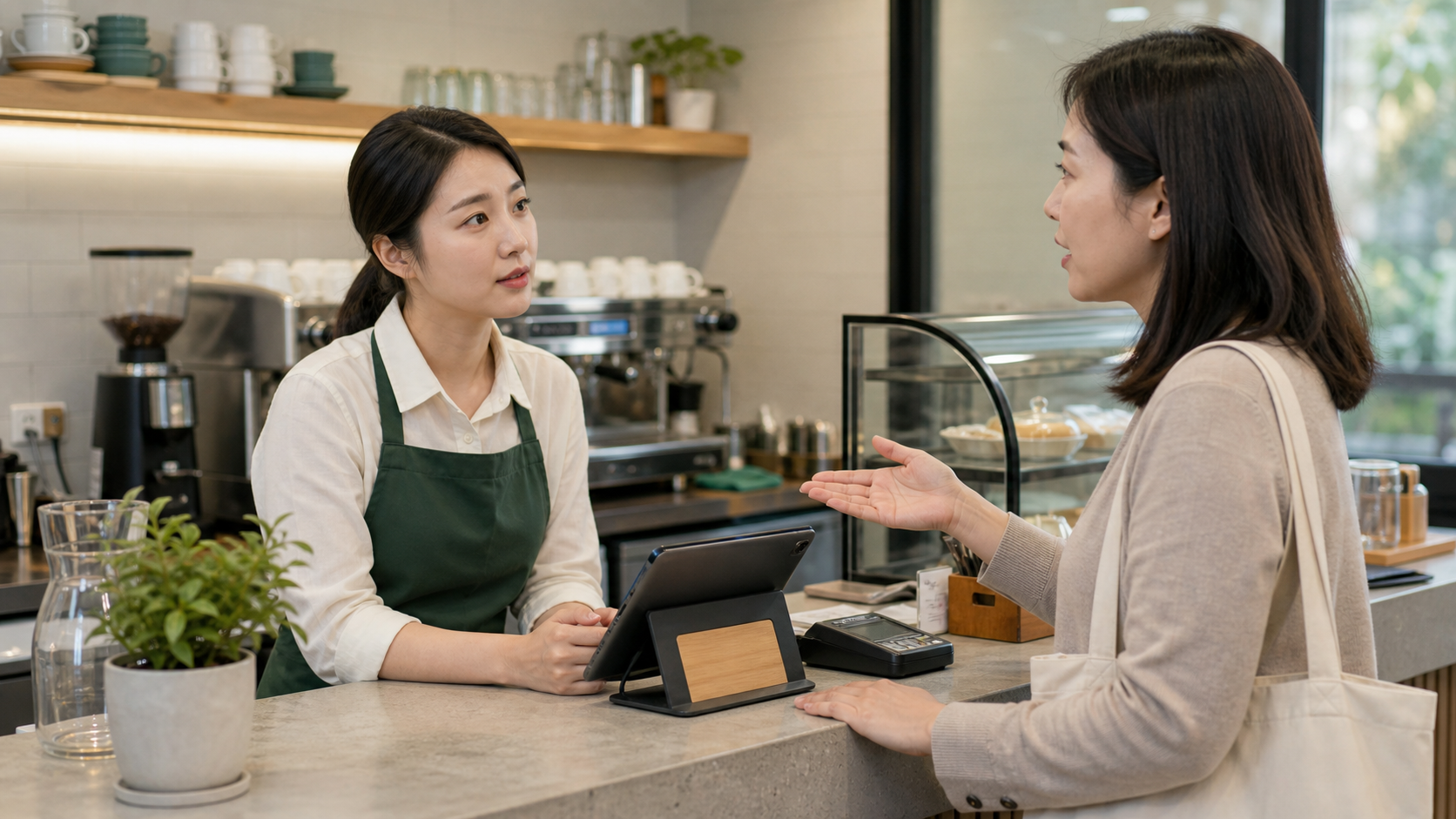
You are working at a Korean cafe, restaurant, hotel desk, or convenience store. A customer comes back to the counter and says there is a problem with the order. The drink may be wrong, the food may be cold, the receipt may not match, or the customer may ask for an exchange or refund. In this moment, polite Korean is not just language study. It is part of service work.
This lesson teaches Korean customer complaint phrases for service workers. The focus is practical: listen to the customer, apologize briefly, check the problem, explain the next step, and call a manager when needed. The words come from the BS3001 word database and can be reused later for Learn Korean, quizzes, audio, and app content.
Key Vocabulary
| Korean | Romanization | English | Level | Usage Note |
|---|---|---|---|---|
| 고객 | gogaek | customer | Beginner | A formal service word for customer. |
| 고객불만 | gogaek bulman | customer complaint | Intermediate | Used in service work and workplace reports. |
| 문제 | munje | problem | Beginner | The basic word for a problem or issue. |
| 실수 | silsu | mistake | Intermediate | Used when the store or worker made an error. |
| 죄송합니다 | joesonghamnida | I am sorry | Beginner | A polite apology used in service situations. |
| 사과 | sagwa | apology | Intermediate | A noun used in reports or formal explanations. |
| 확인 | hwagin | confirmation / check | Intermediate | Used when checking receipt, order, or product. |
| 다시 확인해 주세요 | dasi hwaginhae juseyo | please check again | Beginner | A polite phrase for checking details again. |
| 주문 | jumun | order | Beginner | Used in restaurants, cafes, and delivery work. |
| 주문서 | jumunseo | purchase order / order form | Beginner | More common in workplace or back-office contexts. |
| 교환 | gyohwan | exchange | Beginner | Changing an item for another one. |
| 환불 | hwanbul | refund | Beginner | Giving money back to the customer. |
| 직원 | jigwon | employee | Beginner | Used for staff or worker. |
| 관리자 | gwallija | manager / supervisor | Intermediate | The person to call when the problem is not simple. |
| 업무처리 | eommu cheori | work processing | Beginner | A formal workplace word for handling work tasks. |
Real Service Phrases
| Korean Sentence | English Meaning | When to Use |
|---|---|---|
| 불편을 드려 죄송합니다. | We are sorry for the inconvenience. | First polite response to a complaint. |
| 주문을 확인해 보겠습니다. | I will check the order. | When checking the receipt or POS system. |
| 다시 확인해 주세요. | Please check again. | When asking someone to recheck a detail. |
| 실수가 있었던 것 같습니다. | It seems there was a mistake. | When acknowledging a possible error. |
| 교환해 드릴게요. | We will exchange it for you. | When replacing an item. |
| 환불 가능 여부를 확인해 보겠습니다. | I will check whether a refund is possible. | When the refund rule is unclear. |
| 관리자에게 확인하겠습니다. | I will check with the manager. | When the issue needs approval. |
| 잠시만 기다려 주세요. | Please wait a moment. | When you need time to check or call someone. |
Usage Notes
In Korean service work, the first response should usually be short and polite. 죄송합니다 does not always mean you are admitting full legal responsibility. In many customer-service situations, it is a polite way to recognize that the customer experienced inconvenience.
확인해 보겠습니다 is safer than making a quick promise. It means “I will check.” This is useful when you need to look at the receipt, check the order, ask the kitchen, check stock, or call a manager.
교환 and 환불 are different actions. 교환 means the customer receives another item. 환불 means money is returned. If you are not authorized to decide, say 관리자에게 확인하겠습니다.
고객불만 is more formal than simply saying 문제. You may hear it in staff meetings, reports, or training. At the counter, you normally speak more naturally: 어떤 문제가 있으셨나요? means “What problem did you have?”
Mini Dialogue
Customer: 주문한 음료가 아닌 것 같아요.
Jumunhan eumryoga anin geot gatayo.
I think this is not the drink I ordered.
Staff: 불편을 드려 죄송합니다. 주문을 확인해 보겠습니다.
Bulpyeoneul deuryeo joesonghamnida. Jumuneul hwaginhae bogetsseumnida.
I am sorry for the inconvenience. I will check the order.
Customer: 네, 영수증 여기 있어요.
Ne, yeongsujeung yeogi isseoyo.
Yes, here is the receipt.
Staff: 확인했습니다. 실수가 있었던 것 같습니다. 바로 교환해 드릴게요.
Hwagin haetsseumnida. Silsuga isseotdeon geot gatseumnida. Baro gyohwanhae deurilgeyo.
I checked it. It seems there was a mistake. We will exchange it right away.
Common Mistakes
Mistake 1: Saying only 몰라요.
몰라요 means “I do not know,” but it can sound unhelpful at work. Say 확인해 보겠습니다 instead. It tells the customer you will check.
Mistake 2: Promising a refund too quickly.
Do not say 환불해 드릴게요 if you do not know the policy. Use 환불 가능 여부를 확인해 보겠습니다.
Mistake 3: Using casual speech with customers.
In service jobs, use polite endings like -습니다, -세요, and -드릴게요. Casual speech can sound rude, even if your meaning is correct.
Step-by-Step Practice
- Start with a short apology: 불편을 드려 죄송합니다.
- Ask or check the problem: 어떤 문제가 있으셨나요?.
- Check the order or receipt: 주문을 확인해 보겠습니다.
- Explain the next action: 교환해 드릴게요 or 관리자에게 확인하겠습니다.
- Ask the customer to wait briefly: 잠시만 기다려 주세요.
Quick Quiz
- What does 고객불만 mean?
Answer: Customer complaint. - Which phrase is better than saying “I do not know” at work?
Answer: 확인해 보겠습니다. - You need manager approval. What can you say?
Answer: 관리자에게 확인하겠습니다. - What is the difference between 교환 and 환불?
Answer: 교환 is exchange. 환불 is refund. - A customer received the wrong drink. Which first response is polite?
Answer: 불편을 드려 죄송합니다. 주문을 확인해 보겠습니다.
Review Table
| Korean | Meaning | Best Situation | Beginner Tip |
|---|---|---|---|
| 고객 | customer | Service work | More formal than 손님 in reports. |
| 고객불만 | customer complaint | Workplace reporting | Use in reports or training. |
| 죄송합니다 | I am sorry | First response | Keep it short and polite. |
| 확인 | check | Receipt, order, product | Say 확인해 보겠습니다. |
| 교환 | exchange | Wrong item or size | Not the same as refund. |
| 환불 | refund | Money back | Check the policy first. |
| 관리자 | manager | Approval needed | Call a manager for unclear cases. |
Related Lessons
- Korean Work Schedule Phrases for Foreign Workers
- Korean Refund and Exchange Phrases for Daily Life
- Korean Repair Request Phrases
- BSKorean Practice App
Practice More
Practice this word list in Learn Korean or in the upcoming BS3001 app. Start with 고객불만, 죄송합니다, 확인, 교환, and 환불. These words help service workers respond calmly when a customer has a problem.