
Korean Repair Request Phrases
Useful Korean phrases for asking repairs, explaining a broken item, sending photos, confirming a visit time, and speaking politely with management offices or technicians.


1. When to use these phrases
English · Work Korean · 5 min read
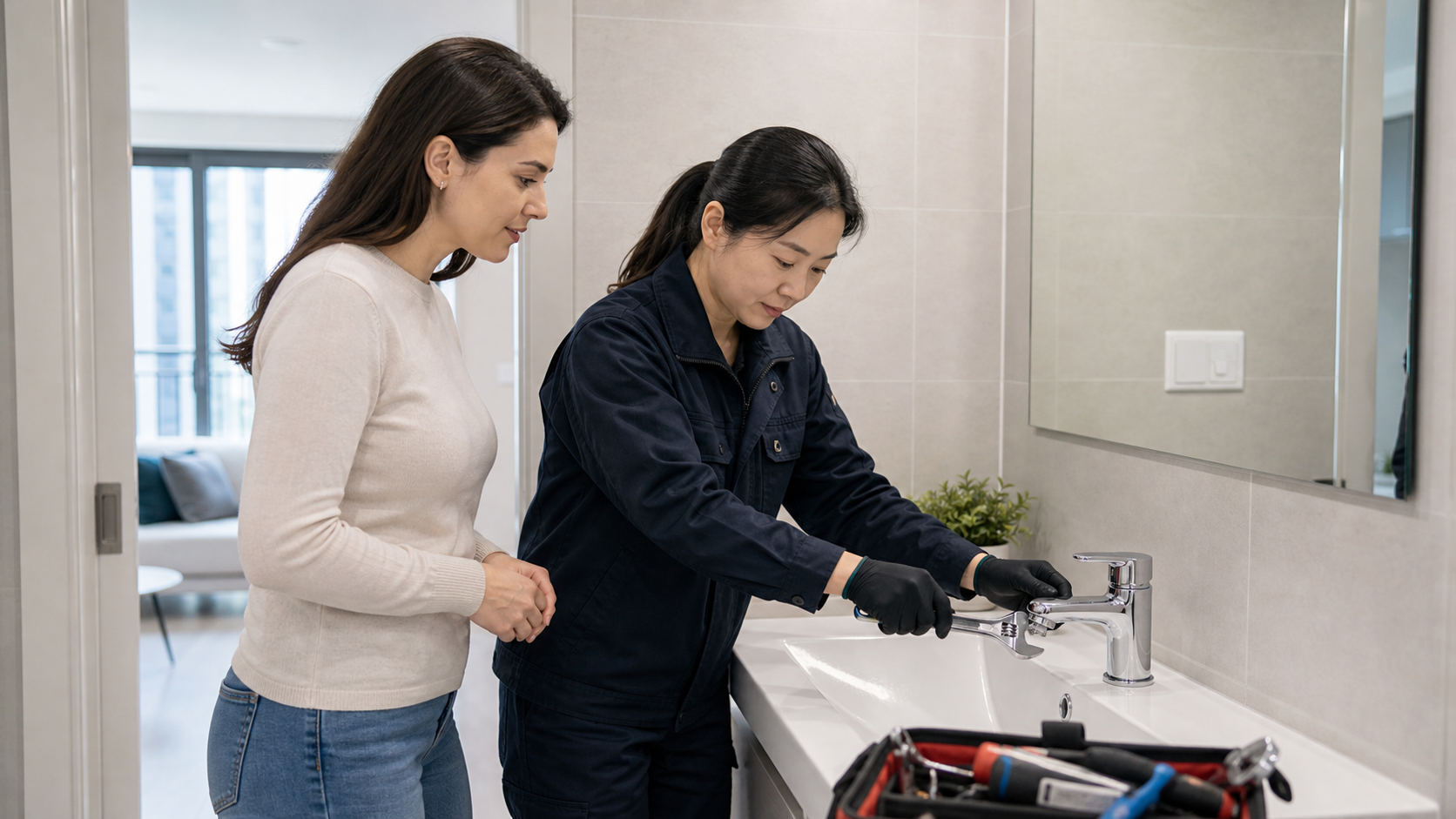
Repairs are one of the most stressful moments for a Korean learner because the situation is practical, time-sensitive, and often happens by phone or chat. This lesson gives you a calm pattern: explain what is broken, show where the problem is, ask for a visit, and confirm cost or timing.
The key is not to translate every sentence from your native language. In Korean, a short polite request works better: name the problem, add 부탁드립니다 or 확인해 주실 수 있나요, and then give the manager enough details to act.
Use this article for apartments, offices, dormitories, small shops, shared housing, and workplace maintenance. The phrases are beginner-friendly, but the flow is realistic enough for real repair messages in Korea.
1. When to use these phrases
- A sink, faucet, toilet, ceiling, outlet, door lock, heater, air conditioner, or light is not working.
- You need to contact a management office, landlord, receptionist, shop worker, or technician.
- You want to send a photo and avoid a long phone explanation.
- You need to ask when someone can visit.
- You want to sound polite without making the sentence too complicated.
The safest repair message follows this order: place, problem, request, photo, visit time, and cost. If you remember that order, you can handle many apartment, office, or shop repair situations even with simple Korean.
2. Key vocabulary
수리 [suri] – repair
고장 [gojang] – breakdown / problem
물이 새요 [muri saeyo] – water is leaking
전기가 안 들어와요 [jeongiga an deureowayo] – power is not working
기사님 [gisanim] – technician
관리사무소 [gwallisamuso] – management office
확인하다 [hwaginhada] – to check
방문하다 [bangmunhada] – to visit
비용 [biyong] – cost
사진 [sajin] – photo
예약 [yeyak] – appointment
싱크대 [singkeudae] – sink
천장 [cheonjang] – ceiling
콘센트 [konsenteu] – outlet
화장실 [hwajangsil] – bathroom
급하다 [geuphada] – urgent
가능하다 [ganeunghada] – possible
연락하다 [yeollakhada] – to contact
부탁드립니다 [butakdeurimnida] – please
오늘 [oneul] – today
3. Request flow
Say the place first
Start with the room or object: 싱크대, 화장실, 콘센트, 천장. This helps the listener understand the problem before hearing the details.
Name the problem simply
Use 고장이 났어요 for general breakdowns, 물이 새요 for leaks, and 전기가 안 들어와요 for power problems. One clear sentence is better than a long uncertain explanation.
Ask for confirmation
확인해 주실 수 있나요? is polite and flexible. It asks the other person to check the situation without sounding demanding.
Ask for the visit time
언제 방문 가능하세요? is useful after the other person understands the problem. If it is urgent, add 조금 급해요.
Close with an action
End with 사진을 보내드릴게요 or 오늘 답장 가능하실까요? so the conversation moves to the next step.
For practice, write one short message using this frame: “안녕하세요. [place/item]이/가 [problem]. 확인해 주실 수 있나요? 사진을 보내드릴게요.” Replace only the bracketed parts and keep the polite ending.
4. Example conversation
A: 안녕하세요. 싱크대가 고장이 났어요.
Hello. The sink is broken.
B: 언제부터 고장이 났나요?
Since when has it been broken?
A: 오늘 아침부터요. 싱크대 아래에서 물이 새요.
Since this morning. Water is leaking under the sink.
B: 먼저 사진을 보내 주세요.
Please send a photo first.
A: 지금 사진을 보내드릴게요. 기사님은 언제 방문 가능하세요?
I will send a photo now. When can a technician visit?
B: 오늘 오후에 방문 가능합니다.
A technician can visit this afternoon.
A: 대략 비용도 알 수 있을까요?
Could you tell me the approximate cost?
B: 기사님이 먼저 확인하고 비용을 안내해 드릴게요.
The technician will check first and explain the cost.
5. Common mistake
Do not use 고쳐 주세요 alone in a first message. It is understandable, but 수리 부탁드립니다 or 확인해 주실 수 있나요 sounds more natural and polite for management offices and technicians.
A natural repair request does not need to sound dramatic. Korean service conversations often value clear information and polite endings. If you are not sure, use 부탁드립니다, 주실 수 있나요, and 보내드릴게요. These endings keep the tone respectful while still asking directly for help.
6. Quick check
What does “고장이 났어요” mean in this repair context?
- It is expensive.
- It is broken.
- I am late.
- I need a receipt.
Answer: B
7. Practice routine
First, read the vocabulary aloud once. Second, choose one problem such as 물이 새요 or 전기가 안 들어와요. Third, combine it with 확인해 주실 수 있나요? Fourth, add a practical next step such as 사진을 보내드릴게요. Finally, repeat the full message until it feels short and automatic.
This lesson belongs to the Work Korean package because repair requests are not only home situations. The same language appears in offices, small businesses, factories, dormitories, clinics, service counters, and shared work spaces. Learning the pattern now gives you a reusable survival phrase set.
Practice this repair request in the app
Review the words, listen to the phrases, and answer short repair-situation questions.
2. Key vocabulary
repair
Beginnerbreakdown / problem
Beginnerwater is leaking
Beginnerpower is not working
Beginnertechnician
Beginner
Practice this lesson in the app
Review these words with multiple-choice questions and weak-Learn Korean.
Practice this lesson →
답글 남기기
Please sign in with Google to comment. Sign in with Google