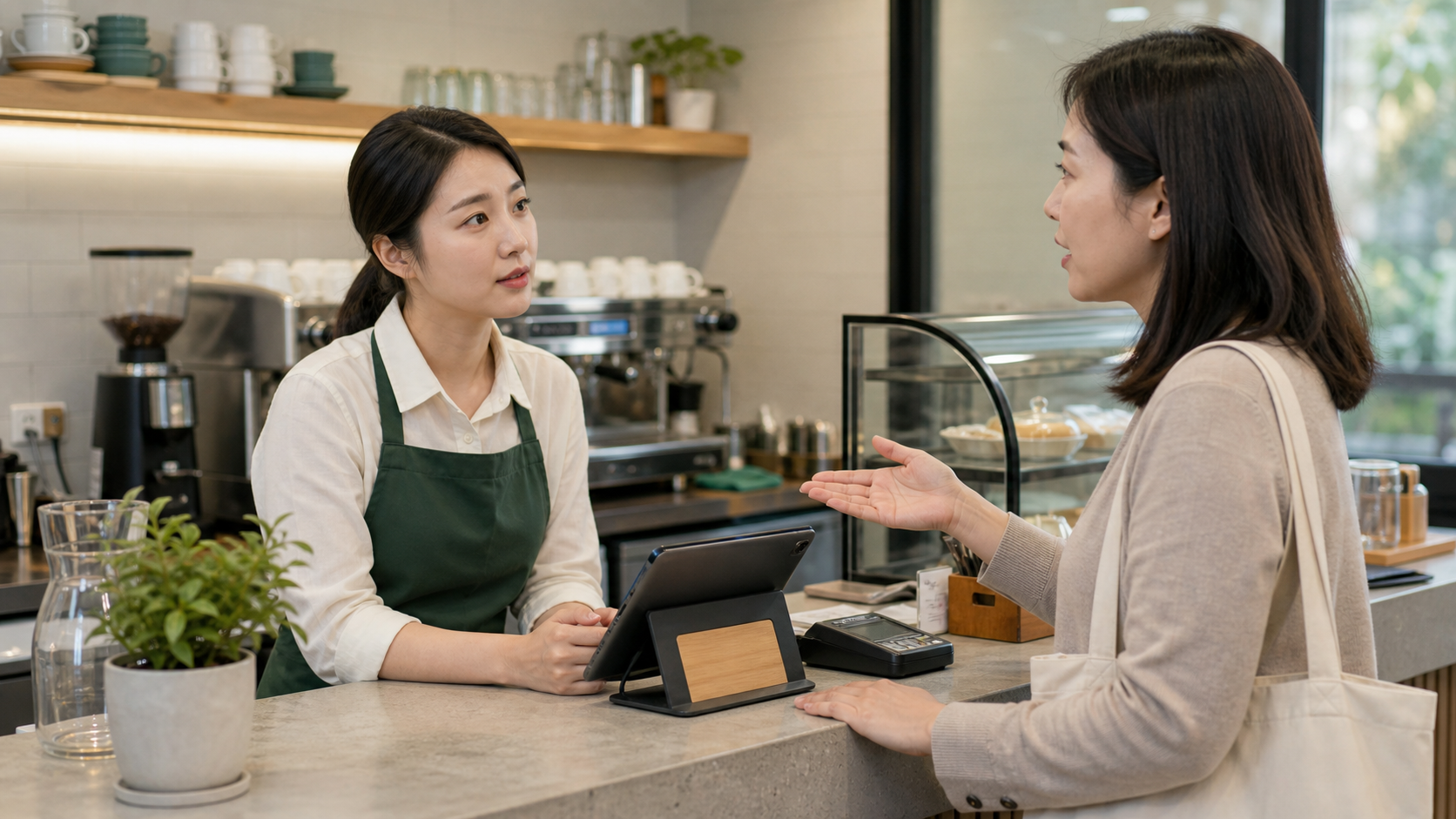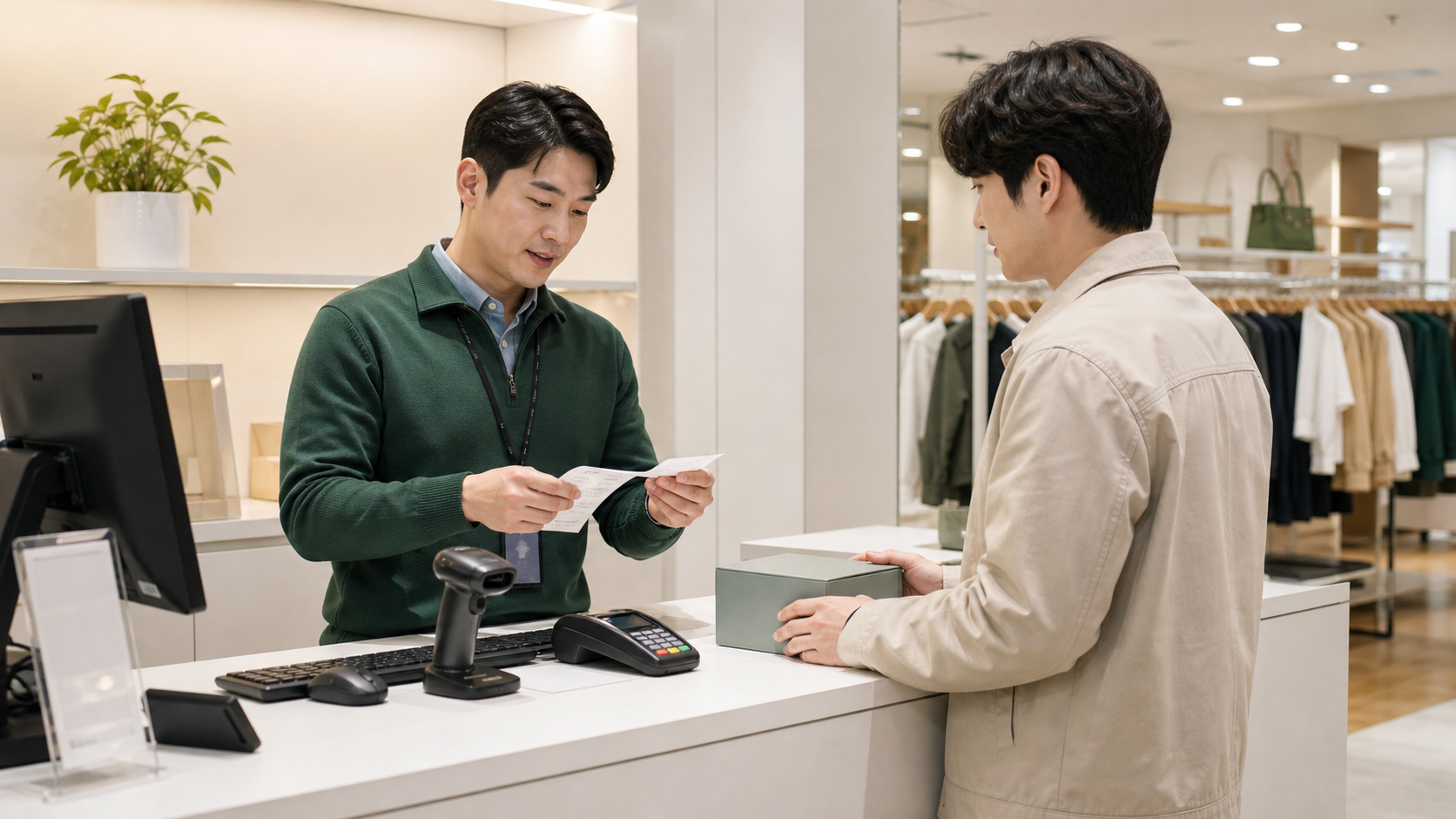
You bought something in Korea, but the size is wrong, the item is damaged, or you received the wrong product. At the store counter, the staff asks for a receipt, checks the card payment, and explains whether a refund or exchange is possible. This is a common daily-life situation, but the Korean words can sound formal and fast.
This lesson teaches practical Korean refund and exchange phrases for foreign residents, workers, students, and travelers in Korea. You will learn how to understand words like 환불, 교환, 반품, 영수증, and 결제취소, and how to explain a simple product problem politely.
Key Vocabulary
| Korean | Romanization | English | Level | Usage Note |
|---|---|---|---|---|
| 환불 | hwanbul | refund | Beginner | The basic word for getting your money back. |
| 교환 | gyohwan | exchange | Beginner | Used when replacing an item with another one. |
| 반품 | banpum | return | Intermediate | Common in online shopping and store return policies. |
| 영수증 | yeongsujeung | receipt | Beginner | Stores often ask for this before processing a refund. |
| 카드 | kadeu | card | Beginner | Used for credit cards, debit cards, and payment cards. |
| 현금 | hyeongeum | cash | Beginner | Refund process may differ for cash and card payments. |
| 확인 | hwagin | confirmation / check | Intermediate | Used when staff check the product, receipt, or payment. |
| 결제 | gyeolje | payment | Beginner | A common word at stores, cafes, banks, and apps. |
| 결제취소 | gyeolje chwiso | payment cancellation | Advanced | Often used when reversing a card payment. |
| 환급 | hwangeup | refund / reimbursement | Advanced | More formal than 환불, often used in official or financial contexts. |
| 환불정책 | hwanbul jeongchaek | refund policy | Advanced | Appears in store rules, online shops, and customer service pages. |
| 청약철회 | cheongyak cheolhoe | withdrawal of purchase | Advanced | A formal consumer-rights term used in online purchases and contracts. |
| 위약금 | wiyageum | penalty fee | Advanced | May appear when canceling a service, reservation, or contract. |
| 오배송 | obaesong | wrong delivery | Advanced | Used when the wrong item or wrong address is involved. |
Real Store Counter Phrases
| Korean Sentence | English Meaning | When to Use |
|---|---|---|
| 환불하고 싶어요. | I would like a refund. | Basic refund request. |
| 교환할 수 있나요? | Can I exchange this? | When size, color, or product type is wrong. |
| 영수증 여기 있어요. | Here is the receipt. | When staff asks for proof of purchase. |
| 카드로 결제했어요. | I paid by card. | When explaining the payment method. |
| 현금으로 결제했어요. | I paid in cash. | When cash refund rules matter. |
| 상품에 문제가 있어요. | There is a problem with the product. | When the item is damaged or defective. |
| 결제취소 가능한가요? | Is payment cancellation possible? | When asking about card reversal. |
| 환불정책을 확인해 주세요. | Please check the refund policy. | When the rule is unclear. |
Usage Notes
환불 and 교환 are the two most important words. 환불 means you want your money back. 교환 means you want another item instead. If you only say 환불 when you really want a different size, staff may start the refund process instead of looking for another product.
반품 is common in online shopping. A store employee may also understand it, but in face-to-face conversation, beginners can usually say 환불 or 교환 first. For example, 반품하고 싶어요 means “I want to return this item.” It sounds natural when you are talking about returning an item after purchase.
영수증 is important because many Korean stores check the purchase date, payment method, and product name before processing a return. If you paid by card, the staff may ask for the same card. That is why 카드로 결제했어요 is useful.
결제취소 is not exactly the same as simply receiving cash. It often means canceling or reversing the card payment record. If the staff says 결제취소, they are usually talking about the payment system, not only handing money back to you.
Mini Dialogue
Customer: 안녕하세요. 이 상품 환불하고 싶어요.
Annyeonghaseyo. I sangpum hwanbulhago sipeoyo.
Hello. I would like to refund this product.
Staff: 영수증 있으세요?
Yeongsujeung isseuseyo?
Do you have the receipt?
Customer: 네, 여기 있어요. 카드로 결제했어요.
Ne, yeogi isseoyo. Kadeuro gyeoljehaesseoyo.
Yes, here it is. I paid by card.
Staff: 확인해 보겠습니다. 결제취소로 처리해 드릴게요.
Hwaginhae bogetsseumnida. Gyeolje chwiso-ro cheorihae deurilgeyo.
I will check it. We will process it as a payment cancellation.
Common Mistakes
Mistake 1: Saying 환불 when you only want a different size.
If you want another size or color, say 교환할 수 있나요? first. 환불 means you want your money back.
Mistake 2: Forgetting the receipt.
In Korea, many stores ask for 영수증. If you do not have it, staff may need to check card payment history or store policy.
Mistake 3: Thinking 결제취소 means instant cash.
결제취소 usually means the card payment is reversed. The money may appear later depending on the card company or bank.
Quick Quiz
- You want your money back. Which word do you need?
Answer: 환불. It means refund. - You want another size instead. What should you ask?
Answer: 교환할 수 있나요? It means “Can I exchange this?” - Staff asks, 영수증 있으세요? What do they want?
Answer: They want the receipt. - You paid by card. What can you say?
Answer: 카드로 결제했어요. - What does 결제취소 usually mean?
Answer: Payment cancellation or reversal, especially for card payments.
How to Choose the Right Word
Before you speak to staff, decide what result you want. If you want the money back, use 환불. If you want a different size, color, or same product, use 교환. If you are sending or giving the item back, especially after an online order, use 반품.
This small choice matters because Korean store staff often process each case differently. A refund may require the original payment card. An exchange may require checking stock. A return may require checking the product condition, package, receipt, or delivery record.
| Your Situation | Best Korean Word | Simple Sentence |
|---|---|---|
| You want your money back. | 환불 | 환불하고 싶어요. |
| You want another size or color. | 교환 | 교환할 수 있나요? |
| You are returning an online order. | 반품 | 반품하고 싶어요. |
| The card payment should be reversed. | 결제취소 | 결제취소 가능한가요? |
| The wrong item arrived. | 오배송 | 오배송된 것 같아요. |
Step-by-Step Practice
Use this order when you speak at a Korean store counter. You do not need a long explanation at first. Start with the purpose, show the receipt, explain the problem, and then answer questions about payment.
- Say the purpose: 환불하고 싶어요 or 교환할 수 있나요?.
- Show the receipt: 영수증 여기 있어요.
- Explain the payment: 카드로 결제했어요 or 현금으로 결제했어요.
- Explain the problem: 상품에 문제가 있어요 or 오배송된 것 같아요.
- Ask what is possible: 환불 가능한가요? or 결제취소 가능한가요?.
Review Table
| Korean | Meaning | Best Situation | Beginner Tip |
|---|---|---|---|
| 환불 | refund | Getting money back | Use this when you do not want the item. |
| 교환 | exchange | Changing size, color, or item | Use this before asking for money back. |
| 반품 | return | Returning a purchased item | Very common for online shopping. |
| 영수증 | receipt | Proof of purchase | Keep it until the product is okay. |
| 결제취소 | payment cancellation | Card payment reversal | Money may not appear instantly. |
| 환불정책 | refund policy | Store or website rules | Check this before arguing. |
Related Lessons
- Korean Bank Transfer Phrases for Daily Life
- Korean Delivery Pickup Phrases for Daily Life
- Korean Repair Request Phrases
- BSKorean Practice App
Practice More
Practice this word list in Learn Korean or in the upcoming BS3001 app. Start with 환불, 교환, 반품, 영수증, and 결제취소. These words help you handle many common store-counter problems in Korea.