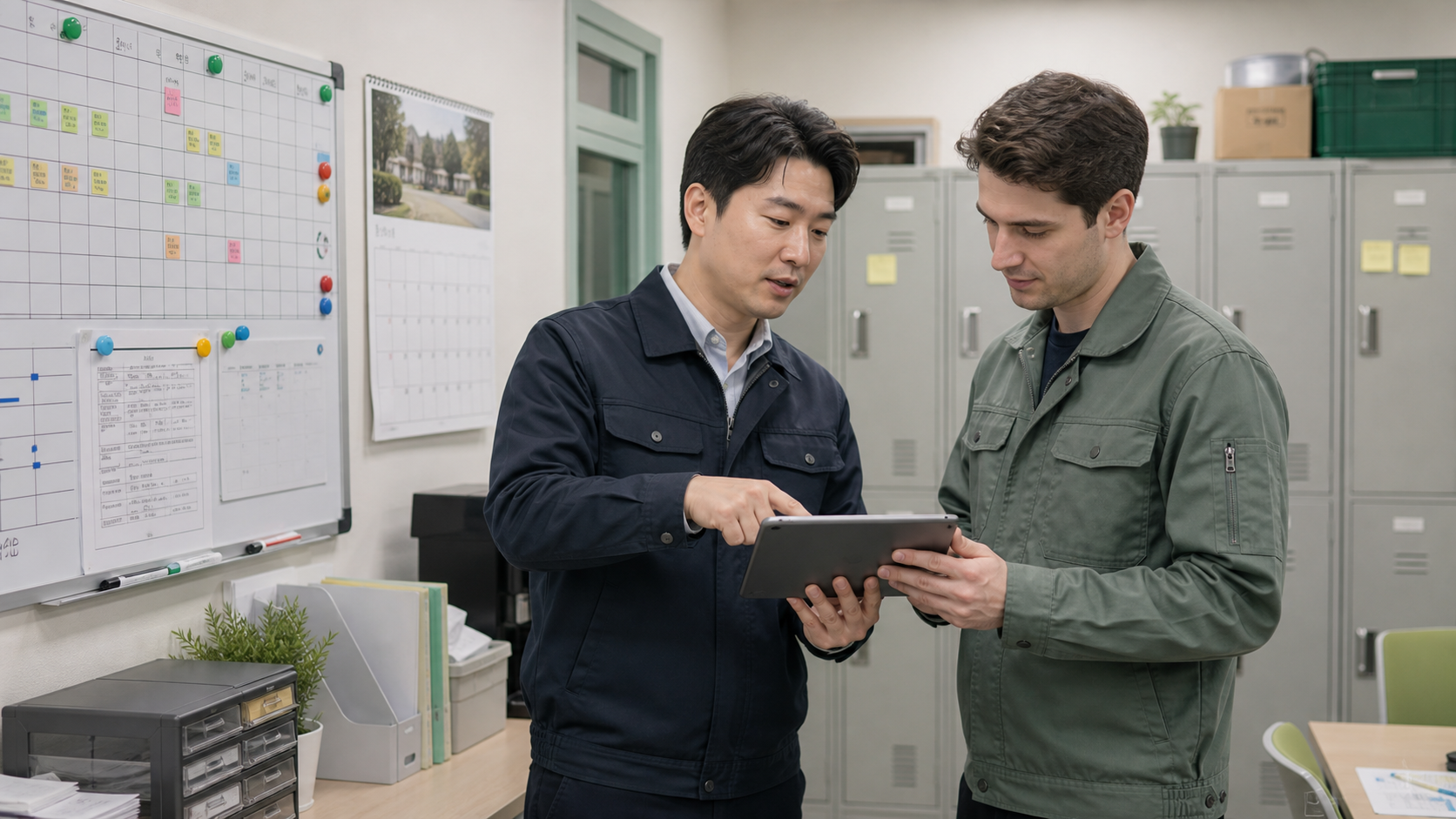
You arrive at work in Korea and see the shift schedule on the wall. Your manager asks when you came in, whether you can work overtime, or why you are late. Even if the words are short, you need to answer clearly because these expressions affect attendance, pay, and trust at work.
This lesson teaches Korean work schedule phrases for foreign workers. It focuses on practical words used in restaurants, factories, hotels, cleaning jobs, construction sites, warehouses, and offices. The goal is simple: understand your schedule and speak to your manager politely when time changes.
Key Vocabulary
| Korean | Romanization | English | Level | Usage Note |
|---|---|---|---|---|
| 출근 | chulgeun | going to work | Beginner | Used when you come to work or clock in. |
| 퇴근 | toegeun | leaving work | Beginner | Used when you finish work and go home. |
| 출근시간 | chulgeun sigan | start time | Beginner | The time you are expected to arrive at work. |
| 퇴근시간 | toegeun sigan | off-work time | Beginner | The time your shift or workday ends. |
| 근무시간 | geunmu sigan | working hours | Beginner | The full work time, often shown on a schedule. |
| 휴게시간 | hyuge sigan | break time | Beginner | Used on workplace notices and shift rules. |
| 지각 | jigak | lateness | Beginner | Used when you arrive after the start time. |
| 조퇴 | jotoe | early leave | Beginner | Leaving before the scheduled end time. |
| 결근 | gyeolgeun | absence from work | Beginner | Not coming to work for a scheduled shift. |
| 병가 | byeongga | sick leave | Beginner | Used when you cannot work because you are sick. |
| 야근 | yageun | overtime / night work | Beginner | Can mean working late after normal hours. |
| 교대근무 | gyodae geunmu | shift work | Beginner | Common in factories, hotels, security, and service jobs. |
| 관리자 | gwallija | manager / supervisor | Intermediate | The person you should report schedule problems to. |
| 보고 | bogo | report | Beginner | Used when telling a manager about a problem or change. |
| 확인 | hwagin | confirmation / check | Intermediate | Used when checking a schedule, time, or instruction. |
Real Workplace Phrases
| Korean Sentence | English Meaning | When to Use |
|---|---|---|
| 오늘 출근시간이 몇 시예요? | What time is the start time today? | When checking your shift. |
| 퇴근시간을 확인하고 싶어요. | I want to check the off-work time. | When the end time is unclear. |
| 오늘 조금 늦을 것 같아요. | I think I will be a little late today. | Before you arrive late. |
| 지각해서 죄송합니다. | I am sorry for being late. | When you already arrived late. |
| 몸이 안 좋아서 병가를 써야 할 것 같아요. | I think I need to take sick leave because I do not feel well. | When illness affects work. |
| 오늘 야근이 있나요? | Is there overtime today? | When checking late work. |
| 관리자님께 보고하겠습니다. | I will report it to the manager. | When a schedule problem must be reported. |
| 근무시간을 다시 확인해 주세요. | Please check the working hours again. | When the schedule may be wrong. |
Usage Notes
출근 and 퇴근 are basic workplace words. 출근 is not just “go” in a general sense. It means going to work for your scheduled shift. 퇴근 means leaving work after the workday or shift ends. In many workplaces, these words are connected to attendance records.
지각, 조퇴, and 결근 are attendance problem words. 지각 means you came late. 조퇴 means you left early. 결근 means you did not come to work. These words can affect pay, schedule records, and manager communication, so it is better to report early and politely.
휴게시간 means break time. In Korea, break time may be written on a workplace notice, schedule board, or employment document. Do not assume every quiet moment is official 휴게시간. If you are unsure, ask your manager or coworker.
야근 is often translated as overtime, but it can also feel like “working late.” If someone asks, 오늘 야근 가능해요?, they are asking if you can work later than usual today. If you cannot, answer politely and briefly.
Mini Dialogue
Worker: 관리자님, 오늘 조금 늦을 것 같아요.
Gwallijanim, oneul jogeum neujeul geot gatayo.
Manager, I think I will be a little late today.
Manager: 몇 시쯤 도착할 수 있어요?
Myeot si-jjeum dochakhal su isseoyo?
Around what time can you arrive?
Worker: 10분 정도 늦을 것 같습니다. 지각해서 죄송합니다.
Sip bun jeongdo neujeul geot gatseumnida. Jigakhaeseo joesonghamnida.
I think I will be about 10 minutes late. I am sorry for being late.
Manager: 알겠습니다. 도착하면 바로 보고해 주세요.
Algetsseumnida. Dochakhamyeon baro bogohae juseyo.
Okay. Please report right away when you arrive.
Common Mistakes
Mistake 1: Saying 늦어요 without explaining the work situation.
늦어요 means “I am late,” but at work it is clearer to say 오늘 조금 늦을 것 같아요 before you arrive, or 지각해서 죄송합니다 after you arrive.
Mistake 2: Confusing 퇴근 and 조퇴.
퇴근 is normal leaving after work. 조퇴 means leaving early before your scheduled end time. If you leave early because of illness or an emergency, ask first.
Mistake 3: Thinking 휴게시간 is always flexible.
Some workplaces have fixed break times. In factories, restaurants, and service jobs, break time may depend on the shift, customer flow, or safety rules.
Step-by-Step Practice
- Find the schedule word first: 출근시간, 퇴근시간, or 근무시간.
- If there is a problem, name it simply: 지각, 조퇴, 결근, or 병가.
- Tell the manager early: 오늘 조금 늦을 것 같아요.
- Use a polite apology when needed: 죄송합니다.
- Confirm the next action: 도착하면 보고하겠습니다.
Quick Quiz
- What does 출근 mean?
Answer: Going to work or coming in for work. - You leave before your scheduled end time. Which word fits?
Answer: 조퇴. - You are sick and cannot work. Which word is useful?
Answer: 병가. - What does 야근 usually mean at work?
Answer: Working late or overtime. - Who should you report a schedule problem to?
Answer: 관리자, the manager or supervisor.
Review Table
| Korean | Meaning | Best Situation | Beginner Tip |
|---|---|---|---|
| 출근 | going to work | Starting your workday | Use it for work, not general movement. |
| 퇴근 | leaving work | Finishing work normally | Different from leaving early. |
| 지각 | lateness | Arriving after start time | Report before you arrive if possible. |
| 조퇴 | early leave | Leaving before end time | Ask first unless it is an emergency. |
| 병가 | sick leave | Illness | Explain briefly and politely. |
| 야근 | overtime | Working late | Confirm whether it is required. |
| 관리자 | manager | Reporting problems | Use polite speech. |
Related Lessons
- Korean Repair Request Phrases
- Field Korean Construction Site Safety Instructions
- Korean Bank Transfer Phrases for Daily Life
- BSKorean Practice App
Practice More
Practice this word list in Learn Korean or in the upcoming BS3001 app. Start with 출근, 퇴근, 지각, 휴게시간, and 야근. These words help you understand schedules and report time problems clearly at work in Korea.