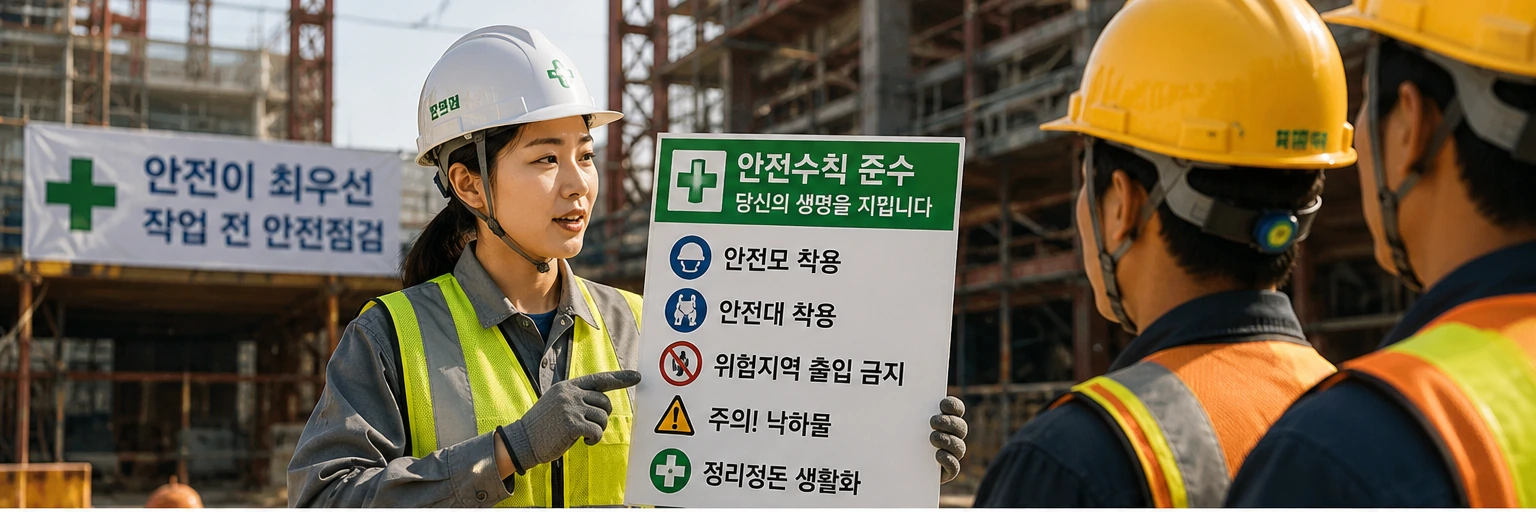
Korean Construction Site Safety Phrases for Foreign Workers
Learn practical Workplace Korean for safety signs, hazard warnings, PPE checks, no-entry areas, and simple questions on a Korean construction site.
1. When to use these phrases
Why these safety phrases matter
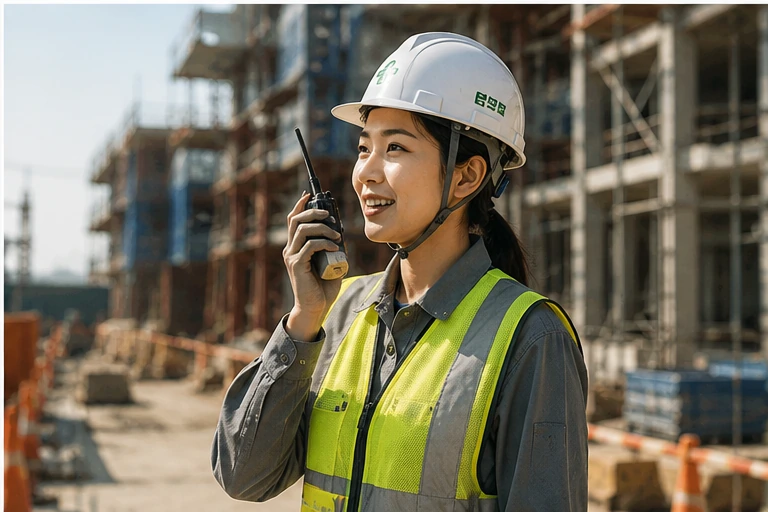
A construction site in Korea can be noisy, fast, and full of short instructions. You may hear only one word, such as 위험, or one polite command, such as 안전모를 착용하세요. This article is not a safety manual and does not replace your company rules. It is a language lesson that helps you recognize the Korean words that often appear before a supervisor points, stops you, or sends you to another walkway.
The best goal is simple: understand the warning, stop for a moment, and ask one clear question. If you can say 다시 말해 주세요, you can slow the conversation down. If you can ask 어디로 가면 돼요?, you can get a safer route instead of guessing. These phrases are useful for factory work, repair work, delivery zones, and especially construction sites, so this lesson belongs inside the Workplace Korean package.
Core vocabulary for signs and spoken warnings
Start with the small set below. Read the Korean first, then the romanization, then the meaning. Do not try to translate every grammar point while you are moving through a site. Treat these as safety signals. When you see or hear one of them, pause, look around, and confirm the next action with the person responsible for the area.
| Korean | Romanization | Meaning | Use it when |
|---|---|---|---|
| 안전모 | anjeonmo | safety helmet | before entering an active work area |
| 보호장비 | boho jangbi | protective equipment | when a supervisor checks PPE |
| 출입금지 | churip geumji | no entry | when an area is closed to workers |
| 위험 | wiheom | danger | when a place or action is unsafe |
| 주의 | juui | caution | when you must slow down and look carefully |
| 낙하물 주의 | nakhamul juui | watch for falling objects | near scaffolding, cranes, or upper floors |
| 감전 주의 | gamjeon juui | electric shock caution | near cables, panels, wet tools, or temporary power |
| 미끄럼 주의 | mikkeureom juui | slip caution | on wet floors, ramps, mud, or dusty steps |
| 안전모를 착용하세요 | anjeonmoreul chagyonghaseyo | please wear a safety helmet | as a direct but polite instruction |
| 여기 들어오지 마세요 | yeogi deureooji maseyo | please do not come in here | when a worker approaches a restricted place |
| 다시 말해 주세요 | dasi malhae juseyo | please say it again | when the instruction was too fast or unclear |
| 어디로 가면 돼요? | eodiro gamyeon dwaeyo? | where should I go? | when you need a safer route |
| 위험한가요? | wiheomhangayo? | is it dangerous? | when you are unsure before starting a task |
| 잠깐 기다리세요 | jamkkan gidariseyo | please wait a moment | when you need to stop movement briefly |
Helmet and protective equipment checks
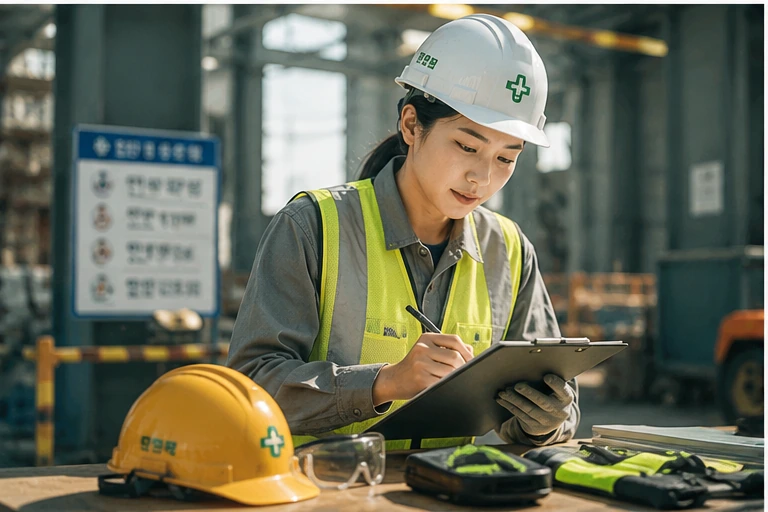
안전모 means safety helmet. 보호장비 means protective equipment. A supervisor may say 안전모를 착용하세요, which literally means “please wear a safety helmet.” The verb 착용하다 is used for wearing equipment, uniforms, masks, gloves, and other gear.
If you already have a helmet but the supervisor still points to your head, check the strap, the fit, and whether the helmet is the correct one for that area. A useful answer is short: 네, 착용하겠습니다, meaning “Yes, I will wear it.” If you are not sure which item is missing, point gently and ask 어떤 보호장비요?, meaning “Which protective equipment?”
No-entry areas and safer routes
출입금지 is one of the most important signs to recognize. It does not mean “be careful and enter slowly.” It means you should not enter unless you are authorized. The spoken version is often 여기 들어오지 마세요. Even if the tone sounds calm, treat it as a stop instruction.
When you are blocked from entering, do not argue with complicated Korean. Ask for the route: 어디로 가면 돼요? If the answer is too fast, say 다시 말해 주세요. A safe communication pattern is “stop, repeat, route.” Stop your movement, ask for the instruction again, then ask where to go.
A: 여기 들어오지 마세요.
Please do not come in here.
B: 네, 어디로 가면 돼요?
Okay. Where should I go?
A: 오른쪽 통로로 가세요. 낙하물 주의하세요.
Use the right walkway. Watch for falling objects.
B: 다시 말해 주세요. 오른쪽 통로요?
Please say that again. The right walkway?
Danger, caution, and hazard words
위험 is stronger than 주의. 위험 tells you that something can hurt people or damage equipment. 주의 tells you to pay attention, slow down, and check the surroundings. Many Korean warning phrases combine a hazard word with 주의, such as 낙하물 주의, 감전 주의, and 미끄럼 주의.
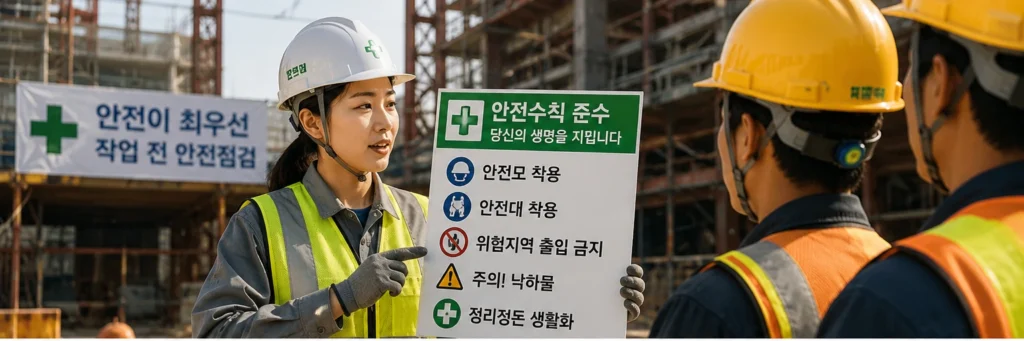
These phrases often appear on temporary boards, barricades, and verbal reminders. Because our image standard does not put readable text inside photos, practice the words here in the article and in the app. On the real site, always follow the official signs, the safety officer, and your employer’s instructions.
How to ask before a task feels unsafe
A beginner learner may want to say a long sentence, but short Korean is safer in a noisy place. Use 위험한가요? when you are unsure whether a step, path, cable, or object is safe. Use 잠깐 기다리세요 when someone is moving too quickly and you need a brief stop. These are not rude when spoken calmly and with body language that shows you are trying to follow the rule.
If you need more help, combine a Korean phrase with a gesture. Point to the area and ask 위험한가요?. Point to the walkway and ask 어디로 가면 돼요?. If you hear a command but miss the key word, say 다시 말해 주세요 immediately. The aim is not perfect grammar. The aim is clear, repeatable, safety-first communication.
Mini practice before you open the app
Practice the words in three passes. First, say only the Korean words: 안전모, 보호장비, 출입금지, 위험, 주의. Second, say the warning phrases: 낙하물 주의, 감전 주의, 미끄럼 주의. Third, say the action phrases: 안전모를 착용하세요, 여기 들어오지 마세요, 다시 말해 주세요, 어디로 가면 돼요, 위험한가요, 잠깐 기다리세요.
After that, imagine one short scene. You are walking toward an area, someone raises a hand and says 여기 들어오지 마세요. Your answer can be 네, 어디로 가면 돼요?. This is the whole lesson in one practical moment: understand the stop signal and ask for the safe path.
Safety phrase patterns you can reuse
Many construction-site warnings follow a simple pattern: a hazard word plus 주의. Once you understand that pattern, you can guess the function of new warnings even when you do not know every word. For example, 낙하물 주의 tells you that something may fall from above, 감전 주의 tells you electricity is the danger, and 미끄럼 주의 tells you the floor or path may be slippery. The second word, 주의, is the signal to slow down and check.
Polite instructions often end with -세요 or -지 마세요. The first pattern usually asks you to do something: 착용하세요, wear it; 가세요, go; 기다리세요, wait. The second pattern tells you not to do something: 들어오지 마세요, do not come in; 만지지 마세요, do not touch. You do not need to produce all of this grammar in an emergency, but recognizing the ending helps you understand whether the speaker wants action or a stop.
When you answer, keep your Korean short. A safe answer is not a speech. 네, 알겠습니다 means “Yes, I understand.” 다시 말해 주세요 asks for repetition. 천천히 말해 주세요 asks the person to speak slowly. 제가 어디로 가면 돼요? is a slightly fuller version of “Where should I go?” If you can remember only one route question, use the shorter 어디로 가면 돼요?.
Three realistic site scripts
Script one is the entry check. A supervisor points at your helmet and says 안전모를 착용하세요. You check the strap and answer 네, 착용하겠습니다. If you are missing another item, ask 어떤 보호장비요?. The key is to respond with action first, not with a long explanation.
Script two is the blocked walkway. You approach a temporary barrier and hear 여기 들어오지 마세요. Stop before the barrier. Say 네, 어디로 가면 돼요?. If the answer includes a direction word you do not know, repeat the part you understood and ask again: 오른쪽 통로요? 다시 말해 주세요. This keeps the conversation grounded in the safe route.
Script three is uncertainty before a task. You see wet ground near a cable, or you are asked to move an object but are not sure whether the area is active. Point to the object or area and ask 위험한가요?. If another person starts moving before you understand, say 잠깐 기다리세요. A short stop can prevent a bigger misunderstanding.
Review checklist
Before you finish this lesson, test yourself in order. First, cover the meanings and read the Korean out loud. Second, look at each Korean phrase and decide whether it means “wear,” “do not enter,” “danger,” “caution,” “repeat,” “route,” or “wait.” Third, make one sentence pair: the warning you hear and the answer you give. For example: 낙하물 주의 → 네, 어디로 가면 돼요?
In the BSKorean app, open the Workplace Korean lesson pack connected to this article and practice the approved words. The app practice helps with recognition, but your real-site habit should be even simpler: pause, look, ask, confirm, then move. That habit is the language goal of this article.
Final field practice: from sign to sentence
To make the lesson stick, connect each warning word to one action sentence. When you read 출입금지, say to yourself: “I stop and ask for the route.” The Korean answer is 네, 어디로 가면 돼요?. When you hear 안전모를 착용하세요, say: “I check my helmet and answer.” The Korean answer is 네, 착용하겠습니다. When you hear 잠깐 기다리세요, say: “I freeze my movement for a moment.” The language is short because the action must be quick.
You can also practice by roles. In role A, you are the worker who needs to confirm a path. In role B, you are the person giving a short safety instruction. Role B says 낙하물 주의하세요. Role A answers 네, 오른쪽 통로로 가면 돼요?. Role B says 여기 들어오지 마세요. Role A answers 네, 어디로 가면 돼요?. Repeat the same exchange with different hazards: electric shock, slippery floor, restricted entry, and protective equipment.
The safest beginner strategy is not to translate the whole site. Learn the few words that stop movement, the few words that ask for a route, and the few words that request repetition. Then use them every time you are unsure. This article gives you that small set. The Workplace Korean app practice lets you repeat it until the words are automatic, but the real success test is simple: you notice the warning before you move into the wrong place.
One-minute review for the workday
Before a shift, review the phrases in the order you will need them. First is equipment: 안전모, 보호장비, 착용하세요. Second is movement control: 출입금지, 여기 들어오지 마세요, 잠깐 기다리세요. Third is hazard recognition: 위험, 주의, 낙하물 주의, 감전 주의, 미끄럼 주의. Last is confirmation: 다시 말해 주세요 and 어디로 가면 돼요?. This order turns vocabulary into a practical safety routine.
If you teach this to another worker, do not start with grammar. Start with the action: wear, stop, avoid, repeat, ask. Then attach the Korean. A learner who remembers only those five actions can still respond better than a learner who memorizes many words but keeps walking when the site changes. The best Korean phrase on a construction site is the one that makes the next movement safer.
2. Key vocabulary
safety helmet
Beginnerdanger; hazard
Beginnercaution
Beginnercaution: falling objects; falling object hazard
Beginnercaution: electric shock
Beginner3. Essential phrases
Practice this lesson in the app
Review these words with multiple-choice questions and weak-Learn Korean.
Practice this lesson →
답글 남기기
Please sign in with Google to comment. Sign in with Google