Use this grocery store lesson first
Grocery store Korean helps you buy food without guessing. Start with 이거 얼마예요?, “how much is this?” Then learn 채소, 과일, 할인, 봉투, and 계산대.
| Shopping need | Korean | Meaning |
|---|---|---|
| Price | 이거 얼마예요? | How much is this? |
| Bag | 봉투 필요해요 | I need a bag. |
| Card | 카드로 계산할게요 | I will pay by card. |
| Receipt | 영수증 주세요 | Please give me a receipt. |
For packaged food, check the date and ask 유통기한이 언제예요?. Related shopping lessons: convenience store words and delivery app words.
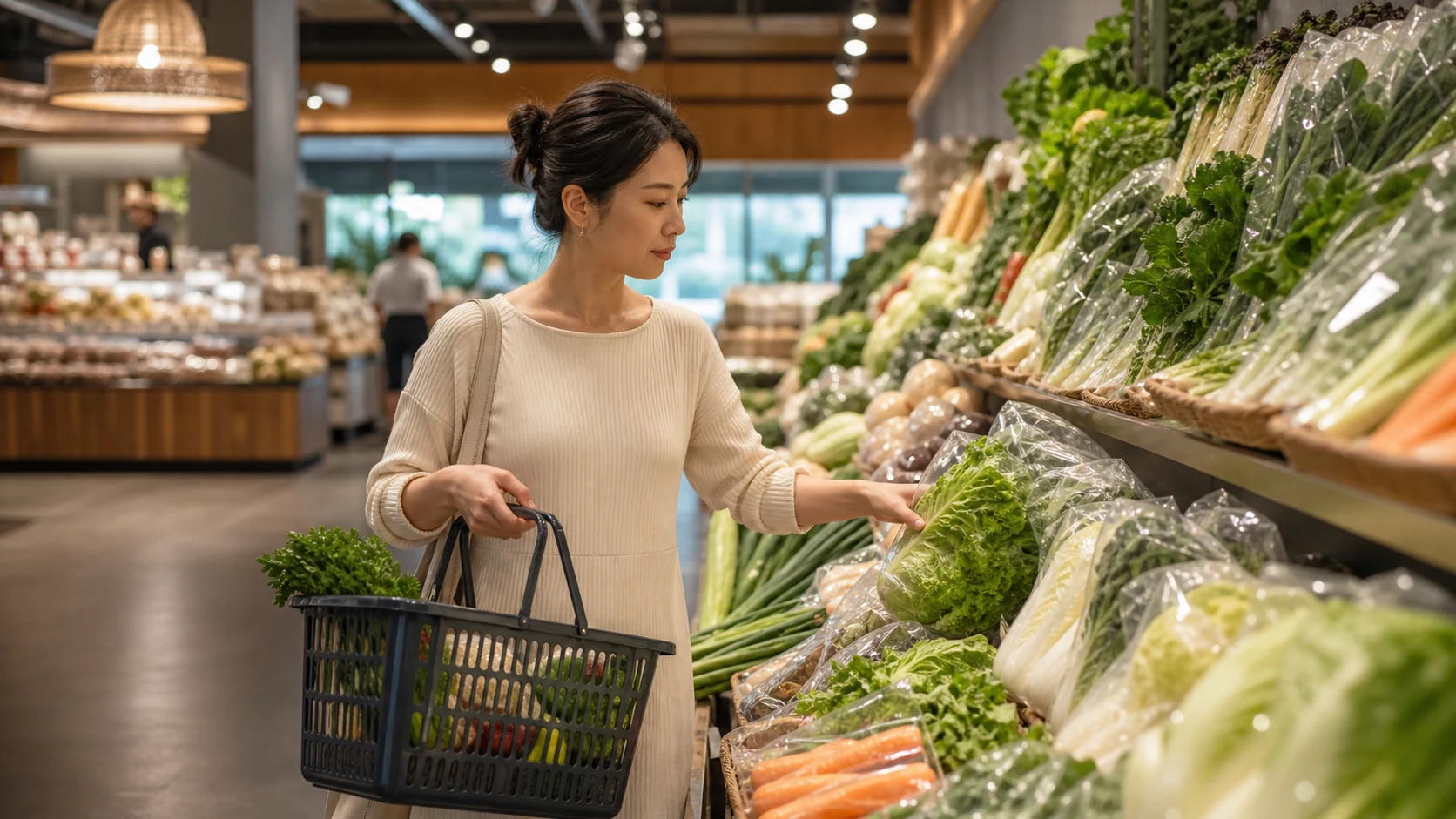
Grocery store words help you buy food, check dates, understand discounts, pay at the checkout counter, and ask for a bag or receipt in Korea. This lesson keeps the situation practical: you are in a mart, choosing everyday food, then speaking briefly at the cashier.
Quick Situation Brief
| Situation | Buying everyday groceries at a Korean supermarket or mart |
| Practice focus | Food sections, use-by dates, discounts, payment, bags, receipts, and refund questions |
| Study time | 10-15 minutes |
This is a language lesson, not store policy advice. Refund rules, discount conditions, card benefits, and food safety decisions should be confirmed with the store, product package, or service provider.
Core Grocery Store Words
| Korean | Romanization | Meaning | Level | Use |
|---|---|---|---|---|
| 마트 | mateu | supermarket; mart | BS1 | The place where you buy groceries. |
| 장바구니 | jangbaguni | shopping cart | BS2 | Use it while choosing items. |
| 채소 | chaeso | vegetables | BS1 | Fresh vegetables and packaged vegetables. |
| 과일 | gwail | fruit | BS1 | Fruit section or fruit packs. |
| 고기 | gogi | meat | BS1 | Meat packs, sliced meat, or butcher section. |
| 우유 | uyu | milk | BS1 | Milk in the refrigerator section. |
| 사용기한 | sayonggihan | use-by date; expiration date | BS3 | Check this before buying food. |
| 할인 | harin | discount | BS1 | Price reduction or promotion. |
| 카드 | kadeu | card | BS1 | Card payment at checkout. |
| 현금 | hyeongeum | cash | BS1 | Cash payment or change. |
| 계산대 | gyesandae | checkout counter | BS2 | Place where you pay. |
| 계산원 | gyesanwon | cashier | BS2 | Person who helps at checkout. |
| 영수증 | yeongsujeung | receipt | BS1 | Ask for it after paying. |
| 봉투 | bongtu | shopping bag; envelope | BS1 | At checkout, it usually means a shopping bag. |
| 환불 | hwanbul | refund | BS2 | Use when asking about a return or refund. |
How to Move Through the Store
- Start with the place: 마트 tells you the setting is a supermarket or mart.
- Choose food by section: 채소, 과일, 고기, and 우유 cover common grocery areas.
- Check timing before buying: 사용기한 helps you notice a use-by date or expiration date.
- Move to payment: 계산대, 계산원, 카드, and 현금 are checkout words.
- Finish the purchase: ask for 영수증 or 봉투, and use 환불 only when asking about a return or refund.
Array
| Korean sentence | Romanization | Meaning | When to use it |
|---|---|---|---|
| 채소는 어디에 있어요? | chaesoneun eodie isseoyo? | Where are the vegetables? | When you cannot find a section. |
| 이거 할인되나요? | igeo harin doenayo? | Is this discounted? | When checking a price or promotion. |
| 카드로 결제할게요. | kadeuro gyeoljehalgeyo. | I will pay by card. | At the checkout counter. |
| 영수증 주세요. | yeongsujeung juseyo. | Please give me a receipt. | After paying. |
| 봉투 하나 주세요. | bongtu hana juseyo. | Please give me one bag. | When you need a shopping bag. |
| 환불 가능해요? | hwanbul ganeunghaeyo? | Is a refund possible? | When asking a store question politely. |
Common Mistakes
- Do not read 봉투 only as an envelope. At checkout, it usually means a shopping bag.
- Do not assume 할인 always applies. Promotions can depend on a card, membership, date, or item count.
- Do not confuse 사용기한 with a general price label. It is about the date for safe or intended use.
- Use short cashier phrases. A full sentence is not always needed when the store is busy.
Short Practice Prompt
Practice aloud: choose three items, say one section word, one payment word, and one finishing phrase. Example: 채소, 카드, 영수증 주세요.
Practice More in BSKorean
Open the BSKorean practice app and review this grocery store word set. Keep the words together so the shopping situation feels like one conversation instead of separate flashcards.