Korean convenience store words help you understand checkout questions, payment options, bags, receipts, discounts, and quick service phrases in Korea. This briefing-style lesson focuses on words you hear at the counter.
Korean Convenience Store Words at Checkout
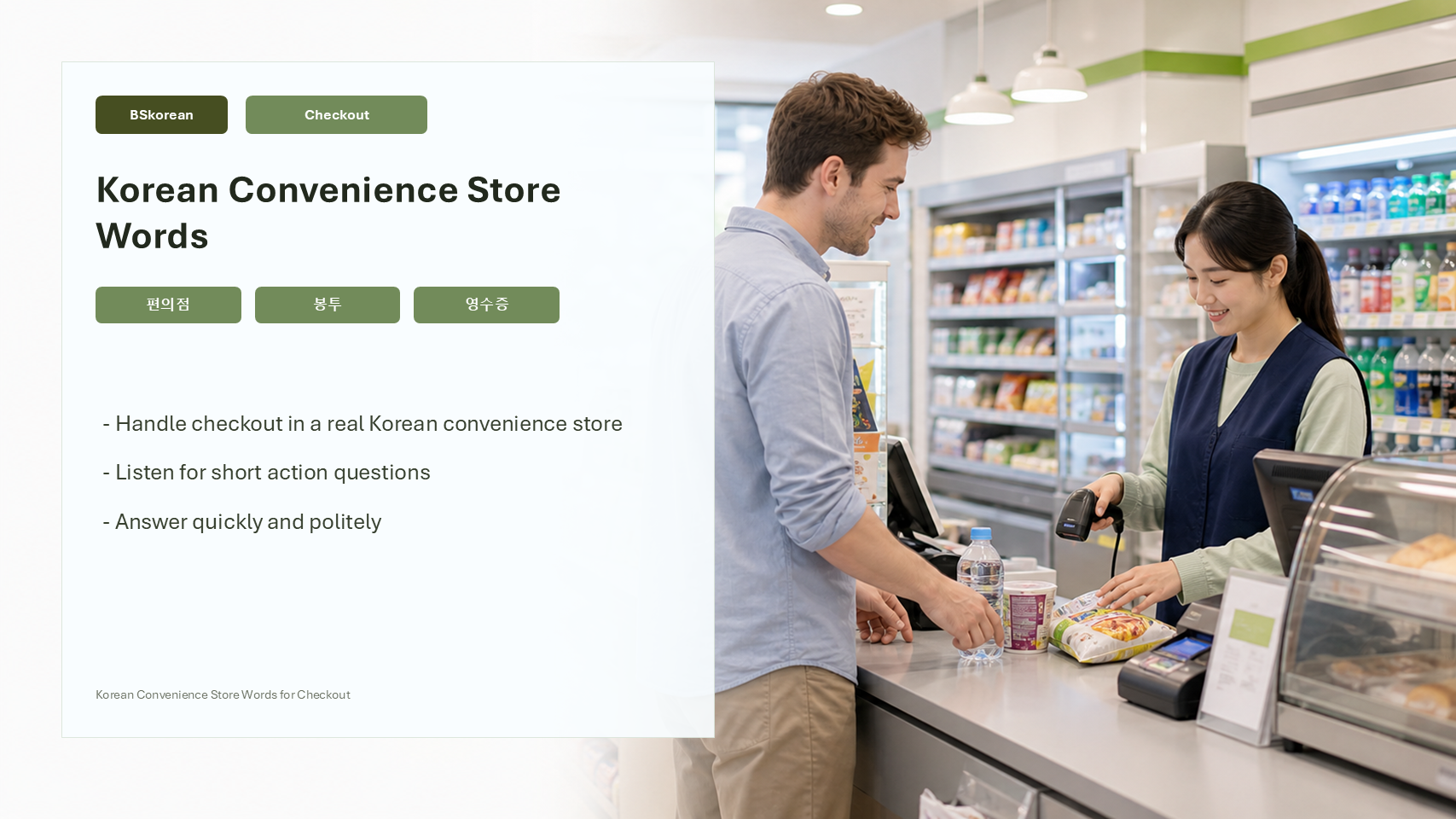
You put a lunch box, bottled water, and a small snack on the counter at a Korean convenience store. The cashier scans the items quickly and asks, 봉투 필요하세요? Another customer is already waiting behind you. You know this is a simple checkout, but the Korean comes fast.
This lesson helps you handle that exact moment. You will learn Korean convenience store words for checkout, bags, receipts, membership points, payment, microwave heating, disposable items, and transport card top-ups. The goal is not to memorize a long conversation. The goal is to recognize the action word and answer clearly.
Download the updated convenience store PPT briefing
Opening Situation
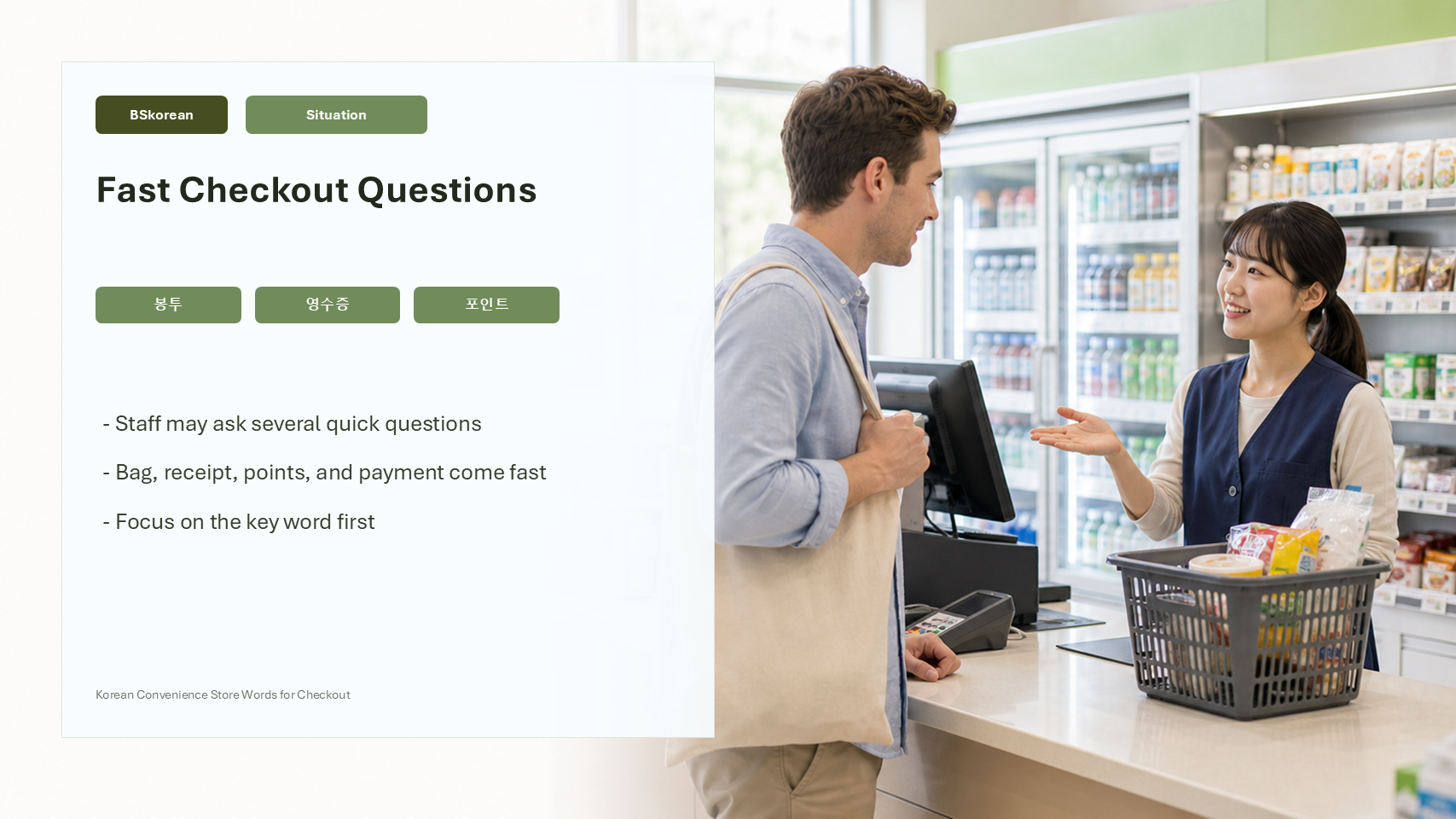
Korean convenience stores are useful for travelers, students, workers, and new residents. You can buy meals, drinks, umbrellas, chargers, medicine-like daily items, and sometimes top up a transport card. Many people also use the microwave area after buying a lunch box or instant food.
The language is usually short. A cashier may not say a full sentence every time. You might hear 봉투요?, 영수증은요?, or 포인트 있으세요? These are not grammar tests. They are checkout signals.
This matters even more if you work in a service job in Korea. Convenience store checkout language overlaps with cafe, restaurant, pharmacy, mart, and hotel front desk Korean. Words like 계산, 카드, 영수증, 포인트, and 할인 appear in many service situations. When you learn them as action words, you are not only learning one store. You are learning a small service counter system.
What You Need to Do
- Listen for the main checkout word: bag, receipt, points, payment, or heating.
- Answer with a short phrase such as 네, 주세요 or 아니요, 괜찮아요.
- Choose your payment method clearly.
- Ask for microwave heating or disposable items only if you need them.
- Use the same words again in cafes, pharmacies, small stores, and service counters.
Core Vocabulary Table
| Korean | Romanization | English | Level | Usage Note |
|---|---|---|---|---|
| 편의점 | pyeonuijeom | convenience store | Beginner 1 | The store itself. Use it for maps, signs, and directions. |
| 계산 | gyesan | checkout / payment | Beginner 2 | Used when paying or asking where to pay. |
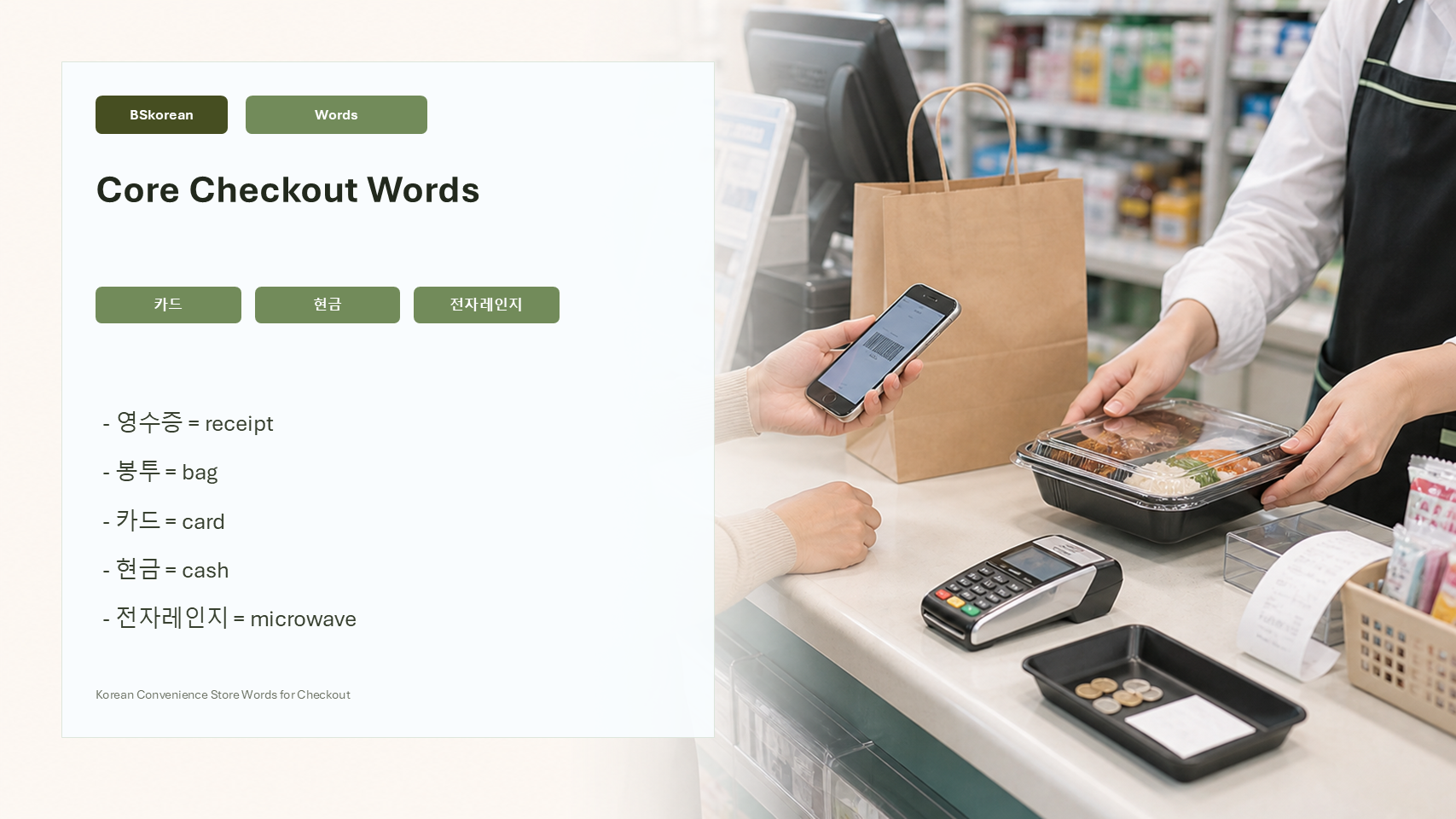
| 봉투 | bongtu | bag | Beginner 2 | A shopping bag. It may cost extra. |
| 영수증 | yeongsujeung | receipt | Beginner 2 | Proof of purchase. The cashier may ask if you need it. |
| 카드 | kadeu | card | Beginner 1 | Debit or credit card. Common payment method in Korea. |
| 현금 | hyeongeum | cash | Beginner 2 | Paper money or coins. |
| 포인트 | pointeu | points | Intermediate 1 | Membership or reward points. Not the same as payment. |
| 할인 | harin | discount | Intermediate 1 | Used in promotions, membership benefits, and signs. |
| 행사 상품 | haengsa sangpum | promotional item | Intermediate 2 | Often appears on shelf labels or 1+1 items. |
| 전자레인지 | jeonjareinji | microwave | Beginner 3 | Used for lunch boxes and instant food. |
| 데워 주세요 | dewo juseyo | please heat it | Beginner 3 | Useful when asking staff to heat food. |
| 일회용품 | ilhoe-yongpum | disposable items | Intermediate 2 | Spoons, chopsticks, forks, or straws. |
| 교통카드 | gyotongkadeu | transport card | Intermediate 1 | Transit card for buses and subways. |
| 충전 | chungjeon | top-up / recharge | Intermediate 1 | Used when adding money to a transport card. |
| 환불 | hwanbul | refund | Advanced 1 | More formal service word. Use when asking about returns. |
Action Signal Formula
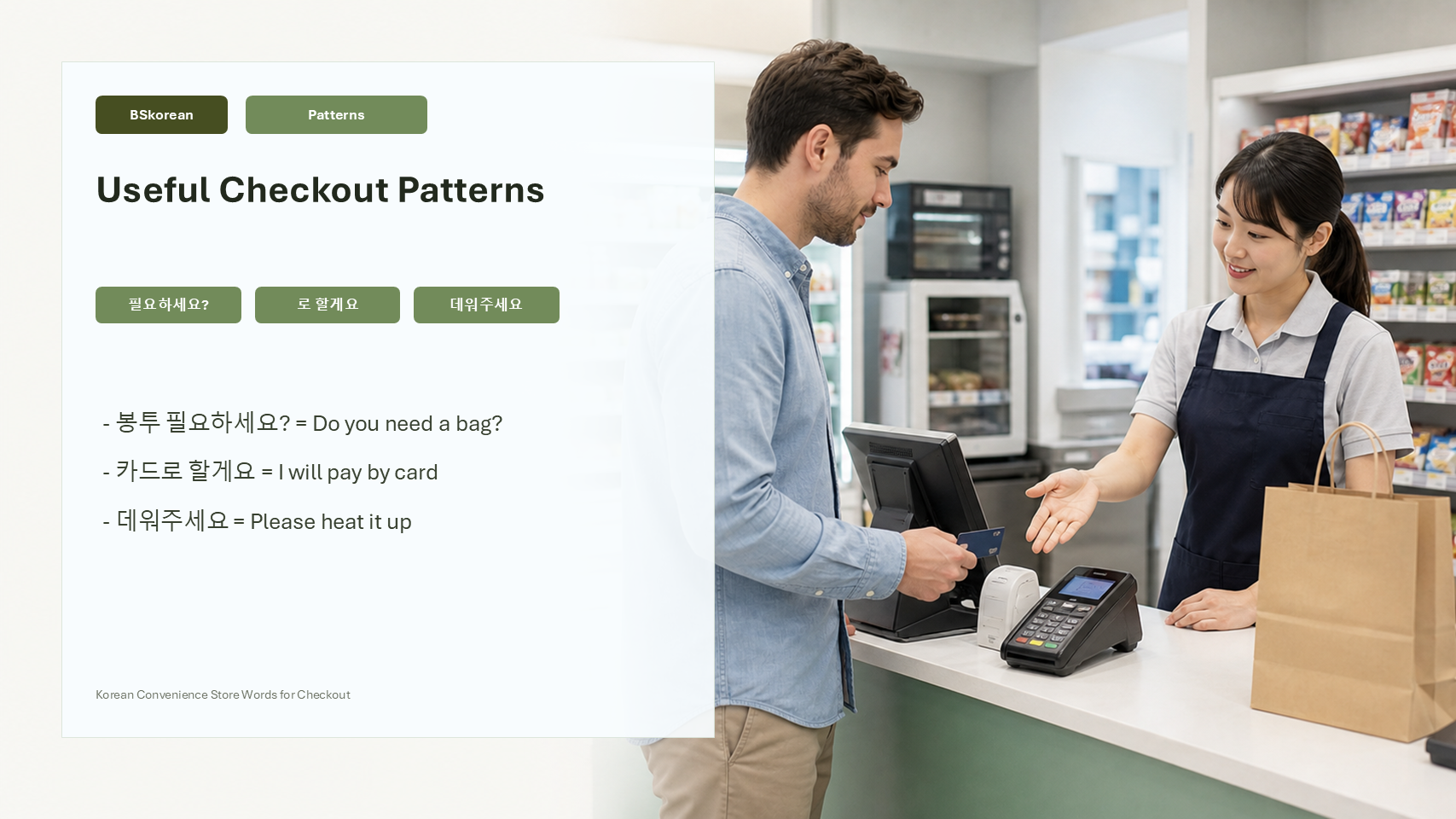
Convenience store Korean is easier when you treat each question as an action signal.
The important point is that the Korean word tells you what decision is being requested. If you hear 봉투, decide whether you need a bag. If you hear 영수증, decide whether you want a receipt. If you hear 포인트, decide whether you have membership points. You do not need to translate every ending while the line is moving.
| Pattern | Meaning | Example |
|---|---|---|
| N 필요하세요? | Do you need N? | 봉투 필요하세요? |
| N 드릴까요? | Shall I give you N? | 영수증 드릴까요? |
| N 있으세요? | Do you have N? | 포인트 있으세요? |
| N로 할게요 | I will use/pay with N | 카드로 할게요. |
| 이거 데워 주세요 | Please heat this up | 이거 데워 주세요. |
| Amount + 충전해 주세요 | Please top up this amount | 만원 충전해 주세요. |
Real-Life Dialogue
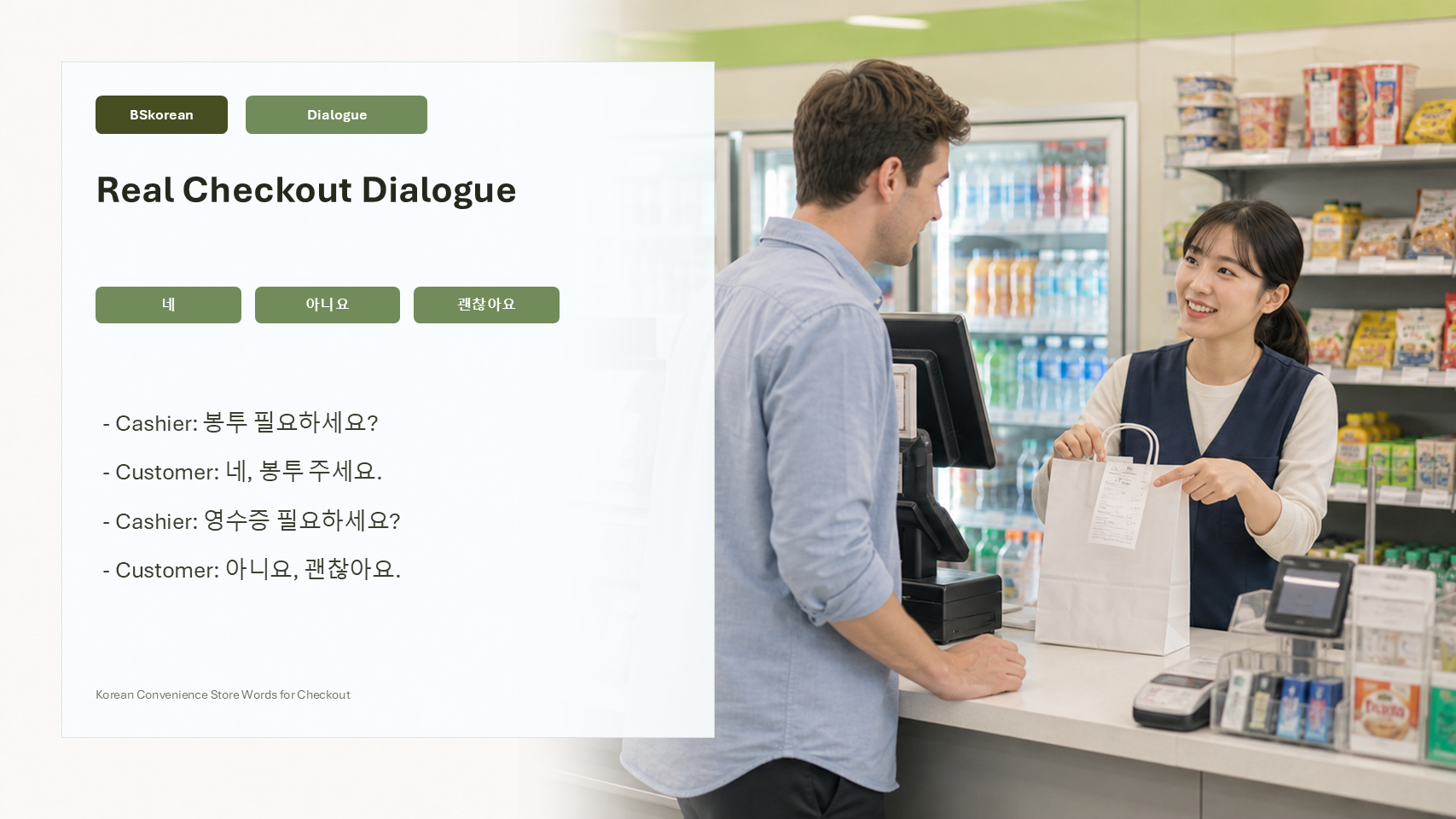
Dialogue 1: Bag, points, and payment
Cashier: 봉투 필요하세요?
Bongtu piryo haseyo?
Do you need a bag?
Customer: 네, 하나 주세요.
Ne, hana juseyo.
Yes, one please.
Cashier: 포인트 있으세요?
Pointeu isseuseyo?
Do you have membership points?
Customer: 아니요, 없어요. 카드로 할게요.
Aniyo, eopseoyo. Kadeuro halgeyo.
No, I do not. I will pay by card.
Dialogue 2: Lunch box and receipt
Customer: 이거 데워 주세요.
Igeo dewo juseyo.
Please heat this up.
Cashier: 네, 잠시만요.
Ne, jamsimanyo.
Yes, one moment.
Cashier: 영수증 드릴까요?
Yeongsujeung deurilkkayo?
Would you like a receipt?
Customer: 아니요, 괜찮아요.
Aniyo, gwaenchanayo.
No, that is okay.
These dialogues are short because real checkout Korean is short. You do not need to explain everything. You only need to answer the current decision.
Notice that the customer does not answer with long grammar. The customer uses short, polite phrases that fit the situation. This is natural in Korea because the counter is busy and the shared goal is simple: complete the payment, give the needed items, and move on. For beginners, this is good news. You can sound natural with a small number of reliable phrases.
Common Mistakes
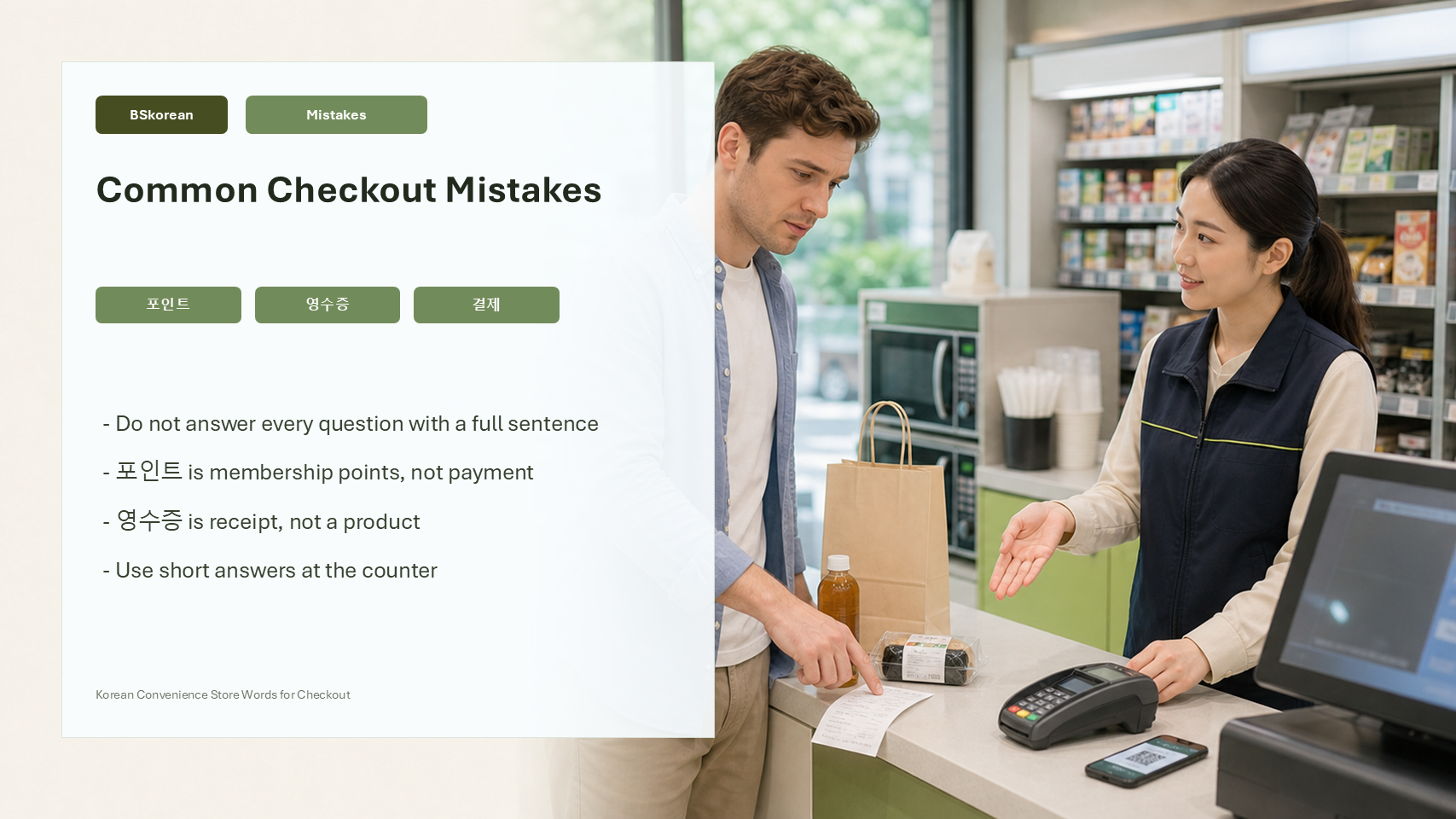
Common Mistake 1: Thinking 포인트 means payment
Why it happens: The word sounds like a payment system to many learners.
Correct understanding: 포인트 usually means membership or reward points. If you do not have them, say 포인트 없어요.
Common Mistake 2: Answering 봉투 필요하세요? with only 네
Why it happens: 네 means yes, so learners think it is enough.
Correct understanding: 네 can work, but 네, 하나 주세요 is clearer. It means “Yes, one please.”
Common Mistake 3: Waiting for staff to heat food automatically
Why it happens: In some countries, staff may prepare hot food automatically.
Correct understanding: If you bought a lunch box and want it heated, say 이거 데워 주세요. Some stores have a self-use microwave area.
Common Mistake 4: Using long sentences under pressure
Why it happens: Learners often try to make a complete textbook sentence.
Correct understanding: Short Korean is normal at checkout. 카드로 할게요, 영수증 괜찮아요, and 포인트 없어요 are natural.
Mini Quiz
- Question 1: What does 봉투 mean?
Answer: bag.
Explanation: The cashier may ask 봉투 필요하세요?, meaning “Do you need a bag?” - Question 2: You want to pay by card. What should you say?
Answer: 카드로 할게요.
Explanation: N로 할게요 is a natural pattern for choosing a payment method. - Question 3: What does 포인트 있으세요? ask?
Answer: Do you have membership points?
Explanation: It is not asking whether you will pay with points in every case. It often means membership points. - Question 4: You do not need a receipt. What can you say?
Answer: 아니요, 괜찮아요.
Explanation: This is a polite and short way to decline. - Question 5: How do you ask staff to heat a lunch box?
Answer: 이거 데워 주세요.
Explanation: 이거 means “this,” and 데워 주세요 means “please heat it.”
Review Table
| Korean | Meaning | Best Situation | Beginner Tip |
|---|---|---|---|
| 봉투 | bag | checkout | Answer with 네, 하나 주세요 if you need one. |
| 영수증 | receipt | after payment | Decline with 아니요, 괜찮아요. |
| 포인트 | membership points | cashier question | Say 포인트 없어요 if you do not have points. |
| 카드 | card | payment | Use 카드로 할게요. |
| 현금 | cash | payment | Use 현금으로 할게요. |
| 전자레인지 | microwave | food area | Look near lunch boxes or instant food. |
| 데워 주세요 | please heat it | lunch box purchase | Point to the food and say 이거. |
| 충전 | top-up | transport card service | Use amount + 충전해 주세요. |
Practice This Set
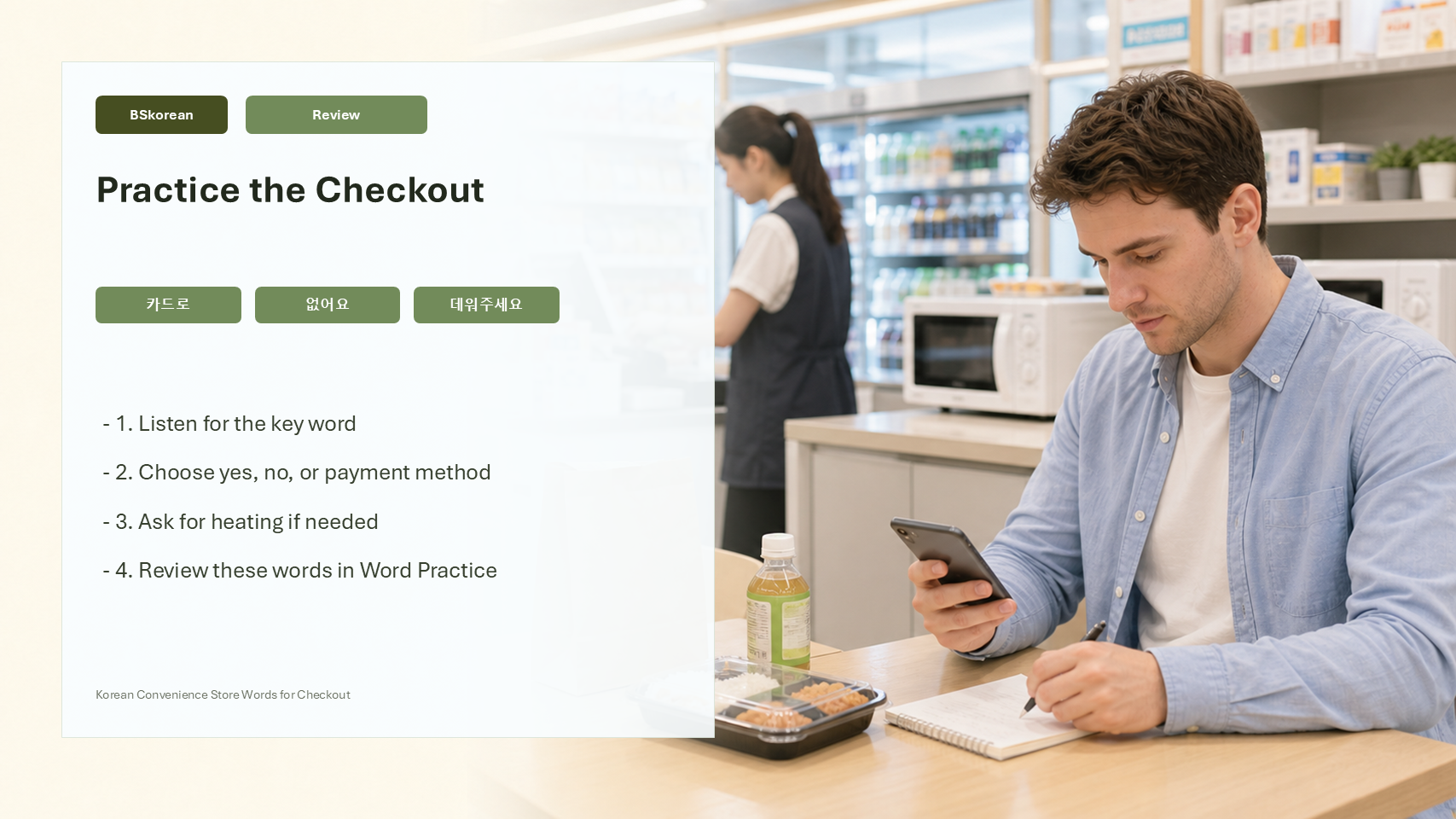
Practice this word list in Learn Korean or in the upcoming BS3001 app. Start with Korean to English recognition first. Then practice English to Korean so you can produce short answers at the counter.
A good practice order is simple. First, recognize the Korean word. Second, choose the English meaning. Third, say one short answer aloud. For example, when you see 영수증, think “receipt,” then practice 아니요, 괜찮아요. When you see 카드, think “card,” then practice 카드로 할게요. This connects vocabulary to real action.
Practice Convenience Store Words
For official Korea travel and daily-life context, check Visit Korea.
Related Lessons
- Korean Restaurant Order Words for Foreign Workers
- Korean Cafe Phrases: A Briefing-Style Lesson
- Korean ATM Words: A Briefing-Style Lesson
Conclusion
Korean convenience store checkout is not one long conversation. It is a series of small choices. Listen for words like 봉투, 영수증, 포인트, 카드, and 전자레인지. Then answer with a short phrase.
If you can say 네, 하나 주세요, 아니요, 괜찮아요, 카드로 할게요, and 이거 데워 주세요, you can handle most convenience store checkout situations in Korea with much less stress.
Practice This Lesson
Review words from this lesson with quiz cards and browser-based review history.