Briefing Summary
Korean ATM words are useful when you need to withdraw cash, check your balance, transfer money, or print a receipt in Korea. This lesson helps you read the most important ATM screen words before you press the final button.
Korean ATM Words You Should Read First
An ATM screen in Korea can feel stressful if you only recognize a few words. The screen may ask you to choose a service, enter a PIN, check a fee, or decide whether to print a receipt. You do not need to understand every long sentence. You need to recognize the function words first.
This briefing-style lesson focuses on the Korean words foreigners are most likely to see when using an ATM in Korea. The goal is simple: read the main action, avoid choosing the wrong menu, and confirm important details before pressing the final button.
| Best for | Main skill | Study time | Practice focus |
|---|---|---|---|
| Foreign residents, workers, students, and travelers in Korea | Reading common ATM screen words | 8-10 minutes | Withdrawal, deposit, balance, transfer, PIN, fee, receipt |
Slide 1. The Situation
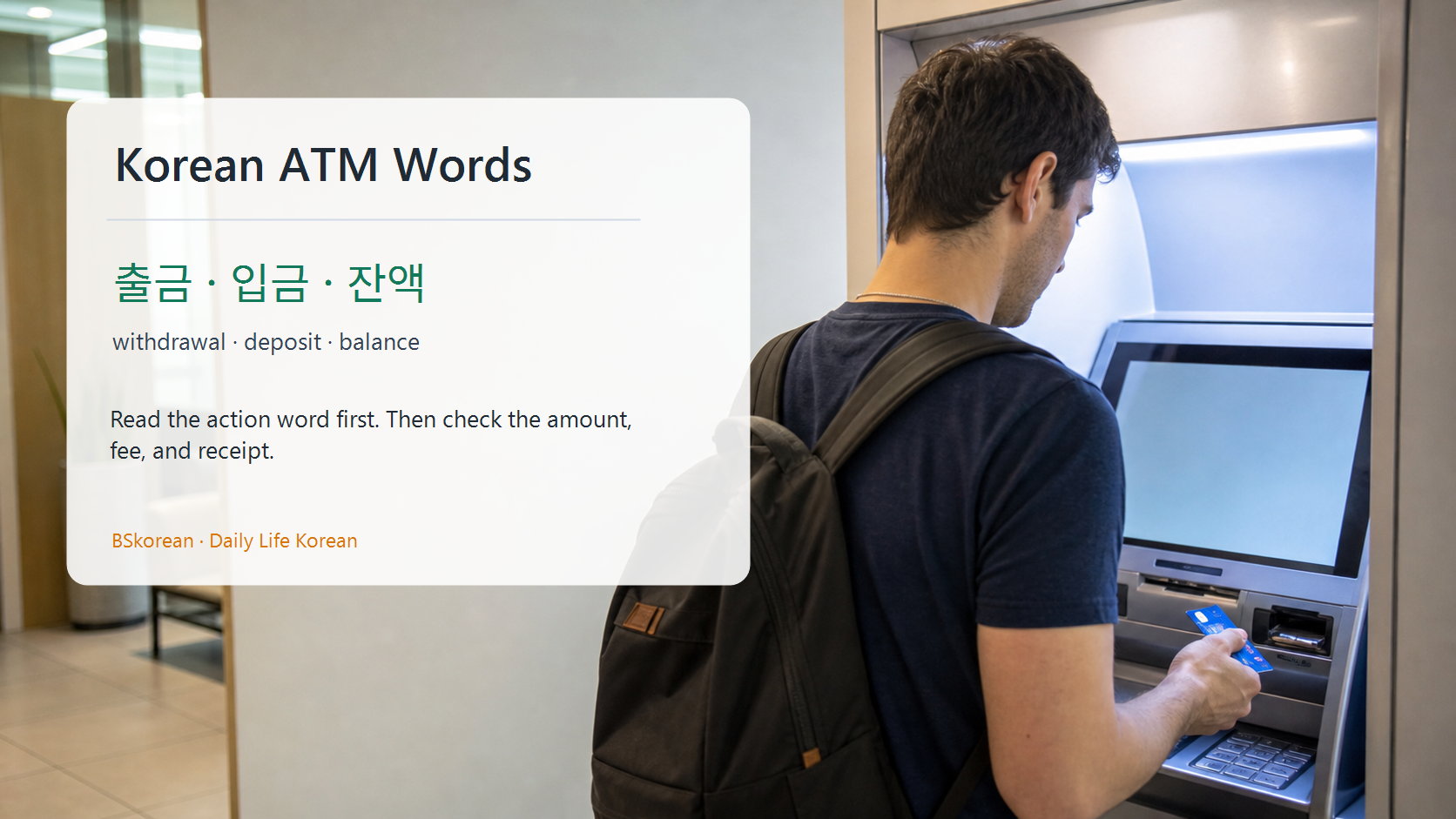
You are standing in front of an ATM in Korea. The machine shows several buttons, and the person behind you may be waiting. At this moment, speed is useful, but accuracy is more important.
Start by looking for the Korean words that tell you the action. Is the machine asking about taking money out, putting money in, checking your balance, sending money, entering your PIN, checking a fee, or printing a receipt?
The slide highlights three words you may see very early on an ATM screen: 출금, 입금, and 잔액. These are not full sentences. They are menu functions. Once you understand them, the screen becomes much easier to read.
Slide 2. Key ATM Words
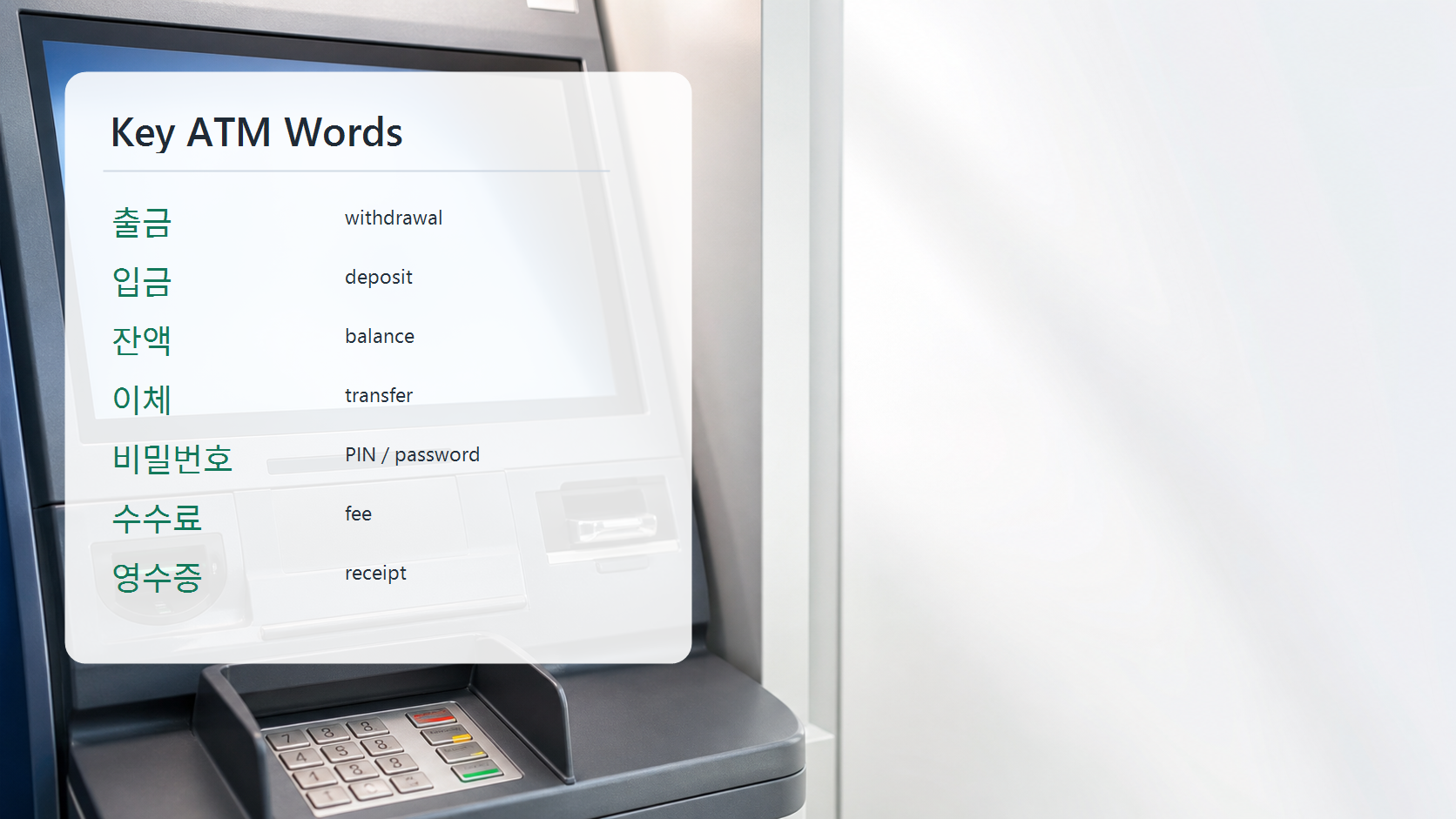
| Korean | Romanization | English | Usage |
|---|---|---|---|
| 출금 | chulgeum | withdrawal | Choose this when you want to take cash out of your account. |
| 입금 | ipgeum | deposit | Choose this when you want to put money into an account. |
| 잔액 | janaek | balance | Used when checking how much money remains in the account. |
| 이체 | iche | transfer | Used when sending money from one account to another. |
| 비밀번호 | bimilbeonho | PIN / password | Used when the machine asks you to enter your secret number. |
| 수수료 | susuryo | fee | Used when the machine shows an extra charge for the service. |
| 영수증 | yeongsujeung | receipt | Used when the machine asks whether to print a receipt. |
These seven words are enough to handle many simple ATM screens. They also appear in bank apps, payment screens, and customer service messages, so they are useful beyond the ATM.
Slide 3. Reading Formulas
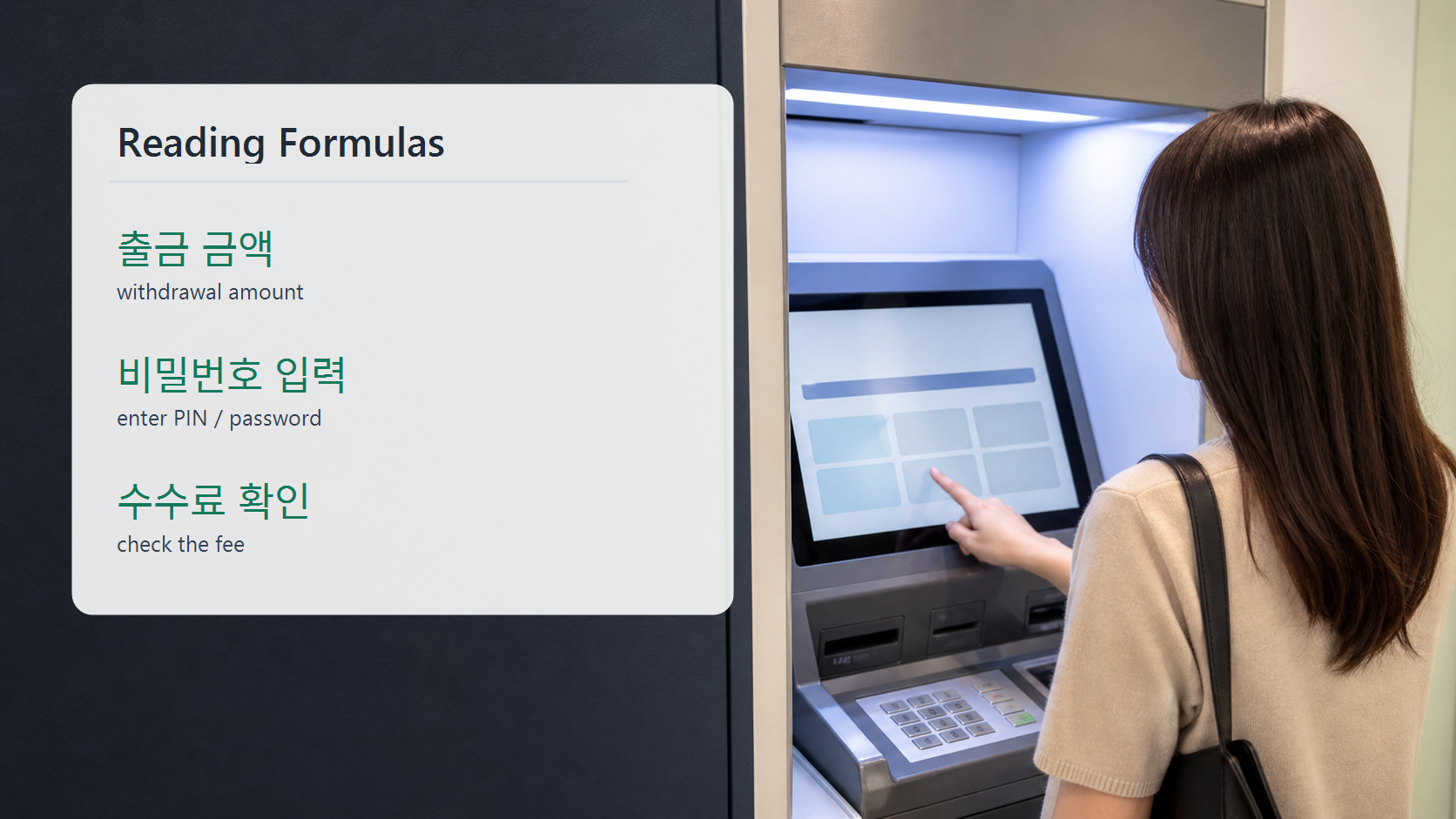
ATM Korean often appears as short labels, not long grammar sentences. Read the words like screen instructions.
Formula 1: Action word + amount
출금 금액
chulgeum geumaek
withdrawal amount
If you see 출금, the screen is about taking money out. If the next part shows an amount, check the number carefully before continuing.
Formula 2: 비밀번호 + 입력
비밀번호 입력
bimilbeonho ipnyeok
enter PIN / enter password
입력 means input or enter. When it appears with 비밀번호, the machine is asking you to enter your secret number. Do this privately and check the keypad before pressing the next button.
Formula 3: 수수료 + 확인
수수료 확인
susuryo hwagin
check the fee
수수료 is important because some ATMs charge extra depending on the bank, time, card, or service. If you see this word before the final confirmation, pause and check the amount.
Slide 4. Read an ATM Screen in 3 Steps
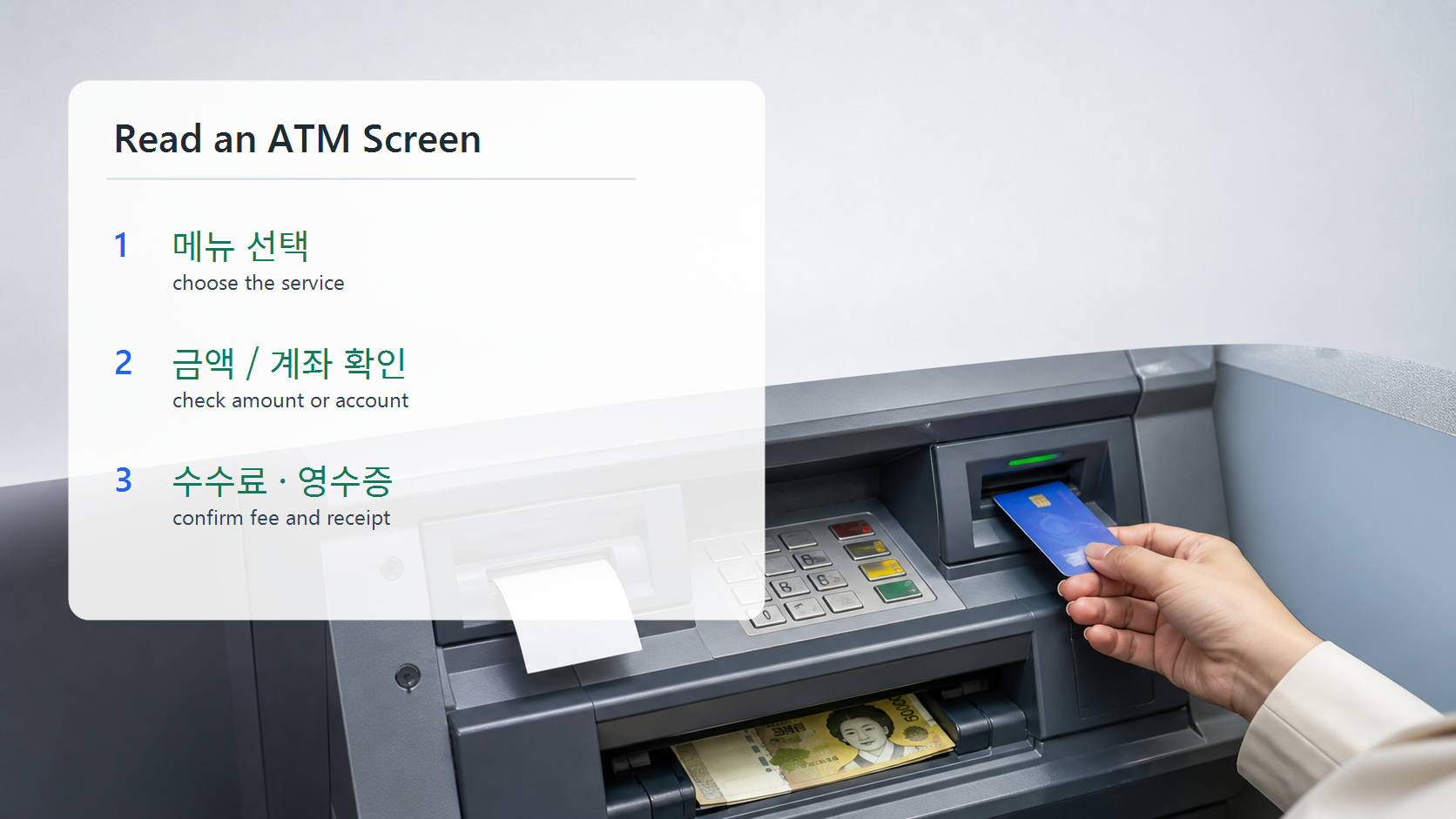
Step 1. Find the main action.
Look first for 출금, 입금, 잔액, or 이체. This tells you what kind of service you are using.
Step 2. Check the sensitive information.
If the screen asks for 비밀번호, enter it carefully. If you are transferring money, check the account details. If you are withdrawing cash, check the amount.
Step 3. Confirm the fee and receipt.
Before the final button, look for 수수료. After the transaction, the machine may ask about 영수증. If you need proof, choose the receipt option.
Example screen logic:
출금 선택 → 비밀번호 입력 → 출금 금액 확인 → 수수료 확인 → 영수증 출력
chulgeum seontaek → bimilbeonho ipnyeok → chulgeum geumaek hwagin → susuryo hwagin → yeongsujeung chullyeok
Choose withdrawal → enter PIN → check withdrawal amount → check fee → print receipt
Slide 5. Mistakes and Practice
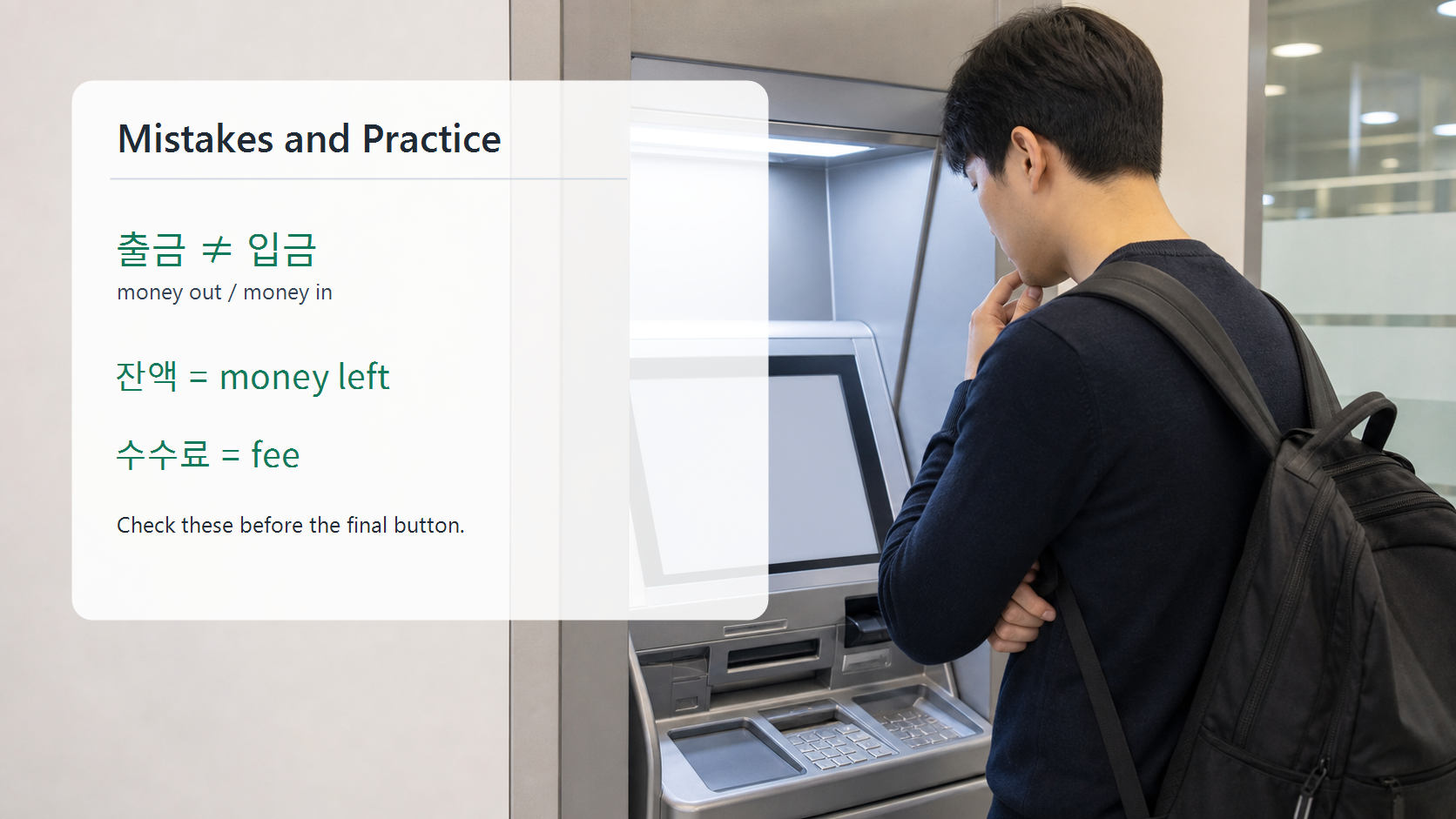
Mistake 1: Confusing 출금 and 입금
출금 means money comes out of your account. 입금 means money goes into an account. They look similar because both end with 금, which relates to money, but the direction is different.
Mistake 2: Thinking 잔액 means the amount you will receive
잔액 means balance, or money left in the account. It is not the cash amount the ATM will give you. If you want to take cash out, look for 출금 and then check the withdrawal amount.
Mistake 3: Ignoring 수수료
수수료 is a fee. It can appear near the final confirmation screen. If the fee is higher than expected, you may want to cancel and use another ATM or another payment method.
Practice
1. What does 출금 mean?
A. deposit / B. withdrawal / C. receipt
Answer: B. withdrawal. Choose this when you want cash from your account.
2. Which word should you look for when checking money left in your account?
Answer: 잔액. It means balance.
3. What does 비밀번호 입력 mean?
Answer: Enter PIN or enter password. The machine is asking for your secret number.
4. You see 수수료 before the final confirmation. What should you do?
Answer: Check the fee before continuing.
5. Which word is useful if you need proof of the transaction?
Answer: 영수증. It means receipt.
Mini Review Table
| Korean | Meaning | Where You See It | Quick Tip |
|---|---|---|---|
| 출금 | withdrawal | Main ATM menu | Cash comes out. |
| 입금 | deposit | Main ATM menu | Money goes in. |
| 잔액 | balance | Account check screen | Money left in the account. |
| 이체 | transfer | Banking menu | Send money to another account. |
| 비밀번호 | PIN / password | Security screen | Enter privately. |
| 수수료 | fee | Confirmation screen | Check before confirming. |
| 영수증 | receipt | Final screen or receipt slot | Choose it if you need proof. |
Final Takeaway
When you use an ATM in Korea, do not try to translate the whole screen first. Find the function word. 출금 is withdrawal, 입금 is deposit, 잔액 is balance, and 이체 is transfer. Then check 비밀번호, 수수료, and 영수증 before you finish.
You can review these words in Korean Learn Korean. They are also useful for future app-based practice because each word connects to a real action on a screen.
For official Korea travel and daily-life context, check Visit Korea.