Korean pharmacy words are useful when you need cold medicine, explain symptoms, ask about dosage, or understand simple instructions from a pharmacist in Korea. This lesson keeps the language practical for real pharmacy visits.
Korean Pharmacy Words for Cold Medicine
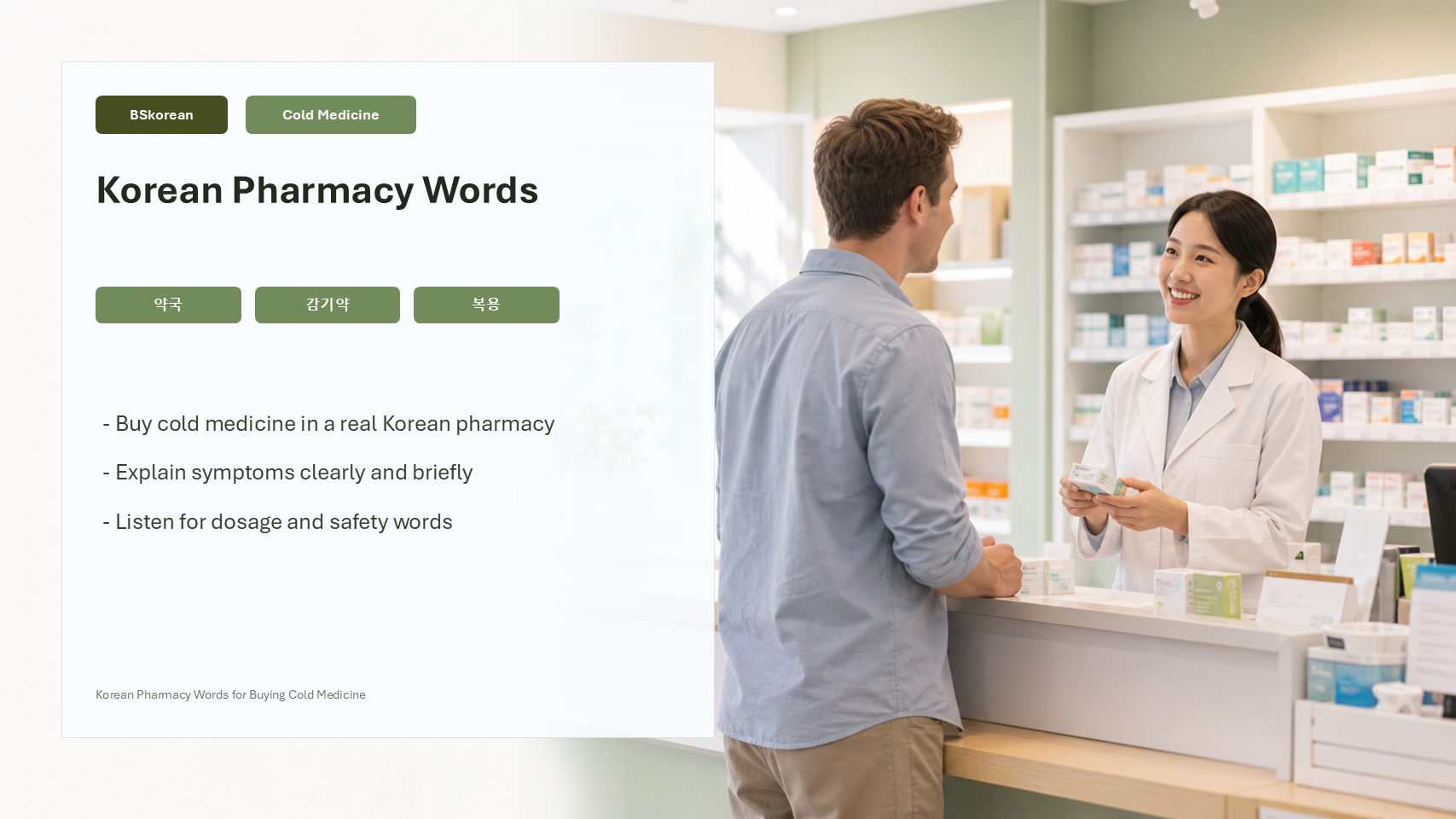
You walk into a Korean pharmacy after work. Your throat hurts, your nose is running, and you still need to get through tomorrow morning. The pharmacist asks, 어디가 불편하세요? You know they are asking what is wrong, but you do not know how to explain your symptoms in simple Korean.
This lesson helps you handle that exact moment. You will learn Korean pharmacy words for cold medicine, symptoms, dosage, drowsiness, allergies, and basic safety questions. The goal is not to replace medical advice. The goal is to help you say the important things clearly and understand the most common instructions at a Korean pharmacy.
Download the updated pharmacy PPT briefing
Opening Situation
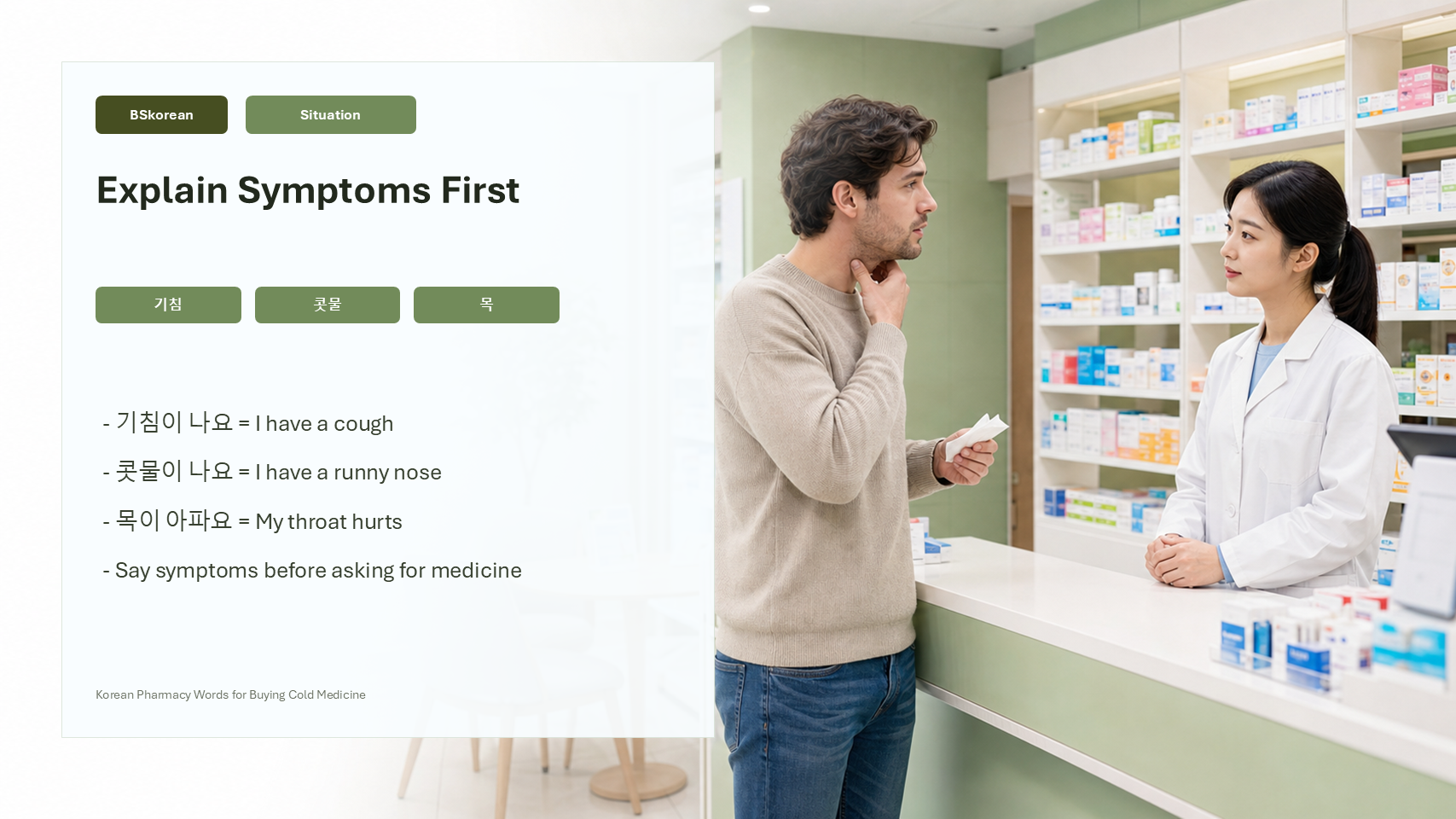
In Korea, many people visit a pharmacy, or 약국 (yakguk), when they have mild cold symptoms. You may not need a long conversation. Most pharmacy visits are short. The pharmacist needs to know your main symptom, whether you have allergies, and whether you want medicine that will not make you too sleepy.
A useful beginner sentence is 감기약 주세요 (gamgiyak juseyo), which means “Please give me cold medicine.” But this sentence is often too general. If you can add one or two symptoms, the pharmacist can guide you better.
What You Need to Do
- Say the main problem: cough, runny nose, fever, sore throat, or body aches.
- Ask for cold medicine in a polite and simple way.
- Check how many times a day you should take it.
- Ask whether it may cause drowsiness if you need to work, drive, or study.
- Mention allergies, other medicine, pregnancy, or a serious condition when relevant.
Core Vocabulary Table
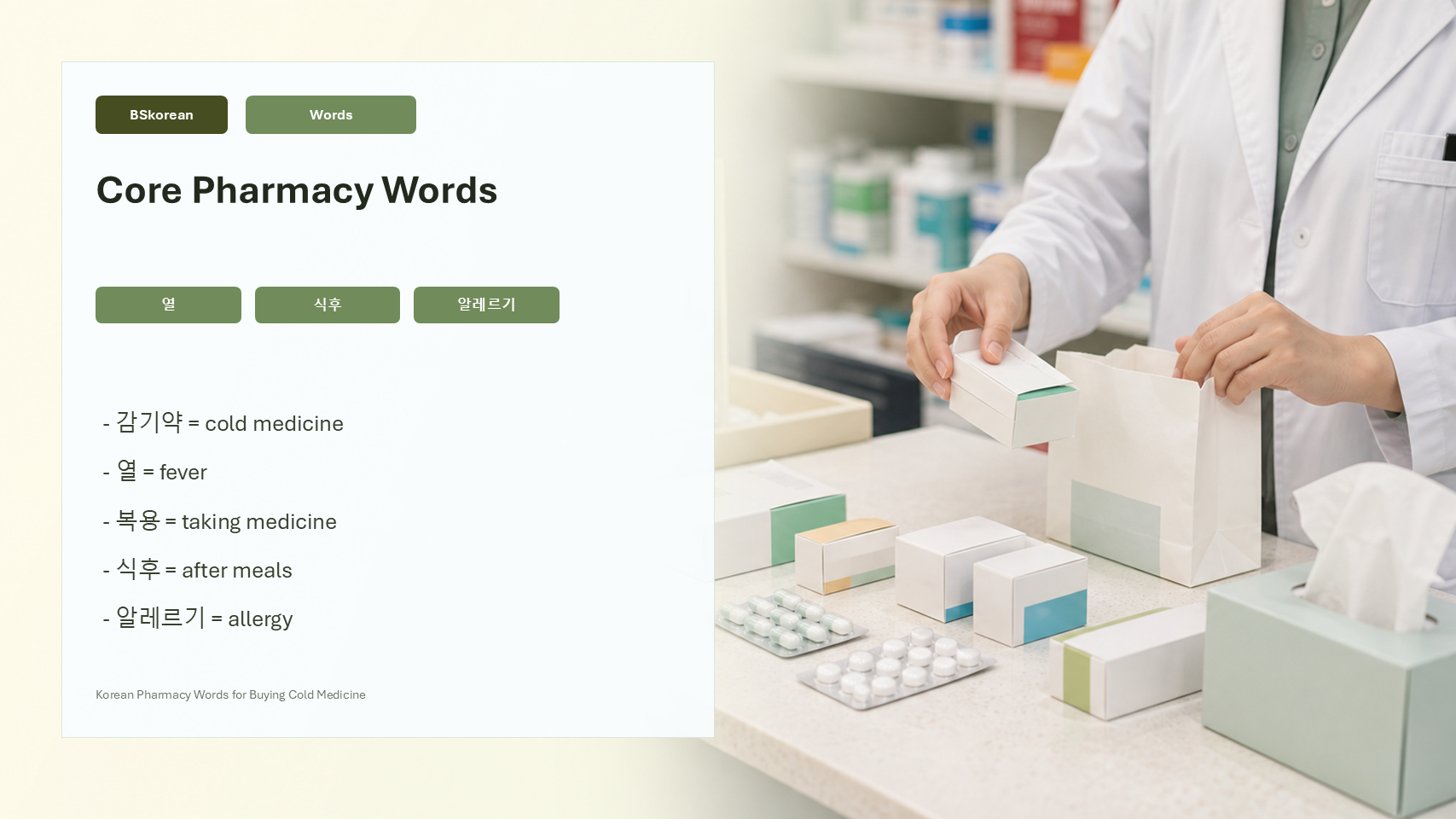
| Korean | Romanization | English | Level | Usage Note |
|---|---|---|---|---|
| 약국 | yakguk | pharmacy | Beginner 1 | The place where you buy medicine or ask a pharmacist. |
| 감기약 | gamgiyak | cold medicine | Beginner 2 | Use this when asking for medicine for cold symptoms. |
| 기침 | gichim | cough | Beginner 2 | A common symptom word. You can say 기침이 나요. |
| 콧물 | konmul | runny nose | Beginner 2 | Often used together with 코가 막혀요, meaning stuffy nose. |
| 목이 아파요 | mogi apayo | my throat hurts | Beginner 2 | A full phrase that is easy to use at the counter. |
| 열 | yeol | fever | Beginner 2 | You can say 열이 있어요, meaning I have a fever. |
| 몸살 | momsal | body aches | Intermediate 1 | Used when your whole body aches from a cold or fatigue. |
| 두통 | dutong | headache | Intermediate 1 | A symptom word used in pharmacies and clinics. |
| 복용 | bogyong | taking medicine | Intermediate 2 | Common on medicine labels and instructions. |
| 식후 | sikhu | after meals | Intermediate 1 | Important dosage word. 식후 30분 means 30 minutes after a meal. |
| 하루 세 번 | haru se beon | three times a day | Intermediate 1 | A common medicine instruction. |
| 졸릴 수 있어요 | jollil su isseoyo | it may make you sleepy | Intermediate 2 | Important if you must work, drive, or study. |
| 알레르기 | allereugi | allergy | Intermediate 1 | Tell the pharmacist if you have an allergy. |
| 처방전 | cheobangjeon | prescription | Intermediate 2 | Some medicine requires a doctor’s prescription. |
| 부작용 | bujagyong | side effect | Advanced 1 | A formal word for an unwanted medicine effect. |
Action Signal Formula
At a Korean pharmacy, do not try to make a long medical speech. Use a short formula.
| Formula | Meaning | Example |
|---|---|---|
| Symptom + 있어요 | I have a symptom | 열이 있어요. |
| Symptom + 나요 | A symptom is happening | 기침이 나요. |
| Body part + 아파요 | A body part hurts | 목이 아파요. |
| N 주세요 | Please give me N | 감기약 주세요. |
| N 없나요? | Do you have one without N? | 졸림 없는 약 없나요? |
For example, 기침이 나고 목이 아파요. 감기약 주세요. means “I have a cough and my throat hurts. Please give me cold medicine.” This is short, polite, and clear.
Real-Life Dialogue

Dialogue 1: Asking for cold medicine
Pharmacist: 어디가 불편하세요?
Eodiga bulpyeonhaseyo?
What feels uncomfortable?
Customer: 기침이 나고 목이 아파요.
Gichimi nago mogi apayo.
I have a cough and my throat hurts.
Pharmacist: 열은 있으세요?
Yeoreun isseuseyo?
Do you have a fever?
Customer: 열은 없어요. 감기약 주세요.
Yeoreun eopseoyo. Gamgiyak juseyo.
I do not have a fever. Please give me cold medicine.
This dialogue shows a natural pharmacy pattern. The pharmacist asks about symptoms, and the customer answers with only the most important details.
Dialogue 2: Checking drowsiness and dosage
Customer: 이 약 졸리나요?
I yak jollinayo?
Does this medicine make you sleepy?
Pharmacist: 조금 졸릴 수 있어요.
Jogeum jollil su isseoyo.
It may make you a little sleepy.
Customer: 하루에 몇 번 먹어요?
Harue myeot beon meogeoyo?
How many times a day should I take it?
Pharmacist: 하루 세 번, 식후에 드세요.
Haru se beon, sikhu-e deuseyo.
Take it three times a day, after meals.
The word 먹어요 literally means “eat,” but Korean speakers often use it naturally for taking medicine. Pharmacists may also use the more formal word 드세요, meaning “please take.”
Common Mistakes
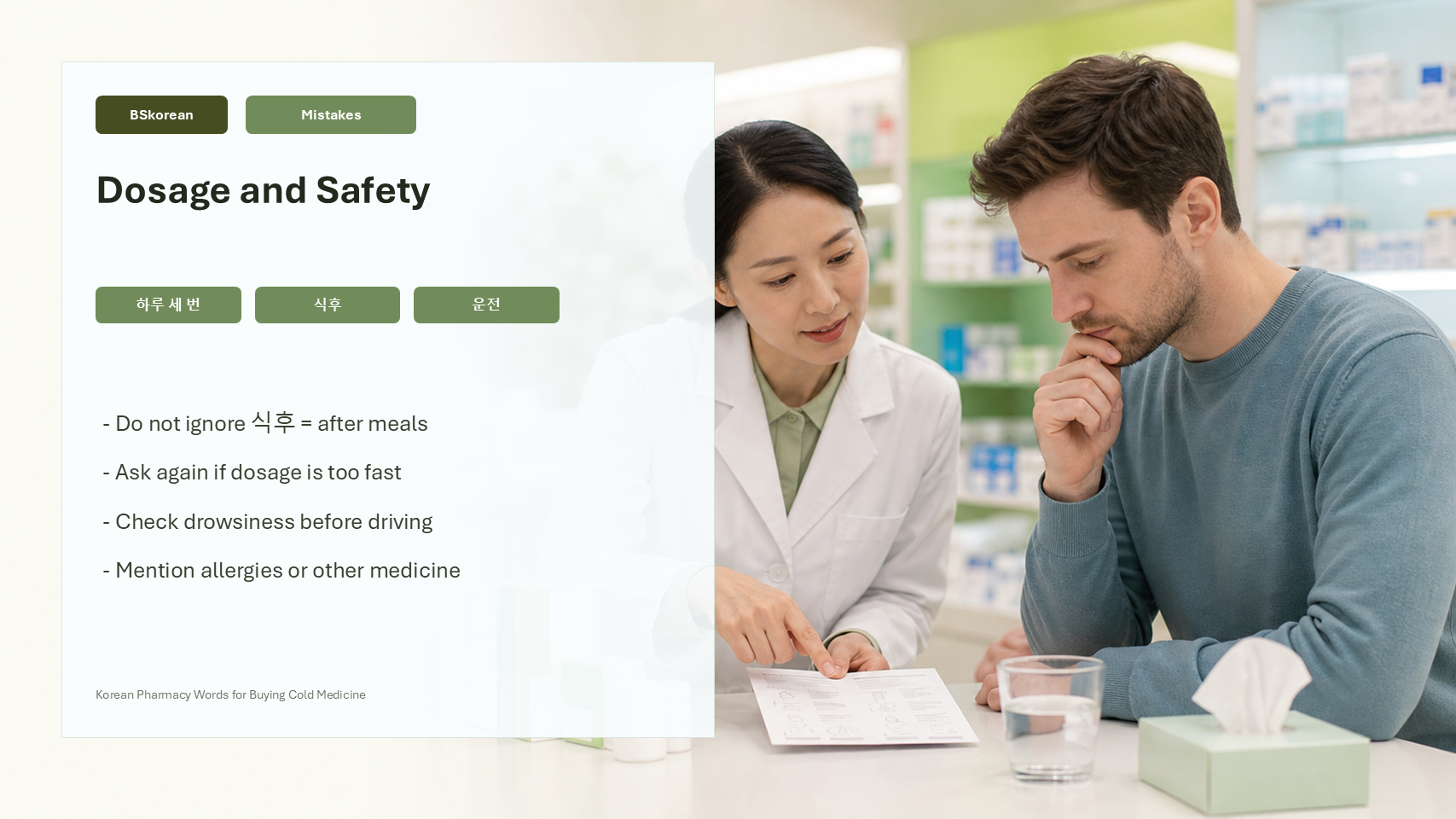
Common Mistake 1: Saying only “감기약 주세요”
Why it happens: Beginners often learn one useful sentence and use it for every cold situation.
Correct understanding: 감기약 주세요 is useful, but symptoms matter. Add one or two words such as 기침, 콧물, 열, or 목이 아파요.
Better example: 기침이 나고 콧물이 나요. 감기약 주세요.
Common Mistake 2: Ignoring 졸릴 수 있어요
Why it happens: Learners may focus only on the medicine name and miss the warning.
Correct understanding: 졸릴 수 있어요 means the medicine may make you sleepy. This matters before driving, operating equipment, studying, or working a long shift.
Useful question: 이 약 졸리나요?
Common Mistake 3: Confusing 식전 and 식후
Why it happens: Both words are short and often appear on labels.
Correct understanding: 식전 means before meals. 식후 means after meals. Most cold medicine instructions at pharmacies may include 식후, but you should check the label or ask.
Useful question: 식전에 먹어요, 식후에 먹어요?
Common Mistake 4: Not mentioning allergies or other medicine
Why it happens: Some learners think a pharmacy visit is too short to mention medical details.
Correct understanding: If you have allergies, take other medicine, are pregnant, or have a serious condition, say it clearly or use a translation app. A short phrase such as 알레르기가 있어요 is important.
Mini Quiz
- Question 1: What does 약국 mean?
Answer: pharmacy.
Explanation: 약국 is the place where you buy medicine and speak with a pharmacist. - Question 2: You have a sore throat. Which phrase is best?
A. 목이 아파요. B. 처방전 있어요. C. 하루 세 번.
Answer: A.
Explanation: 목이 아파요 means “My throat hurts.” - Question 3: What does 하루 세 번 mean?
Answer: three times a day.
Explanation: 하루 means one day, 세 means three, and 번 means times. - Question 4: What should you ask if you need to avoid sleepy medicine?
Answer: 이 약 졸리나요?
Explanation: This asks whether the medicine may cause drowsiness. - Question 5: What is the difference between 식전 and 식후?
Answer: 식전 means before meals, and 식후 means after meals.
Explanation: These are important dosage timing words.
Review Table
| Korean | Meaning | Best Situation | Beginner Tip |
|---|---|---|---|
| 감기약 | cold medicine | asking for medicine | Add your symptom if possible. |
| 기침 | cough | explaining symptoms | Say 기침이 나요. |
| 콧물 | runny nose | explaining symptoms | Often appears with cold symptoms. |
| 열 | fever | checking severity | Say 열이 있어요 or 열은 없어요. |
| 식후 | after meals | dosage instructions | Check if the medicine is taken after meals. |
| 하루 세 번 | three times a day | dosage frequency | Look for the number before 번. |
| 졸릴 수 있어요 | may cause drowsiness | safety warning | Ask before work or driving. |
| 알레르기 | allergy | safety information | Mention it before buying medicine. |
Practice This Set
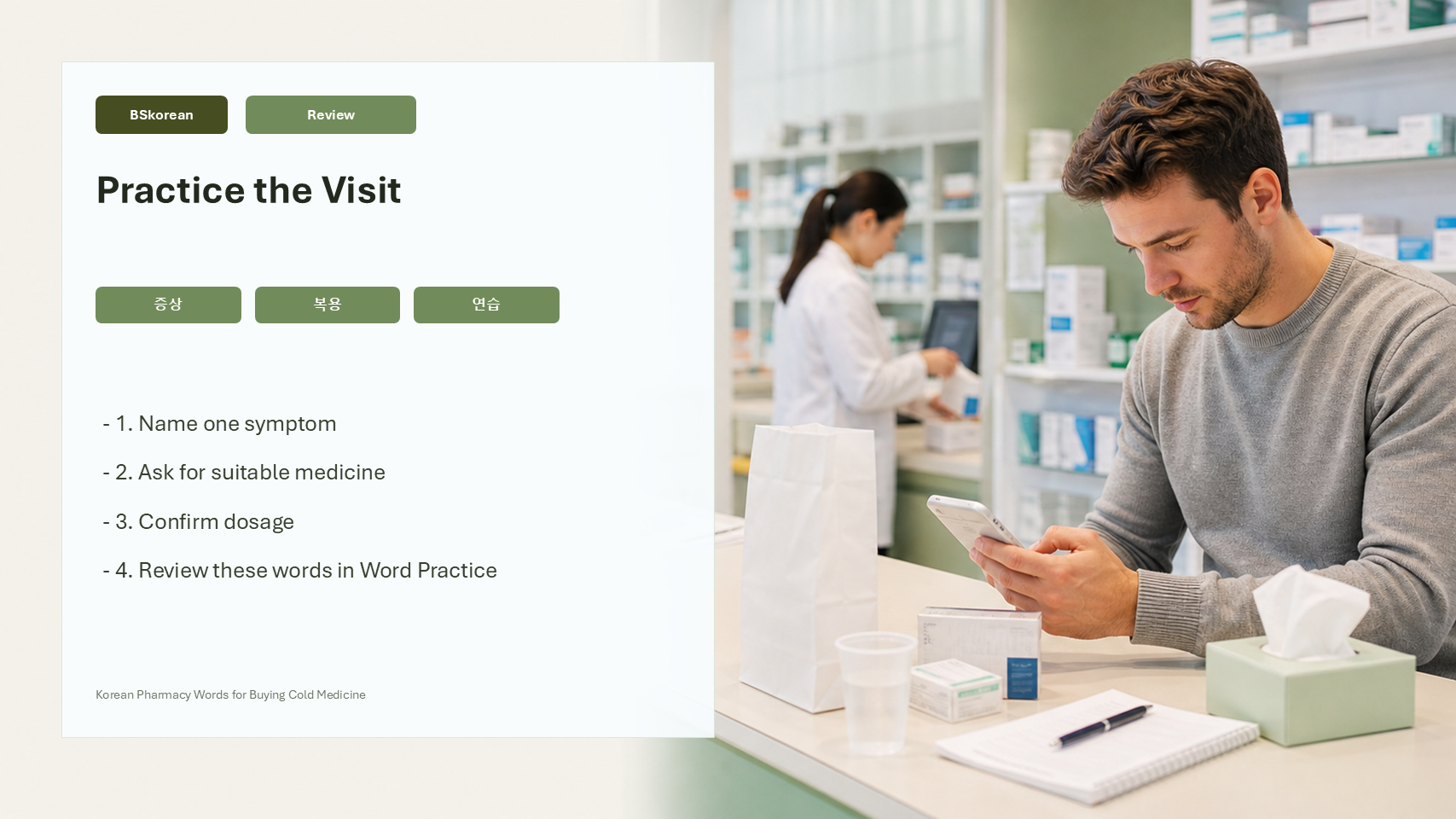
Practice this word list in Learn Korean or in the upcoming BS3001 app. Use the quiz mode to review Korean pharmacy words until you can recognize the Korean word first and choose the English meaning quickly.
Practice Korean Pharmacy Words
For official medicine and safety information in Korea, check the English site of the Ministry of Food and Drug Safety.
Related Lessons
- Korean Convenience Store Words for Checkout
- Korean Cafe Phrases: A Briefing-Style Lesson
- Korean ATM Words: A Briefing-Style Lesson
Conclusion
A Korean pharmacy visit becomes easier when you focus on three things: your symptom, the medicine request, and the dosage instruction. Start with short phrases like 기침이 나요, 목이 아파요, and 감기약 주세요. Then check words such as 식후, 하루 세 번, and 졸릴 수 있어요.
These Korean pharmacy words are practical for daily life, but they are also useful for workers, students, and travelers who need to solve a small health problem in Korea without a long conversation.
Practice This Lesson
Review words from this lesson with quiz cards and browser-based review history.