Korean construction safety words help foreign workers understand basic safety instructions, warning signs, and supervisor directions on a Korean construction site. This lesson focuses on words that can prevent confusion in real work situations.
Korean Construction Safety Words to Read First
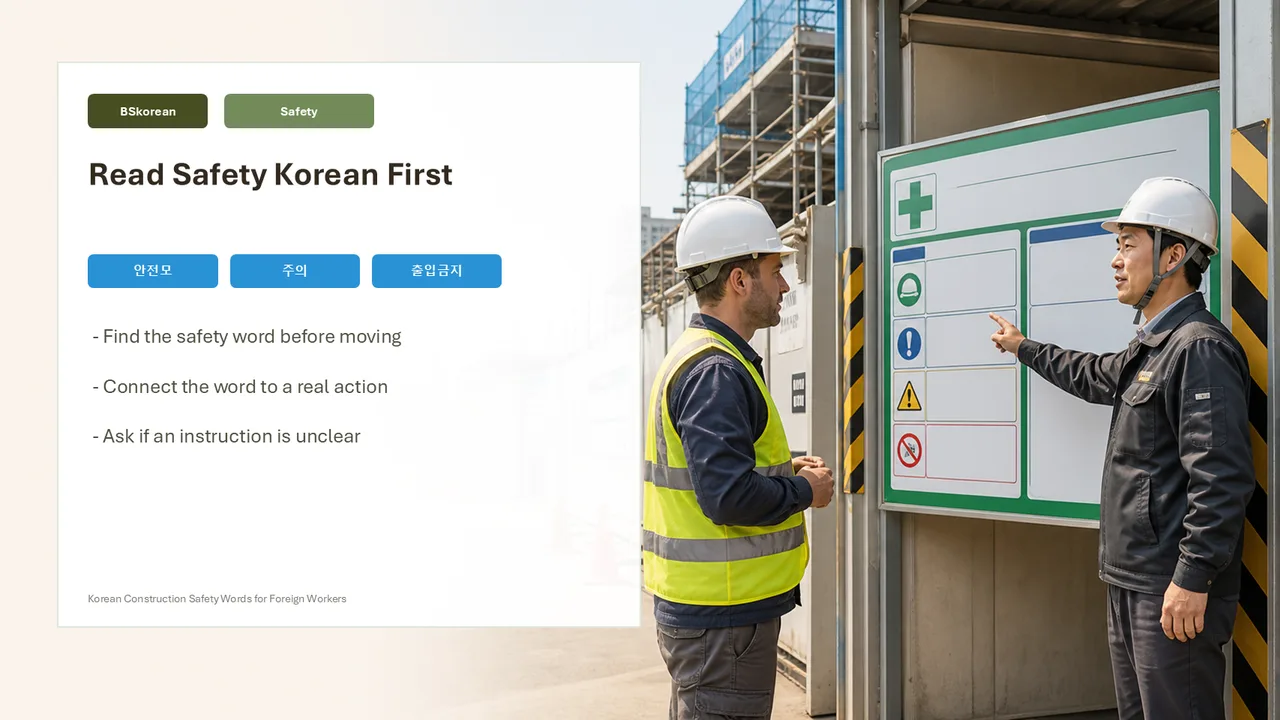
You arrive at a Korean construction site for your first shift. Before you start working, a supervisor points to the safety board and says short instructions like 안전모 쓰세요, 조심하세요, and 출입금지.
These are not long grammar lessons. They are safety actions. If you understand the main word quickly, you can know whether to wear something, stop, avoid an area, organize tools, or ask for confirmation.
This lesson is based on the BSkorean word database and focuses on practical Korean construction safety words that foreign workers may see or hear on a real site.
Download the updated image-based PPT for this lesson
Key Vocabulary
| Korean | Romanization | English | Level |
|---|---|---|---|
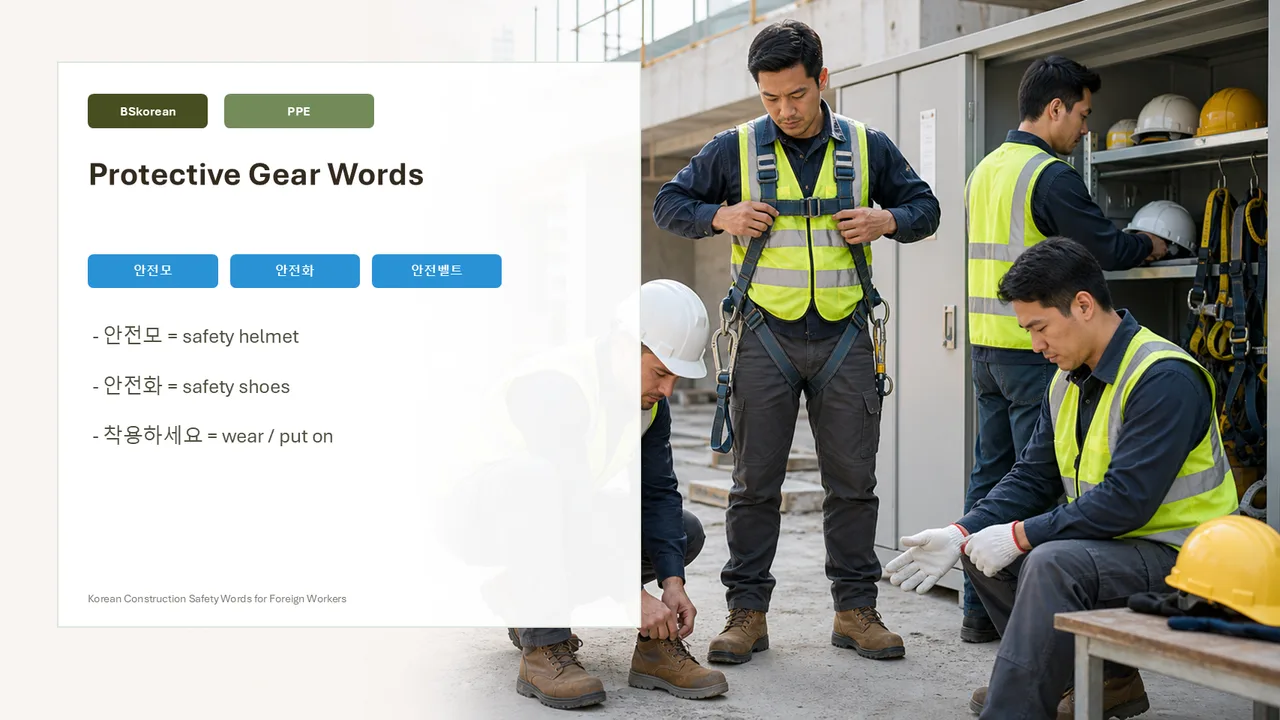
| 안전모 | anjeonmo | safety helmet | Intermediate 1 |
| 안전화 | anjeonhwa | safety shoes | Intermediate 1 |
| 안전벨트 | anjeonbelteu | safety belt | Intermediate 1 |
| 착용 | chagyong | wearing / putting on | Intermediate 1 |
| 조심하세요 | josimhaseyo | be careful | Beginner 3 |
| 멈추세요 | meomchuseyo | stop | Beginner 3 |
| 들어오지 마세요 | deureooji maseyo | do not come in | Beginner 3 |
| 출입금지 | churipgeumji | no entry | Intermediate 1 |
| 위험 | wiheom | danger | Intermediate 1 |
| 주의 | juui | caution | Intermediate 1 |
| 작업중 | jageopjung | work in progress | Beginner 3 |
| 낙하물 주의 | nakhamul juui | falling objects caution | Intermediate 1 |
| 자재 | jajae | materials | Beginner 3 |
| 공구 | gonggu | tools | Beginner 3 |
| 비계 | bigye | scaffolding | Beginner 3 |
Real Workplace Phrases
| Korean Sentence | English Meaning | When to Use |
|---|---|---|
| 안전모 쓰세요. | Put on your safety helmet. | Before entering or working on site |
| 안전화 착용하세요. | Wear safety shoes. | When PPE is required |
| 잠깐 멈추세요. | Stop for a moment. | When movement or work must pause |
| 뒤에 조심하세요. | Watch behind you. | When equipment or people are moving nearby |
| 여기 들어오지 마세요. | Do not come in here. | For restricted areas |
| 공구 정리하세요. | Organize the tools. | At the end of work or before inspection |
Usage Notes
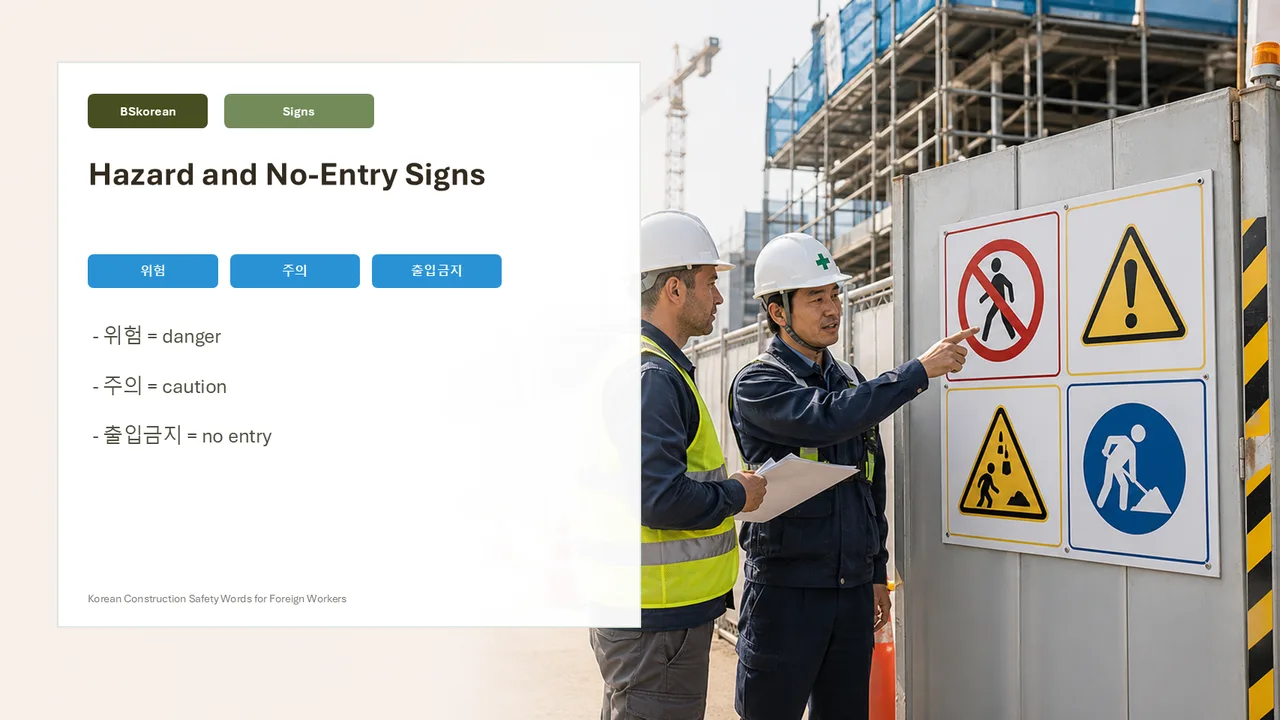
안전모, 안전화, and 안전벨트 are protective gear words. On a construction site, these words are often followed by 쓰세요, 하세요, or 착용하세요. The exact verb may change, but the action is usually the same: put on the required gear before work.
출입금지 is stronger than a simple warning. It means you should not enter the area. It may appear near temporary fences, machine zones, elevator shafts, demolition areas, or unfinished spaces. If you are not sure whether you can enter, ask your supervisor before moving.
주의 and 위험 are common on warning signs. 주의 means caution. It tells you to pay attention. 위험 means danger. It usually means the risk is more serious, so you should stop and check the situation before acting.
작업중 means work in progress. It does not always mean the area is forbidden, but it means something is actively happening. Machines, tools, materials, or workers may be moving nearby.
How to Read Safety Signs
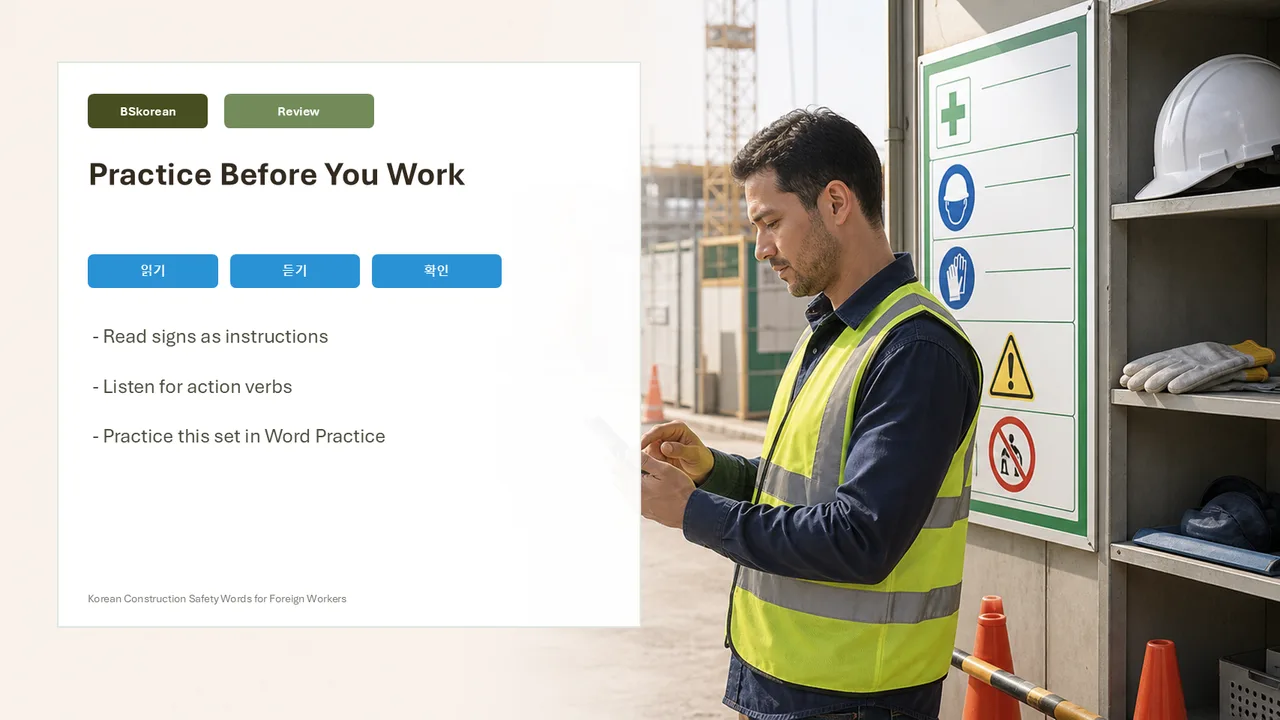
When you see a Korean safety sign, do not try to translate every word first. Read it as an action signal.
| Step | What to Check | Example |
|---|---|---|
| 1 | Find the main word | 출입금지 |
| 2 | Connect it to an action | Do not enter |
| 3 | Check the place or object | 현장, 구역, 비계, 자재 |
| 4 | Ask if unclear | 여기 들어가도 돼요? |
Tools and Materials
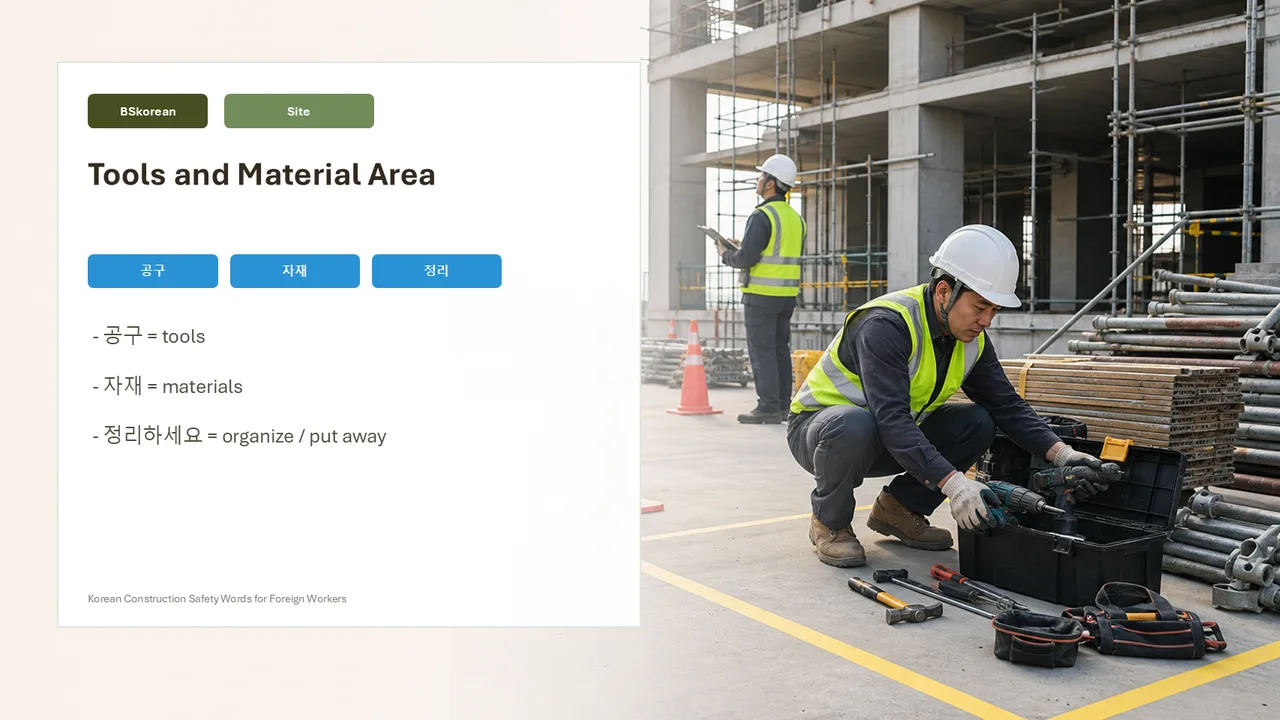
Construction Korean is not only about danger signs. Workers also hear words for tools, materials, and site organization. 공구 means tools. 자재 means materials. 비계 means scaffolding.
If a supervisor says 공구 정리하세요, the main action is 정리하세요, which means organize or put things in order. If the supervisor says 자재는 여기 두세요, the important word is 자재, and the action is to place the materials here.
Mini Dialogue
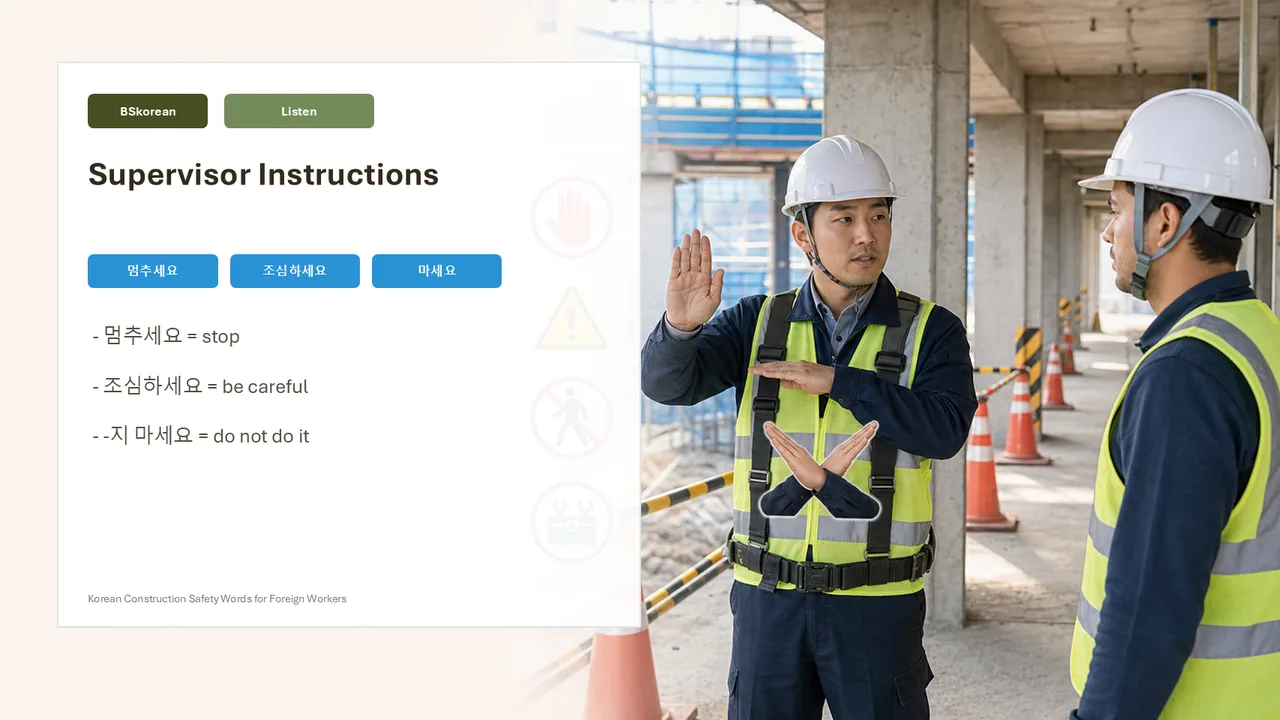
Supervisor: 안전모 쓰세요.
Put on your safety helmet.
Worker: 네, 알겠습니다.
Yes, I understand.
Supervisor: 저쪽은 출입금지 구역입니다.
That area is a no-entry zone.
Worker: 여기로 가면 돼요?
Should I go this way?
Supervisor: 네. 그리고 뒤에 조심하세요.
Yes. And watch behind you.
This dialogue is short, but it shows the real pattern. The supervisor gives a safety instruction. The worker answers simply and asks for confirmation. On a real site, asking a short question is better than guessing.
Quick Quiz
- What does 안전모 mean?
Answer: safety helmet. It is protective gear for your head. - What should you do if you see 출입금지?
Answer: do not enter. Ask first if you are not sure. - Which word means caution?
Answer: 주의. - What does 공구 정리하세요 mean?
Answer: organize the tools. - You hear 잠깐 멈추세요. What is the action?
Answer: stop for a moment.
Review Table
| Korean | Meaning | Best Situation | Beginner Tip |
|---|---|---|---|
| 안전모 | safety helmet | Before entering the site | Listen for 쓰세요 or 착용하세요 |
| 출입금지 | no entry | Restricted area | Do not enter first |
| 주의 | caution | Warning sign | Slow down and check |
| 위험 | danger | High-risk area | Stop and ask if unsure |
| 공구 | tools | Tool area | Often used with 정리하세요 |
| 자재 | materials | Material storage area | Often used with 두세요 |
For official workplace safety and employment information in Korea, check the English site of the Ministry of Employment and Labor.
Related Lessons
- Korean Factory Inspection Words for Foreign Workers
- Korean Workplace Problem Report Phrases for Foreign Workers
- Korean Agriculture Words for Foreign Farm Workers
Practice More
Practice this word list in Learn Korean or in the upcoming BSkorean app. Start with words such as 안전모, 주의, 위험, and 출입금지. These words are short, but they can change what you should do immediately on a real construction site.
Conclusion
Korean construction safety words are easiest to learn as action signals. First, find the main word. Then connect it to the action: wear, stop, avoid, organize, or ask. This habit helps you understand Korean safety signs and supervisor instructions faster and more safely.
Practice This Lesson
Review words from this lesson with quiz cards and browser-based review history.
Practice these Korean words in the BSKorean app
After reading this lesson, continue with the BSKorean practical Korean app guide or open the BSKorean practice app to review words by level and real-life situation.