Korean workplace problem report phrases help foreign workers explain a problem quickly when something is broken, delayed, dangerous, missing, or unclear. This lesson focuses on calm, practical reporting language used at work in Korea.
Korean Workplace Problem Report Phrases to Use Clearly
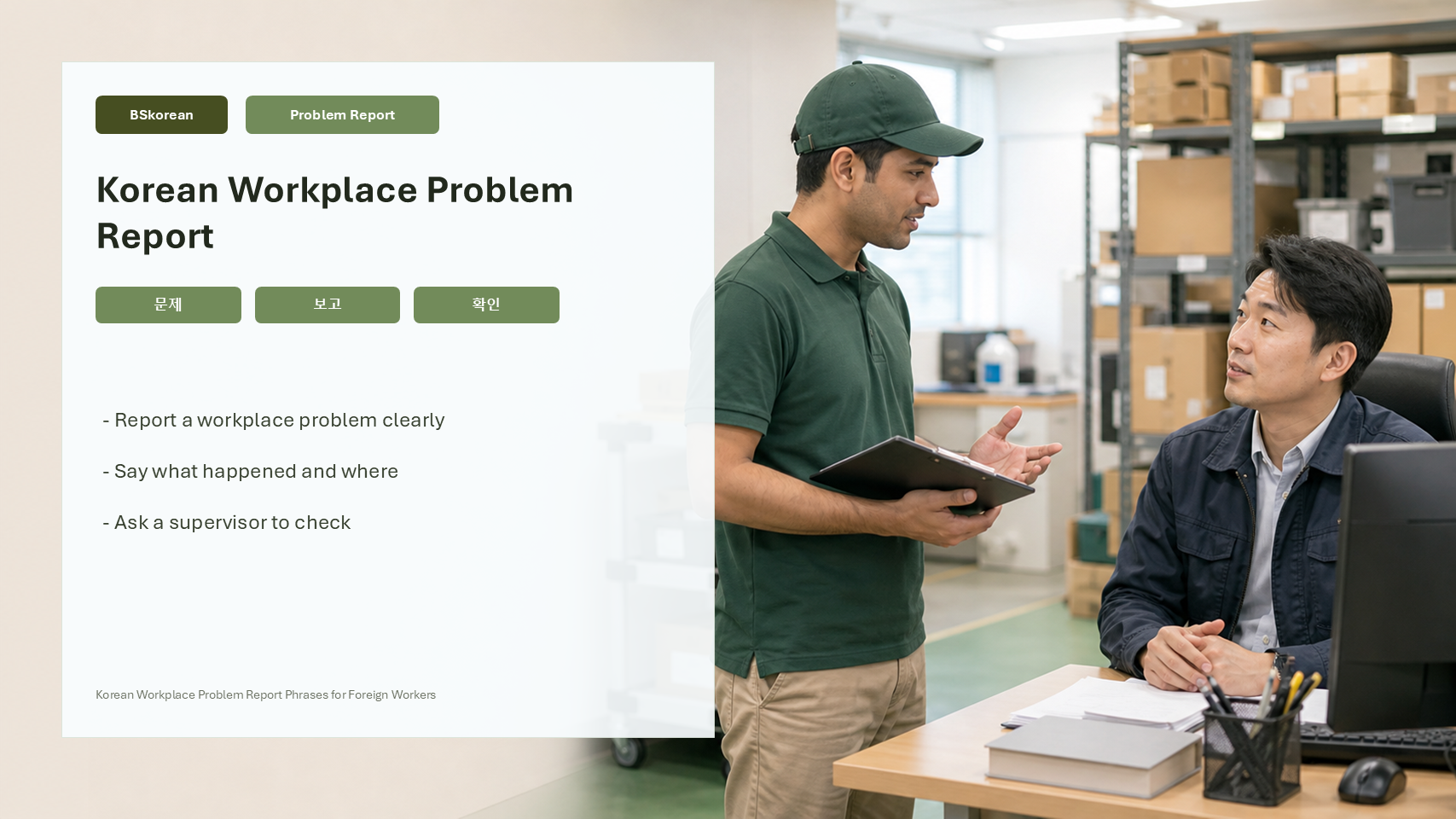
You are working a busy shift in Korea. A machine stops, a delivery is late, a customer is upset, or one item is missing from an order. Your supervisor is nearby, but you only have a few seconds to explain the problem. In that moment, you do not need advanced Korean. You need a clear problem report.
This lesson teaches Korean workplace problem report phrases for foreign workers in service jobs, factories, warehouses, construction sites, cleaning work, hotels, and other practical workplaces. The goal is to help you say what happened, where it happened, and what kind of help you need.
Download the updated workplace problem report PPT briefing
Opening Situation
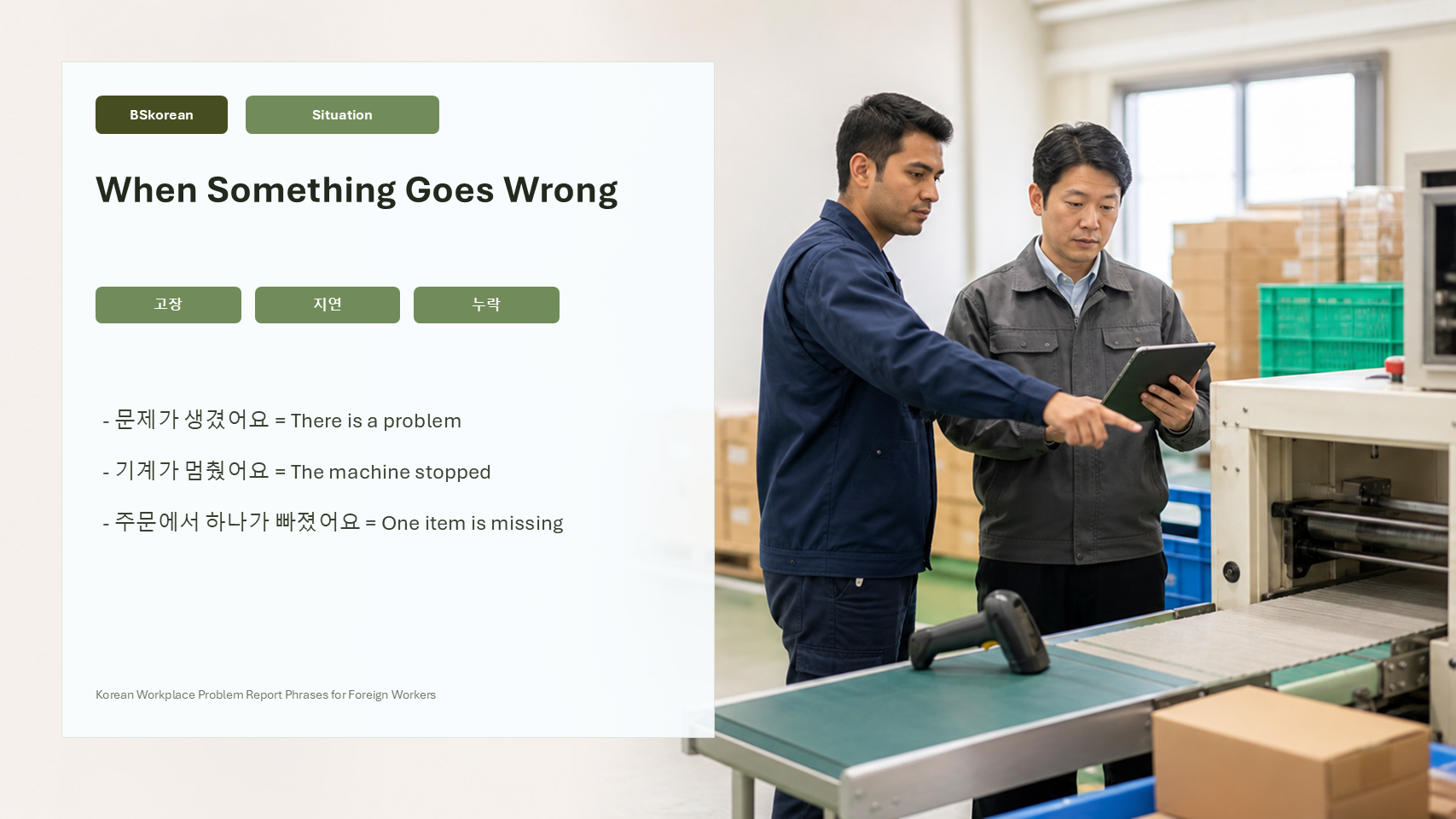
At work, Korean can become stressful when something goes wrong. Normal words feel harder because you are also dealing with time pressure. Maybe the packing line stopped. Maybe the wrong item was delivered. Maybe a customer is complaining at the counter. A short phrase like 문제가 생겼어요 can help you start the report.
Many industrial and service workplaces in Korea use direct reporting language. Managers often want three pieces of information: what the problem is, where it happened, and whether immediate action is needed. If you can report those three things, you can communicate more safely and professionally.
What You Need to Do
- Say that there is a problem.
- Name the specific issue: delay, defect, missing item, breakdown, complaint, or mistake.
- Say the place or item connected to the problem.
- Ask for confirmation or help.
- Report again after the issue is checked or fixed.
Core Vocabulary Table
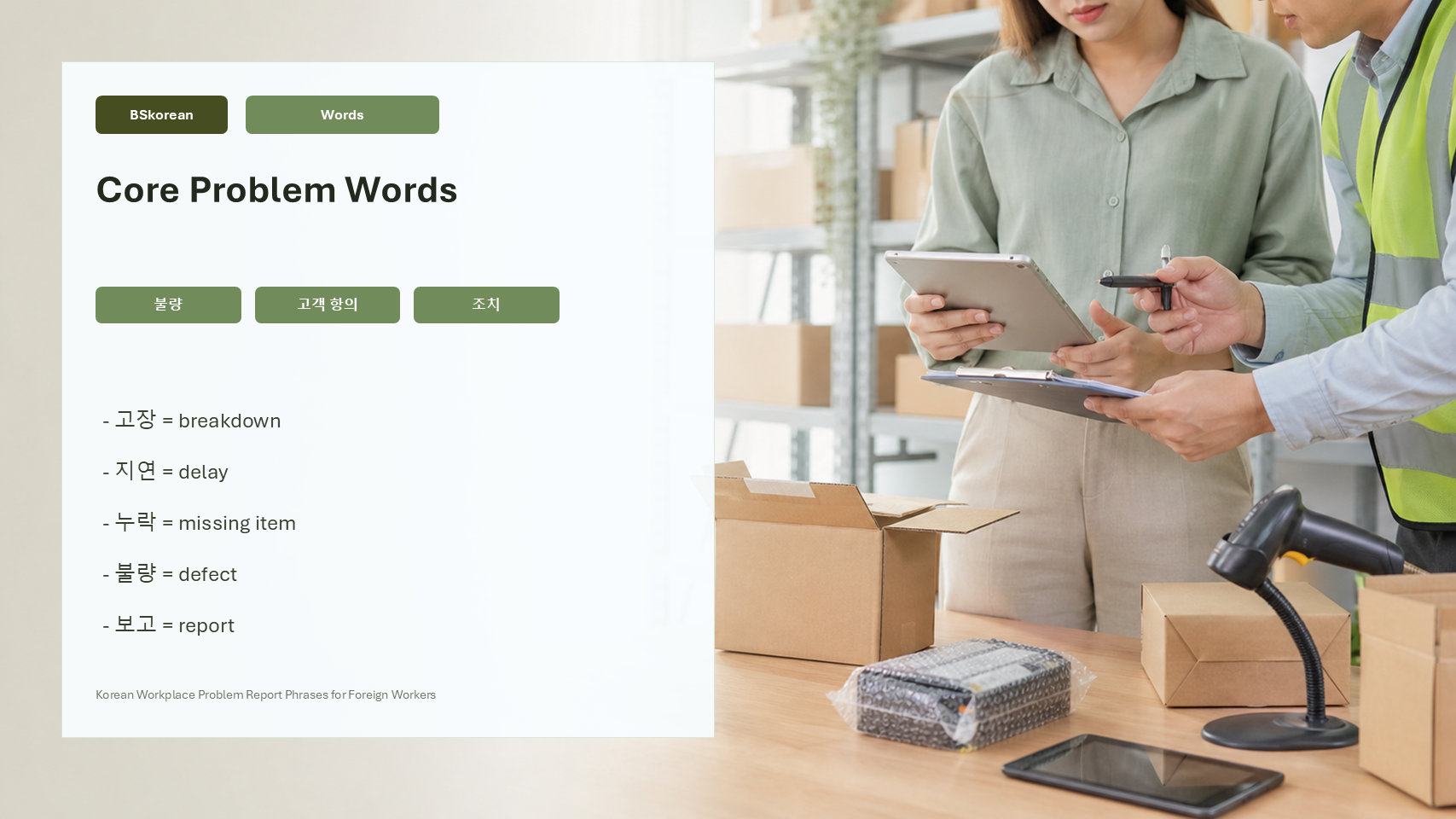
| Korean | Romanization | English | Level | Usage Note |
|---|---|---|---|---|
| 문제 | munje | problem | Beginner 2 | General problem word used in all workplaces. |
| 보고 | bogo | report | Intermediate 1 | Used when telling a supervisor or manager. |
| 확인 | hwagin | check / confirm | Beginner 3 | Useful for asking someone to check a situation. |
| 고장 | gojang | breakdown | Intermediate 1 | Used for machines, equipment, doors, or devices. |
| 지연 | jiyeon | delay | Intermediate 2 | Common in delivery, production, service, and schedules. |
| 누락 | nurak | missing item | Advanced 1 | Formal word for something omitted or missing. |
| 불량 | bullyang | defect | Intermediate 2 | Used in factories, products, packaging, and quality checks. |
| 실수 | silsu | mistake | Beginner 3 | A general mistake, often used in daily work conversation. |
| 고객 항의 | gogaek hangui | customer complaint | Advanced 1 | Useful in service jobs and customer support. |
| 주문 | jumun | order | Beginner 2 | Used in restaurants, cafes, delivery, and online sales. |
| 재고 | jaego | stock / inventory | Intermediate 2 | Used in stores, warehouses, and production. |
| 조치 | jochi | action / measure | Advanced 1 | Formal word for what will be done to solve a problem. |
| 담당자 | damdangja | person in charge | Intermediate 2 | The person responsible for a task or issue. |
| 관리자 | gwallija | manager / supervisor | Intermediate 1 | The person you report to or ask for instructions. |
| 다시 확인해 주세요 | dasi hwaginhae juseyo | please check again | Beginner 3 | Polite request when something seems wrong. |
Action Signal Formula
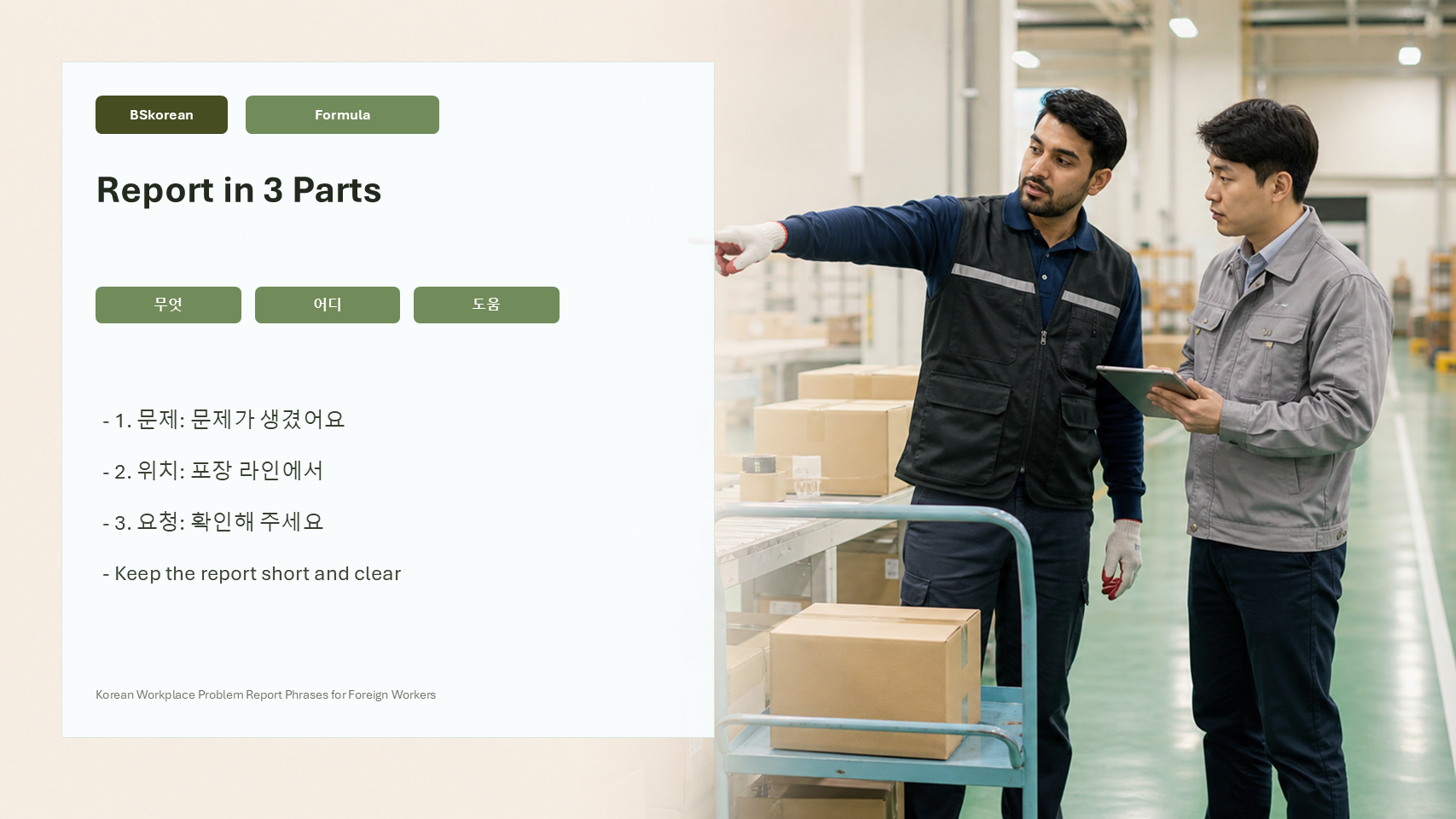
A useful workplace report does not need to be long. Use this order:
| Formula | Meaning | Example |
|---|---|---|
| 문제가 생겼어요 | There is a problem | 관리자님, 문제가 생겼어요. |
| N에 문제가 있어요 | There is a problem with N | 포장 라인에 문제가 있어요. |
| N이 고장 났어요 | N is broken | 기계가 고장 났어요. |
| N이 지연됐어요 | N is delayed | 배송이 지연됐어요. |
| N이 누락됐어요 | N is missing | 주문에서 음료가 누락됐어요. |
| 확인 부탁드립니다 | Please check | 재고 확인 부탁드립니다. |
This pattern works across industries. A restaurant worker can report an order problem. A warehouse worker can report missing stock. A factory worker can report a defect. A construction worker can report a tool or equipment problem.
For service jobs, the most useful words are often 주문, 누락, 고객 항의, and 확인. For field jobs, the most useful words are often 고장, 불량, 지연, and 조치. You can use the same report structure, but change the noun to match your workplace.
Usage Notes
보고 sounds more formal than just “telling someone.” It is often used when information moves from a worker to a supervisor, from a staff member to a manager, or from one department to another. In a short spoken situation, you can say 보고드릴 게 있습니다, which means “I have something to report.”
확인 is one of the safest workplace words because it does not blame anyone. If you are not sure whether something is wrong, say 확인 부탁드립니다 or 다시 확인해 주세요. This lets the other person check the situation before deciding what happened.
조치 is a manager-style word. It means the action or measure taken after a problem is found. You may hear 조치하겠습니다, meaning “I will take action,” or 조치가 필요합니다, meaning “action is needed.” You do not need to use this word often as a beginner, but you should recognize it in workplace messages.
Real-Life Dialogue
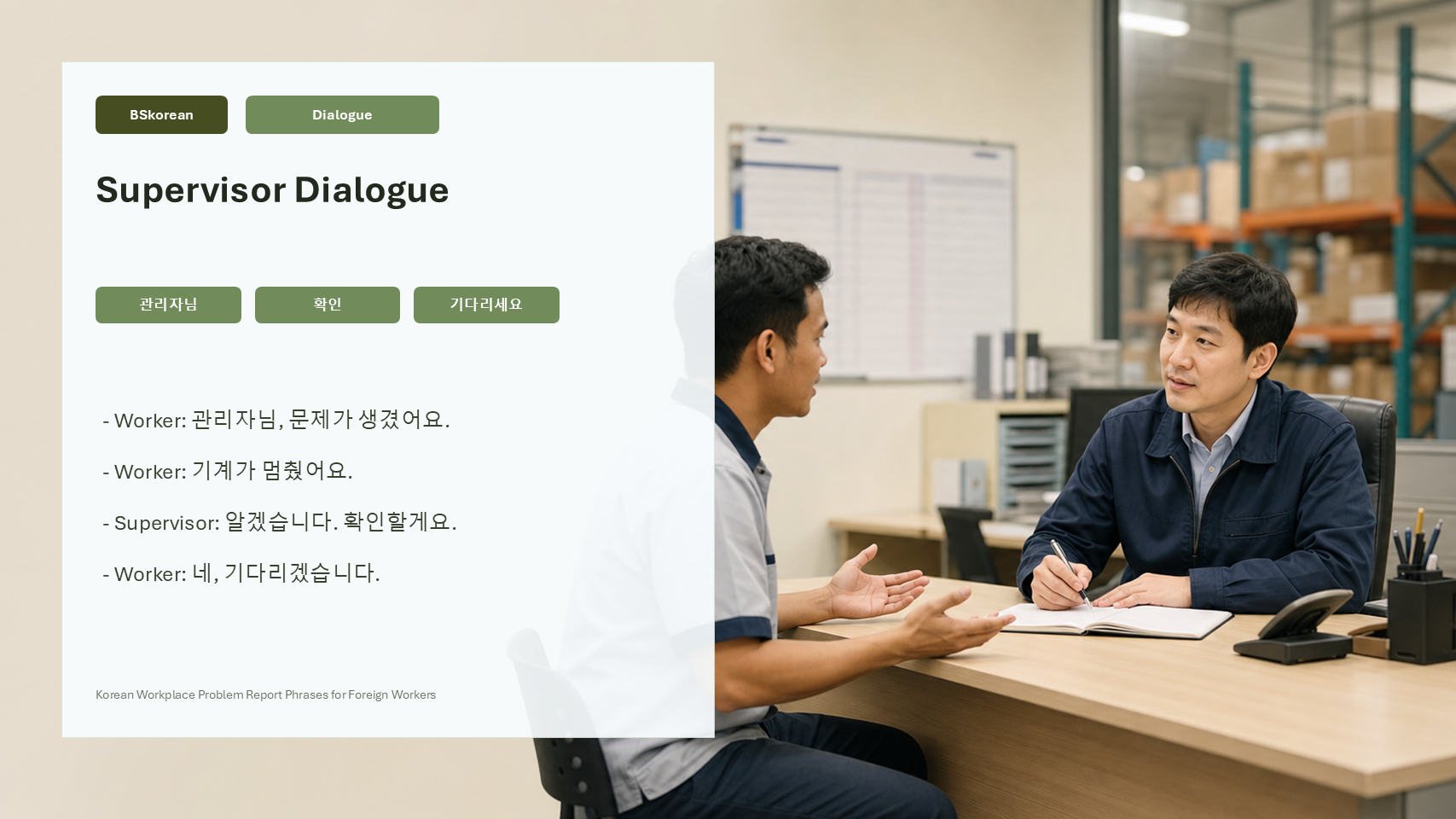
Dialogue 1: Factory or warehouse problem
Worker: 관리자님, 문제가 생겼어요.
Gwallijanim, munjega saenggyeosseoyo.
Manager, there is a problem.
Supervisor: 어디 문제예요?
Eodi munjeyeyo?
Where is the problem?
Worker: 포장 라인에 문제가 있어요. 기계가 멈췄어요.
Pojang raine munjega isseoyo. Gigyega meomchwosseoyo.
There is a problem on the packing line. The machine stopped.
Supervisor: 알겠습니다. 잠시 멈추고 기다리세요.
Algesseumnida. Jamsi meomchugo gidariseyo.
Understood. Stop for a moment and wait.
Dialogue 2: Service job problem
Staff: 주문에서 음료가 누락됐어요.
Jumuneseo eumryoga nurakdwaesseoyo.
A drink is missing from the order.
Manager: 고객님께 말씀드렸어요?
Gogaeknimkke malsseumdeuryeosseoyo?
Did you tell the customer?
Staff: 아직이요. 다시 확인해 주세요.
Ajigiyo. Dasi hwaginhae juseyo.
Not yet. Please check again.
Manager: 네, 제가 확인하겠습니다.
Ne, jega hwaginhagetseumnida.
Yes, I will check.
Common Mistakes
Common Mistake 1: Saying only 문제
Why it happens: Beginners may remember the noun but not the reporting phrase.
Correct understanding: Use a sentence such as 문제가 생겼어요 or N에 문제가 있어요. The sentence tells your supervisor that action is needed.
Common Mistake 2: Using 고장 for every problem
Why it happens: 고장 is easy to remember because it means broken.
Correct understanding: 고장 is best for machines, equipment, devices, or facilities. Use 누락 for missing items, 지연 for delays, and 불량 for defective products.
Common Mistake 3: Forgetting the location
Why it happens: Under pressure, learners report the problem but not where it happened.
Correct understanding: Add the place or item: 포장 라인에, 주문에서, 창고에, 계산대에서. This helps the manager respond faster.
Common Mistake 4: Sounding too casual with customers
Why it happens: Workplace learners may use the same phrase with coworkers and customers.
Correct understanding: With customers, use polite forms such as 확인해 드리겠습니다 or 잠시만 기다려 주세요. With a coworker, short direct phrases may be acceptable.
Mini Quiz
- Question 1: What does 문제가 생겼어요 mean?
Answer: There is a problem.
Explanation: This is a useful first sentence for reporting an issue. - Question 2: Which word is best for a broken machine?
Answer: 고장.
Explanation: 고장 is used for machines, equipment, devices, or facilities that do not work. - Question 3: Which word means delay?
Answer: 지연.
Explanation: 지연 is used for delayed delivery, production, service, or schedules. - Question 4: A drink is missing from an order. Which word fits best?
Answer: 누락.
Explanation: 누락 means something is missing or omitted. - Question 5: How do you politely ask someone to check again?
Answer: 다시 확인해 주세요.
Explanation: This is short, polite, and useful in many workplaces.
Review Table
| Korean | Meaning | Best Situation | Beginner Tip |
|---|---|---|---|
| 문제가 생겼어요 | There is a problem | first report to a supervisor | Use this to start the report. |
| 고장 | breakdown | machine or equipment issue | Use with 기계, 문, 장비, or 컴퓨터. |
| 지연 | delay | delivery, production, schedule | Use when something is late. |
| 누락 | missing item | orders, documents, inventory | Formal but very useful at work. |
| 불량 | defect | product or quality issue | Common in factory and warehouse work. |
| 확인 부탁드립니다 | Please check | polite work request | Good for messages and reports. |
| 조치 | action / measure | after checking a problem | Often used by managers. |
Practice This Set
Practice this word list in Learn Korean or in the upcoming BS3001 app. Start by recognizing the problem word, then practice one report sentence for each word. For example, when you see 고장, say 기계가 고장 났어요. When you see 누락, say 주문에서 하나가 누락됐어요.
Practice Workplace Report Words
For official employment and workplace information in Korea, check the English site of the Ministry of Employment and Labor.
Related Lessons
- Korean Factory Inspection Words for Foreign Workers
- Korean Construction Safety Words for Foreign Workers
- Korean Agriculture Words for Foreign Farm Workers
Conclusion
Workplace Korean becomes more useful when you learn it as reporting language. In many jobs, the most important sentence is not complicated. It is 문제가 생겼어요. After that, add the specific word: 고장, 지연, 누락, 불량, or 고객 항의.
A clear report protects time, safety, and customer trust. Say what happened, where it happened, and what you need the manager to check. That simple structure works across factories, warehouses, restaurants, cafes, stores, hotels, and field work in Korea.
Practice This Lesson
Review words from this lesson with quiz cards and browser-based review history.