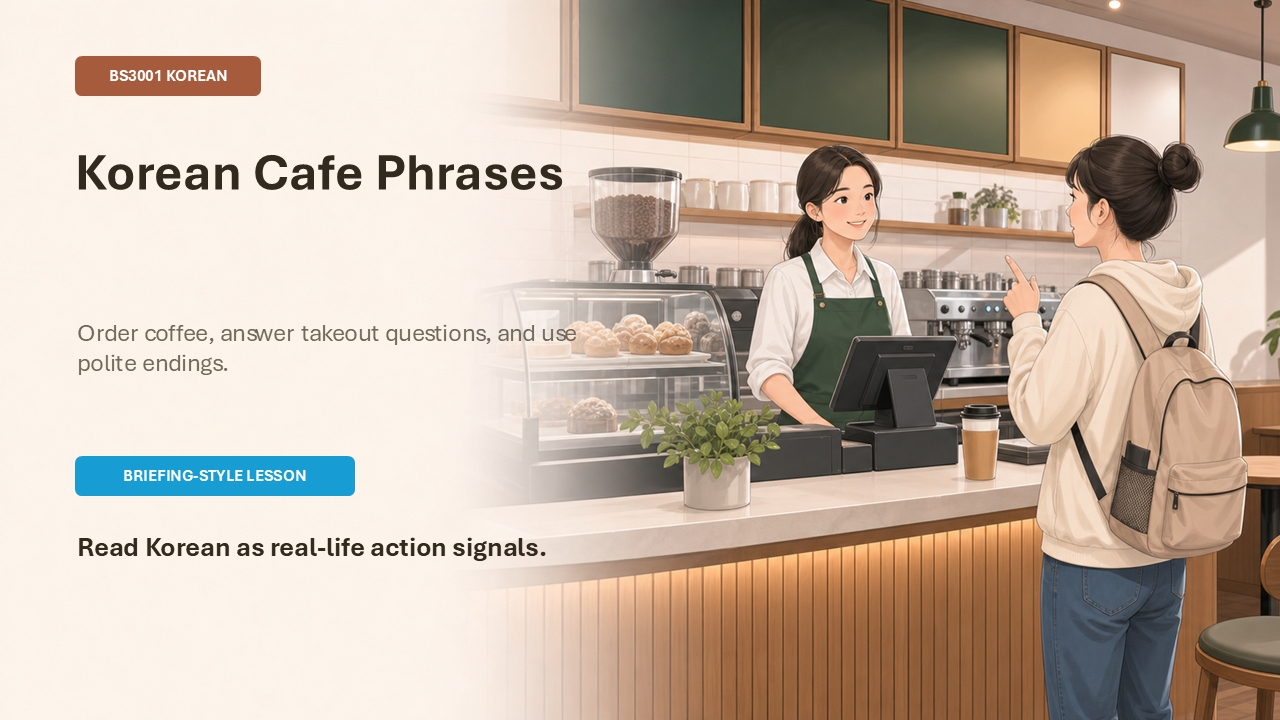
Korean cafe phrases help you order drinks, choose iced or hot, ask for takeout, pay, and answer simple service questions in Korea. This lesson focuses on short phrases you can use at a real cafe counter.
Korean Cafe Phrases for Ordering
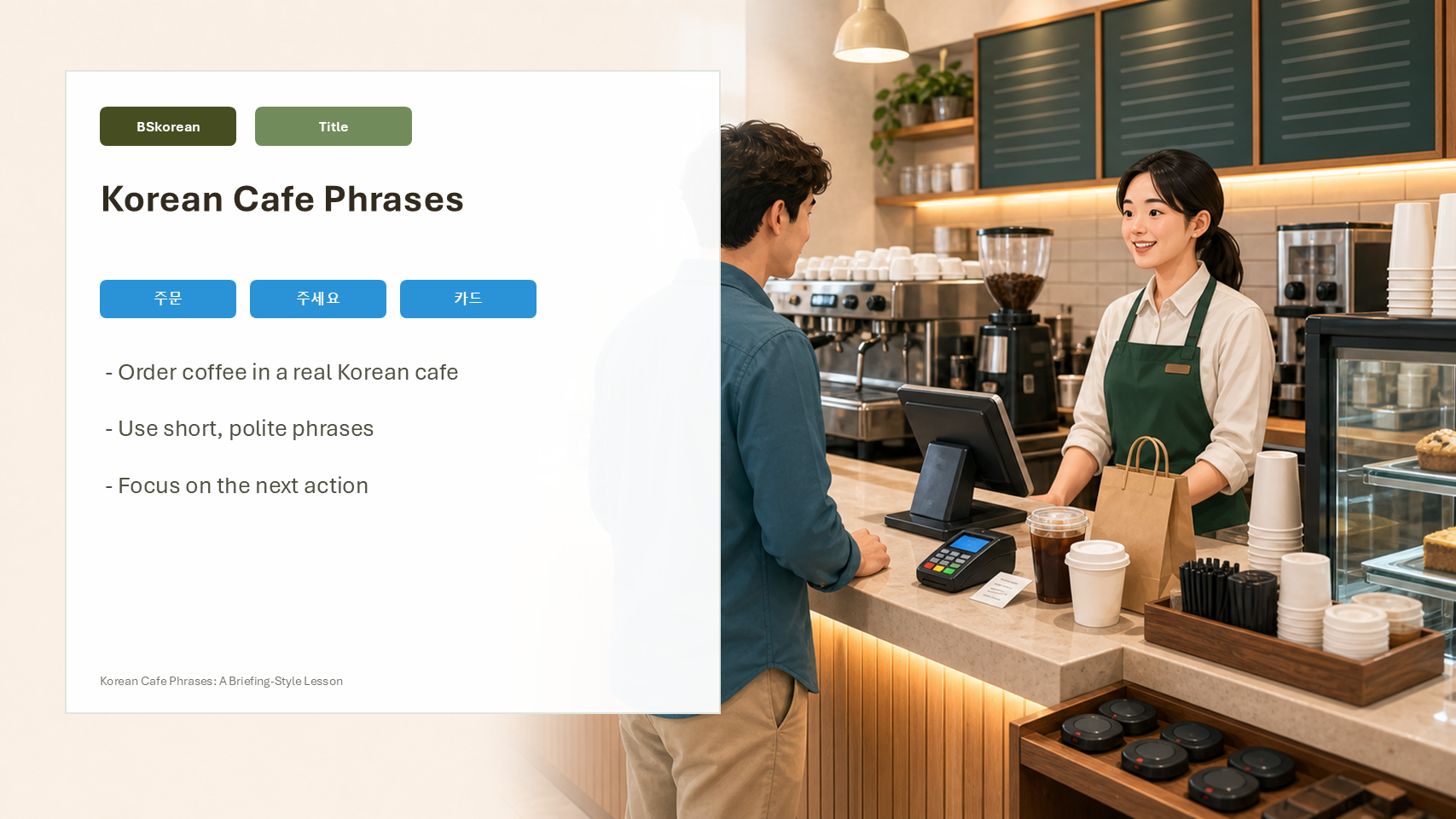
Opening Situation
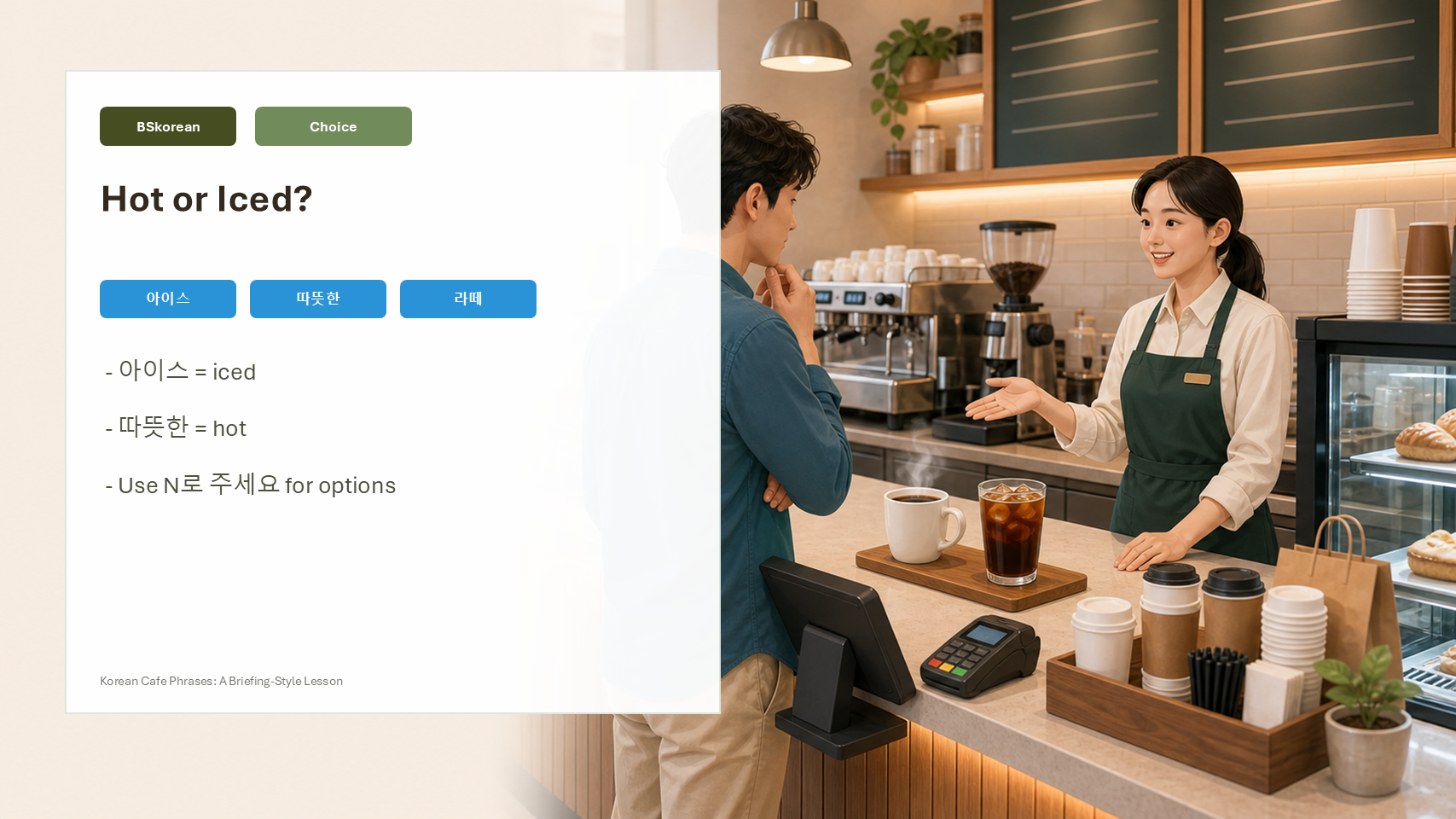
You walk into a Korean cafe and order an Americano. The staff asks, 드시고 가세요? Then they ask, 따뜻한 걸로 드릴까요, 아이스로 드릴까요? You know coffee words, but the questions come quickly.
This lesson teaches Korean cafe phrases as a checkout briefing. You will learn the words that decide the order: here or to go, hot or iced, size, payment, receipt, pickup, and simple polite answers.
Learning Snapshot
Level: Beginner
Best for: Travelers, exchange students, cafe customers, new residents
Main skill: Ordering and answering common Korean cafe questions
Study time: 8-10 minutes
This briefing lesson focuses on a real situation rather than a memorized word list. Use the tables, patterns, examples, mistakes, and practice steps together so the Korean words become practical actions.
Why This Topic Matters
Cafe Korean is practical because the same short questions appear again and again. Staff often speak fast because the order flow is routine. Beginners do not need long grammar explanations at the counter; they need a few reliable answers.
Korean cafes also use self-order kiosks, pickup numbers, and short counter phrases. If you can recognize 포장, 매장, 아이스, and 영수증, you can handle most simple orders with less stress.
Core Vocabulary Table
| Korean | Romanization | Basic Meaning | Natural Meaning | Where You See It | Example |
|---|---|---|---|---|---|
| 주문 | jumun | order | placing or receiving an order | counter, kiosk, receipt | 주문하시겠어요? |
| 아메리카노 | amerikano | Americano | common coffee order | menu boards, cafes | 아메리카노 하나 |
| 따뜻한 | ttatteuthan | warm/hot | hot drink option | staff questions, menu | 따뜻한 걸로 |
| 아이스 | aiseu | ice | iced drink option | menus, spoken orders | 아이스로 주세요 |
| 포장 | pojang | packing | to go or takeaway | cafes, restaurants | 포장해 주세요 |
| 매장 | maejang | store | for here in the cafe | staff questions, kiosks | 매장에서 먹을게요 |
| 사이즈 | saijeu | size | drink size option | menus, kiosks | 사이즈업 |
| 샷 | syat | shot | espresso shot | coffee menus | 샷 추가 |
| 시럽 | sireop | syrup | sweetener or flavor syrup | drink options | 시럽 빼 주세요 |
| 결제 | gyeolje | payment | paying for the order | counter, kiosk | 결제 도와드릴게요 |
| 카드 | kadeu | card | credit or debit card | payment counter | 카드로 할게요 |
| 영수증 | yeongsujeung | receipt | printed or digital receipt | checkout | 영수증 드릴까요? |
| 진동벨 | jindongbel | pager | pickup buzzer | cafe counter | 진동벨 받아 주세요 |
Do not study this table as isolated dictionary entries. First notice where the word appears, then connect it to the action you need to take in that place.
How Koreans Actually Use These Words
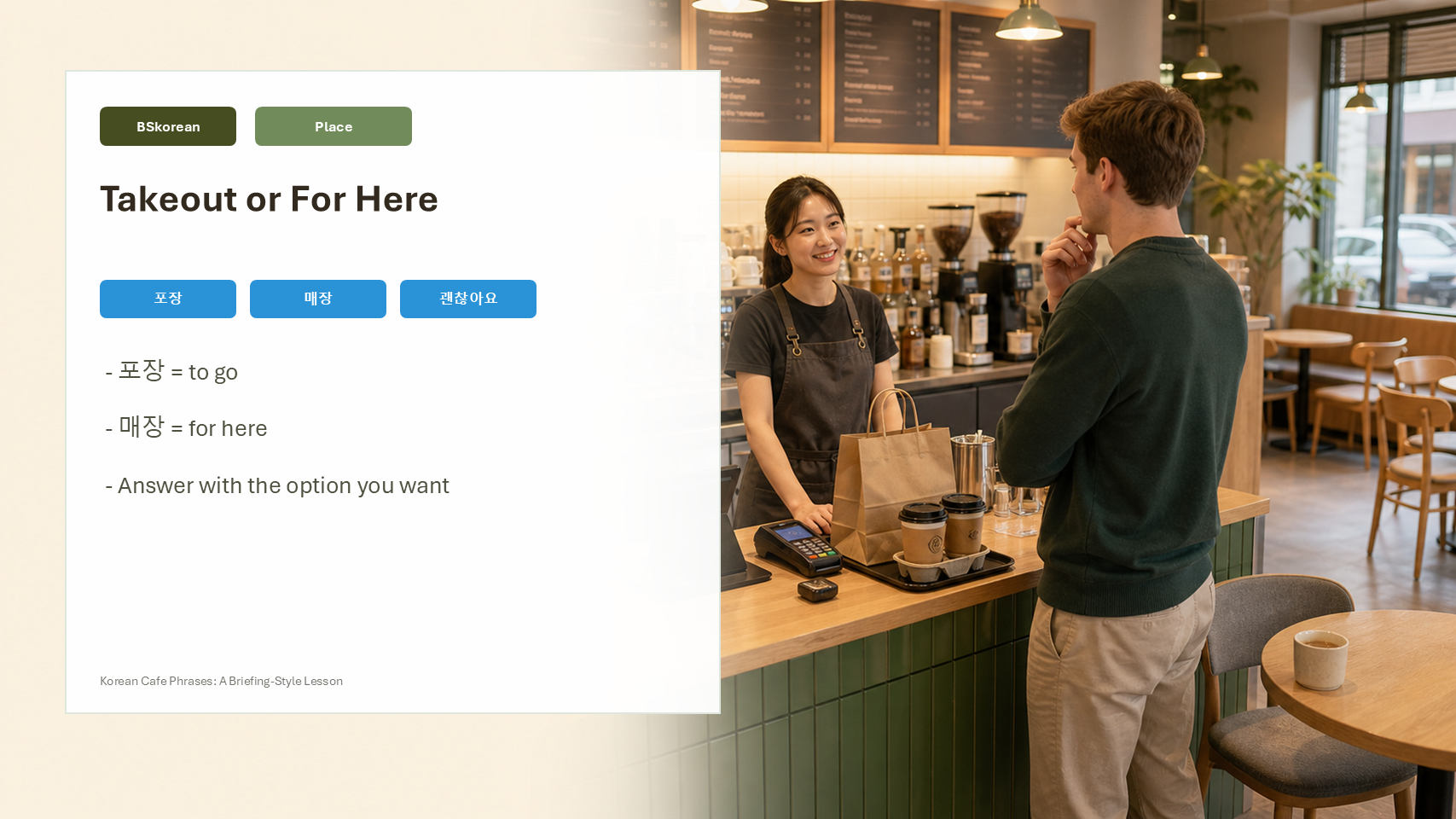
드시고 가세요? literally includes eating or drinking, but in a cafe it means “for here?” A simple answer is 네, 매장에서요 for here or 포장해 주세요 for takeaway.
아이스로 주세요 is a natural beginner answer when choosing an iced drink. For hot drinks, 따뜻한 걸로 주세요 works well. You do not need a full sentence to be polite at the counter.
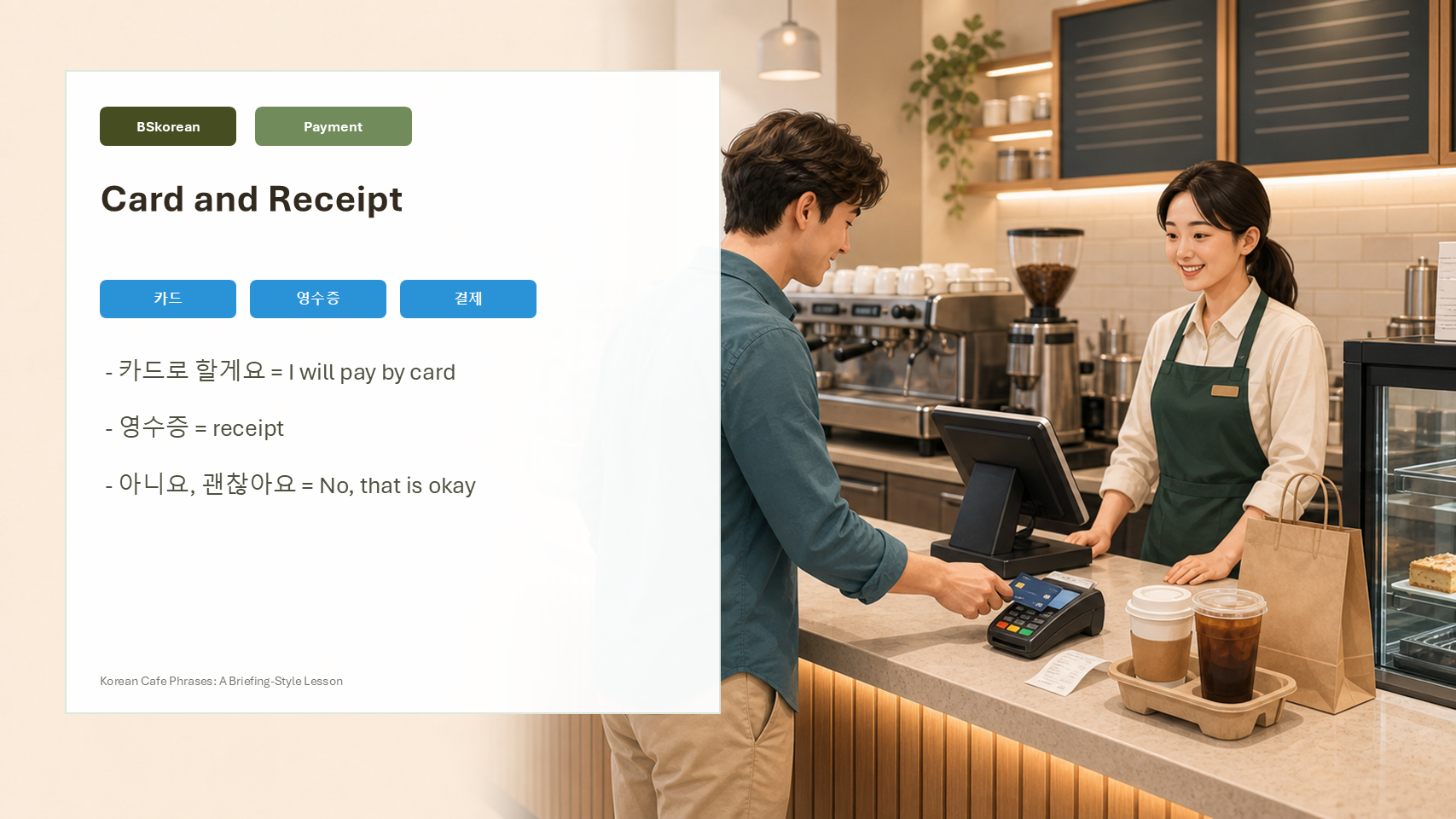
영수증 드릴까요? is a receipt question. If you do not need it, 아니요, 괜찮아요 is natural and short. This answer is useful in cafes, convenience stores, pharmacies, and restaurants.
In many Korean cafes, the staff may ask several questions in a fixed order: drink, temperature, size, here or to go, payment, and receipt. If you miss one question, do not panic. You can answer with one keyword, such as 아이스요, 포장이요, or 카드요, and the staff will usually understand.
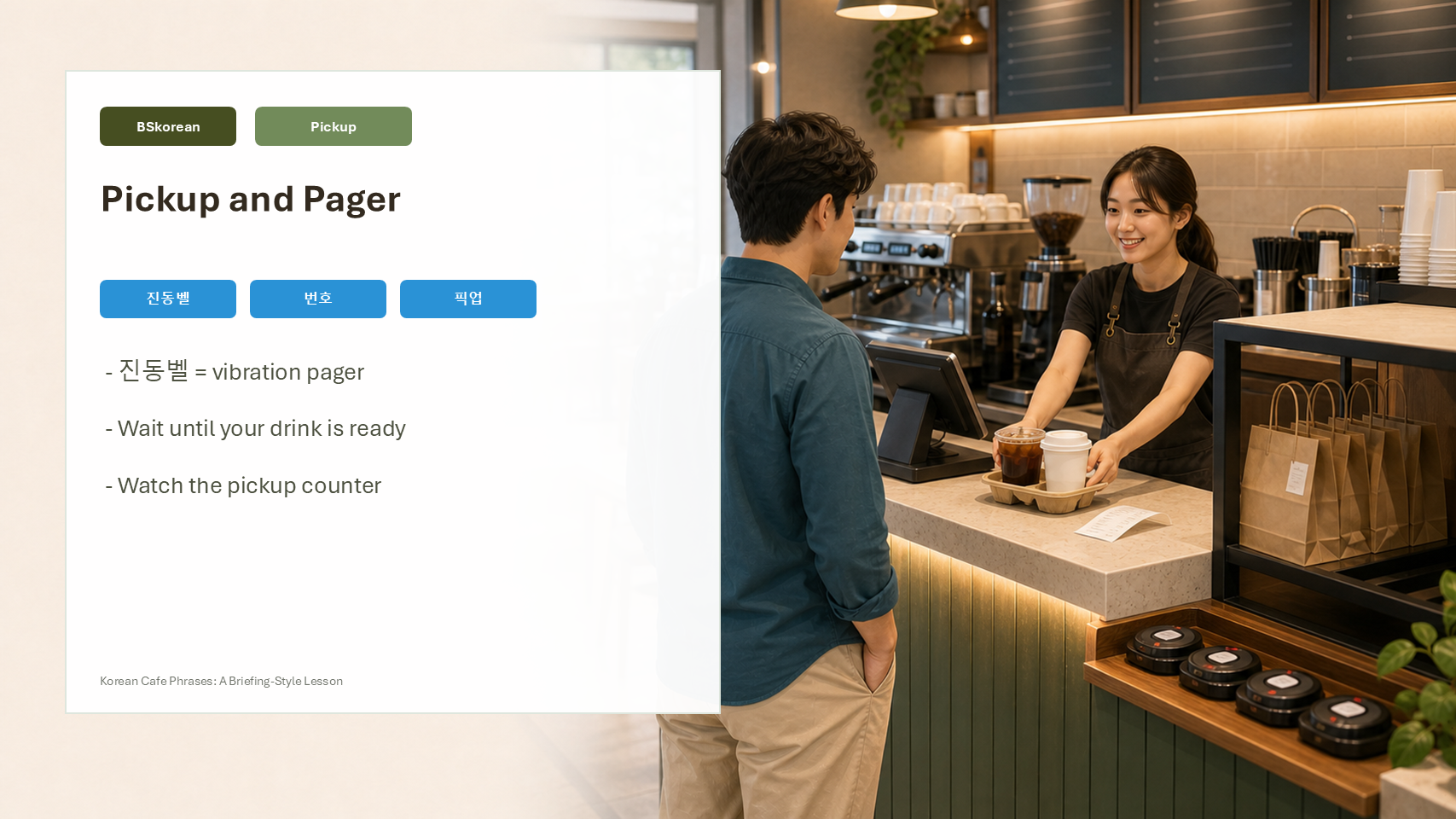
Korean cafe culture also includes pickup counters and order numbers. After payment, the interaction may not be finished. Watch the screen, listen for your number, or hold the 진동벨. This is why pickup vocabulary matters as much as the ordering sentence itself.
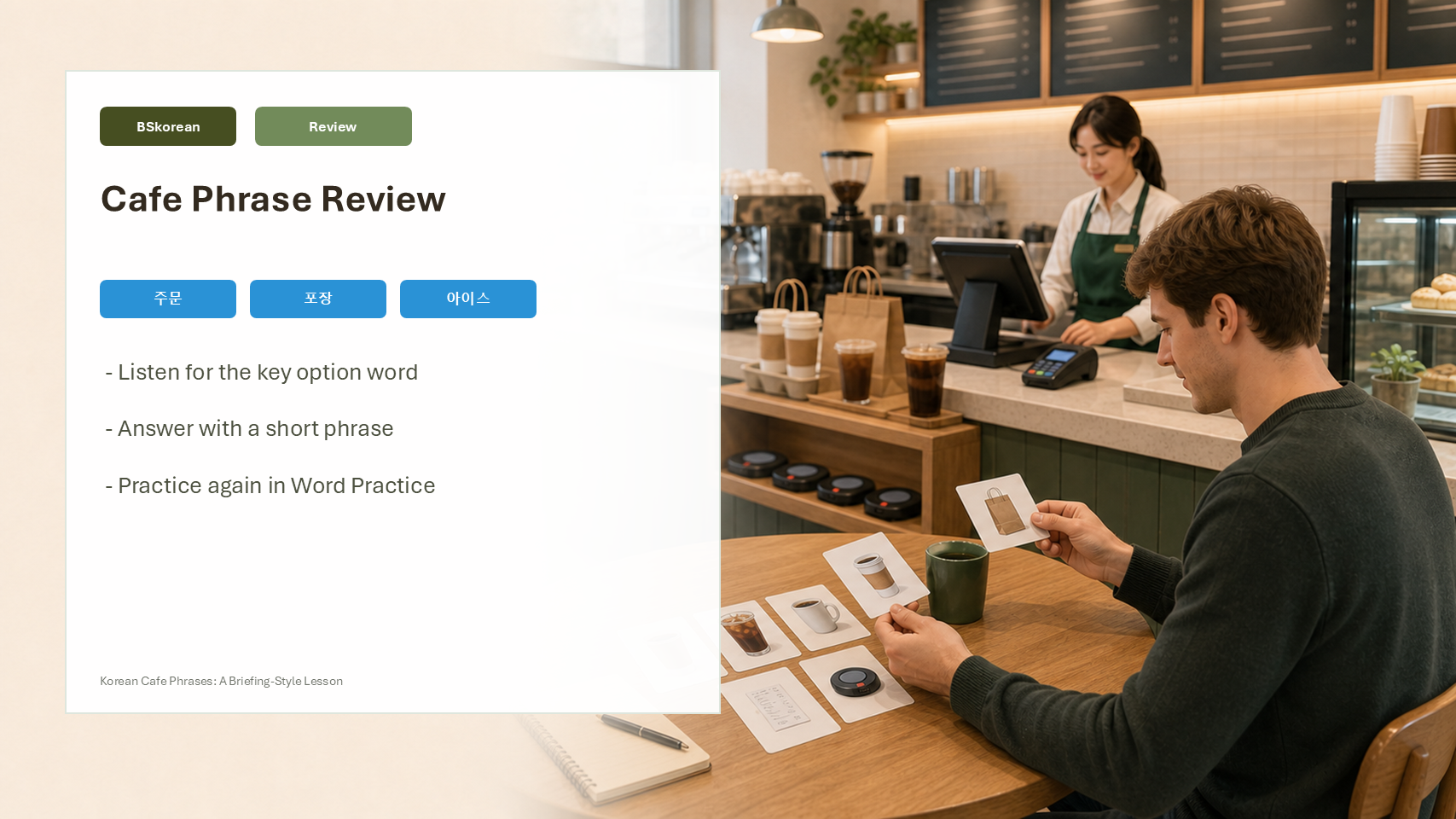
A useful beginner habit is to listen for the keyword first and the grammar second. In real Korean spaces, staff, signs, and notices often use compact wording because everyone is expected to understand the situation quickly.
Sentence Patterns
| Pattern | Meaning | Example |
|---|---|---|
| N 주세요 | Please give me N | 아메리카노 하나 주세요 |
| N로 주세요 | Please make it as N | 아이스로 주세요 |
| N 빼 주세요 | Please leave out N | 시럽 빼 주세요 |
| N 추가해 주세요 | Please add N | 샷 추가해 주세요 |
| N로 할게요 | I will use/pay with N | 카드로 할게요 |
Patterns help you read new examples without starting from zero. When the noun changes, the structure often stays the same, so you can understand a new sign or question by recognizing the formula.
Real-Life Dialogue
Dialogue 1
Staff: 주문하시겠어요?
Customer: 아메리카노 하나 주세요.
Staff: 따뜻한 걸로 드릴까요, 아이스로 드릴까요?
Customer: 아이스로 주세요.
Explanation: The customer answers with the drink first, then chooses the temperature. 아이스로 주세요 is short and natural.
Dialogue 2
Staff: 드시고 가세요?
Customer: 아니요, 포장해 주세요.
Staff: 영수증 드릴까요?
Customer: 아니요, 괜찮아요.
Explanation: 포장해 주세요 means to go. 아니요, 괜찮아요 politely refuses the receipt.
The key is to decide what the Korean is asking you to do. In daily life, the best reading is usually a short action: answer yes, choose a direction, pay with a card, wait for pickup, ask the office, or avoid a restricted area.
Common Mistakes
Common Mistake 1: Translating 매장 as only store
Why it happens: Dictionary meaning can make learners think 매장 only means a shop location.
Correct understanding: At a cafe counter, 매장에서 means for here or inside the cafe.
Example: 매장에서 드실게요? means “Will you have it here?”
Common Mistake 2: Using 주세요 for every answer
Why it happens: 주세요 is useful, so beginners overuse it even when a yes/no answer is enough.
Correct understanding: When refusing a receipt or bag, 아니요, 괜찮아요 is more natural.
Example: For 영수증 드릴까요?, answer 아니요, 괜찮아요 if you do not need it.
Common Mistake 3: Missing the pickup system
Why it happens: Many Korean cafes do not call your name. They use a number, screen, or pager.
Correct understanding: Watch for 진동벨, 번호, or the pickup counter after payment.
Example: If staff says 진동벨 받아 주세요, take the pager and wait.
Step-by-Step Practice
- Step 1. Listen for the order question: 주문하시겠어요?
- Step 2. Give the drink and count: 아메리카노 하나 주세요.
- Step 3. Choose hot, iced, here, or to go with short answers.
- Step 4. Answer payment and receipt questions simply: 카드로 할게요 / 아니요, 괜찮아요.
Practice slowly at first. After a few repetitions, try to reduce the Korean into one practical decision. This is how the vocabulary becomes usable outside a lesson page.
For one week, choose three words from this lesson whenever you see a similar place in Korea or in a photo. Say the Korean word first, then say the real action in English. For example, do not only say “this word means exit.” Say “출구 tells me where to leave.” That small habit trains you to connect Korean with movement, payment, access, warning, or choice.
If you are studying outside Korea, use maps, street-view images, apartment listing screenshots, cafe menus, or transportation photos. The goal is not to memorize perfect sentences in isolation. The goal is to recognize the Korean word fast enough to make a simple decision when the situation appears.
Mini Quiz
Question 1
You want an iced latte. What should you add to your order?
Answer: 아이스로 주세요.
Explanation: 아이스로 주세요 means please make it iced.
Question 2
Staff asks 드시고 가세요?. You want takeout. What do you say?
Answer: 포장해 주세요.
Explanation: 포장 is the cafe and restaurant word for to go.
Question 3
How do you politely refuse a receipt?
Answer: 아니요, 괜찮아요.
Explanation: This is a natural short refusal.
Question 4
You want no syrup. What pattern do you use?
Answer: 시럽 빼 주세요.
Explanation: N 빼 주세요 means please leave out N.
Review Table
| Korean | Meaning | Best Situation | Beginner Tip |
|---|---|---|---|
| 포장 | to go | takeaway order | Use 포장해 주세요. |
| 매장 | for here | eating or drinking inside | 매장에서요 is a short answer. |
| 아이스 | iced | cold drink option | Use 아이스로 주세요. |
| 영수증 | receipt | checkout question | Refuse with 아니요, 괜찮아요. |
| 진동벨 | pager | waiting for pickup | Take it and wait for vibration. |
Practice these words again in Korean Learn Korean so you can connect the Korean word to the real situation.
For official Korea travel and daily-life context, check Visit Korea.
Related Lessons
- Korean Convenience Store Words for Checkout
- Korean Restaurant Order Words for Foreign Workers
- Korean Pharmacy Words for Buying Cold Medicine
Conclusion
These Korean words become easier when you read them through the situation. Start with the purpose word, check the detail next to it, and turn the whole expression into a simple action. That habit is more useful than translating every word slowly.