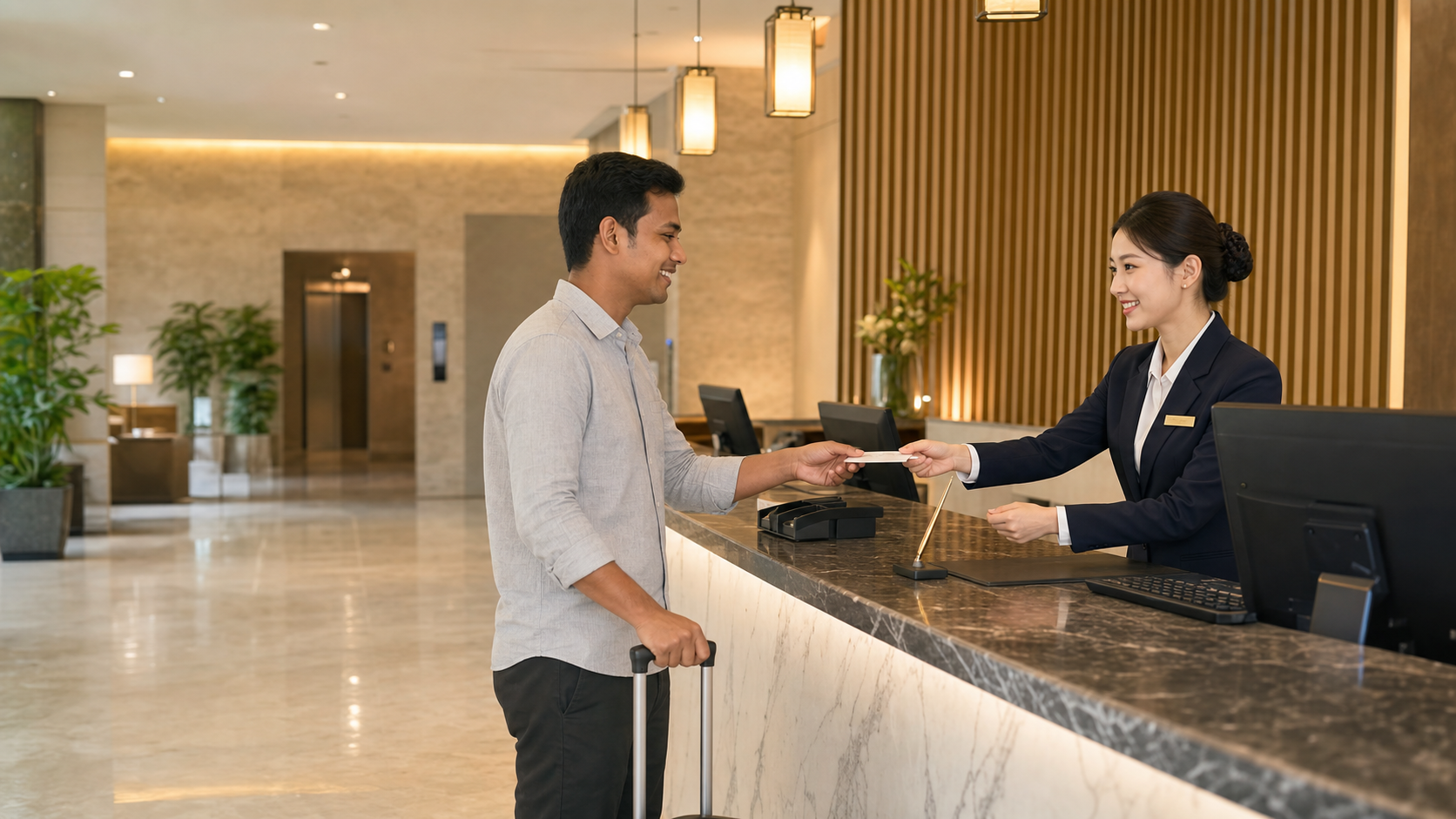
Frasa Bahasa Korea untuk Check-in Hotel bagi Staf Front Desk
Pelajari frasa Korea untuk check-in hotel: konfirmasi reservasi, identitas, kunci kamar, sarapan, deposit, dan waktu check-out.
Complete Key Vocabulary
| Korean | Romanization | English Meaning | Level | Usage Note |
|---|---|---|---|---|
| 예약 | yeyak | reservation | Pemula | The booking record you confirm first. |
| 예약 확인 | yeyak hwagin | reservation check | Pemula | The action of checking the guest booking. |
| 성함 | seongham | name | Pemula | Polite word for a guest name. |
| 신분증 | sinbunjeung | ID card | Pemula | Identification card for check-in. |
| 여권 | yeogwon | passport | Pemula | Foreign guest identification document. |
| 객실 | gaeksil | guest room | Pemula | Formal hotel word for room. |
| 객실 키 | gaeksil ki | room key | Pemula | Room key or key card. |
| 체크인 | chekeuin | check-in | Pemula | The process of entering the hotel as a guest. |
| 체크아웃 | chekeuaut | check-out | Pemula | Leaving the hotel and closing the stay. |
| 조식 | josik | breakfast | Pemula | Hotel breakfast service. |
| 보증금 | bojeunggeum | deposit | Intermediate | Temporary deposit or security hold. |
| 결제 | gyeolje | payment | Pemula | Payment by card, cash, or app. |
| 서명 | seomyeong | signature | Intermediate | Signature on a form, receipt, or policy agreement. |
| 안내 | annae | guidance; information | Intermediate | Explaining hotel rules, facilities, or directions. |
| 엘리베이터 | ellibeiteo | elevator | Pemula | Elevator location. |
| 층 | cheung | floor | Pemula | Floor number in a building. |
| 와이파이 | waipai | Wi-Fi | Pemula | Internet access in the hotel. |
| 금연 | geumyeon | non-smoking | Intermediate | No smoking rule. |
| 요청 | yocheong | request | Intermediate | Something the guest asks for. |
| 문의 | munui | inquiry; question | Intermediate | A question or request for help. |
Real Situation
At a Korean hotel, the first important word is usually 예약. A guest may say 예약했어요, 예약했는데요, or simply give a name. A short professional response is 예약 확인 도와드리겠습니다.
After reservation confirmation, the front desk asks for a name. 성함 is the polite service word for name. In casual life you may hear 이름, but at a hotel, 성함이 어떻게 되세요? sounds more respectful.
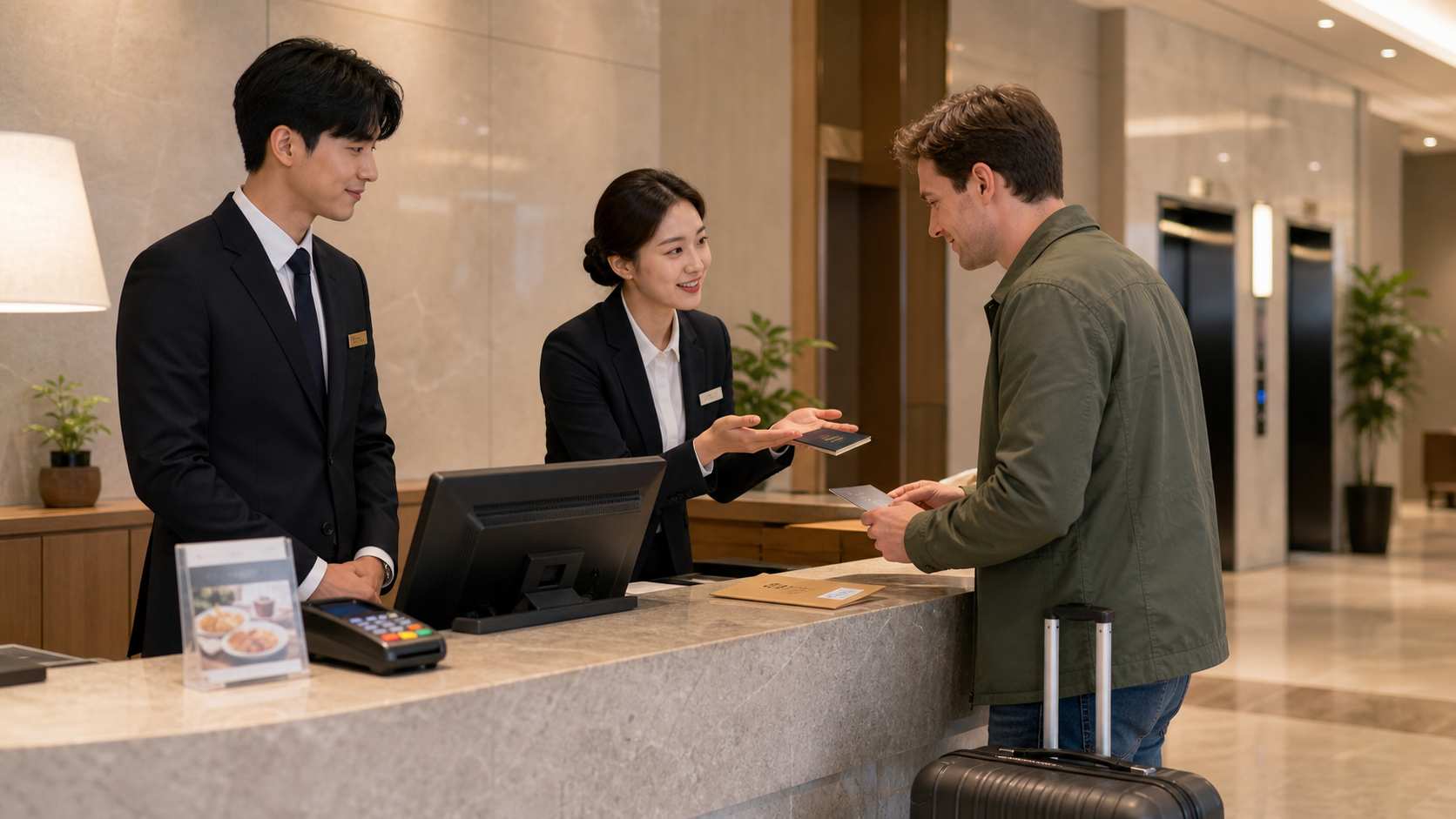
The next step is ID. For Korean guests, you may ask for 신분증. For foreign guests, 여권 is often needed. The polite pattern 보여 주시겠어요? means “Could you show me?” It is softer than just saying “give me.”
When the reservation and ID are confirmed, the staff gives the room information. 객실 is the hotel word for guest room. 객실은 1205호입니다 means “Your room is 1205.” Then you can say 객실 키 여기 있습니다, meaning “Here is your room key.”
Many check-ins also include breakfast, elevator, Wi-Fi, non-smoking rules, deposit, and check-out time. Explain one point at a time so the guest can follow the workflow.
Common Expressions
| Korean Expression | Romanization | English Meaning | Level | When to Use |
|---|---|---|---|---|
| 예약 확인 도와드리겠습니다. | Yeyak hwagin dowadeurigetsseumnida. | I will help check your reservation. | Intermediate | Opening phrase when the guest arrives. |
| 성함이 어떻게 되세요? | Seongham-i eotteoke doeseyo? | May I have your name? | Pemula | Polite way to ask the guest name. |
| 신분증 확인 부탁드립니다. | Sinbunjeung hwagin butakdeurimnida. | Please let me check your ID. | Intermediate | When checking an ID card. |
| 여권 보여 주시겠어요? | Yeogwon boyeo jusigesseoyo? | Could you show me your passport? | Intermediate | When a foreign guest needs passport confirmation. |
| 객실은 1205호입니다. | Gaeksil-eun cheoni-baek-o-ho-imnida. | Your room is 1205. | Pemula | When giving the room number. |
| 객실 키 여기 있습니다. | Gaeksil ki yeogi itseumnida. | Here is your room key. | Pemula | When handing the key card. |
| 조식은 2층에서 이용하시면 됩니다. | Josik-eun i-cheung-eseo iyonghasimyeon doemnida. | Breakfast is available on the second floor. | Intermediate | When explaining breakfast location. |
| 체크아웃은 오전 11시입니다. | Chekeuaut-eun ojeon yeol-hansi-imnida. | Check-out is at 11 a.m. | Pemula | When explaining departure time. |
| 보증금 결제가 필요합니다. | Bojeunggeum gyeolje-ga piryohamnida. | A deposit payment is required. | Advanced | When explaining a deposit or card hold. |
| 문의 사항 있으시면 말씀해 주세요. | Munui sahang isseusimyeon malsseumhae juseyo. | Please tell us if you have any questions. | Intermediate | Closing phrase after check-in guidance. |
Usage Notes
예약 확인 도와드리겠습니다 is a strong opening phrase because it tells the guest what you are doing. 도와드리겠습니다 is polite service Korean used in hotels, stores, banks, clinics, and service desks.
성함이 어떻게 되세요? is more polite than 이름이 뭐예요?. In service work, the same meaning can feel different depending on word choice.
신분증 확인 부탁드립니다 naturally means “Please let me check your ID.” It is clearer than only saying 신분증 주세요. For foreign guests, 여권 보여 주시겠어요? is usually smoother.
객실 and 방 both connect to “room,” but 객실 is the better hotel word. Use it with room number, room type, room status, and guest information.
조식은 2층에서 이용하시면 됩니다 means “Breakfast is available on the second floor.” The pattern 이용하시면 됩니다 often appears in facility explanations.
보증금 needs care. Some guests may think it is an extra fee. If your hotel takes a deposit or card hold, explain it simply and say whether it is refunded or only held.
문의 사항 있으시면 말씀해 주세요 is a useful closing phrase. It invites questions and shows the staff is still available.
Mini Dialogue
Staff: 예약 확인 도와드리겠습니다. 성함이 어떻게 되세요?
Yeyak hwagin dowadeurigetsseumnida. Seongham-i eotteoke doeseyo?
I will help check your reservation. May I have your name?
Guest: 김민수로 예약했어요.
Gim Minsu-ro yeyakhaesseoyo.
I made a reservation under Kim Min-su.
Staff: 네, 확인됐습니다. 신분증 확인 부탁드립니다.
Ne, hwagin-doetsseumnida. Sinbunjeung hwagin butakdeurimnida.
Yes, it has been confirmed. Please let me check your ID.
Guest: 여기 있습니다.
Yeogi itseumnida.
Here it is.
Staff: 객실은 1205호입니다. 객실 키 여기 있습니다.
Gaeksil-eun cheoni-baek-o-ho-imnida. Gaeksil ki yeogi itseumnida.
Your room is 1205. Here is your room key.
Staff: 조식은 2층에서 이용하시면 됩니다. 체크아웃은 오전 11시입니다.
Josik-eun i-cheung-eseo iyonghasimyeon doemnida. Chekeuaut-eun ojeon yeol-hansi-imnida.
Breakfast is available on the second floor. Check-out is at 11 a.m.
Guest: 와이파이 비밀번호는 어디에 있나요?
Waipai bimilbeonho-neun eodie innayo?
Where is the Wi-Fi password?
Staff: 카드 안쪽에 있습니다. 문의 사항 있으시면 말씀해 주세요.
Kadeu anjjok-e itseumnida. Munui sahang isseusimyeon malsseumhae juseyo.
It is inside the card holder. Please tell us if you have any questions.
This dialogue is short on purpose. A clear flow is better than long service sentences: confirm, request ID, give room information, explain key details, and invite questions.
Common Mistakes
- Using 이름 with every guest
이름 means name, but 성함 is more polite for a guest. At a hotel front desk, 성함이 어떻게 되세요? sounds more professional than 이름이 뭐예요? - Saying 신분증 주세요 too directly
신분증 주세요 is understandable, but it can sound too short. 신분증 확인 부탁드립니다 or 신분증 보여 주시겠어요? is better for front desk service. - Confusing 객실 and 방
방 means room in daily Korean. 객실 is the standard hotel word. Use 객실 when assigning a hotel room, explaining a room number, or speaking formally. - Not explaining 보증금 clearly
보증금 may be confusing for foreign guests. If a deposit is required, explain it as a deposit or temporary card hold and keep the sentence simple. - Giving too much information at once
Check-in has many details: room, key, breakfast, Wi-Fi, check-out, deposit. Short sentences help the guest understand and help the staff avoid mistakes.
Practice Steps
- Start with the reservation. Say 예약 확인 도와드리겠습니다. Do not jump directly to payment or room key.
- Ask for the name politely. Use 성함이 어떻게 되세요?. If the guest already gave the name, repeat it softly to confirm.
- Request ID or passport. Use 신분증 확인 부탁드립니다 or 여권 보여 주시겠어요?.
- Give room information in one sentence. Say 객실은 1205호입니다. Then hand the room key separately.
- Explain only the essential hotel information. Breakfast location, check-out time, Wi-Fi, deposit, and non-smoking rules should be short and clear.
- Close with a question invitation. Say 문의 사항 있으시면 말씀해 주세요.
Quick Quiz
- Question 1. A guest arrives and you want to start checking the booking. What should you say?
Answer: 예약 확인 도와드리겠습니다.
This phrase opens the check-in process politely and tells the guest what you will do next. - Question 2. Which word is more polite for asking a guest name: 이름 or 성함?
Answer: 성함
성함 is the polite service word for a customer or guest name. - Question 3. What does 객실 키 mean?
Answer: room key
객실 means guest room, and 키 means key. In hotels, it usually means a key card. - Question 4. You need to ask for a passport politely. Which phrase works best?
Answer: 여권 보여 주시겠어요?
보여 주시겠어요? is a polite request pattern meaning “Could you show me?” - Question 5. What does 체크아웃은 오전 11시입니다 mean?
Answer: Check-out is at 11 a.m.
체크아웃 is check-out, 오전 is morning, and 11시 is 11 o’clock.
Review Table
| Korean | Meaning | Best Situation | Pemula Tip |
|---|---|---|---|
| 예약 확인 | reservation check | First step at check-in | Use 도와드리겠습니다 for polite service. |
| 성함 | guest name | Asking who the reservation is under | More polite than 이름. |
| 신분증 / 여권 | ID / passport | Identity confirmation | Use 확인 부탁드립니다 or 보여 주시겠어요. |
| 객실 키 | room key | After check-in is confirmed | Give the key after room number explanation. |
| 조식 | breakfast | Hotel facility explanation | Mention floor and time clearly. |
| 보증금 | deposit | Payment or card hold | Explain that it is a deposit, not a room fee. |
| 체크아웃 | check-out | Departure information | Say the time in a short sentence. |
| 문의 사항 | questions or inquiries | Closing phrase | Invite questions politely. |
Related Lessons
Practice More
Practice this word list in Learn Korean or in the upcoming BSKorean app. Start with 예약 확인, 성함, 신분증, 여권, 객실 키, 조식, 보증금, and 문의 사항.
Conclusion
Korean hotel check-in phrases become easier when you learn them as a front desk sequence. First, check the reservation. Next, ask for the guest name and ID. Then give the room number and room key. After that, explain breakfast, check-out time, Wi-Fi, deposit, and hotel rules only as needed.
The goal is not to memorize every possible hotel sentence. The goal is to recognize the action behind each word. 예약 확인 starts the process. 성함 identifies the guest. 신분증 and 여권 confirm identity. 객실 키 completes the handover. 문의 사항 있으시면 말씀해 주세요 closes the interaction politely.