[태그:] Korean for service workers

  • Cụm từ tiếng Hàn khi làm thủ tục nhận phòng khách sạn

    Cụm từ tiếng Hàn khi làm thủ tục nhận phòng khách sạn

    Tiếng Hàn dịch vụ cho nhân viên khách sạn

    Cụm từ tiếng Hàn khi làm thủ tục nhận phòng khách sạn

    Học cụm từ tiếng Hàn cho lễ tân khách sạn: xác nhận đặt phòng, giấy tờ tùy thân, thẻ phòng, bữa sáng, đặt cọc và trả phòng.
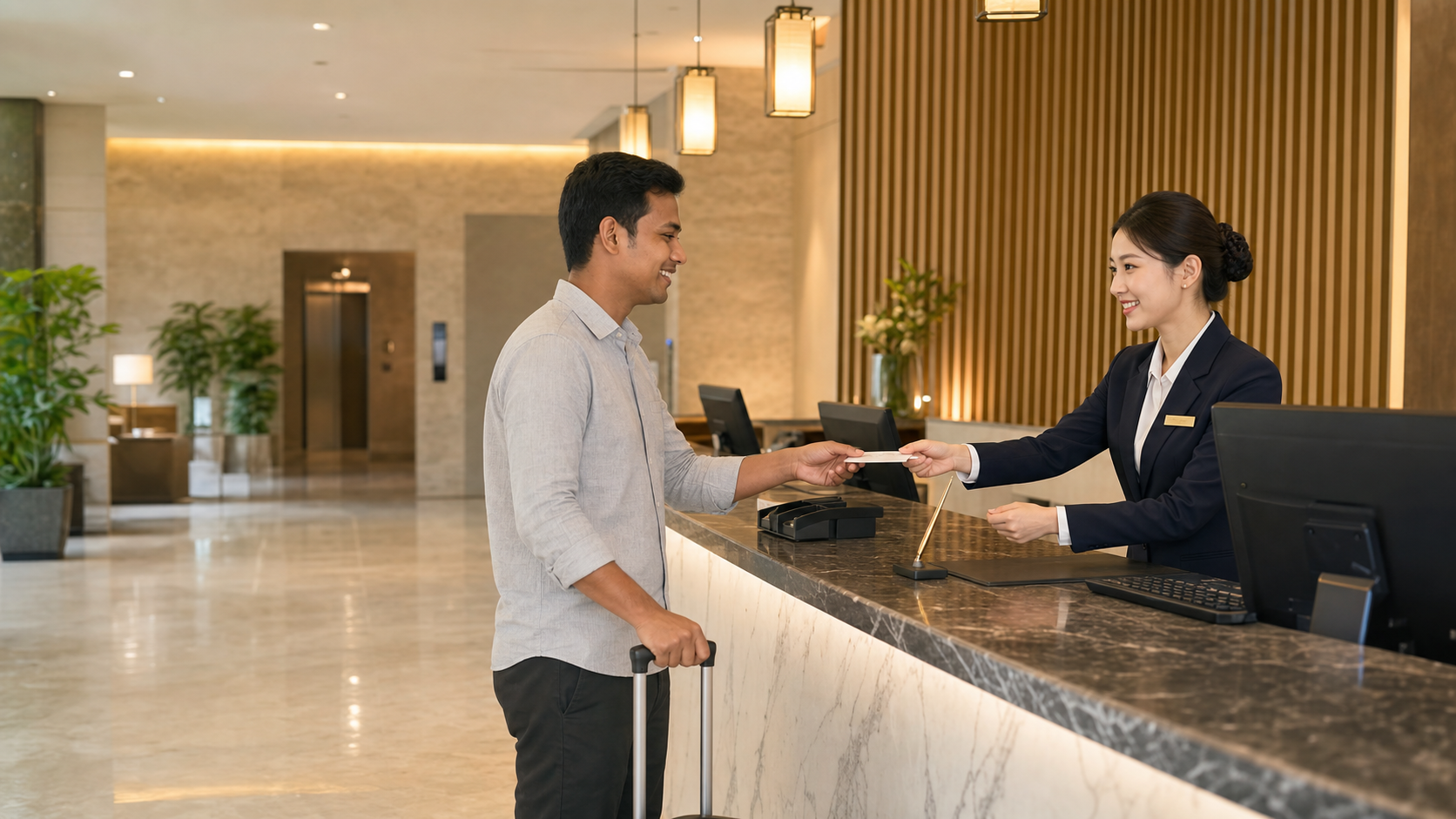
    Korean hotel front desk check-in phrases for service workers
    Korean hotel front desk check-in phrases for service workers.

    Download the PPT briefing for this lesson.

    Ghi chú tiếng Việt: Bài học dành cho lễ tân khách sạn.

    Short Introduction

    A guest walks into a Korean hotel lobby with a suitcase. You are at the front desk. The guest says, 예약했는데요 (I have a reservation), and now you must move through the check-in process without making the guest wait too long.

    Hotel front desk Korean follows a service sequence. You confirm the reservation, ask for the guest name, check an ID or passport, explain the room number, hand over the room key, mention breakfast, give check-out time, and answer small questions.

    This lesson teaches practical Korean hotel check-in phrases for service workers. The focus is knowing which Korean word controls the next front desk action. If you understand 예약 확인, 성함, 신분증, 객실 키, 조식, 보증금, and 문의, you can handle normal check-in moments more calmly.

    Key Vocabulary

    Korean Romanization English Meaning Level Usage Note
    예약 yeyak reservation Beginner The booking record you confirm first.
    예약 확인 yeyak hwagin reservation check Beginner The action of checking the guest booking.
    성함 seongham name Beginner Polite word for a guest name.
    신분증 sinbunjeung ID card Beginner Identification card for check-in.
    여권 yeogwon passport Beginner Foreign guest identification document.
    객실 gaeksil guest room Beginner Formal hotel word for room.
    객실 키 gaeksil ki room key Beginner Room key or key card.
    체크인 chekeuin check-in Beginner The process of entering the hotel as a guest.
    체크아웃 chekeuaut check-out Beginner Leaving the hotel and closing the stay.
    조식 josik breakfast Beginner Hotel breakfast service.
    보증금 bojeunggeum deposit Intermediate Temporary deposit or security hold.
    결제 gyeolje payment Beginner Payment by card, cash, or app.
    서명 seomyeong signature Intermediate Signature on a form, receipt, or policy agreement.
    안내 annae guidance; information Intermediate Explaining hotel rules, facilities, or directions.
    엘리베이터 ellibeiteo elevator Beginner Elevator location.
    cheung floor Beginner Floor number in a building.
    와이파이 waipai Wi-Fi Beginner Internet access in the hotel.
    금연 geumyeon non-smoking Intermediate No smoking rule.
    요청 yocheong request Intermediate Something the guest asks for.
    문의 munui inquiry; question Intermediate A question or request for help.

    Real Situation

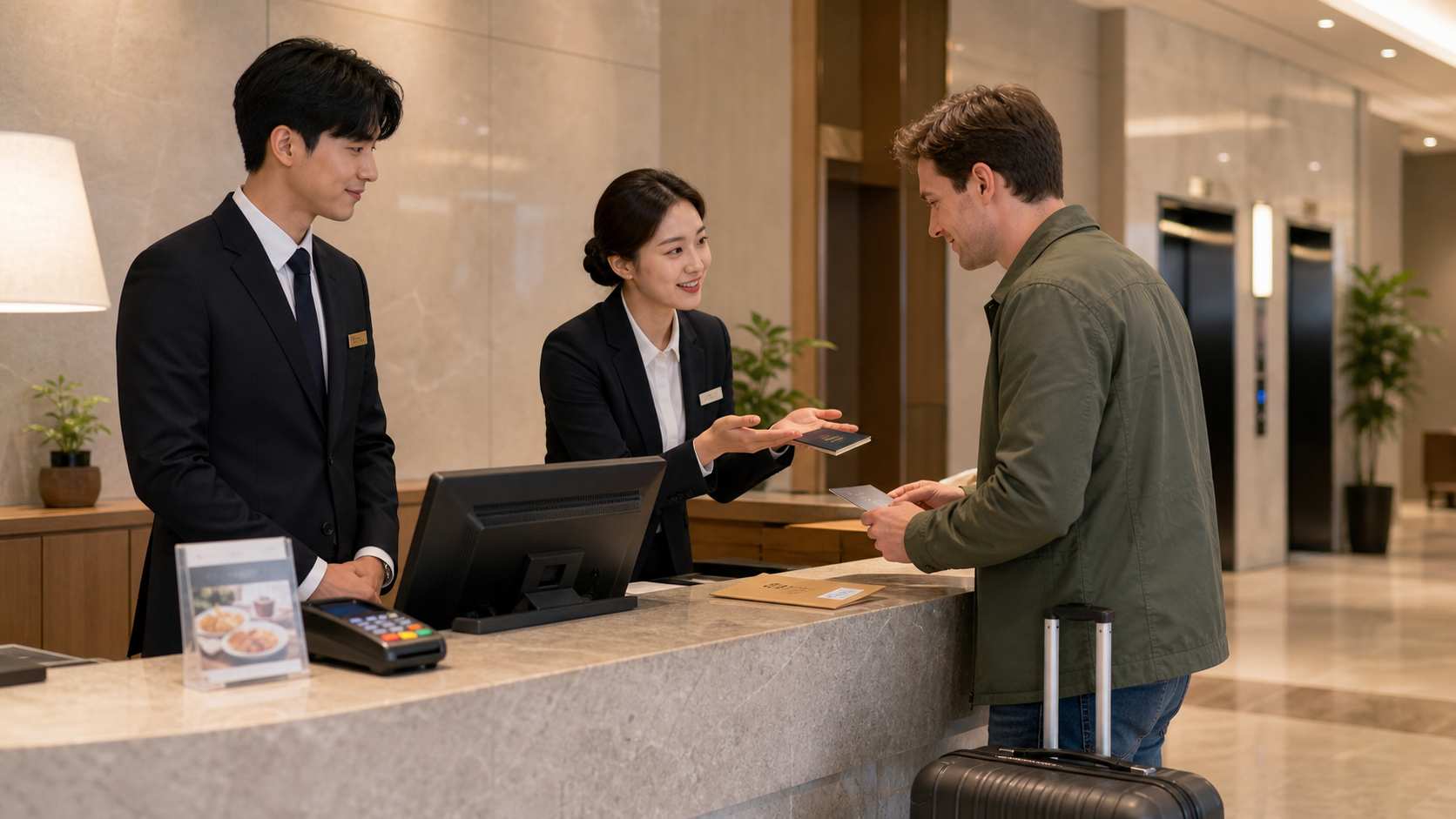
    Hotel receptionist checking a guest passport and room key during Korean check-in training
    Front desk check-in is a sequence: reservation, ID, room key, hotel information, and guest questions.

    At a Korean hotel, the first important word is usually 예약. A guest may say 예약했어요, 예약했는데요, or simply give a name. A short professional response is 예약 확인 도와드리겠습니다.

    After reservation confirmation, the front desk asks for a name. 성함 is the polite service word for name. In casual life you may hear 이름, but at a hotel, 성함이 어떻게 되세요? sounds more respectful.

    The next step is ID. For Korean guests, you may ask for 신분증. For foreign guests, 여권 is often needed. The polite pattern 보여 주시겠어요? means “Could you show me?” It is softer than just saying “give me.”

    When the reservation and ID are confirmed, the staff gives the room information. 객실 is the hotel word for guest room. 객실은 1205호입니다 means “Your room is 1205.” Then you can say 객실 키 여기 있습니다, meaning “Here is your room key.”

    Many check-ins also include breakfast, elevator, Wi-Fi, non-smoking rules, deposit, and check-out time. Explain one point at a time so the guest can follow the workflow.

    Common Expressions

    Korean Expression Romanization English Meaning Level When to Use
    예약 확인 도와드리겠습니다. Yeyak hwagin dowadeurigetsseumnida. I will help check your reservation. Intermediate Opening phrase when the guest arrives.
    성함이 어떻게 되세요? Seongham-i eotteoke doeseyo? May I have your name? Beginner Polite way to ask the guest name.
    신분증 확인 부탁드립니다. Sinbunjeung hwagin butakdeurimnida. Please let me check your ID. Intermediate When checking an ID card.
    여권 보여 주시겠어요? Yeogwon boyeo jusigesseoyo? Could you show me your passport? Intermediate When a foreign guest needs passport confirmation.
    객실은 1205호입니다. Gaeksil-eun cheoni-baek-o-ho-imnida. Your room is 1205. Beginner When giving the room number.
    객실 키 여기 있습니다. Gaeksil ki yeogi itseumnida. Here is your room key. Beginner When handing the key card.
    조식은 2층에서 이용하시면 됩니다. Josik-eun i-cheung-eseo iyonghasimyeon doemnida. Breakfast is available on the second floor. Intermediate When explaining breakfast location.
    체크아웃은 오전 11시입니다. Chekeuaut-eun ojeon yeol-hansi-imnida. Check-out is at 11 a.m. Beginner When explaining departure time.
    보증금 결제가 필요합니다. Bojeunggeum gyeolje-ga piryohamnida. A deposit payment is required. Advanced When explaining a deposit or card hold.
    문의 사항 있으시면 말씀해 주세요. Munui sahang isseusimyeon malsseumhae juseyo. Please tell us if you have any questions. Intermediate Closing phrase after check-in guidance.

    Usage Notes

    예약 확인 도와드리겠습니다 is a strong opening phrase because it tells the guest what you are doing. 도와드리겠습니다 is polite service Korean used in hotels, stores, banks, clinics, and service desks.

    성함이 어떻게 되세요? is more polite than 이름이 뭐예요?. In service work, the same meaning can feel different depending on word choice.

    신분증 확인 부탁드립니다 naturally means “Please let me check your ID.” It is clearer than only saying 신분증 주세요. For foreign guests, 여권 보여 주시겠어요? is usually smoother.

    객실 and both connect to “room,” but 객실 is the better hotel word. Use it with room number, room type, room status, and guest information.

    조식은 2층에서 이용하시면 됩니다 means “Breakfast is available on the second floor.” The pattern 이용하시면 됩니다 often appears in facility explanations.

    보증금 needs care. Some guests may think it is an extra fee. If your hotel takes a deposit or card hold, explain it simply and say whether it is refunded or only held.

    문의 사항 있으시면 말씀해 주세요 is a useful closing phrase. It invites questions and shows the staff is still available.

    Mini Dialogue

    Staff: 예약 확인 도와드리겠습니다. 성함이 어떻게 되세요?
    Yeyak hwagin dowadeurigetsseumnida. Seongham-i eotteoke doeseyo?
    I will help check your reservation. May I have your name?

    Guest: 김민수로 예약했어요.
    Gim Minsu-ro yeyakhaesseoyo.
    I made a reservation under Kim Min-su.

    Staff: 네, 확인됐습니다. 신분증 확인 부탁드립니다.
    Ne, hwagin-doetsseumnida. Sinbunjeung hwagin butakdeurimnida.
    Yes, it has been confirmed. Please let me check your ID.

    Guest: 여기 있습니다.
    Yeogi itseumnida.
    Here it is.

    Staff: 객실은 1205호입니다. 객실 키 여기 있습니다.
    Gaeksil-eun cheoni-baek-o-ho-imnida. Gaeksil ki yeogi itseumnida.
    Your room is 1205. Here is your room key.

    Staff: 조식은 2층에서 이용하시면 됩니다. 체크아웃은 오전 11시입니다.
    Josik-eun i-cheung-eseo iyonghasimyeon doemnida. Chekeuaut-eun ojeon yeol-hansi-imnida.
    Breakfast is available on the second floor. Check-out is at 11 a.m.

    Guest: 와이파이 비밀번호는 어디에 있나요?
    Waipai bimilbeonho-neun eodie innayo?
    Where is the Wi-Fi password?

    Staff: 카드 안쪽에 있습니다. 문의 사항 있으시면 말씀해 주세요.
    Kadeu anjjok-e itseumnida. Munui sahang isseusimyeon malsseumhae juseyo.
    It is inside the card holder. Please tell us if you have any questions.

    This dialogue is short on purpose. A clear flow is better than long service sentences: confirm, request ID, give room information, explain key details, and invite questions.

    Common Mistakes

    1. Using 이름 with every guest
      이름 means name, but 성함 is more polite for a guest. At a hotel front desk, 성함이 어떻게 되세요? sounds more professional than 이름이 뭐예요?
    2. Saying 신분증 주세요 too directly
      신분증 주세요 is understandable, but it can sound too short. 신분증 확인 부탁드립니다 or 신분증 보여 주시겠어요? is better for front desk service.
    3. Confusing 객실 and 방
      방 means room in daily Korean. 객실 is the standard hotel word. Use 객실 when assigning a hotel room, explaining a room number, or speaking formally.
    4. Not explaining 보증금 clearly
      보증금 may be confusing for foreign guests. If a deposit is required, explain it as a deposit or temporary card hold and keep the sentence simple.
    5. Giving too much information at once
      Check-in has many details: room, key, breakfast, Wi-Fi, check-out, deposit. Short sentences help the guest understand and help the staff avoid mistakes.

    Practice Steps

    1. Start with the reservation. Say 예약 확인 도와드리겠습니다. Do not jump directly to payment or room key.
    2. Ask for the name politely. Use 성함이 어떻게 되세요?. If the guest already gave the name, repeat it softly to confirm.
    3. Request ID or passport. Use 신분증 확인 부탁드립니다 or 여권 보여 주시겠어요?.
    4. Give room information in one sentence. Say 객실은 1205호입니다. Then hand the room key separately.
    5. Explain only the essential hotel information. Breakfast location, check-out time, Wi-Fi, deposit, and non-smoking rules should be short and clear.
    6. Close with a question invitation. Say 문의 사항 있으시면 말씀해 주세요.

    Quick Quiz

    1. Question 1. A guest arrives and you want to start checking the booking. What should you say?
      Answer: 예약 확인 도와드리겠습니다.
      This phrase opens the check-in process politely and tells the guest what you will do next.
    2. Question 2. Which word is more polite for asking a guest name: 이름 or 성함?
      Answer: 성함
      성함 is the polite service word for a customer or guest name.
    3. Question 3. What does 객실 키 mean?
      Answer: room key
      객실 means guest room, and 키 means key. In hotels, it usually means a key card.
    4. Question 4. You need to ask for a passport politely. Which phrase works best?
      Answer: 여권 보여 주시겠어요?
      보여 주시겠어요? is a polite request pattern meaning “Could you show me?”
    5. Question 5. What does 체크아웃은 오전 11시입니다 mean?
      Answer: Check-out is at 11 a.m.
      체크아웃 is check-out, 오전 is morning, and 11시 is 11 o’clock.

    Review Table

    Korean Meaning Best Situation Beginner Tip
    예약 확인 reservation check First step at check-in Use 도와드리겠습니다 for polite service.
    성함 guest name Asking who the reservation is under More polite than 이름.
    신분증 / 여권 ID / passport Identity confirmation Use 확인 부탁드립니다 or 보여 주시겠어요.
    객실 키 room key After check-in is confirmed Give the key after room number explanation.
    조식 breakfast Hotel facility explanation Mention floor and time clearly.
    보증금 deposit Payment or card hold Explain that it is a deposit, not a room fee.
    체크아웃 check-out Departure information Say the time in a short sentence.
    문의 사항 questions or inquiries Closing phrase Invite questions politely.

    Related Lessons

    Practice More

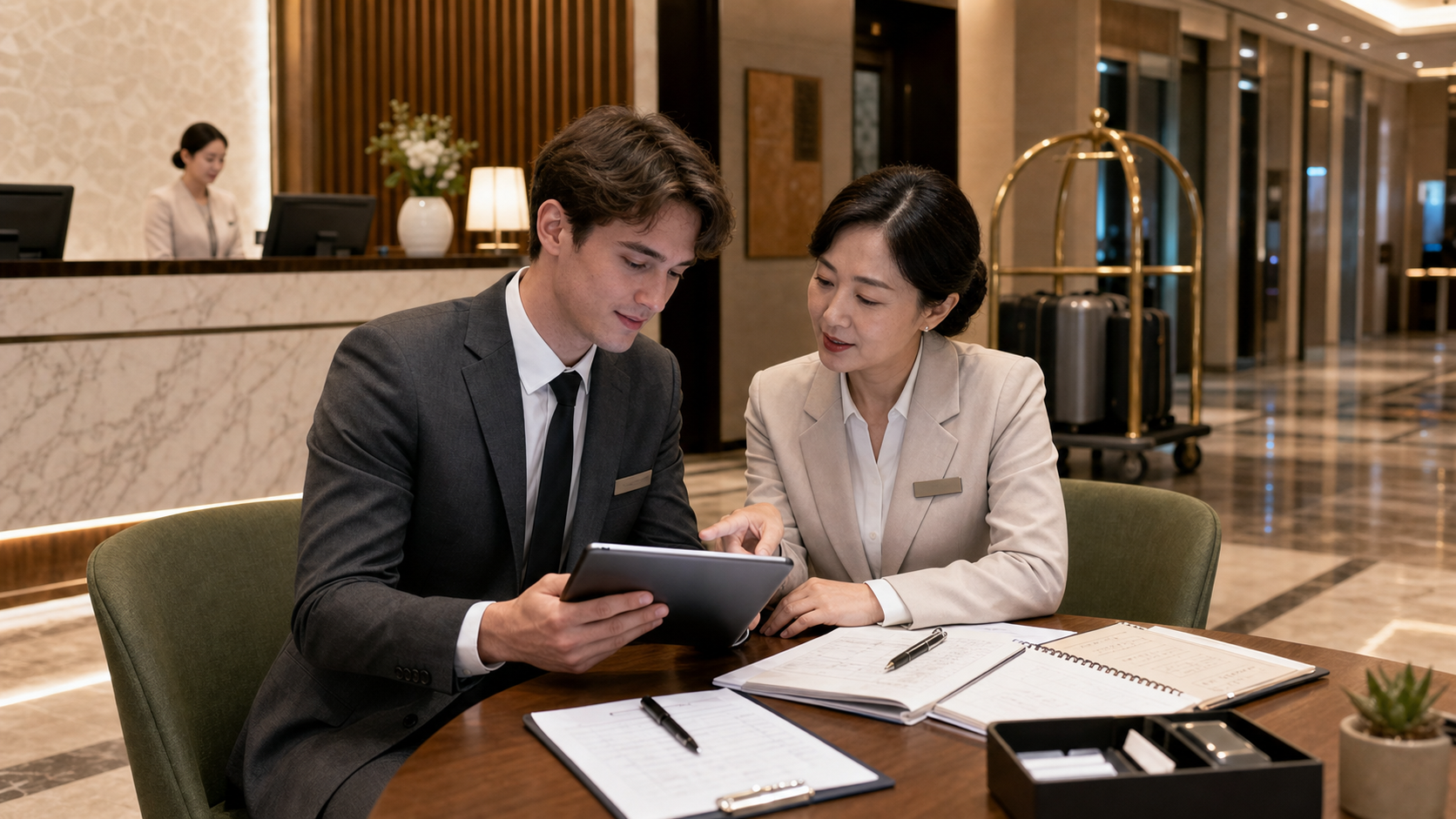
    Hotel manager and front desk trainee reviewing Korean check-in vocabulary
    Review hotel check-in phrases after a front desk shift so the flow becomes automatic.

    Practice this word list in Learn Korean or in the upcoming BSKorean app. Start with 예약 확인, 성함, 신분증, 여권, 객실 키, 조식, 보증금, and 문의 사항.

    Conclusion

    Korean hotel check-in phrases become easier when you learn them as a front desk sequence. First, check the reservation. Next, ask for the guest name and ID. Then give the room number and room key. After that, explain breakfast, check-out time, Wi-Fi, deposit, and hotel rules only as needed.

    The goal is not to memorize every possible hotel sentence. The goal is to recognize the action behind each word. 예약 확인 starts the process. 성함 identifies the guest. 신분증 and 여권 confirm identity. 객실 키 completes the handover. 문의 사항 있으시면 말씀해 주세요 closes the interaction politely.
  • วลีภาษาเกาหลีสำหรับเช็กอินโรงแรมที่แผนกต้อนรับ

    วลีภาษาเกาหลีสำหรับเช็กอินโรงแรมที่แผนกต้อนรับ

    ภาษาเกาหลีบริการสำหรับพนักงานโรงแรม

    วลีภาษาเกาหลีสำหรับเช็กอินโรงแรมที่แผนกต้อนรับ

    เรียนวลีภาษาเกาหลีสำหรับงานเช็กอินโรงแรม เช่น ตรวจจอง ขอบัตร ยื่นคีย์การ์ด อธิบายอาหารเช้า เงินมัดจำ เวลาเช็กเอาต์ และคำถามลูกค้า.

    Korean hotel front desk check-in phrases for service workers
    Korean hotel front desk check-in phrases for service workers.

    Download the PPT briefing for this lesson.

    หมายเหตุภาษาไทย: บทเรียนนี้เหมาะสำหรับพนักงานแผนกต้อนรับโรงแรมที่ต้องใช้ภาษาเกาหลีอย่างสุภาพตอนเช็กอิน ตัวอย่างภาษาเกาหลีใช้รูปแบบที่พบได้จริงในที่ทำงาน

    Short Introduction

    A guest walks into a Korean hotel lobby with a suitcase. You are at the front desk. The guest says, 예약했는데요 (I have a reservation), and now you must move through the check-in process without making the guest wait too long.

    Hotel front desk Korean follows a service sequence. You confirm the reservation, ask for the guest name, check an ID or passport, explain the room number, hand over the room key, mention breakfast, give check-out time, and answer small questions.

    This lesson teaches practical Korean hotel check-in phrases for service workers. The focus is knowing which Korean word controls the next front desk action. If you understand 예약 확인, 성함, 신분증, 객실 키, 조식, 보증금, and 문의, you can handle normal check-in moments more calmly.

    Key Vocabulary

    Korean Romanization English Meaning Level Usage Note
    예약 yeyak reservation Beginner The booking record you confirm first.
    예약 확인 yeyak hwagin reservation check Beginner The action of checking the guest booking.
    성함 seongham name Beginner Polite word for a guest name.
    신분증 sinbunjeung ID card Beginner Identification card for check-in.
    여권 yeogwon passport Beginner Foreign guest identification document.
    객실 gaeksil guest room Beginner Formal hotel word for room.
    객실 키 gaeksil ki room key Beginner Room key or key card.
    체크인 chekeuin check-in Beginner The process of entering the hotel as a guest.
    체크아웃 chekeuaut check-out Beginner Leaving the hotel and closing the stay.
    조식 josik breakfast Beginner Hotel breakfast service.
    보증금 bojeunggeum deposit Intermediate Temporary deposit or security hold.
    결제 gyeolje payment Beginner Payment by card, cash, or app.
    서명 seomyeong signature Intermediate Signature on a form, receipt, or policy agreement.
    안내 annae guidance; information Intermediate Explaining hotel rules, facilities, or directions.
    엘리베이터 ellibeiteo elevator Beginner Elevator location.
    cheung floor Beginner Floor number in a building.
    와이파이 waipai Wi-Fi Beginner Internet access in the hotel.
    금연 geumyeon non-smoking Intermediate No smoking rule.
    요청 yocheong request Intermediate Something the guest asks for.
    문의 munui inquiry; question Intermediate A question or request for help.

    Real Situation

    Hotel receptionist checking a guest passport and room key during Korean check-in training
    Front desk check-in is a sequence: reservation, ID, room key, hotel information, and guest questions.

    At a Korean hotel, the first important word is usually 예약. A guest may say 예약했어요, 예약했는데요, or simply give a name. A short professional response is 예약 확인 도와드리겠습니다.

    After reservation confirmation, the front desk asks for a name. 성함 is the polite service word for name. In casual life you may hear 이름, but at a hotel, 성함이 어떻게 되세요? sounds more respectful.

    The next step is ID. For Korean guests, you may ask for 신분증. For foreign guests, 여권 is often needed. The polite pattern 보여 주시겠어요? means “Could you show me?” It is softer than just saying “give me.”

    When the reservation and ID are confirmed, the staff gives the room information. 객실 is the hotel word for guest room. 객실은 1205호입니다 means “Your room is 1205.” Then you can say 객실 키 여기 있습니다, meaning “Here is your room key.”

    Many check-ins also include breakfast, elevator, Wi-Fi, non-smoking rules, deposit, and check-out time. Explain one point at a time so the guest can follow the workflow.

    Common Expressions

    Korean Expression Romanization English Meaning Level When to Use
    예약 확인 도와드리겠습니다. Yeyak hwagin dowadeurigetsseumnida. I will help check your reservation. Intermediate Opening phrase when the guest arrives.
    성함이 어떻게 되세요? Seongham-i eotteoke doeseyo? May I have your name? Beginner Polite way to ask the guest name.
    신분증 확인 부탁드립니다. Sinbunjeung hwagin butakdeurimnida. Please let me check your ID. Intermediate When checking an ID card.
    여권 보여 주시겠어요? Yeogwon boyeo jusigesseoyo? Could you show me your passport? Intermediate When a foreign guest needs passport confirmation.
    객실은 1205호입니다. Gaeksil-eun cheoni-baek-o-ho-imnida. Your room is 1205. Beginner When giving the room number.
    객실 키 여기 있습니다. Gaeksil ki yeogi itseumnida. Here is your room key. Beginner When handing the key card.
    조식은 2층에서 이용하시면 됩니다. Josik-eun i-cheung-eseo iyonghasimyeon doemnida. Breakfast is available on the second floor. Intermediate When explaining breakfast location.
    체크아웃은 오전 11시입니다. Chekeuaut-eun ojeon yeol-hansi-imnida. Check-out is at 11 a.m. Beginner When explaining departure time.
    보증금 결제가 필요합니다. Bojeunggeum gyeolje-ga piryohamnida. A deposit payment is required. Advanced When explaining a deposit or card hold.
    문의 사항 있으시면 말씀해 주세요. Munui sahang isseusimyeon malsseumhae juseyo. Please tell us if you have any questions. Intermediate Closing phrase after check-in guidance.

    Usage Notes

    예약 확인 도와드리겠습니다 is a strong opening phrase because it tells the guest what you are doing. 도와드리겠습니다 is polite service Korean used in hotels, stores, banks, clinics, and service desks.

    성함이 어떻게 되세요? is more polite than 이름이 뭐예요?. In service work, the same meaning can feel different depending on word choice.

    신분증 확인 부탁드립니다 naturally means “Please let me check your ID.” It is clearer than only saying 신분증 주세요. For foreign guests, 여권 보여 주시겠어요? is usually smoother.

    객실 and both connect to “room,” but 객실 is the better hotel word. Use it with room number, room type, room status, and guest information.

    조식은 2층에서 이용하시면 됩니다 means “Breakfast is available on the second floor.” The pattern 이용하시면 됩니다 often appears in facility explanations.

    보증금 needs care. Some guests may think it is an extra fee. If your hotel takes a deposit or card hold, explain it simply and say whether it is refunded or only held.

    문의 사항 있으시면 말씀해 주세요 is a useful closing phrase. It invites questions and shows the staff is still available.

    Mini Dialogue

    Staff: 예약 확인 도와드리겠습니다. 성함이 어떻게 되세요?
    Yeyak hwagin dowadeurigetsseumnida. Seongham-i eotteoke doeseyo?
    I will help check your reservation. May I have your name?

    Guest: 김민수로 예약했어요.
    Gim Minsu-ro yeyakhaesseoyo.
    I made a reservation under Kim Min-su.

    Staff: 네, 확인됐습니다. 신분증 확인 부탁드립니다.
    Ne, hwagin-doetsseumnida. Sinbunjeung hwagin butakdeurimnida.
    Yes, it has been confirmed. Please let me check your ID.

    Guest: 여기 있습니다.
    Yeogi itseumnida.
    Here it is.

    Staff: 객실은 1205호입니다. 객실 키 여기 있습니다.
    Gaeksil-eun cheoni-baek-o-ho-imnida. Gaeksil ki yeogi itseumnida.
    Your room is 1205. Here is your room key.

    Staff: 조식은 2층에서 이용하시면 됩니다. 체크아웃은 오전 11시입니다.
    Josik-eun i-cheung-eseo iyonghasimyeon doemnida. Chekeuaut-eun ojeon yeol-hansi-imnida.
    Breakfast is available on the second floor. Check-out is at 11 a.m.

    Guest: 와이파이 비밀번호는 어디에 있나요?
    Waipai bimilbeonho-neun eodie innayo?
    Where is the Wi-Fi password?

    Staff: 카드 안쪽에 있습니다. 문의 사항 있으시면 말씀해 주세요.
    Kadeu anjjok-e itseumnida. Munui sahang isseusimyeon malsseumhae juseyo.
    It is inside the card holder. Please tell us if you have any questions.

    This dialogue is short on purpose. A clear flow is better than long service sentences: confirm, request ID, give room information, explain key details, and invite questions.

    Common Mistakes

    1. Using 이름 with every guest
      이름 means name, but 성함 is more polite for a guest. At a hotel front desk, 성함이 어떻게 되세요? sounds more professional than 이름이 뭐예요?
    2. Saying 신분증 주세요 too directly
      신분증 주세요 is understandable, but it can sound too short. 신분증 확인 부탁드립니다 or 신분증 보여 주시겠어요? is better for front desk service.
    3. Confusing 객실 and 방
      방 means room in daily Korean. 객실 is the standard hotel word. Use 객실 when assigning a hotel room, explaining a room number, or speaking formally.
    4. Not explaining 보증금 clearly
      보증금 may be confusing for foreign guests. If a deposit is required, explain it as a deposit or temporary card hold and keep the sentence simple.
    5. Giving too much information at once
      Check-in has many details: room, key, breakfast, Wi-Fi, check-out, deposit. Short sentences help the guest understand and help the staff avoid mistakes.

    Practice Steps

    1. Start with the reservation. Say 예약 확인 도와드리겠습니다. Do not jump directly to payment or room key.
    2. Ask for the name politely. Use 성함이 어떻게 되세요?. If the guest already gave the name, repeat it softly to confirm.
    3. Request ID or passport. Use 신분증 확인 부탁드립니다 or 여권 보여 주시겠어요?.
    4. Give room information in one sentence. Say 객실은 1205호입니다. Then hand the room key separately.
    5. Explain only the essential hotel information. Breakfast location, check-out time, Wi-Fi, deposit, and non-smoking rules should be short and clear.
    6. Close with a question invitation. Say 문의 사항 있으시면 말씀해 주세요.

    Quick Quiz

    1. Question 1. A guest arrives and you want to start checking the booking. What should you say?
      Answer: 예약 확인 도와드리겠습니다.
      This phrase opens the check-in process politely and tells the guest what you will do next.
    2. Question 2. Which word is more polite for asking a guest name: 이름 or 성함?
      Answer: 성함
      성함 is the polite service word for a customer or guest name.
    3. Question 3. What does 객실 키 mean?
      Answer: room key
      객실 means guest room, and 키 means key. In hotels, it usually means a key card.
    4. Question 4. You need to ask for a passport politely. Which phrase works best?
      Answer: 여권 보여 주시겠어요?
      보여 주시겠어요? is a polite request pattern meaning “Could you show me?”
    5. Question 5. What does 체크아웃은 오전 11시입니다 mean?
      Answer: Check-out is at 11 a.m.
      체크아웃 is check-out, 오전 is morning, and 11시 is 11 o’clock.

    Review Table

    Korean Meaning Best Situation Beginner Tip
    예약 확인 reservation check First step at check-in Use 도와드리겠습니다 for polite service.
    성함 guest name Asking who the reservation is under More polite than 이름.
    신분증 / 여권 ID / passport Identity confirmation Use 확인 부탁드립니다 or 보여 주시겠어요.
    객실 키 room key After check-in is confirmed Give the key after room number explanation.
    조식 breakfast Hotel facility explanation Mention floor and time clearly.
    보증금 deposit Payment or card hold Explain that it is a deposit, not a room fee.
    체크아웃 check-out Departure information Say the time in a short sentence.
    문의 사항 questions or inquiries Closing phrase Invite questions politely.

    Related Lessons

    Practice More

    Hotel manager and front desk trainee reviewing Korean check-in vocabulary
    Review hotel check-in phrases after a front desk shift so the flow becomes automatic.

    Practice this word list in Learn Korean or in the upcoming BSKorean app. Start with 예약 확인, 성함, 신분증, 여권, 객실 키, 조식, 보증금, and 문의 사항.

    Conclusion

    Korean hotel check-in phrases become easier when you learn them as a front desk sequence. First, check the reservation. Next, ask for the guest name and ID. Then give the room number and room key. After that, explain breakfast, check-out time, Wi-Fi, deposit, and hotel rules only as needed.

    The goal is not to memorize every possible hotel sentence. The goal is to recognize the action behind each word. 예약 확인 starts the process. 성함 identifies the guest. 신분증 and 여권 confirm identity. 객실 키 completes the handover. 문의 사항 있으시면 말씀해 주세요 closes the interaction politely.
  • ホテルフロントで使う韓国語チェックイン表現

    ホテルフロントで使う韓国語チェックイン表現

    ホテルスタッフ向けサービス韓国語

    ホテルフロントで使う韓国語チェックイン表現

    ホテルのフロント業務で使う韓国語チェックイン表現を学びます。予約確認、身分証、客室キー、朝食、保証金、チェックアウト時間、問い合わせ対応まで練習できます。

    Korean hotel front desk check-in phrases for service workers
    Korean hotel front desk check-in phrases for service workers.

    Download the PPT briefing for this lesson.

    日本語メモ: このレッスンは、ホテルのフロントで働く人がチェックイン対応に使う丁寧な韓国語を学ぶためのものです。韓国語の例文は実際の職場で使いやすい形にしています。

    Short Introduction

    A guest walks into a Korean hotel lobby with a suitcase. You are at the front desk. The guest says, 예약했는데요 (I have a reservation), and now you must move through the check-in process without making the guest wait too long.

    Hotel front desk Korean follows a service sequence. You confirm the reservation, ask for the guest name, check an ID or passport, explain the room number, hand over the room key, mention breakfast, give check-out time, and answer small questions.

    This lesson teaches practical Korean hotel check-in phrases for service workers. The focus is knowing which Korean word controls the next front desk action. If you understand 예약 확인, 성함, 신분증, 객실 키, 조식, 보증금, and 문의, you can handle normal check-in moments more calmly.

    Key Vocabulary

    Korean Romanization English Meaning Level Usage Note
    예약 yeyak reservation Beginner The booking record you confirm first.
    예약 확인 yeyak hwagin reservation check Beginner The action of checking the guest booking.
    성함 seongham name Beginner Polite word for a guest name.
    신분증 sinbunjeung ID card Beginner Identification card for check-in.
    여권 yeogwon passport Beginner Foreign guest identification document.
    객실 gaeksil guest room Beginner Formal hotel word for room.
    객실 키 gaeksil ki room key Beginner Room key or key card.
    체크인 chekeuin check-in Beginner The process of entering the hotel as a guest.
    체크아웃 chekeuaut check-out Beginner Leaving the hotel and closing the stay.
    조식 josik breakfast Beginner Hotel breakfast service.
    보증금 bojeunggeum deposit Intermediate Temporary deposit or security hold.
    결제 gyeolje payment Beginner Payment by card, cash, or app.
    서명 seomyeong signature Intermediate Signature on a form, receipt, or policy agreement.
    안내 annae guidance; information Intermediate Explaining hotel rules, facilities, or directions.
    엘리베이터 ellibeiteo elevator Beginner Elevator location.
    cheung floor Beginner Floor number in a building.
    와이파이 waipai Wi-Fi Beginner Internet access in the hotel.
    금연 geumyeon non-smoking Intermediate No smoking rule.
    요청 yocheong request Intermediate Something the guest asks for.
    문의 munui inquiry; question Intermediate A question or request for help.

    Real Situation

    Hotel receptionist checking a guest passport and room key during Korean check-in training
    Front desk check-in is a sequence: reservation, ID, room key, hotel information, and guest questions.

    At a Korean hotel, the first important word is usually 예약. A guest may say 예약했어요, 예약했는데요, or simply give a name. A short professional response is 예약 확인 도와드리겠습니다.

    After reservation confirmation, the front desk asks for a name. 성함 is the polite service word for name. In casual life you may hear 이름, but at a hotel, 성함이 어떻게 되세요? sounds more respectful.

    The next step is ID. For Korean guests, you may ask for 신분증. For foreign guests, 여권 is often needed. The polite pattern 보여 주시겠어요? means “Could you show me?” It is softer than just saying “give me.”

    When the reservation and ID are confirmed, the staff gives the room information. 객실 is the hotel word for guest room. 객실은 1205호입니다 means “Your room is 1205.” Then you can say 객실 키 여기 있습니다, meaning “Here is your room key.”

    Many check-ins also include breakfast, elevator, Wi-Fi, non-smoking rules, deposit, and check-out time. Explain one point at a time so the guest can follow the workflow.

    Common Expressions

    Korean Expression Romanization English Meaning Level When to Use
    예약 확인 도와드리겠습니다. Yeyak hwagin dowadeurigetsseumnida. I will help check your reservation. Intermediate Opening phrase when the guest arrives.
    성함이 어떻게 되세요? Seongham-i eotteoke doeseyo? May I have your name? Beginner Polite way to ask the guest name.
    신분증 확인 부탁드립니다. Sinbunjeung hwagin butakdeurimnida. Please let me check your ID. Intermediate When checking an ID card.
    여권 보여 주시겠어요? Yeogwon boyeo jusigesseoyo? Could you show me your passport? Intermediate When a foreign guest needs passport confirmation.
    객실은 1205호입니다. Gaeksil-eun cheoni-baek-o-ho-imnida. Your room is 1205. Beginner When giving the room number.
    객실 키 여기 있습니다. Gaeksil ki yeogi itseumnida. Here is your room key. Beginner When handing the key card.
    조식은 2층에서 이용하시면 됩니다. Josik-eun i-cheung-eseo iyonghasimyeon doemnida. Breakfast is available on the second floor. Intermediate When explaining breakfast location.
    체크아웃은 오전 11시입니다. Chekeuaut-eun ojeon yeol-hansi-imnida. Check-out is at 11 a.m. Beginner When explaining departure time.
    보증금 결제가 필요합니다. Bojeunggeum gyeolje-ga piryohamnida. A deposit payment is required. Advanced When explaining a deposit or card hold.
    문의 사항 있으시면 말씀해 주세요. Munui sahang isseusimyeon malsseumhae juseyo. Please tell us if you have any questions. Intermediate Closing phrase after check-in guidance.

    Usage Notes

    예약 확인 도와드리겠습니다 is a strong opening phrase because it tells the guest what you are doing. 도와드리겠습니다 is polite service Korean used in hotels, stores, banks, clinics, and service desks.

    성함이 어떻게 되세요? is more polite than 이름이 뭐예요?. In service work, the same meaning can feel different depending on word choice.

    신분증 확인 부탁드립니다 naturally means “Please let me check your ID.” It is clearer than only saying 신분증 주세요. For foreign guests, 여권 보여 주시겠어요? is usually smoother.

    객실 and both connect to “room,” but 객실 is the better hotel word. Use it with room number, room type, room status, and guest information.

    조식은 2층에서 이용하시면 됩니다 means “Breakfast is available on the second floor.” The pattern 이용하시면 됩니다 often appears in facility explanations.

    보증금 needs care. Some guests may think it is an extra fee. If your hotel takes a deposit or card hold, explain it simply and say whether it is refunded or only held.

    문의 사항 있으시면 말씀해 주세요 is a useful closing phrase. It invites questions and shows the staff is still available.

    Mini Dialogue

    Staff: 예약 확인 도와드리겠습니다. 성함이 어떻게 되세요?
    Yeyak hwagin dowadeurigetsseumnida. Seongham-i eotteoke doeseyo?
    I will help check your reservation. May I have your name?

    Guest: 김민수로 예약했어요.
    Gim Minsu-ro yeyakhaesseoyo.
    I made a reservation under Kim Min-su.

    Staff: 네, 확인됐습니다. 신분증 확인 부탁드립니다.
    Ne, hwagin-doetsseumnida. Sinbunjeung hwagin butakdeurimnida.
    Yes, it has been confirmed. Please let me check your ID.

    Guest: 여기 있습니다.
    Yeogi itseumnida.
    Here it is.

    Staff: 객실은 1205호입니다. 객실 키 여기 있습니다.
    Gaeksil-eun cheoni-baek-o-ho-imnida. Gaeksil ki yeogi itseumnida.
    Your room is 1205. Here is your room key.

    Staff: 조식은 2층에서 이용하시면 됩니다. 체크아웃은 오전 11시입니다.
    Josik-eun i-cheung-eseo iyonghasimyeon doemnida. Chekeuaut-eun ojeon yeol-hansi-imnida.
    Breakfast is available on the second floor. Check-out is at 11 a.m.

    Guest: 와이파이 비밀번호는 어디에 있나요?
    Waipai bimilbeonho-neun eodie innayo?
    Where is the Wi-Fi password?

    Staff: 카드 안쪽에 있습니다. 문의 사항 있으시면 말씀해 주세요.
    Kadeu anjjok-e itseumnida. Munui sahang isseusimyeon malsseumhae juseyo.
    It is inside the card holder. Please tell us if you have any questions.

    This dialogue is short on purpose. A clear flow is better than long service sentences: confirm, request ID, give room information, explain key details, and invite questions.

    Common Mistakes

    1. Using 이름 with every guest
      이름 means name, but 성함 is more polite for a guest. At a hotel front desk, 성함이 어떻게 되세요? sounds more professional than 이름이 뭐예요?
    2. Saying 신분증 주세요 too directly
      신분증 주세요 is understandable, but it can sound too short. 신분증 확인 부탁드립니다 or 신분증 보여 주시겠어요? is better for front desk service.
    3. Confusing 객실 and 방
      방 means room in daily Korean. 객실 is the standard hotel word. Use 객실 when assigning a hotel room, explaining a room number, or speaking formally.
    4. Not explaining 보증금 clearly
      보증금 may be confusing for foreign guests. If a deposit is required, explain it as a deposit or temporary card hold and keep the sentence simple.
    5. Giving too much information at once
      Check-in has many details: room, key, breakfast, Wi-Fi, check-out, deposit. Short sentences help the guest understand and help the staff avoid mistakes.

    Practice Steps

    1. Start with the reservation. Say 예약 확인 도와드리겠습니다. Do not jump directly to payment or room key.
    2. Ask for the name politely. Use 성함이 어떻게 되세요?. If the guest already gave the name, repeat it softly to confirm.
    3. Request ID or passport. Use 신분증 확인 부탁드립니다 or 여권 보여 주시겠어요?.
    4. Give room information in one sentence. Say 객실은 1205호입니다. Then hand the room key separately.
    5. Explain only the essential hotel information. Breakfast location, check-out time, Wi-Fi, deposit, and non-smoking rules should be short and clear.
    6. Close with a question invitation. Say 문의 사항 있으시면 말씀해 주세요.

    Quick Quiz

    1. Question 1. A guest arrives and you want to start checking the booking. What should you say?
      Answer: 예약 확인 도와드리겠습니다.
      This phrase opens the check-in process politely and tells the guest what you will do next.
    2. Question 2. Which word is more polite for asking a guest name: 이름 or 성함?
      Answer: 성함
      성함 is the polite service word for a customer or guest name.
    3. Question 3. What does 객실 키 mean?
      Answer: room key
      객실 means guest room, and 키 means key. In hotels, it usually means a key card.
    4. Question 4. You need to ask for a passport politely. Which phrase works best?
      Answer: 여권 보여 주시겠어요?
      보여 주시겠어요? is a polite request pattern meaning “Could you show me?”
    5. Question 5. What does 체크아웃은 오전 11시입니다 mean?
      Answer: Check-out is at 11 a.m.
      체크아웃 is check-out, 오전 is morning, and 11시 is 11 o’clock.

    Review Table

    Korean Meaning Best Situation Beginner Tip
    예약 확인 reservation check First step at check-in Use 도와드리겠습니다 for polite service.
    성함 guest name Asking who the reservation is under More polite than 이름.
    신분증 / 여권 ID / passport Identity confirmation Use 확인 부탁드립니다 or 보여 주시겠어요.
    객실 키 room key After check-in is confirmed Give the key after room number explanation.
    조식 breakfast Hotel facility explanation Mention floor and time clearly.
    보증금 deposit Payment or card hold Explain that it is a deposit, not a room fee.
    체크아웃 check-out Departure information Say the time in a short sentence.
    문의 사항 questions or inquiries Closing phrase Invite questions politely.

    Related Lessons

    Practice More

    Hotel manager and front desk trainee reviewing Korean check-in vocabulary
    Review hotel check-in phrases after a front desk shift so the flow becomes automatic.

    Practice this word list in Learn Korean or in the upcoming BSKorean app. Start with 예약 확인, 성함, 신분증, 여권, 객실 키, 조식, 보증금, and 문의 사항.

    Conclusion

    Korean hotel check-in phrases become easier when you learn them as a front desk sequence. First, check the reservation. Next, ask for the guest name and ID. Then give the room number and room key. After that, explain breakfast, check-out time, Wi-Fi, deposit, and hotel rules only as needed.

    The goal is not to memorize every possible hotel sentence. The goal is to recognize the action behind each word. 예약 확인 starts the process. 성함 identifies the guest. 신분증 and 여권 confirm identity. 객실 키 completes the handover. 문의 사항 있으시면 말씀해 주세요 closes the interaction politely.

  • Frasa Bahasa Korea untuk Check-in Hotel bagi Staf Front Desk

    Frasa Bahasa Korea untuk Check-in Hotel bagi Staf Front Desk

    Bahasa Korea layanan untuk pekerja hotel

    Frasa Bahasa Korea untuk Check-in Hotel bagi Staf Front Desk

    Pelajari frasa Korea untuk check-in hotel: konfirmasi reservasi, identitas, kunci kamar, sarapan, deposit, dan waktu check-out.

    Korean hotel front desk check-in phrases for service workers
    Korean hotel front desk check-in phrases for service workers.

    Download the PPT briefing for this lesson.

    Catatan bahasa Indonesia: Pelajaran ini ditulis untuk pekerja front desk hotel yang perlu memakai bahasa Korea sopan saat check-in. Contoh utama tetap memakai hangul agar dapat langsung dipraktikkan di tempat kerja.

    Short Introduction

    A guest walks into a Korean hotel lobby with a suitcase. You are at the front desk. The guest says, 예약했는데요 (I have a reservation), and now you must move through the check-in process without making the guest wait too long.

    Hotel front desk Korean follows a service sequence. You confirm the reservation, ask for the guest name, check an ID or passport, explain the room number, hand over the room key, mention breakfast, give check-out time, and answer small questions.

    This lesson teaches practical Korean hotel check-in phrases for service workers. The focus is knowing which Korean word controls the next front desk action. If you understand 예약 확인, 성함, 신분증, 객실 키, 조식, 보증금, and 문의, you can handle normal check-in moments more calmly.

    Key Vocabulary

    Korean Romanization English Meaning Level Usage Note
    예약 yeyak reservation Beginner The booking record you confirm first.
    예약 확인 yeyak hwagin reservation check Beginner The action of checking the guest booking.
    성함 seongham name Beginner Polite word for a guest name.
    신분증 sinbunjeung ID card Beginner Identification card for check-in.
    여권 yeogwon passport Beginner Foreign guest identification document.
    객실 gaeksil guest room Beginner Formal hotel word for room.
    객실 키 gaeksil ki room key Beginner Room key or key card.
    체크인 chekeuin check-in Beginner The process of entering the hotel as a guest.
    체크아웃 chekeuaut check-out Beginner Leaving the hotel and closing the stay.
    조식 josik breakfast Beginner Hotel breakfast service.
    보증금 bojeunggeum deposit Intermediate Temporary deposit or security hold.
    결제 gyeolje payment Beginner Payment by card, cash, or app.
    서명 seomyeong signature Intermediate Signature on a form, receipt, or policy agreement.
    안내 annae guidance; information Intermediate Explaining hotel rules, facilities, or directions.
    엘리베이터 ellibeiteo elevator Beginner Elevator location.
    cheung floor Beginner Floor number in a building.
    와이파이 waipai Wi-Fi Beginner Internet access in the hotel.
    금연 geumyeon non-smoking Intermediate No smoking rule.
    요청 yocheong request Intermediate Something the guest asks for.
    문의 munui inquiry; question Intermediate A question or request for help.

    Real Situation

    Hotel receptionist checking a guest passport and room key during Korean check-in training
    Front desk check-in is a sequence: reservation, ID, room key, hotel information, and guest questions.

    At a Korean hotel, the first important word is usually 예약. A guest may say 예약했어요, 예약했는데요, or simply give a name. A short professional response is 예약 확인 도와드리겠습니다.

    After reservation confirmation, the front desk asks for a name. 성함 is the polite service word for name. In casual life you may hear 이름, but at a hotel, 성함이 어떻게 되세요? sounds more respectful.

    The next step is ID. For Korean guests, you may ask for 신분증. For foreign guests, 여권 is often needed. The polite pattern 보여 주시겠어요? means “Could you show me?” It is softer than just saying “give me.”

    When the reservation and ID are confirmed, the staff gives the room information. 객실 is the hotel word for guest room. 객실은 1205호입니다 means “Your room is 1205.” Then you can say 객실 키 여기 있습니다, meaning “Here is your room key.”

    Many check-ins also include breakfast, elevator, Wi-Fi, non-smoking rules, deposit, and check-out time. Explain one point at a time so the guest can follow the workflow.

    Common Expressions

    Korean Expression Romanization English Meaning Level When to Use
    예약 확인 도와드리겠습니다. Yeyak hwagin dowadeurigetsseumnida. I will help check your reservation. Intermediate Opening phrase when the guest arrives.
    성함이 어떻게 되세요? Seongham-i eotteoke doeseyo? May I have your name? Beginner Polite way to ask the guest name.
    신분증 확인 부탁드립니다. Sinbunjeung hwagin butakdeurimnida. Please let me check your ID. Intermediate When checking an ID card.
    여권 보여 주시겠어요? Yeogwon boyeo jusigesseoyo? Could you show me your passport? Intermediate When a foreign guest needs passport confirmation.
    객실은 1205호입니다. Gaeksil-eun cheoni-baek-o-ho-imnida. Your room is 1205. Beginner When giving the room number.
    객실 키 여기 있습니다. Gaeksil ki yeogi itseumnida. Here is your room key. Beginner When handing the key card.
    조식은 2층에서 이용하시면 됩니다. Josik-eun i-cheung-eseo iyonghasimyeon doemnida. Breakfast is available on the second floor. Intermediate When explaining breakfast location.
    체크아웃은 오전 11시입니다. Chekeuaut-eun ojeon yeol-hansi-imnida. Check-out is at 11 a.m. Beginner When explaining departure time.
    보증금 결제가 필요합니다. Bojeunggeum gyeolje-ga piryohamnida. A deposit payment is required. Advanced When explaining a deposit or card hold.
    문의 사항 있으시면 말씀해 주세요. Munui sahang isseusimyeon malsseumhae juseyo. Please tell us if you have any questions. Intermediate Closing phrase after check-in guidance.

    Usage Notes

    예약 확인 도와드리겠습니다 is a strong opening phrase because it tells the guest what you are doing. 도와드리겠습니다 is polite service Korean used in hotels, stores, banks, clinics, and service desks.

    성함이 어떻게 되세요? is more polite than 이름이 뭐예요?. In service work, the same meaning can feel different depending on word choice.

    신분증 확인 부탁드립니다 naturally means “Please let me check your ID.” It is clearer than only saying 신분증 주세요. For foreign guests, 여권 보여 주시겠어요? is usually smoother.

    객실 and both connect to “room,” but 객실 is the better hotel word. Use it with room number, room type, room status, and guest information.

    조식은 2층에서 이용하시면 됩니다 means “Breakfast is available on the second floor.” The pattern 이용하시면 됩니다 often appears in facility explanations.

    보증금 needs care. Some guests may think it is an extra fee. If your hotel takes a deposit or card hold, explain it simply and say whether it is refunded or only held.

    문의 사항 있으시면 말씀해 주세요 is a useful closing phrase. It invites questions and shows the staff is still available.

    Mini Dialogue

    Staff: 예약 확인 도와드리겠습니다. 성함이 어떻게 되세요?
    Yeyak hwagin dowadeurigetsseumnida. Seongham-i eotteoke doeseyo?
    I will help check your reservation. May I have your name?

    Guest: 김민수로 예약했어요.
    Gim Minsu-ro yeyakhaesseoyo.
    I made a reservation under Kim Min-su.

    Staff: 네, 확인됐습니다. 신분증 확인 부탁드립니다.
    Ne, hwagin-doetsseumnida. Sinbunjeung hwagin butakdeurimnida.
    Yes, it has been confirmed. Please let me check your ID.

    Guest: 여기 있습니다.
    Yeogi itseumnida.
    Here it is.

    Staff: 객실은 1205호입니다. 객실 키 여기 있습니다.
    Gaeksil-eun cheoni-baek-o-ho-imnida. Gaeksil ki yeogi itseumnida.
    Your room is 1205. Here is your room key.

    Staff: 조식은 2층에서 이용하시면 됩니다. 체크아웃은 오전 11시입니다.
    Josik-eun i-cheung-eseo iyonghasimyeon doemnida. Chekeuaut-eun ojeon yeol-hansi-imnida.
    Breakfast is available on the second floor. Check-out is at 11 a.m.

    Guest: 와이파이 비밀번호는 어디에 있나요?
    Waipai bimilbeonho-neun eodie innayo?
    Where is the Wi-Fi password?

    Staff: 카드 안쪽에 있습니다. 문의 사항 있으시면 말씀해 주세요.
    Kadeu anjjok-e itseumnida. Munui sahang isseusimyeon malsseumhae juseyo.
    It is inside the card holder. Please tell us if you have any questions.

    This dialogue is short on purpose. A clear flow is better than long service sentences: confirm, request ID, give room information, explain key details, and invite questions.

    Common Mistakes

    1. Using 이름 with every guest
      이름 means name, but 성함 is more polite for a guest. At a hotel front desk, 성함이 어떻게 되세요? sounds more professional than 이름이 뭐예요?
    2. Saying 신분증 주세요 too directly
      신분증 주세요 is understandable, but it can sound too short. 신분증 확인 부탁드립니다 or 신분증 보여 주시겠어요? is better for front desk service.
    3. Confusing 객실 and 방
      방 means room in daily Korean. 객실 is the standard hotel word. Use 객실 when assigning a hotel room, explaining a room number, or speaking formally.
    4. Not explaining 보증금 clearly
      보증금 may be confusing for foreign guests. If a deposit is required, explain it as a deposit or temporary card hold and keep the sentence simple.
    5. Giving too much information at once
      Check-in has many details: room, key, breakfast, Wi-Fi, check-out, deposit. Short sentences help the guest understand and help the staff avoid mistakes.

    Practice Steps

    1. Start with the reservation. Say 예약 확인 도와드리겠습니다. Do not jump directly to payment or room key.
    2. Ask for the name politely. Use 성함이 어떻게 되세요?. If the guest already gave the name, repeat it softly to confirm.
    3. Request ID or passport. Use 신분증 확인 부탁드립니다 or 여권 보여 주시겠어요?.
    4. Give room information in one sentence. Say 객실은 1205호입니다. Then hand the room key separately.
    5. Explain only the essential hotel information. Breakfast location, check-out time, Wi-Fi, deposit, and non-smoking rules should be short and clear.
    6. Close with a question invitation. Say 문의 사항 있으시면 말씀해 주세요.

    Quick Quiz

    1. Question 1. A guest arrives and you want to start checking the booking. What should you say?
      Answer: 예약 확인 도와드리겠습니다.
      This phrase opens the check-in process politely and tells the guest what you will do next.
    2. Question 2. Which word is more polite for asking a guest name: 이름 or 성함?
      Answer: 성함
      성함 is the polite service word for a customer or guest name.
    3. Question 3. What does 객실 키 mean?
      Answer: room key
      객실 means guest room, and 키 means key. In hotels, it usually means a key card.
    4. Question 4. You need to ask for a passport politely. Which phrase works best?
      Answer: 여권 보여 주시겠어요?
      보여 주시겠어요? is a polite request pattern meaning “Could you show me?”
    5. Question 5. What does 체크아웃은 오전 11시입니다 mean?
      Answer: Check-out is at 11 a.m.
      체크아웃 is check-out, 오전 is morning, and 11시 is 11 o’clock.

    Review Table

    Korean Meaning Best Situation Beginner Tip
    예약 확인 reservation check First step at check-in Use 도와드리겠습니다 for polite service.
    성함 guest name Asking who the reservation is under More polite than 이름.
    신분증 / 여권 ID / passport Identity confirmation Use 확인 부탁드립니다 or 보여 주시겠어요.
    객실 키 room key After check-in is confirmed Give the key after room number explanation.
    조식 breakfast Hotel facility explanation Mention floor and time clearly.
    보증금 deposit Payment or card hold Explain that it is a deposit, not a room fee.
    체크아웃 check-out Departure information Say the time in a short sentence.
    문의 사항 questions or inquiries Closing phrase Invite questions politely.

    Related Lessons

    Practice More

    Hotel manager and front desk trainee reviewing Korean check-in vocabulary
    Review hotel check-in phrases after a front desk shift so the flow becomes automatic.

    Practice this word list in Learn Korean or in the upcoming BSKorean app. Start with 예약 확인, 성함, 신분증, 여권, 객실 키, 조식, 보증금, and 문의 사항.

    Conclusion

    Korean hotel check-in phrases become easier when you learn them as a front desk sequence. First, check the reservation. Next, ask for the guest name and ID. Then give the room number and room key. After that, explain breakfast, check-out time, Wi-Fi, deposit, and hotel rules only as needed.

    The goal is not to memorize every possible hotel sentence. The goal is to recognize the action behind each word. 예약 확인 starts the process. 성함 identifies the guest. 신분증 and 여권 confirm identity. 객실 키 completes the handover. 문의 사항 있으시면 말씀해 주세요 closes the interaction politely.

  • Korean Hotel Front Desk Check-in Phrases for Service Workers

    Korean Hotel Front Desk Check-in Phrases for Service Workers

    Service Korean for hotel workers

    Korean Hotel Front Desk Check-in Phrases for Service Workers

    Learn Korean hotel check-in phrases for front desk work, including reservation checks, ID requests, room keys, breakfast, deposits, and checkout.

    Korean hotel front desk check-in phrases for service workers
    Korean hotel front desk check-in phrases for service workers.

    Download the PPT briefing for this lesson.

    Short Introduction

    A guest walks into a Korean hotel lobby with a suitcase. You are at the front desk. The guest says, 예약했는데요 (I have a reservation), and now you must move through the check-in process without making the guest wait too long.

    Hotel front desk Korean follows a service sequence. You confirm the reservation, ask for the guest name, check an ID or passport, explain the room number, hand over the room key, mention breakfast, give check-out time, and answer small questions.

    This lesson teaches practical Korean hotel check-in phrases for service workers. The focus is knowing which Korean word controls the next front desk action. If you understand 예약 확인, 성함, 신분증, 객실 키, 조식, 보증금, and 문의, you can handle normal check-in moments more calmly.

    Key Vocabulary

    Korean Romanization English Meaning Level Usage Note
    예약 yeyak reservation Beginner The booking record you confirm first.
    예약 확인 yeyak hwagin reservation check Beginner The action of checking the guest booking.
    성함 seongham name Beginner Polite word for a guest name.
    신분증 sinbunjeung ID card Beginner Identification card for check-in.
    여권 yeogwon passport Beginner Foreign guest identification document.
    객실 gaeksil guest room Beginner Formal hotel word for room.
    객실 키 gaeksil ki room key Beginner Room key or key card.
    체크인 chekeuin check-in Beginner The process of entering the hotel as a guest.
    체크아웃 chekeuaut check-out Beginner Leaving the hotel and closing the stay.
    조식 josik breakfast Beginner Hotel breakfast service.
    보증금 bojeunggeum deposit Intermediate Temporary deposit or security hold.
    결제 gyeolje payment Beginner Payment by card, cash, or app.
    서명 seomyeong signature Intermediate Signature on a form, receipt, or policy agreement.
    안내 annae guidance; information Intermediate Explaining hotel rules, facilities, or directions.
    엘리베이터 ellibeiteo elevator Beginner Elevator location.
    cheung floor Beginner Floor number in a building.
    와이파이 waipai Wi-Fi Beginner Internet access in the hotel.
    금연 geumyeon non-smoking Intermediate No smoking rule.
    요청 yocheong request Intermediate Something the guest asks for.
    문의 munui inquiry; question Intermediate A question or request for help.

    Real Situation

    Hotel receptionist checking a guest passport and room key during Korean check-in training
    Front desk check-in is a sequence: reservation, ID, room key, hotel information, and guest questions.

    At a Korean hotel, the first important word is usually 예약. A guest may say 예약했어요, 예약했는데요, or simply give a name. A short professional response is 예약 확인 도와드리겠습니다.

    After reservation confirmation, the front desk asks for a name. 성함 is the polite service word for name. In casual life you may hear 이름, but at a hotel, 성함이 어떻게 되세요? sounds more respectful.

    The next step is ID. For Korean guests, you may ask for 신분증. For foreign guests, 여권 is often needed. The polite pattern 보여 주시겠어요? means “Could you show me?” It is softer than just saying “give me.”

    When the reservation and ID are confirmed, the staff gives the room information. 객실 is the hotel word for guest room. 객실은 1205호입니다 means “Your room is 1205.” Then you can say 객실 키 여기 있습니다, meaning “Here is your room key.”

    Many check-ins also include breakfast, elevator, Wi-Fi, non-smoking rules, deposit, and check-out time. Explain one point at a time so the guest can follow the workflow.

    Common Expressions

    Korean Expression Romanization English Meaning Level When to Use
    예약 확인 도와드리겠습니다. Yeyak hwagin dowadeurigetsseumnida. I will help check your reservation. Intermediate Opening phrase when the guest arrives.
    성함이 어떻게 되세요? Seongham-i eotteoke doeseyo? May I have your name? Beginner Polite way to ask the guest name.
    신분증 확인 부탁드립니다. Sinbunjeung hwagin butakdeurimnida. Please let me check your ID. Intermediate When checking an ID card.
    여권 보여 주시겠어요? Yeogwon boyeo jusigesseoyo? Could you show me your passport? Intermediate When a foreign guest needs passport confirmation.
    객실은 1205호입니다. Gaeksil-eun cheoni-baek-o-ho-imnida. Your room is 1205. Beginner When giving the room number.
    객실 키 여기 있습니다. Gaeksil ki yeogi itseumnida. Here is your room key. Beginner When handing the key card.
    조식은 2층에서 이용하시면 됩니다. Josik-eun i-cheung-eseo iyonghasimyeon doemnida. Breakfast is available on the second floor. Intermediate When explaining breakfast location.
    체크아웃은 오전 11시입니다. Chekeuaut-eun ojeon yeol-hansi-imnida. Check-out is at 11 a.m. Beginner When explaining departure time.
    보증금 결제가 필요합니다. Bojeunggeum gyeolje-ga piryohamnida. A deposit payment is required. Advanced When explaining a deposit or card hold.
    문의 사항 있으시면 말씀해 주세요. Munui sahang isseusimyeon malsseumhae juseyo. Please tell us if you have any questions. Intermediate Closing phrase after check-in guidance.

    Usage Notes

    예약 확인 도와드리겠습니다 is a strong opening phrase because it tells the guest what you are doing. 도와드리겠습니다 is polite service Korean used in hotels, stores, banks, clinics, and service desks.

    성함이 어떻게 되세요? is more polite than 이름이 뭐예요?. In service work, the same meaning can feel different depending on word choice.

    신분증 확인 부탁드립니다 naturally means “Please let me check your ID.” It is clearer than only saying 신분증 주세요. For foreign guests, 여권 보여 주시겠어요? is usually smoother.

    객실 and both connect to “room,” but 객실 is the better hotel word. Use it with room number, room type, room status, and guest information.

    조식은 2층에서 이용하시면 됩니다 means “Breakfast is available on the second floor.” The pattern 이용하시면 됩니다 often appears in facility explanations.

    보증금 needs care. Some guests may think it is an extra fee. If your hotel takes a deposit or card hold, explain it simply and say whether it is refunded or only held.

    문의 사항 있으시면 말씀해 주세요 is a useful closing phrase. It invites questions and shows the staff is still available.

    Mini Dialogue

    Staff: 예약 확인 도와드리겠습니다. 성함이 어떻게 되세요?
    Yeyak hwagin dowadeurigetsseumnida. Seongham-i eotteoke doeseyo?
    I will help check your reservation. May I have your name?

    Guest: 김민수로 예약했어요.
    Gim Minsu-ro yeyakhaesseoyo.
    I made a reservation under Kim Min-su.

    Staff: 네, 확인됐습니다. 신분증 확인 부탁드립니다.
    Ne, hwagin-doetsseumnida. Sinbunjeung hwagin butakdeurimnida.
    Yes, it has been confirmed. Please let me check your ID.

    Guest: 여기 있습니다.
    Yeogi itseumnida.
    Here it is.

    Staff: 객실은 1205호입니다. 객실 키 여기 있습니다.
    Gaeksil-eun cheoni-baek-o-ho-imnida. Gaeksil ki yeogi itseumnida.
    Your room is 1205. Here is your room key.

    Staff: 조식은 2층에서 이용하시면 됩니다. 체크아웃은 오전 11시입니다.
    Josik-eun i-cheung-eseo iyonghasimyeon doemnida. Chekeuaut-eun ojeon yeol-hansi-imnida.
    Breakfast is available on the second floor. Check-out is at 11 a.m.

    Guest: 와이파이 비밀번호는 어디에 있나요?
    Waipai bimilbeonho-neun eodie innayo?
    Where is the Wi-Fi password?

    Staff: 카드 안쪽에 있습니다. 문의 사항 있으시면 말씀해 주세요.
    Kadeu anjjok-e itseumnida. Munui sahang isseusimyeon malsseumhae juseyo.
    It is inside the card holder. Please tell us if you have any questions.

    This dialogue is short on purpose. A clear flow is better than long service sentences: confirm, request ID, give room information, explain key details, and invite questions.

    Common Mistakes

    1. Using 이름 with every guest
      이름 means name, but 성함 is more polite for a guest. At a hotel front desk, 성함이 어떻게 되세요? sounds more professional than 이름이 뭐예요?
    2. Saying 신분증 주세요 too directly
      신분증 주세요 is understandable, but it can sound too short. 신분증 확인 부탁드립니다 or 신분증 보여 주시겠어요? is better for front desk service.
    3. Confusing 객실 and 방
      방 means room in daily Korean. 객실 is the standard hotel word. Use 객실 when assigning a hotel room, explaining a room number, or speaking formally.
    4. Not explaining 보증금 clearly
      보증금 may be confusing for foreign guests. If a deposit is required, explain it as a deposit or temporary card hold and keep the sentence simple.
    5. Giving too much information at once
      Check-in has many details: room, key, breakfast, Wi-Fi, check-out, deposit. Short sentences help the guest understand and help the staff avoid mistakes.

    Practice Steps

    1. Start with the reservation. Say 예약 확인 도와드리겠습니다. Do not jump directly to payment or room key.
    2. Ask for the name politely. Use 성함이 어떻게 되세요?. If the guest already gave the name, repeat it softly to confirm.
    3. Request ID or passport. Use 신분증 확인 부탁드립니다 or 여권 보여 주시겠어요?.
    4. Give room information in one sentence. Say 객실은 1205호입니다. Then hand the room key separately.
    5. Explain only the essential hotel information. Breakfast location, check-out time, Wi-Fi, deposit, and non-smoking rules should be short and clear.
    6. Close with a question invitation. Say 문의 사항 있으시면 말씀해 주세요.

    Quick Quiz

    1. Question 1. A guest arrives and you want to start checking the booking. What should you say?
      Answer: 예약 확인 도와드리겠습니다.
      This phrase opens the check-in process politely and tells the guest what you will do next.
    2. Question 2. Which word is more polite for asking a guest name: 이름 or 성함?
      Answer: 성함
      성함 is the polite service word for a customer or guest name.
    3. Question 3. What does 객실 키 mean?
      Answer: room key
      객실 means guest room, and 키 means key. In hotels, it usually means a key card.
    4. Question 4. You need to ask for a passport politely. Which phrase works best?
      Answer: 여권 보여 주시겠어요?
      보여 주시겠어요? is a polite request pattern meaning “Could you show me?”
    5. Question 5. What does 체크아웃은 오전 11시입니다 mean?
      Answer: Check-out is at 11 a.m.
      체크아웃 is check-out, 오전 is morning, and 11시 is 11 o’clock.

    Review Table

    Korean Meaning Best Situation Beginner Tip
    예약 확인 reservation check First step at check-in Use 도와드리겠습니다 for polite service.
    성함 guest name Asking who the reservation is under More polite than 이름.
    신분증 / 여권 ID / passport Identity confirmation Use 확인 부탁드립니다 or 보여 주시겠어요.
    객실 키 room key After check-in is confirmed Give the key after room number explanation.
    조식 breakfast Hotel facility explanation Mention floor and time clearly.
    보증금 deposit Payment or card hold Explain that it is a deposit, not a room fee.
    체크아웃 check-out Departure information Say the time in a short sentence.
    문의 사항 questions or inquiries Closing phrase Invite questions politely.

    Related Lessons

    Practice More

    Hotel manager and front desk trainee reviewing Korean check-in vocabulary
    Review hotel check-in phrases after a front desk shift so the flow becomes automatic.

    Practice this word list in Learn Korean or in the upcoming BSKorean app. Start with 예약 확인, 성함, 신분증, 여권, 객실 키, 조식, 보증금, and 문의 사항.

    Conclusion

    Korean hotel check-in phrases become easier when you learn them as a front desk sequence. First, check the reservation. Next, ask for the guest name and ID. Then give the room number and room key. After that, explain breakfast, check-out time, Wi-Fi, deposit, and hotel rules only as needed.

    The goal is not to memorize every possible hotel sentence. The goal is to recognize the action behind each word. 예약 확인 starts the process. 성함 identifies the guest. 신분증 and 여권 confirm identity. 객실 키 completes the handover. 문의 사항 있으시면 말씀해 주세요 closes the interaction politely.

  • Cụm từ tiếng Hàn về nhận đồ uống và số đơn ở quán cà phê

    Cụm từ tiếng Hàn về nhận đồ uống và số đơn ở quán cà phê

    Tiếng Hàn dịch vụ cho nhân viên quán cà phê

    Cụm từ tiếng Hàn về nhận đồ uống và số đơn ở quán cà phê

    Học cụm từ tiếng Hàn ở quán cà phê cho số đơn, chuông rung, quầy nhận đồ uống và cách đưa đồ uống lịch sự.

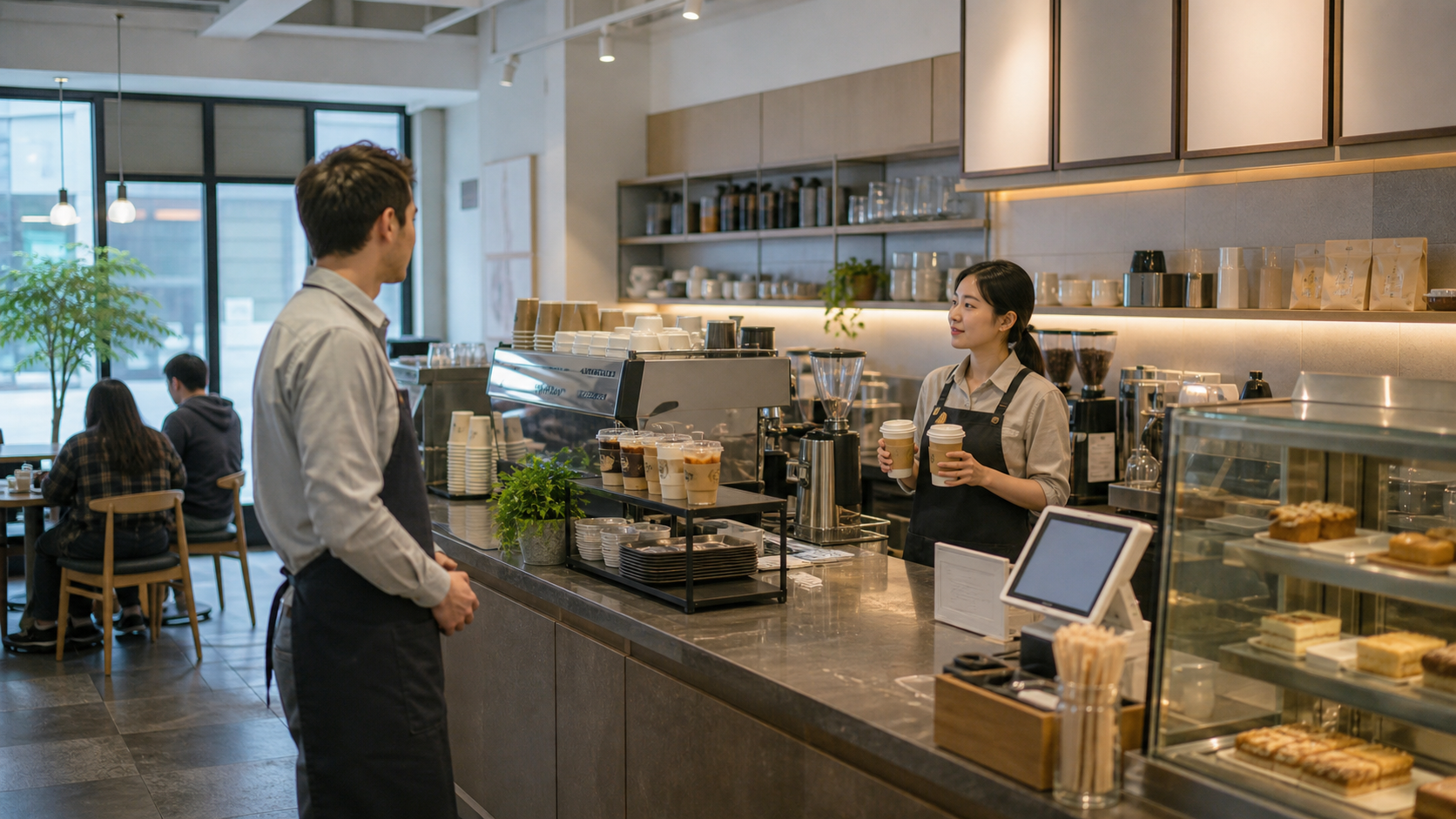
    Korean cafe pickup and order number training scene for service workers
    Korean cafe pickup and order number phrases for service workers.

    Download the PPT briefing for this lesson.

    Ghi chú tiếng Việt: Bài học này giúp nhân viên quán cà phê hiểu các cụm từ như 주문번호 확인해 주세요, 진동벨 울리면 와 주세요, 픽업대, và 음료 나왔습니다 trong ca làm thật.

    Short Introduction

    You are working behind the counter at a Korean cafe. A customer has already paid, but the drink is not ready yet. The pickup shelf is full, the order screen is changing, and several vibration pagers are beside the POS counter.

    The hard part is matching the right drink to the right customer without slowing the line. You may need to say 주문번호가 몇 번이세요?, give a pager, call 24번 고객님, or explain that the order is still being prepared.

    This lesson teaches Korean cafe pickup phrases for service workers: order number, vibration pager, pickup counter, waiting, ready status, and polite handover phrases. These phrases repeat many times during one shift, so a small set of clear patterns can prevent handover mistakes.

    Key Vocabulary

    Korean Romanization English Meaning Level Usage Note Where You See It Example
    주문 jumun order Beginner Customer order. Cafe counter, POS screen 주문 확인해 주세요.
    주문번호 jumun beonho order number Beginner Number used to match a drink. Order screen, receipt, pickup counter 주문번호가 몇 번이세요?
    번호 beonho number Beginner Number for waiting or order checking. Cafe, clinic, public office 24번 고객님
    진동벨 jindongbel vibrating pager Beginner Pager that alerts the customer. Cafe, food court 진동벨 울리면 와 주세요.
    픽업 pikeop pickup Beginner Receiving prepared food or drink. Cafe pickup area 픽업하시면 됩니다.
    픽업대 pikeopdae pickup counter Beginner Counter for finished drinks. Cafe counter 픽업대에서 받아 주세요.
    음료 eumnyo drink; beverage Beginner Prepared drink. Cafe, restaurant 음료 나왔습니다.
    준비 완료 junbi wallyo ready; complete Intermediate Order is ready. Order status screen 24번 준비 완료입니다.
    대기 daegi waiting Intermediate Waiting status. Order screen, waiting area 잠시 대기해 주세요.
    호출 hochul call; paging Intermediate Calling a customer. Pickup counter 번호를 호출해 주세요.
    포장 pojang takeout; to go Beginner Takeout order. Cafe, restaurant 포장 주문입니다.
    매장 maejang in-store; for here Beginner Inside the store. Cafe counter 매장에서 드시나요?
    영수증 yeongsujeung receipt Beginner Receipt after payment. Cafe, store 영수증 필요하세요?
    확인 hwagin check; confirmation Beginner Checking an order or number. Counter, POS, pickup area 주문번호 확인해 주세요.
    손님 sonnim customer; guest Beginner Polite word for customer. Service jobs 24번 손님, 음료 나왔습니다.
    카페 kape cafe Beginner Coffee shop. Workplace, street signs 카페에서 일해요.
    커피 keopi coffee Beginner Coffee drink. Cafe menu 커피 두 잔 나왔습니다.
    결제 gyeolje payment; checkout Beginner Payment before pickup. POS counter 결제 완료되었습니다.
    직원 jigwon staff; employee Beginner Worker or staff member. Workplace 직원에게 문의해 주세요.
    기다리다 gidarida to wait Beginner Waiting for an order. Cafe, clinic, service counter 잠시만 기다려 주세요.

    Real Situation

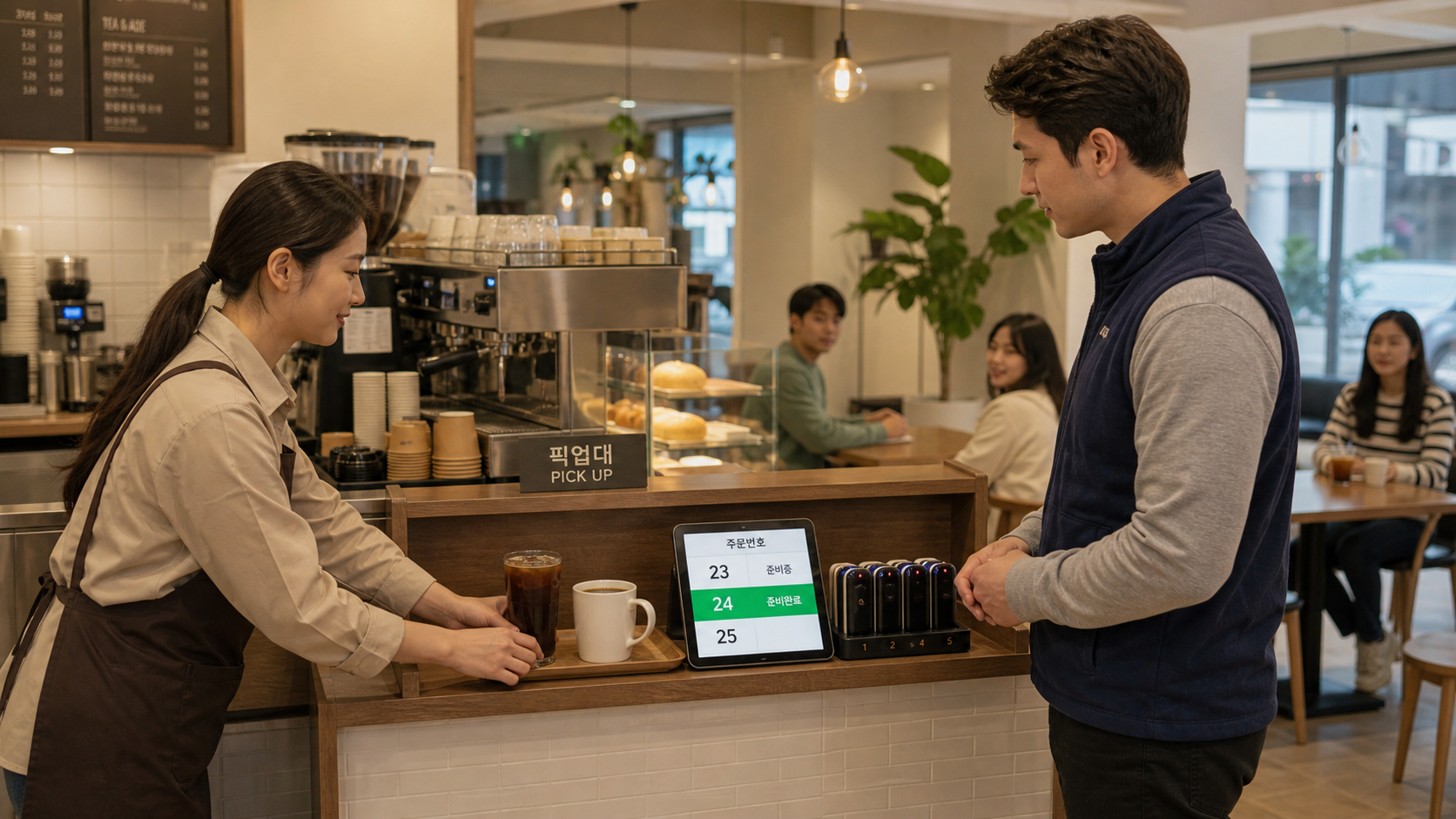
    Korean cafe pickup counter with order number screen and vibration pagers
    The pickup step depends on order number, pager, and customer confirmation.

    In many Korean cafes, customers order and pay first. After payment, the customer waits nearby, sits down, or holds a vibration pager. When the drink is ready, staff call the order number, update the screen, or wait for the pager to bring the customer back.

    주문번호 means order number. It is safer than using only the drink name because several customers may order the same iced Americano or latte. If two similar drinks are ready, the order number prevents a wrong handover.

    진동벨 means vibrating pager. 진동벨 울리면 와 주세요 means “Please come when the pager rings.” The customer does not need every grammar detail. The practical meaning is simple: wait until the pager alerts you.

    픽업대 means pickup counter, where finished drinks are received. 픽업대에서 받아 주세요 is polite, short, and clear. Also remember 매장 means for here, and 포장 means to go.

    Common Expressions

    Korean Expression Romanization English Meaning Level When to Use
    주문번호 확인해 주세요. Jumun beonho hwagin-hae juseyo. Please check your order number. Intermediate When matching a customer to a drink.
    주문번호가 몇 번이세요? Jumun beonho-ga myeot beon-iseyo? What is your order number? Beginner When the customer comes to the pickup counter.
    진동벨 울리면 와 주세요. Jindongbel ullimyeon wa juseyo. Please come when the pager rings. Intermediate After giving a vibration pager.
    음료 나왔습니다. Eumnyo nawatsseumnida. Your drink is ready. Beginner When handing over the drink.
    24번 고객님, 음료 나왔습니다. Isipsa-beon gogaengnim, eumnyo nawatsseumnida. Customer number 24, your drink is ready. Intermediate When calling an order number.
    픽업대에서 받아 주세요. Pikeopdae-eseo bada juseyo. Please pick it up at the pickup counter. Beginner When guiding the pickup location.
    잠시만 기다려 주세요. Jamsiman gidaryeo juseyo. Please wait a moment. Beginner When the drink is not ready yet.
    매장 주문이세요, 포장 주문이세요? Maejang jumun-iseyo, pojang jumun-iseyo? Is it for here or to go? Intermediate When confirming the order type.
    영수증 필요하세요? Yeongsujeung piryo-haseyo? Do you need a receipt? Beginner After payment.
    주문이 지연되고 있습니다. Jumun-i jiyeon-doego itseumnida. The order is being delayed. Advanced When you need a polite delay explanation.

    Usage Notes

    The main pickup pattern is Number + 번 고객님. 24번 고객님 means “customer number 24.” This is clearer than calling only a menu item.

    Another useful pattern is N 확인해 주세요. 주문번호 확인해 주세요 means “Please check your order number.” Use it when the customer comes to the pickup counter before you are sure which order is theirs.

    For a finished drink, use 음료 나왔습니다. Literally, it means “the drink came out,” but the natural meaning is “Your drink is ready.” You may hear the same pattern in restaurants: 음식 나왔습니다.

    When the drink is not ready, keep the sentence short. 잠시만 기다려 주세요 means “Please wait a moment.” For a real delay, use 주문이 지연되고 있습니다. Staff-to-customer language should stay polite: 받아 주세요, 와 주세요, and 기다려 주세요.

    Mini Dialogue

    Staff: 주문번호가 몇 번이세요?
    Jumun beonho-ga myeot beon-iseyo?
    What is your order number?

    Customer: 24번이에요.
    Isipsa-beon-ieyo.
    It is number 24.

    Staff: 네, 확인했습니다. 잠시만 기다려 주세요.
    Ne, hwagin-haetsseumnida. Jamsiman gidaryeo juseyo.
    Yes, I checked it. Please wait a moment.

    Staff: 24번 고객님, 음료 나왔습니다.
    Isipsa-beon gogaengnim, eumnyo nawatsseumnida.
    Customer number 24, your drink is ready.

    Customer: 감사합니다.
    Gamsahamnida.
    Thank you.

    Staff: 맛있게 드세요.
    Masitge deuseyo.
    Please enjoy it.

    Real cafe pickup conversations are short. The staff confirms the order number, asks the customer to wait, calls the number, and hands over the drink. 맛있게 드세요 is a friendly closing phrase.

    Common Mistakes

    1. Calling only the drink name
      Use the order number first. “24번 고객님, 음료 나왔습니다” is safer than calling only “iced latte.”
    2. Confusing 매장 and 포장
      매장 means for here. 포장 means to go. This changes cups, lids, trays, and bags.
    3. Using 가져가요 with customers
      Use 가져가세요 or 받아 주세요. They sound more polite in a service role.
    4. Not checking the order number
      Check 주문번호 before handover, especially when several similar drinks are ready.
    5. Explaining delays with a long sentence
      Use one clear sentence first: 주문이 지연되고 있습니다. 잠시만 기다려 주세요.

    Practice Steps

    1. Check the pickup situation. Is the customer waiting, asking about an order, or receiving a finished drink?
    2. Find the key word. Use 주문번호 for order number, 진동벨 for pager, 픽업대 for pickup counter, and 음료 for drink.
    3. Confirm before handing over. Ask 주문번호가 몇 번이세요? or 주문번호 확인해 주세요.
    4. Give one clear instruction. Say 진동벨 울리면 와 주세요, 픽업대에서 받아 주세요, or 잠시만 기다려 주세요.
    5. Close politely. After handover, say 감사합니다 or 맛있게 드세요.

    Quick Quiz

    1. Question 1. A customer comes to the pickup counter. What should you ask first if you need to match the drink?
      Answer: 주문번호가 몇 번이세요?
      This asks for the order number. It is safer than guessing from the drink name.
    2. Question 2. What does 진동벨 울리면 와 주세요 mean?
      Answer: Please come when the pager rings.
      진동벨 is a vibrating pager. 울리면 means when it rings or vibrates.
    3. Question 3. You want to say “Your drink is ready.” Which phrase is best?
      Answer: 음료 나왔습니다.
      This is a common cafe phrase for handing over a prepared drink.
    4. Question 4. A customer asks where to receive the drink. What can you say?
      Answer: 픽업대에서 받아 주세요.
      픽업대 means pickup counter. 받아 주세요 is polite and practical.
    5. Question 5. Which pair means “for here / to go”?
      Answer: 매장 / 포장
      매장 is in-store. 포장 is takeout or to go.

    Review Table

    Korean Meaning Best Situation Beginner Tip
    주문번호 order number Checking the correct drink Use number before drink name.
    진동벨 vibrating pager Customer waits after payment Say 울리면 와 주세요.
    픽업대 pickup counter Where customers receive drinks Use 받아 주세요 for polite guidance.
    음료 나왔습니다 Your drink is ready Finished drink handover Natural cafe phrase, not a literal sentence.
    매장 / 포장 for here / to go Order type confirmation Cup, lid, tray, and bag can change.
    잠시만 기다려 주세요 Please wait a moment Short delay Simple and polite.

    Related Lessons

    Practice More

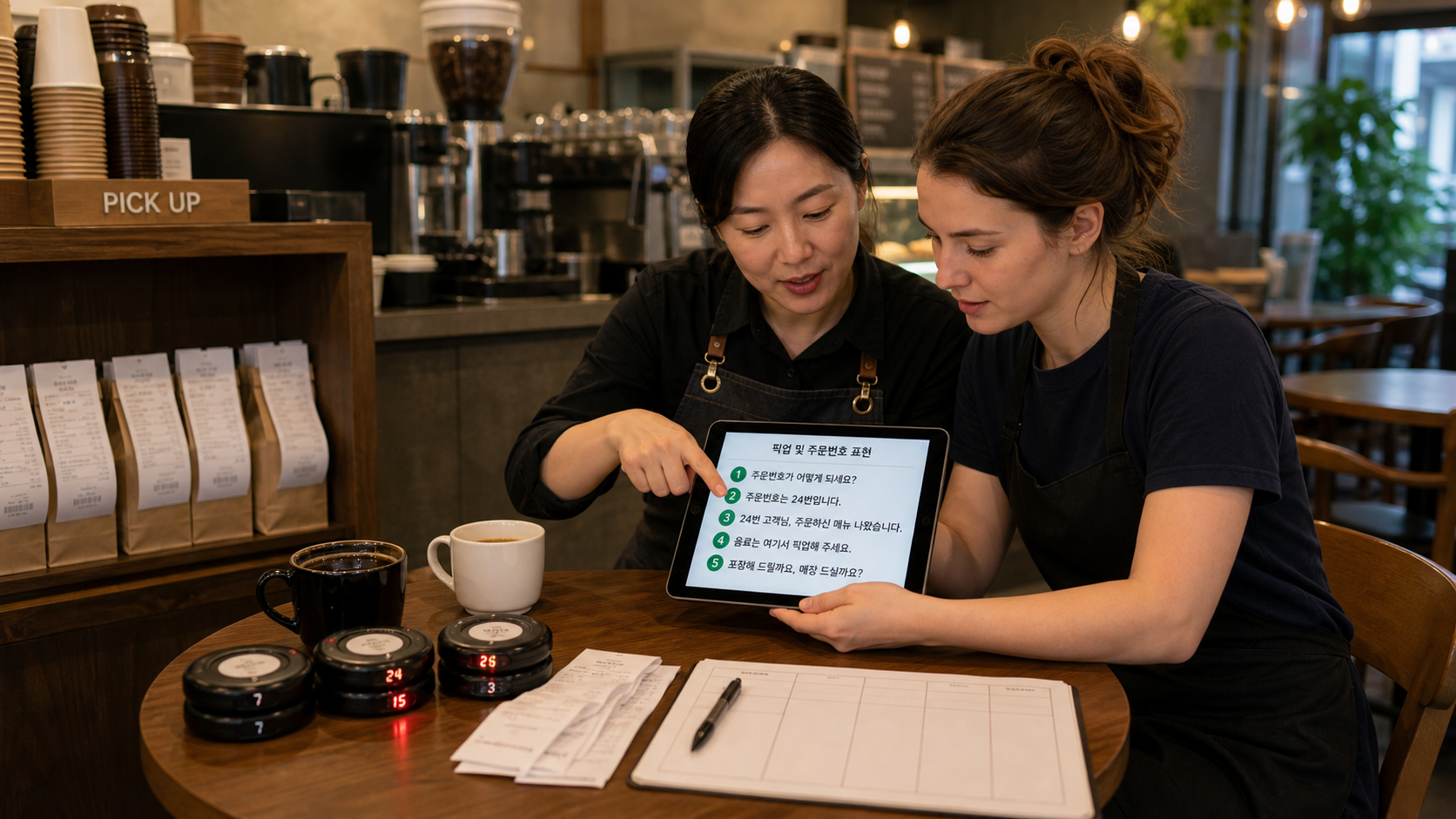
    Cafe manager and foreign worker reviewing Korean pickup phrases after a shift
    Review pickup phrases after a cafe shift so the expressions become automatic.

    Practice this word list in Learn Korean or in the upcoming BSKorean app. Start with 주문번호, 진동벨, 픽업대, 음료 나왔습니다, 잠시만 기다려 주세요, 매장, and 포장.

    Conclusion

    Korean cafe pickup phrases become easier when you treat them as counter actions. First, confirm the order number. Then explain the pager or waiting step. When the drink is ready, call the number and hand over the drink politely.

    You do not need long Korean sentences to work well at a cafe pickup counter. You need a few accurate words, a clear order number check, and polite service endings such as 와 주세요, 받아 주세요, and 기다려 주세요.

  • วลีภาษาเกาหลีสำหรับรับเครื่องดื่มและเลขออเดอร์ในคาเฟ่

    วลีภาษาเกาหลีสำหรับรับเครื่องดื่มและเลขออเดอร์ในคาเฟ่

    ภาษาเกาหลีงานบริการสำหรับพนักงานคาเฟ่

    วลีภาษาเกาหลีสำหรับรับเครื่องดื่มและเลขออเดอร์ในคาเฟ่

    เรียนวลีภาษาเกาหลีสำหรับพนักงานคาเฟ่ เช่น เลขออเดอร์ เพจเจอร์สั่น เคาน์เตอร์รับเครื่องดื่ม และประโยคส่งเครื่องดื่ม.

    Korean cafe pickup and order number training scene for service workers
    Korean cafe pickup and order number phrases for service workers.

    Download the PPT briefing for this lesson.

    หมายเหตุภาษาไทย: บทเรียนนี้เหมาะกับพนักงานคาเฟ่ที่ต้องเข้าใจคำเกาหลีอย่าง 주문번호, 진동벨, 픽업대 และ 음료 나왔습니다 ในสถานการณ์จริงที่เคาน์เตอร์รับเครื่องดื่ม.

    Short Introduction

    You are working behind the counter at a Korean cafe. A customer has already paid, but the drink is not ready yet. The pickup shelf is full, the order screen is changing, and several vibration pagers are beside the POS counter.

    The hard part is matching the right drink to the right customer without slowing the line. You may need to say 주문번호가 몇 번이세요?, give a pager, call 24번 고객님, or explain that the order is still being prepared.

    This lesson teaches Korean cafe pickup phrases for service workers: order number, vibration pager, pickup counter, waiting, ready status, and polite handover phrases. These phrases repeat many times during one shift, so a small set of clear patterns can prevent handover mistakes.

    Key Vocabulary

    Korean Romanization English Meaning Level Usage Note Where You See It Example
    주문 jumun order Beginner Customer order. Cafe counter, POS screen 주문 확인해 주세요.
    주문번호 jumun beonho order number Beginner Number used to match a drink. Order screen, receipt, pickup counter 주문번호가 몇 번이세요?
    번호 beonho number Beginner Number for waiting or order checking. Cafe, clinic, public office 24번 고객님
    진동벨 jindongbel vibrating pager Beginner Pager that alerts the customer. Cafe, food court 진동벨 울리면 와 주세요.
    픽업 pikeop pickup Beginner Receiving prepared food or drink. Cafe pickup area 픽업하시면 됩니다.
    픽업대 pikeopdae pickup counter Beginner Counter for finished drinks. Cafe counter 픽업대에서 받아 주세요.
    음료 eumnyo drink; beverage Beginner Prepared drink. Cafe, restaurant 음료 나왔습니다.
    준비 완료 junbi wallyo ready; complete Intermediate Order is ready. Order status screen 24번 준비 완료입니다.
    대기 daegi waiting Intermediate Waiting status. Order screen, waiting area 잠시 대기해 주세요.
    호출 hochul call; paging Intermediate Calling a customer. Pickup counter 번호를 호출해 주세요.
    포장 pojang takeout; to go Beginner Takeout order. Cafe, restaurant 포장 주문입니다.
    매장 maejang in-store; for here Beginner Inside the store. Cafe counter 매장에서 드시나요?
    영수증 yeongsujeung receipt Beginner Receipt after payment. Cafe, store 영수증 필요하세요?
    확인 hwagin check; confirmation Beginner Checking an order or number. Counter, POS, pickup area 주문번호 확인해 주세요.
    손님 sonnim customer; guest Beginner Polite word for customer. Service jobs 24번 손님, 음료 나왔습니다.
    카페 kape cafe Beginner Coffee shop. Workplace, street signs 카페에서 일해요.
    커피 keopi coffee Beginner Coffee drink. Cafe menu 커피 두 잔 나왔습니다.
    결제 gyeolje payment; checkout Beginner Payment before pickup. POS counter 결제 완료되었습니다.
    직원 jigwon staff; employee Beginner Worker or staff member. Workplace 직원에게 문의해 주세요.
    기다리다 gidarida to wait Beginner Waiting for an order. Cafe, clinic, service counter 잠시만 기다려 주세요.

    Real Situation

    Korean cafe pickup counter with order number screen and vibration pagers
    The pickup step depends on order number, pager, and customer confirmation.

    In many Korean cafes, customers order and pay first. After payment, the customer waits nearby, sits down, or holds a vibration pager. When the drink is ready, staff call the order number, update the screen, or wait for the pager to bring the customer back.

    주문번호 means order number. It is safer than using only the drink name because several customers may order the same iced Americano or latte. If two similar drinks are ready, the order number prevents a wrong handover.

    진동벨 means vibrating pager. 진동벨 울리면 와 주세요 means “Please come when the pager rings.” The customer does not need every grammar detail. The practical meaning is simple: wait until the pager alerts you.

    픽업대 means pickup counter, where finished drinks are received. 픽업대에서 받아 주세요 is polite, short, and clear. Also remember 매장 means for here, and 포장 means to go.

    Common Expressions

    Korean Expression Romanization English Meaning Level When to Use
    주문번호 확인해 주세요. Jumun beonho hwagin-hae juseyo. Please check your order number. Intermediate When matching a customer to a drink.
    주문번호가 몇 번이세요? Jumun beonho-ga myeot beon-iseyo? What is your order number? Beginner When the customer comes to the pickup counter.
    진동벨 울리면 와 주세요. Jindongbel ullimyeon wa juseyo. Please come when the pager rings. Intermediate After giving a vibration pager.
    음료 나왔습니다. Eumnyo nawatsseumnida. Your drink is ready. Beginner When handing over the drink.
    24번 고객님, 음료 나왔습니다. Isipsa-beon gogaengnim, eumnyo nawatsseumnida. Customer number 24, your drink is ready. Intermediate When calling an order number.
    픽업대에서 받아 주세요. Pikeopdae-eseo bada juseyo. Please pick it up at the pickup counter. Beginner When guiding the pickup location.
    잠시만 기다려 주세요. Jamsiman gidaryeo juseyo. Please wait a moment. Beginner When the drink is not ready yet.
    매장 주문이세요, 포장 주문이세요? Maejang jumun-iseyo, pojang jumun-iseyo? Is it for here or to go? Intermediate When confirming the order type.
    영수증 필요하세요? Yeongsujeung piryo-haseyo? Do you need a receipt? Beginner After payment.
    주문이 지연되고 있습니다. Jumun-i jiyeon-doego itseumnida. The order is being delayed. Advanced When you need a polite delay explanation.

    Usage Notes

    The main pickup pattern is Number + 번 고객님. 24번 고객님 means “customer number 24.” This is clearer than calling only a menu item.

    Another useful pattern is N 확인해 주세요. 주문번호 확인해 주세요 means “Please check your order number.” Use it when the customer comes to the pickup counter before you are sure which order is theirs.

    For a finished drink, use 음료 나왔습니다. Literally, it means “the drink came out,” but the natural meaning is “Your drink is ready.” You may hear the same pattern in restaurants: 음식 나왔습니다.

    When the drink is not ready, keep the sentence short. 잠시만 기다려 주세요 means “Please wait a moment.” For a real delay, use 주문이 지연되고 있습니다. Staff-to-customer language should stay polite: 받아 주세요, 와 주세요, and 기다려 주세요.

    Mini Dialogue

    Staff: 주문번호가 몇 번이세요?
    Jumun beonho-ga myeot beon-iseyo?
    What is your order number?

    Customer: 24번이에요.
    Isipsa-beon-ieyo.
    It is number 24.

    Staff: 네, 확인했습니다. 잠시만 기다려 주세요.
    Ne, hwagin-haetsseumnida. Jamsiman gidaryeo juseyo.
    Yes, I checked it. Please wait a moment.

    Staff: 24번 고객님, 음료 나왔습니다.
    Isipsa-beon gogaengnim, eumnyo nawatsseumnida.
    Customer number 24, your drink is ready.

    Customer: 감사합니다.
    Gamsahamnida.
    Thank you.

    Staff: 맛있게 드세요.
    Masitge deuseyo.
    Please enjoy it.

    Real cafe pickup conversations are short. The staff confirms the order number, asks the customer to wait, calls the number, and hands over the drink. 맛있게 드세요 is a friendly closing phrase.

    Common Mistakes

    1. Calling only the drink name
      Use the order number first. “24번 고객님, 음료 나왔습니다” is safer than calling only “iced latte.”
    2. Confusing 매장 and 포장
      매장 means for here. 포장 means to go. This changes cups, lids, trays, and bags.
    3. Using 가져가요 with customers
      Use 가져가세요 or 받아 주세요. They sound more polite in a service role.
    4. Not checking the order number
      Check 주문번호 before handover, especially when several similar drinks are ready.
    5. Explaining delays with a long sentence
      Use one clear sentence first: 주문이 지연되고 있습니다. 잠시만 기다려 주세요.

    Practice Steps

    1. Check the pickup situation. Is the customer waiting, asking about an order, or receiving a finished drink?
    2. Find the key word. Use 주문번호 for order number, 진동벨 for pager, 픽업대 for pickup counter, and 음료 for drink.
    3. Confirm before handing over. Ask 주문번호가 몇 번이세요? or 주문번호 확인해 주세요.
    4. Give one clear instruction. Say 진동벨 울리면 와 주세요, 픽업대에서 받아 주세요, or 잠시만 기다려 주세요.
    5. Close politely. After handover, say 감사합니다 or 맛있게 드세요.

    Quick Quiz

    1. Question 1. A customer comes to the pickup counter. What should you ask first if you need to match the drink?
      Answer: 주문번호가 몇 번이세요?
      This asks for the order number. It is safer than guessing from the drink name.
    2. Question 2. What does 진동벨 울리면 와 주세요 mean?
      Answer: Please come when the pager rings.
      진동벨 is a vibrating pager. 울리면 means when it rings or vibrates.
    3. Question 3. You want to say “Your drink is ready.” Which phrase is best?
      Answer: 음료 나왔습니다.
      This is a common cafe phrase for handing over a prepared drink.
    4. Question 4. A customer asks where to receive the drink. What can you say?
      Answer: 픽업대에서 받아 주세요.
      픽업대 means pickup counter. 받아 주세요 is polite and practical.
    5. Question 5. Which pair means “for here / to go”?
      Answer: 매장 / 포장
      매장 is in-store. 포장 is takeout or to go.

    Review Table

    Korean Meaning Best Situation Beginner Tip
    주문번호 order number Checking the correct drink Use number before drink name.
    진동벨 vibrating pager Customer waits after payment Say 울리면 와 주세요.
    픽업대 pickup counter Where customers receive drinks Use 받아 주세요 for polite guidance.
    음료 나왔습니다 Your drink is ready Finished drink handover Natural cafe phrase, not a literal sentence.
    매장 / 포장 for here / to go Order type confirmation Cup, lid, tray, and bag can change.
    잠시만 기다려 주세요 Please wait a moment Short delay Simple and polite.

    Related Lessons

    Practice More

    Cafe manager and foreign worker reviewing Korean pickup phrases after a shift
    Review pickup phrases after a cafe shift so the expressions become automatic.

    Practice this word list in Learn Korean or in the upcoming BSKorean app. Start with 주문번호, 진동벨, 픽업대, 음료 나왔습니다, 잠시만 기다려 주세요, 매장, and 포장.

    Conclusion

    Korean cafe pickup phrases become easier when you treat them as counter actions. First, confirm the order number. Then explain the pager or waiting step. When the drink is ready, call the number and hand over the drink politely.

    You do not need long Korean sentences to work well at a cafe pickup counter. You need a few accurate words, a clear order number check, and polite service endings such as 와 주세요, 받아 주세요, and 기다려 주세요.

  • カフェの受け取りと注文番号で使う韓国語フレーズ

    カフェの受け取りと注文番号で使う韓国語フレーズ

    カフェ勤務者のためのサービス韓国語

    カフェの受け取りと注文番号で使う韓国語フレーズ

    韓国のカフェで使う注文番号、振動ベル、受け取りカウンター、飲み物の受け渡し表現を学びます。

    Korean cafe pickup and order number training scene for service workers
    Korean cafe pickup and order number phrases for service workers.

    Download the PPT briefing for this lesson.

    日本語メモ: このレッスンでは、韓国のカフェで働く人がよく聞く注文番号、진동벨、픽업대、음료 나왔습니다 などの表現を扱います。本文の例文は現場でそのまま確認できるようにハングルを中心にしています。

    Short Introduction

    You are working behind the counter at a Korean cafe. A customer has already paid, but the drink is not ready yet. The pickup shelf is full, the order screen is changing, and several vibration pagers are beside the POS counter.

    The hard part is matching the right drink to the right customer without slowing the line. You may need to say 주문번호가 몇 번이세요?, give a pager, call 24번 고객님, or explain that the order is still being prepared.

    This lesson teaches Korean cafe pickup phrases for service workers: order number, vibration pager, pickup counter, waiting, ready status, and polite handover phrases. These phrases repeat many times during one shift, so a small set of clear patterns can prevent handover mistakes.

    Key Vocabulary

    Korean Romanization English Meaning Level Usage Note Where You See It Example
    주문 jumun order Beginner Customer order. Cafe counter, POS screen 주문 확인해 주세요.
    주문번호 jumun beonho order number Beginner Number used to match a drink. Order screen, receipt, pickup counter 주문번호가 몇 번이세요?
    번호 beonho number Beginner Number for waiting or order checking. Cafe, clinic, public office 24번 고객님
    진동벨 jindongbel vibrating pager Beginner Pager that alerts the customer. Cafe, food court 진동벨 울리면 와 주세요.
    픽업 pikeop pickup Beginner Receiving prepared food or drink. Cafe pickup area 픽업하시면 됩니다.
    픽업대 pikeopdae pickup counter Beginner Counter for finished drinks. Cafe counter 픽업대에서 받아 주세요.
    음료 eumnyo drink; beverage Beginner Prepared drink. Cafe, restaurant 음료 나왔습니다.
    준비 완료 junbi wallyo ready; complete Intermediate Order is ready. Order status screen 24번 준비 완료입니다.
    대기 daegi waiting Intermediate Waiting status. Order screen, waiting area 잠시 대기해 주세요.
    호출 hochul call; paging Intermediate Calling a customer. Pickup counter 번호를 호출해 주세요.
    포장 pojang takeout; to go Beginner Takeout order. Cafe, restaurant 포장 주문입니다.
    매장 maejang in-store; for here Beginner Inside the store. Cafe counter 매장에서 드시나요?
    영수증 yeongsujeung receipt Beginner Receipt after payment. Cafe, store 영수증 필요하세요?
    확인 hwagin check; confirmation Beginner Checking an order or number. Counter, POS, pickup area 주문번호 확인해 주세요.
    손님 sonnim customer; guest Beginner Polite word for customer. Service jobs 24번 손님, 음료 나왔습니다.
    카페 kape cafe Beginner Coffee shop. Workplace, street signs 카페에서 일해요.
    커피 keopi coffee Beginner Coffee drink. Cafe menu 커피 두 잔 나왔습니다.
    결제 gyeolje payment; checkout Beginner Payment before pickup. POS counter 결제 완료되었습니다.
    직원 jigwon staff; employee Beginner Worker or staff member. Workplace 직원에게 문의해 주세요.
    기다리다 gidarida to wait Beginner Waiting for an order. Cafe, clinic, service counter 잠시만 기다려 주세요.

    Real Situation

    Korean cafe pickup counter with order number screen and vibration pagers
    The pickup step depends on order number, pager, and customer confirmation.

    In many Korean cafes, customers order and pay first. After payment, the customer waits nearby, sits down, or holds a vibration pager. When the drink is ready, staff call the order number, update the screen, or wait for the pager to bring the customer back.

    주문번호 means order number. It is safer than using only the drink name because several customers may order the same iced Americano or latte. If two similar drinks are ready, the order number prevents a wrong handover.

    진동벨 means vibrating pager. 진동벨 울리면 와 주세요 means “Please come when the pager rings.” The customer does not need every grammar detail. The practical meaning is simple: wait until the pager alerts you.

    픽업대 means pickup counter, where finished drinks are received. 픽업대에서 받아 주세요 is polite, short, and clear. Also remember 매장 means for here, and 포장 means to go.

    Common Expressions

    Korean Expression Romanization English Meaning Level When to Use
    주문번호 확인해 주세요. Jumun beonho hwagin-hae juseyo. Please check your order number. Intermediate When matching a customer to a drink.
    주문번호가 몇 번이세요? Jumun beonho-ga myeot beon-iseyo? What is your order number? Beginner When the customer comes to the pickup counter.
    진동벨 울리면 와 주세요. Jindongbel ullimyeon wa juseyo. Please come when the pager rings. Intermediate After giving a vibration pager.
    음료 나왔습니다. Eumnyo nawatsseumnida. Your drink is ready. Beginner When handing over the drink.
    24번 고객님, 음료 나왔습니다. Isipsa-beon gogaengnim, eumnyo nawatsseumnida. Customer number 24, your drink is ready. Intermediate When calling an order number.
    픽업대에서 받아 주세요. Pikeopdae-eseo bada juseyo. Please pick it up at the pickup counter. Beginner When guiding the pickup location.
    잠시만 기다려 주세요. Jamsiman gidaryeo juseyo. Please wait a moment. Beginner When the drink is not ready yet.
    매장 주문이세요, 포장 주문이세요? Maejang jumun-iseyo, pojang jumun-iseyo? Is it for here or to go? Intermediate When confirming the order type.
    영수증 필요하세요? Yeongsujeung piryo-haseyo? Do you need a receipt? Beginner After payment.
    주문이 지연되고 있습니다. Jumun-i jiyeon-doego itseumnida. The order is being delayed. Advanced When you need a polite delay explanation.

    Usage Notes

    The main pickup pattern is Number + 번 고객님. 24번 고객님 means “customer number 24.” This is clearer than calling only a menu item.

    Another useful pattern is N 확인해 주세요. 주문번호 확인해 주세요 means “Please check your order number.” Use it when the customer comes to the pickup counter before you are sure which order is theirs.

    For a finished drink, use 음료 나왔습니다. Literally, it means “the drink came out,” but the natural meaning is “Your drink is ready.” You may hear the same pattern in restaurants: 음식 나왔습니다.

    When the drink is not ready, keep the sentence short. 잠시만 기다려 주세요 means “Please wait a moment.” For a real delay, use 주문이 지연되고 있습니다. Staff-to-customer language should stay polite: 받아 주세요, 와 주세요, and 기다려 주세요.

    Mini Dialogue

    Staff: 주문번호가 몇 번이세요?
    Jumun beonho-ga myeot beon-iseyo?
    What is your order number?

    Customer: 24번이에요.
    Isipsa-beon-ieyo.
    It is number 24.

    Staff: 네, 확인했습니다. 잠시만 기다려 주세요.
    Ne, hwagin-haetsseumnida. Jamsiman gidaryeo juseyo.
    Yes, I checked it. Please wait a moment.

    Staff: 24번 고객님, 음료 나왔습니다.
    Isipsa-beon gogaengnim, eumnyo nawatsseumnida.
    Customer number 24, your drink is ready.

    Customer: 감사합니다.
    Gamsahamnida.
    Thank you.

    Staff: 맛있게 드세요.
    Masitge deuseyo.
    Please enjoy it.

    Real cafe pickup conversations are short. The staff confirms the order number, asks the customer to wait, calls the number, and hands over the drink. 맛있게 드세요 is a friendly closing phrase.

    Common Mistakes

    1. Calling only the drink name
      Use the order number first. “24번 고객님, 음료 나왔습니다” is safer than calling only “iced latte.”
    2. Confusing 매장 and 포장
      매장 means for here. 포장 means to go. This changes cups, lids, trays, and bags.
    3. Using 가져가요 with customers
      Use 가져가세요 or 받아 주세요. They sound more polite in a service role.
    4. Not checking the order number
      Check 주문번호 before handover, especially when several similar drinks are ready.
    5. Explaining delays with a long sentence
      Use one clear sentence first: 주문이 지연되고 있습니다. 잠시만 기다려 주세요.

    Practice Steps

    1. Check the pickup situation. Is the customer waiting, asking about an order, or receiving a finished drink?
    2. Find the key word. Use 주문번호 for order number, 진동벨 for pager, 픽업대 for pickup counter, and 음료 for drink.
    3. Confirm before handing over. Ask 주문번호가 몇 번이세요? or 주문번호 확인해 주세요.
    4. Give one clear instruction. Say 진동벨 울리면 와 주세요, 픽업대에서 받아 주세요, or 잠시만 기다려 주세요.
    5. Close politely. After handover, say 감사합니다 or 맛있게 드세요.

    Quick Quiz

    1. Question 1. A customer comes to the pickup counter. What should you ask first if you need to match the drink?
      Answer: 주문번호가 몇 번이세요?
      This asks for the order number. It is safer than guessing from the drink name.
    2. Question 2. What does 진동벨 울리면 와 주세요 mean?
      Answer: Please come when the pager rings.
      진동벨 is a vibrating pager. 울리면 means when it rings or vibrates.
    3. Question 3. You want to say “Your drink is ready.” Which phrase is best?
      Answer: 음료 나왔습니다.
      This is a common cafe phrase for handing over a prepared drink.
    4. Question 4. A customer asks where to receive the drink. What can you say?
      Answer: 픽업대에서 받아 주세요.
      픽업대 means pickup counter. 받아 주세요 is polite and practical.
    5. Question 5. Which pair means “for here / to go”?
      Answer: 매장 / 포장
      매장 is in-store. 포장 is takeout or to go.

    Review Table

    Korean Meaning Best Situation Beginner Tip
    주문번호 order number Checking the correct drink Use number before drink name.
    진동벨 vibrating pager Customer waits after payment Say 울리면 와 주세요.
    픽업대 pickup counter Where customers receive drinks Use 받아 주세요 for polite guidance.
    음료 나왔습니다 Your drink is ready Finished drink handover Natural cafe phrase, not a literal sentence.
    매장 / 포장 for here / to go Order type confirmation Cup, lid, tray, and bag can change.
    잠시만 기다려 주세요 Please wait a moment Short delay Simple and polite.

    Related Lessons

    Practice More

    Cafe manager and foreign worker reviewing Korean pickup phrases after a shift
    Review pickup phrases after a cafe shift so the expressions become automatic.

    Practice this word list in Learn Korean or in the upcoming BSKorean app. Start with 주문번호, 진동벨, 픽업대, 음료 나왔습니다, 잠시만 기다려 주세요, 매장, and 포장.

    Conclusion

    Korean cafe pickup phrases become easier when you treat them as counter actions. First, confirm the order number. Then explain the pager or waiting step. When the drink is ready, call the number and hand over the drink politely.

    You do not need long Korean sentences to work well at a cafe pickup counter. You need a few accurate words, a clear order number check, and polite service endings such as 와 주세요, 받아 주세요, and 기다려 주세요.

  • Frasa Bahasa Korea untuk Pickup dan Nomor Pesanan di Kafe

    Frasa Bahasa Korea untuk Pickup dan Nomor Pesanan di Kafe

    Bahasa Korea layanan untuk pekerja kafe

    Frasa Bahasa Korea untuk Pickup dan Nomor Pesanan di Kafe

    Pelajari frasa bahasa Korea untuk pickup kafe, nomor pesanan, pager getar, dan cara menyerahkan minuman dengan sopan.

    Korean cafe pickup and order number training scene for service workers
    Korean cafe pickup and order number phrases for service workers.

    Download the PPT briefing for this lesson.

    Catatan bahasa Indonesia: Pelajaran ini membantu pekerja kafe memahami frasa Korea seperti 주문번호 확인해 주세요, 진동벨 울리면 와 주세요, dan 음료 나왔습니다. Contoh utama tetap ditulis dalam hangul agar bisa langsung dipakai di tempat kerja.

    Short Introduction

    You are working behind the counter at a Korean cafe. A customer has already paid, but the drink is not ready yet. The pickup shelf is full, the order screen is changing, and several vibration pagers are beside the POS counter.

    The hard part is matching the right drink to the right customer without slowing the line. You may need to say 주문번호가 몇 번이세요?, give a pager, call 24번 고객님, or explain that the order is still being prepared.

    This lesson teaches Korean cafe pickup phrases for service workers: order number, vibration pager, pickup counter, waiting, ready status, and polite handover phrases. These phrases repeat many times during one shift, so a small set of clear patterns can prevent handover mistakes.

    Key Vocabulary

    Korean Romanization English Meaning Level Usage Note Where You See It Example
    주문 jumun order Beginner Customer order. Cafe counter, POS screen 주문 확인해 주세요.
    주문번호 jumun beonho order number Beginner Number used to match a drink. Order screen, receipt, pickup counter 주문번호가 몇 번이세요?
    번호 beonho number Beginner Number for waiting or order checking. Cafe, clinic, public office 24번 고객님
    진동벨 jindongbel vibrating pager Beginner Pager that alerts the customer. Cafe, food court 진동벨 울리면 와 주세요.
    픽업 pikeop pickup Beginner Receiving prepared food or drink. Cafe pickup area 픽업하시면 됩니다.
    픽업대 pikeopdae pickup counter Beginner Counter for finished drinks. Cafe counter 픽업대에서 받아 주세요.
    음료 eumnyo drink; beverage Beginner Prepared drink. Cafe, restaurant 음료 나왔습니다.
    준비 완료 junbi wallyo ready; complete Intermediate Order is ready. Order status screen 24번 준비 완료입니다.
    대기 daegi waiting Intermediate Waiting status. Order screen, waiting area 잠시 대기해 주세요.
    호출 hochul call; paging Intermediate Calling a customer. Pickup counter 번호를 호출해 주세요.
    포장 pojang takeout; to go Beginner Takeout order. Cafe, restaurant 포장 주문입니다.
    매장 maejang in-store; for here Beginner Inside the store. Cafe counter 매장에서 드시나요?
    영수증 yeongsujeung receipt Beginner Receipt after payment. Cafe, store 영수증 필요하세요?
    확인 hwagin check; confirmation Beginner Checking an order or number. Counter, POS, pickup area 주문번호 확인해 주세요.
    손님 sonnim customer; guest Beginner Polite word for customer. Service jobs 24번 손님, 음료 나왔습니다.
    카페 kape cafe Beginner Coffee shop. Workplace, street signs 카페에서 일해요.
    커피 keopi coffee Beginner Coffee drink. Cafe menu 커피 두 잔 나왔습니다.
    결제 gyeolje payment; checkout Beginner Payment before pickup. POS counter 결제 완료되었습니다.
    직원 jigwon staff; employee Beginner Worker or staff member. Workplace 직원에게 문의해 주세요.
    기다리다 gidarida to wait Beginner Waiting for an order. Cafe, clinic, service counter 잠시만 기다려 주세요.

    Real Situation

    Korean cafe pickup counter with order number screen and vibration pagers
    The pickup step depends on order number, pager, and customer confirmation.

    In many Korean cafes, customers order and pay first. After payment, the customer waits nearby, sits down, or holds a vibration pager. When the drink is ready, staff call the order number, update the screen, or wait for the pager to bring the customer back.

    주문번호 means order number. It is safer than using only the drink name because several customers may order the same iced Americano or latte. If two similar drinks are ready, the order number prevents a wrong handover.

    진동벨 means vibrating pager. 진동벨 울리면 와 주세요 means “Please come when the pager rings.” The customer does not need every grammar detail. The practical meaning is simple: wait until the pager alerts you.

    픽업대 means pickup counter, where finished drinks are received. 픽업대에서 받아 주세요 is polite, short, and clear. Also remember 매장 means for here, and 포장 means to go.

    Common Expressions

    Korean Expression Romanization English Meaning Level When to Use
    주문번호 확인해 주세요. Jumun beonho hwagin-hae juseyo. Please check your order number. Intermediate When matching a customer to a drink.
    주문번호가 몇 번이세요? Jumun beonho-ga myeot beon-iseyo? What is your order number? Beginner When the customer comes to the pickup counter.
    진동벨 울리면 와 주세요. Jindongbel ullimyeon wa juseyo. Please come when the pager rings. Intermediate After giving a vibration pager.
    음료 나왔습니다. Eumnyo nawatsseumnida. Your drink is ready. Beginner When handing over the drink.
    24번 고객님, 음료 나왔습니다. Isipsa-beon gogaengnim, eumnyo nawatsseumnida. Customer number 24, your drink is ready. Intermediate When calling an order number.
    픽업대에서 받아 주세요. Pikeopdae-eseo bada juseyo. Please pick it up at the pickup counter. Beginner When guiding the pickup location.
    잠시만 기다려 주세요. Jamsiman gidaryeo juseyo. Please wait a moment. Beginner When the drink is not ready yet.
    매장 주문이세요, 포장 주문이세요? Maejang jumun-iseyo, pojang jumun-iseyo? Is it for here or to go? Intermediate When confirming the order type.
    영수증 필요하세요? Yeongsujeung piryo-haseyo? Do you need a receipt? Beginner After payment.
    주문이 지연되고 있습니다. Jumun-i jiyeon-doego itseumnida. The order is being delayed. Advanced When you need a polite delay explanation.

    Usage Notes

    The main pickup pattern is Number + 번 고객님. 24번 고객님 means “customer number 24.” This is clearer than calling only a menu item.

    Another useful pattern is N 확인해 주세요. 주문번호 확인해 주세요 means “Please check your order number.” Use it when the customer comes to the pickup counter before you are sure which order is theirs.

    For a finished drink, use 음료 나왔습니다. Literally, it means “the drink came out,” but the natural meaning is “Your drink is ready.” You may hear the same pattern in restaurants: 음식 나왔습니다.

    When the drink is not ready, keep the sentence short. 잠시만 기다려 주세요 means “Please wait a moment.” For a real delay, use 주문이 지연되고 있습니다. Staff-to-customer language should stay polite: 받아 주세요, 와 주세요, and 기다려 주세요.

    Mini Dialogue

    Staff: 주문번호가 몇 번이세요?
    Jumun beonho-ga myeot beon-iseyo?
    What is your order number?

    Customer: 24번이에요.
    Isipsa-beon-ieyo.
    It is number 24.

    Staff: 네, 확인했습니다. 잠시만 기다려 주세요.
    Ne, hwagin-haetsseumnida. Jamsiman gidaryeo juseyo.
    Yes, I checked it. Please wait a moment.

    Staff: 24번 고객님, 음료 나왔습니다.
    Isipsa-beon gogaengnim, eumnyo nawatsseumnida.
    Customer number 24, your drink is ready.

    Customer: 감사합니다.
    Gamsahamnida.
    Thank you.

    Staff: 맛있게 드세요.
    Masitge deuseyo.
    Please enjoy it.

    Real cafe pickup conversations are short. The staff confirms the order number, asks the customer to wait, calls the number, and hands over the drink. 맛있게 드세요 is a friendly closing phrase.

    Common Mistakes

    1. Calling only the drink name
      Use the order number first. “24번 고객님, 음료 나왔습니다” is safer than calling only “iced latte.”
    2. Confusing 매장 and 포장
      매장 means for here. 포장 means to go. This changes cups, lids, trays, and bags.
    3. Using 가져가요 with customers
      Use 가져가세요 or 받아 주세요. They sound more polite in a service role.
    4. Not checking the order number
      Check 주문번호 before handover, especially when several similar drinks are ready.
    5. Explaining delays with a long sentence
      Use one clear sentence first: 주문이 지연되고 있습니다. 잠시만 기다려 주세요.

    Practice Steps

    1. Check the pickup situation. Is the customer waiting, asking about an order, or receiving a finished drink?
    2. Find the key word. Use 주문번호 for order number, 진동벨 for pager, 픽업대 for pickup counter, and 음료 for drink.
    3. Confirm before handing over. Ask 주문번호가 몇 번이세요? or 주문번호 확인해 주세요.
    4. Give one clear instruction. Say 진동벨 울리면 와 주세요, 픽업대에서 받아 주세요, or 잠시만 기다려 주세요.
    5. Close politely. After handover, say 감사합니다 or 맛있게 드세요.

    Quick Quiz

    1. Question 1. A customer comes to the pickup counter. What should you ask first if you need to match the drink?
      Answer: 주문번호가 몇 번이세요?
      This asks for the order number. It is safer than guessing from the drink name.
    2. Question 2. What does 진동벨 울리면 와 주세요 mean?
      Answer: Please come when the pager rings.
      진동벨 is a vibrating pager. 울리면 means when it rings or vibrates.
    3. Question 3. You want to say “Your drink is ready.” Which phrase is best?
      Answer: 음료 나왔습니다.
      This is a common cafe phrase for handing over a prepared drink.
    4. Question 4. A customer asks where to receive the drink. What can you say?
      Answer: 픽업대에서 받아 주세요.
      픽업대 means pickup counter. 받아 주세요 is polite and practical.
    5. Question 5. Which pair means “for here / to go”?
      Answer: 매장 / 포장
      매장 is in-store. 포장 is takeout or to go.

    Review Table

    Korean Meaning Best Situation Beginner Tip
    주문번호 order number Checking the correct drink Use number before drink name.
    진동벨 vibrating pager Customer waits after payment Say 울리면 와 주세요.
    픽업대 pickup counter Where customers receive drinks Use 받아 주세요 for polite guidance.
    음료 나왔습니다 Your drink is ready Finished drink handover Natural cafe phrase, not a literal sentence.
    매장 / 포장 for here / to go Order type confirmation Cup, lid, tray, and bag can change.
    잠시만 기다려 주세요 Please wait a moment Short delay Simple and polite.

    Related Lessons

    Practice More

    Cafe manager and foreign worker reviewing Korean pickup phrases after a shift
    Review pickup phrases after a cafe shift so the expressions become automatic.

    Practice this word list in Learn Korean or in the upcoming BSKorean app. Start with 주문번호, 진동벨, 픽업대, 음료 나왔습니다, 잠시만 기다려 주세요, 매장, and 포장.

    Conclusion

    Korean cafe pickup phrases become easier when you treat them as counter actions. First, confirm the order number. Then explain the pager or waiting step. When the drink is ready, call the number and hand over the drink politely.

    You do not need long Korean sentences to work well at a cafe pickup counter. You need a few accurate words, a clear order number check, and polite service endings such as 와 주세요, 받아 주세요, and 기다려 주세요.

  • Korean Cafe Pickup and Order Number Phrases for Service Workers

    Korean Cafe Pickup and Order Number Phrases for Service Workers

    Service Korean for cafe workers

    Korean Cafe Pickup and Order Number Phrases for Service Workers

    Learn Korean cafe pickup and order number phrases for service workers, including 진동벨, 주문번호, 픽업대, and 음료 나왔습니다.

    Korean cafe pickup and order number training scene for service workers
    Korean cafe pickup and order number phrases for service workers.

    Download the PPT briefing for this lesson.

    Short Introduction

    You are working behind the counter at a Korean cafe. A customer has already paid, but the drink is not ready yet. The pickup shelf is full, the order screen is changing, and several vibration pagers are beside the POS counter.

    The hard part is matching the right drink to the right customer without slowing the line. You may need to say 주문번호가 몇 번이세요?, give a pager, call 24번 고객님, or explain that the order is still being prepared.

    This lesson teaches Korean cafe pickup phrases for service workers: order number, vibration pager, pickup counter, waiting, ready status, and polite handover phrases. These phrases repeat many times during one shift, so a small set of clear patterns can prevent handover mistakes.

    Key Vocabulary

    Korean Romanization English Meaning Level Usage Note Where You See It Example
    주문 jumun order Beginner Customer order. Cafe counter, POS screen 주문 확인해 주세요.
    주문번호 jumun beonho order number Beginner Number used to match a drink. Order screen, receipt, pickup counter 주문번호가 몇 번이세요?
    번호 beonho number Beginner Number for waiting or order checking. Cafe, clinic, public office 24번 고객님
    진동벨 jindongbel vibrating pager Beginner Pager that alerts the customer. Cafe, food court 진동벨 울리면 와 주세요.
    픽업 pikeop pickup Beginner Receiving prepared food or drink. Cafe pickup area 픽업하시면 됩니다.
    픽업대 pikeopdae pickup counter Beginner Counter for finished drinks. Cafe counter 픽업대에서 받아 주세요.
    음료 eumnyo drink; beverage Beginner Prepared drink. Cafe, restaurant 음료 나왔습니다.
    준비 완료 junbi wallyo ready; complete Intermediate Order is ready. Order status screen 24번 준비 완료입니다.
    대기 daegi waiting Intermediate Waiting status. Order screen, waiting area 잠시 대기해 주세요.
    호출 hochul call; paging Intermediate Calling a customer. Pickup counter 번호를 호출해 주세요.
    포장 pojang takeout; to go Beginner Takeout order. Cafe, restaurant 포장 주문입니다.
    매장 maejang in-store; for here Beginner Inside the store. Cafe counter 매장에서 드시나요?
    영수증 yeongsujeung receipt Beginner Receipt after payment. Cafe, store 영수증 필요하세요?
    확인 hwagin check; confirmation Beginner Checking an order or number. Counter, POS, pickup area 주문번호 확인해 주세요.
    손님 sonnim customer; guest Beginner Polite word for customer. Service jobs 24번 손님, 음료 나왔습니다.
    카페 kape cafe Beginner Coffee shop. Workplace, street signs 카페에서 일해요.
    커피 keopi coffee Beginner Coffee drink. Cafe menu 커피 두 잔 나왔습니다.
    결제 gyeolje payment; checkout Beginner Payment before pickup. POS counter 결제 완료되었습니다.
    직원 jigwon staff; employee Beginner Worker or staff member. Workplace 직원에게 문의해 주세요.
    기다리다 gidarida to wait Beginner Waiting for an order. Cafe, clinic, service counter 잠시만 기다려 주세요.

    Real Situation

    Korean cafe pickup counter with order number screen and vibration pagers
    The pickup step depends on order number, pager, and customer confirmation.

    In many Korean cafes, customers order and pay first. After payment, the customer waits nearby, sits down, or holds a vibration pager. When the drink is ready, staff call the order number, update the screen, or wait for the pager to bring the customer back.

    주문번호 means order number. It is safer than using only the drink name because several customers may order the same iced Americano or latte. If two similar drinks are ready, the order number prevents a wrong handover.

    진동벨 means vibrating pager. 진동벨 울리면 와 주세요 means “Please come when the pager rings.” The customer does not need every grammar detail. The practical meaning is simple: wait until the pager alerts you.

    픽업대 means pickup counter, where finished drinks are received. 픽업대에서 받아 주세요 is polite, short, and clear. Also remember 매장 means for here, and 포장 means to go.

    Common Expressions

    Korean Expression Romanization English Meaning Level When to Use
    주문번호 확인해 주세요. Jumun beonho hwagin-hae juseyo. Please check your order number. Intermediate When matching a customer to a drink.
    주문번호가 몇 번이세요? Jumun beonho-ga myeot beon-iseyo? What is your order number? Beginner When the customer comes to the pickup counter.
    진동벨 울리면 와 주세요. Jindongbel ullimyeon wa juseyo. Please come when the pager rings. Intermediate After giving a vibration pager.
    음료 나왔습니다. Eumnyo nawatsseumnida. Your drink is ready. Beginner When handing over the drink.
    24번 고객님, 음료 나왔습니다. Isipsa-beon gogaengnim, eumnyo nawatsseumnida. Customer number 24, your drink is ready. Intermediate When calling an order number.
    픽업대에서 받아 주세요. Pikeopdae-eseo bada juseyo. Please pick it up at the pickup counter. Beginner When guiding the pickup location.
    잠시만 기다려 주세요. Jamsiman gidaryeo juseyo. Please wait a moment. Beginner When the drink is not ready yet.
    매장 주문이세요, 포장 주문이세요? Maejang jumun-iseyo, pojang jumun-iseyo? Is it for here or to go? Intermediate When confirming the order type.
    영수증 필요하세요? Yeongsujeung piryo-haseyo? Do you need a receipt? Beginner After payment.
    주문이 지연되고 있습니다. Jumun-i jiyeon-doego itseumnida. The order is being delayed. Advanced When you need a polite delay explanation.

    Usage Notes

    The main pickup pattern is Number + 번 고객님. 24번 고객님 means “customer number 24.” This is clearer than calling only a menu item.

    Another useful pattern is N 확인해 주세요. 주문번호 확인해 주세요 means “Please check your order number.” Use it when the customer comes to the pickup counter before you are sure which order is theirs.

    For a finished drink, use 음료 나왔습니다. Literally, it means “the drink came out,” but the natural meaning is “Your drink is ready.” You may hear the same pattern in restaurants: 음식 나왔습니다.

    When the drink is not ready, keep the sentence short. 잠시만 기다려 주세요 means “Please wait a moment.” For a real delay, use 주문이 지연되고 있습니다. Staff-to-customer language should stay polite: 받아 주세요, 와 주세요, and 기다려 주세요.

    Mini Dialogue

    Staff: 주문번호가 몇 번이세요?
    Jumun beonho-ga myeot beon-iseyo?
    What is your order number?

    Customer: 24번이에요.
    Isipsa-beon-ieyo.
    It is number 24.

    Staff: 네, 확인했습니다. 잠시만 기다려 주세요.
    Ne, hwagin-haetsseumnida. Jamsiman gidaryeo juseyo.
    Yes, I checked it. Please wait a moment.

    Staff: 24번 고객님, 음료 나왔습니다.
    Isipsa-beon gogaengnim, eumnyo nawatsseumnida.
    Customer number 24, your drink is ready.

    Customer: 감사합니다.
    Gamsahamnida.
    Thank you.

    Staff: 맛있게 드세요.
    Masitge deuseyo.
    Please enjoy it.

    Real cafe pickup conversations are short. The staff confirms the order number, asks the customer to wait, calls the number, and hands over the drink. 맛있게 드세요 is a friendly closing phrase.

    Common Mistakes

    1. Calling only the drink name
      Use the order number first. “24번 고객님, 음료 나왔습니다” is safer than calling only “iced latte.”
    2. Confusing 매장 and 포장
      매장 means for here. 포장 means to go. This changes cups, lids, trays, and bags.
    3. Using 가져가요 with customers
      Use 가져가세요 or 받아 주세요. They sound more polite in a service role.
    4. Not checking the order number
      Check 주문번호 before handover, especially when several similar drinks are ready.
    5. Explaining delays with a long sentence
      Use one clear sentence first: 주문이 지연되고 있습니다. 잠시만 기다려 주세요.

    Practice Steps

    1. Check the pickup situation. Is the customer waiting, asking about an order, or receiving a finished drink?
    2. Find the key word. Use 주문번호 for order number, 진동벨 for pager, 픽업대 for pickup counter, and 음료 for drink.
    3. Confirm before handing over. Ask 주문번호가 몇 번이세요? or 주문번호 확인해 주세요.
    4. Give one clear instruction. Say 진동벨 울리면 와 주세요, 픽업대에서 받아 주세요, or 잠시만 기다려 주세요.
    5. Close politely. After handover, say 감사합니다 or 맛있게 드세요.

    Quick Quiz

    1. Question 1. A customer comes to the pickup counter. What should you ask first if you need to match the drink?
      Answer: 주문번호가 몇 번이세요?
      This asks for the order number. It is safer than guessing from the drink name.
    2. Question 2. What does 진동벨 울리면 와 주세요 mean?
      Answer: Please come when the pager rings.
      진동벨 is a vibrating pager. 울리면 means when it rings or vibrates.
    3. Question 3. You want to say “Your drink is ready.” Which phrase is best?
      Answer: 음료 나왔습니다.
      This is a common cafe phrase for handing over a prepared drink.
    4. Question 4. A customer asks where to receive the drink. What can you say?
      Answer: 픽업대에서 받아 주세요.
      픽업대 means pickup counter. 받아 주세요 is polite and practical.
    5. Question 5. Which pair means “for here / to go”?
      Answer: 매장 / 포장
      매장 is in-store. 포장 is takeout or to go.

    Review Table

    Korean Meaning Best Situation Beginner Tip
    주문번호 order number Checking the correct drink Use number before drink name.
    진동벨 vibrating pager Customer waits after payment Say 울리면 와 주세요.
    픽업대 pickup counter Where customers receive drinks Use 받아 주세요 for polite guidance.
    음료 나왔습니다 Your drink is ready Finished drink handover Natural cafe phrase, not a literal sentence.
    매장 / 포장 for here / to go Order type confirmation Cup, lid, tray, and bag can change.
    잠시만 기다려 주세요 Please wait a moment Short delay Simple and polite.

    Related Lessons

    Practice More

    Cafe manager and foreign worker reviewing Korean pickup phrases after a shift
    Review pickup phrases after a cafe shift so the expressions become automatic.

    Practice this word list in Learn Korean or in the upcoming BSKorean app. Start with 주문번호, 진동벨, 픽업대, 음료 나왔습니다, 잠시만 기다려 주세요, 매장, and 포장.

    Conclusion

    Korean cafe pickup phrases become easier when you treat them as counter actions. First, confirm the order number. Then explain the pager or waiting step. When the drink is ready, call the number and hand over the drink politely.

    You do not need long Korean sentences to work well at a cafe pickup counter. You need a few accurate words, a clear order number check, and polite service endings such as 와 주세요, 받아 주세요, and 기다려 주세요.