Briefing Summary
Korean weather app words help you check the day before you leave home in Korea. A weather screen may look crowded, but most of the useful information comes from a few repeated labels. In this briefing, you will read forecast words, temperature labels, rain words, humidity, fine dust, and the practical umbrella signal. The goal is simple: check the screen, understand the risk, and decide what to carry.
Download the complete Korean weather app words PPT briefing
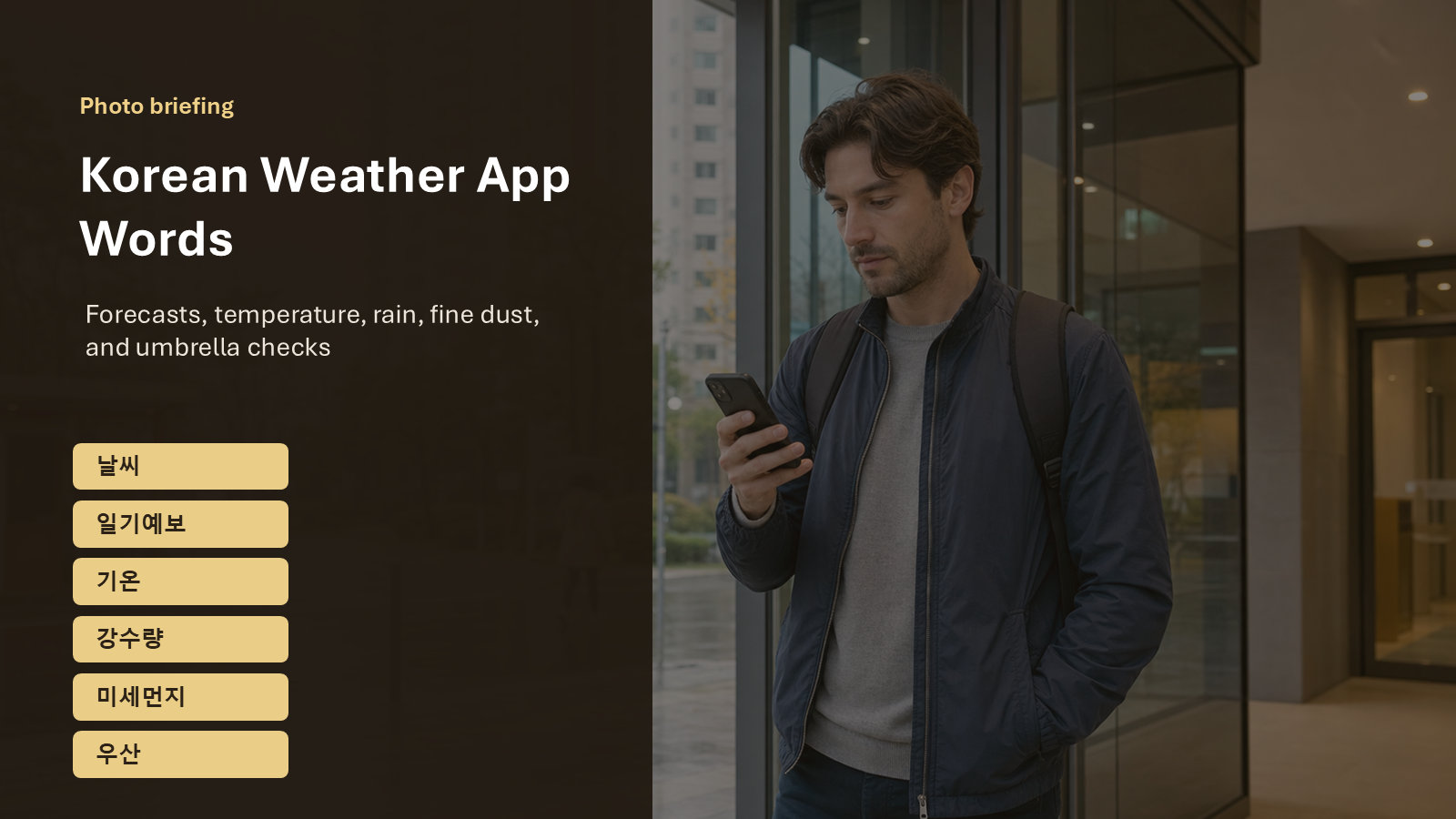
Slide 1. The Situation
You are about to leave an apartment lobby in Korea. Outside, the pavement is wet, the sky is gray, and people are moving carefully. Before you step out, you check a weather app. You do not need to understand every line. First, find the main weather word, then the temperature, then the rain or air quality signal.
This is why the lesson starts with a photo briefing. The image shows a real daily decision, not a grammar exercise. A learner checks the phone before choosing a jacket, mask, or umbrella. In Korea, the weather screen often affects small choices: whether to walk, take a bus, carry an umbrella, or avoid outdoor time when fine dust is bad.
Think of the screen as a checklist. The top area usually gives the general condition. The middle area often gives numbers, such as temperature or rainfall. Lower sections may show air quality, hourly changes, or warnings. If you read the labels in this order, the screen becomes much less stressful.
Slide 2. Key Weather App Words
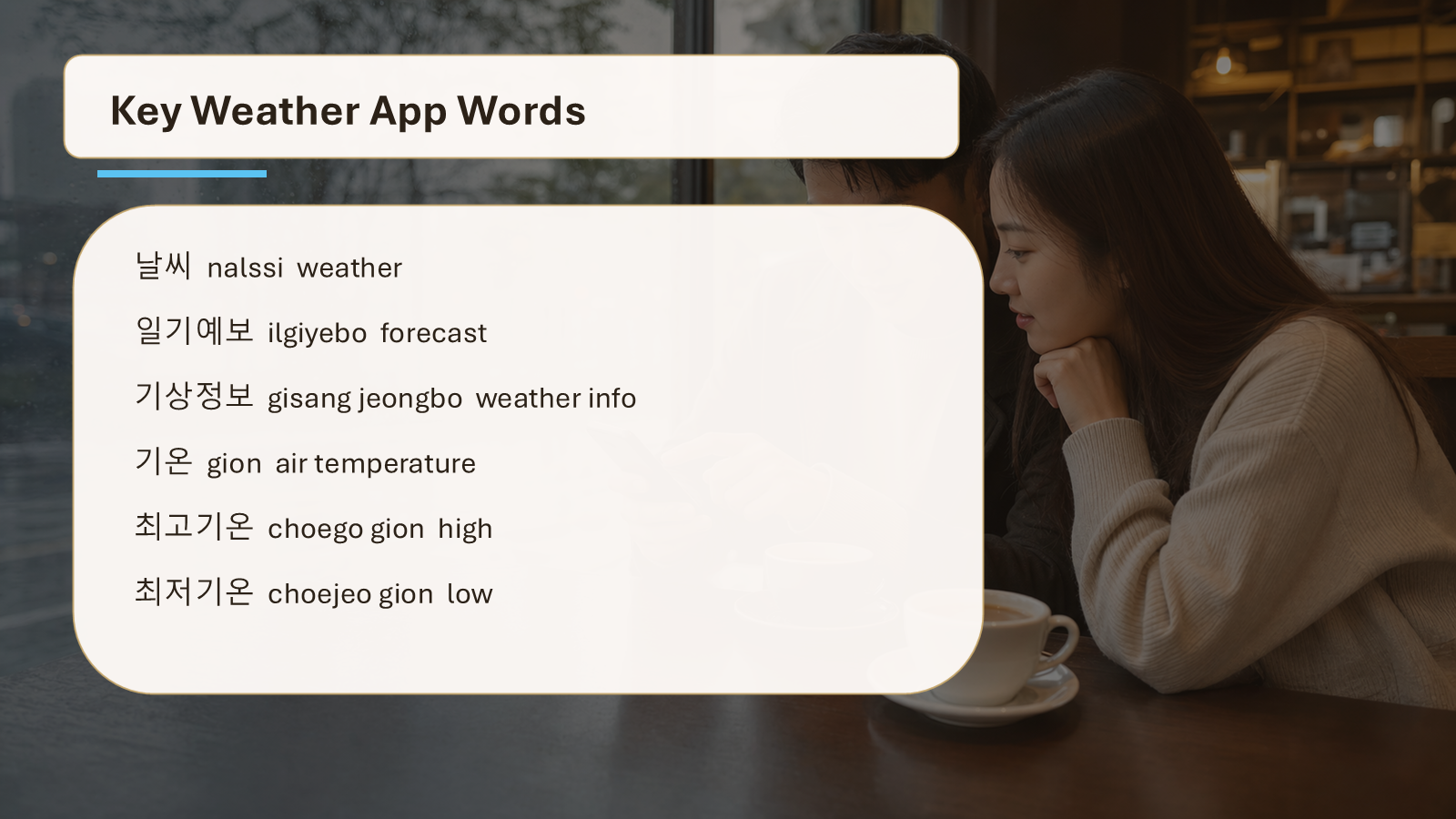
The key words below come from the Bs3001 Wordbook database. Learn them as screen labels first. Many weather apps show a short Korean word beside a number, icon, or warning color.
| Korean | Romanization | English | Usage |
|---|---|---|---|
| 날씨 | nalssi | weather | Main word for weather screens and daily talk. |
| 일기예보 | ilgiyebo | weather forecast | Use this for future weather information. |
| 기상정보 | gisang jeongbo | weather information | Formal label for weather data or notices. |
| 기온 | gion | air temperature | Temperature of the outside air. |
| 최고기온 | choego gion | highest temperature | The warmest expected temperature. |
| 최저기온 | choejeo gion | lowest temperature | The coldest expected temperature. |
| 강수량 | gangsuryang | rainfall amount | How much rain is expected or recorded. |
| 습도 | seupdo | humidity | How humid the air feels. |
| 미세먼지 | mise meonji | fine dust | Air quality word often shown in Korea. |
| 비 | bi | rain | Simple rain word for icons and forecasts. |
| 소나기 | sonagi | shower | A short sudden rain shower. |
| 우산 | usan | umbrella | The practical item to carry when rain is likely. |
Notice the order. The first three words tell you what kind of screen you are reading. The next three words show the temperature range. The last six words help you decide what to do outside. This is more useful than memorizing a long list without a situation.
When you study the table, say the Korean word first, then the English meaning. Do not start with a full sentence yet. A weather app usually gives you short signals, not conversation. For example, 기온 plus a number is enough to understand the temperature. 비 plus an afternoon time is enough to prepare for rain later.
The words also group naturally. 날씨, 일기예보, and 기상정보 tell you the type of information. 기온, 최고기온, and 최저기온 tell you the temperature range. 비, 소나기, and 강수량 tell you how rain may affect your movement.
Slide 3. Reading Formulas
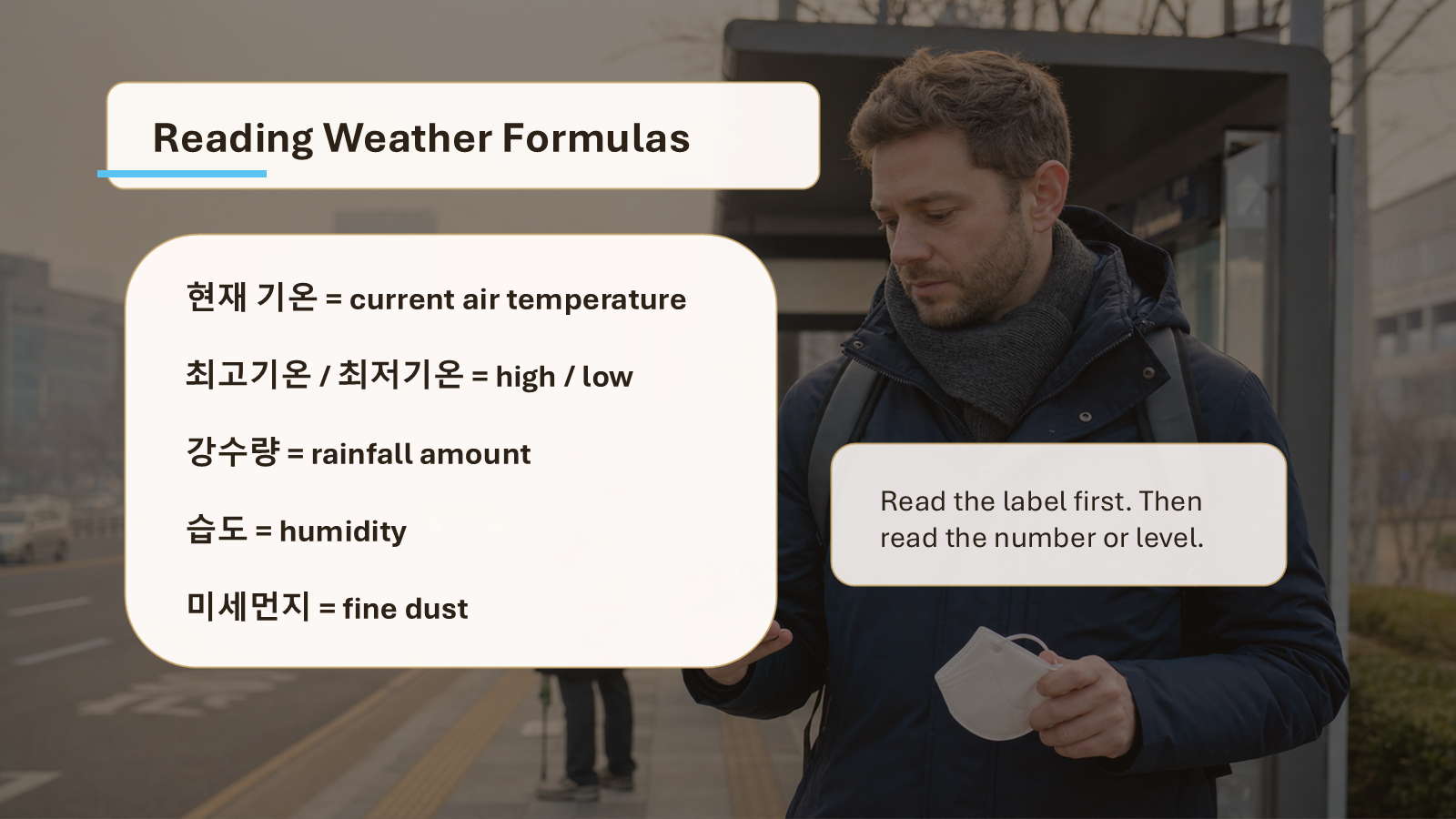
Weather app Korean often works like a formula. You see a label, then a number, level, or short result. For example, 현재 기온 means current air temperature. If you see 18도 beside it, you can read the key idea without building a full sentence.
최고기온 and 최저기온 are also label words. They show the daily high and low. This matters because the current temperature may not tell the whole story. A morning can be cool, but the day may become warm. A night can become much colder than the afternoon.
For rain, focus on 비, 소나기, and 강수량. 비 is the simple rain word. 소나기 warns you about a sudden shower. 강수량 gives more detail about the amount of rain. Then check 습도 and 미세먼지. They affect comfort and outdoor plans, even when it is not raining.
Be careful with English habits. Some learners see one weather icon and skip the Korean label. That works only until the icon is unclear. Korean labels give the precise clue. A cloud icon may feel simple, but 소나기, 강수량, and 미세먼지 each change your plan in a different way.
Slide 4. Read Weather App in 3 Steps
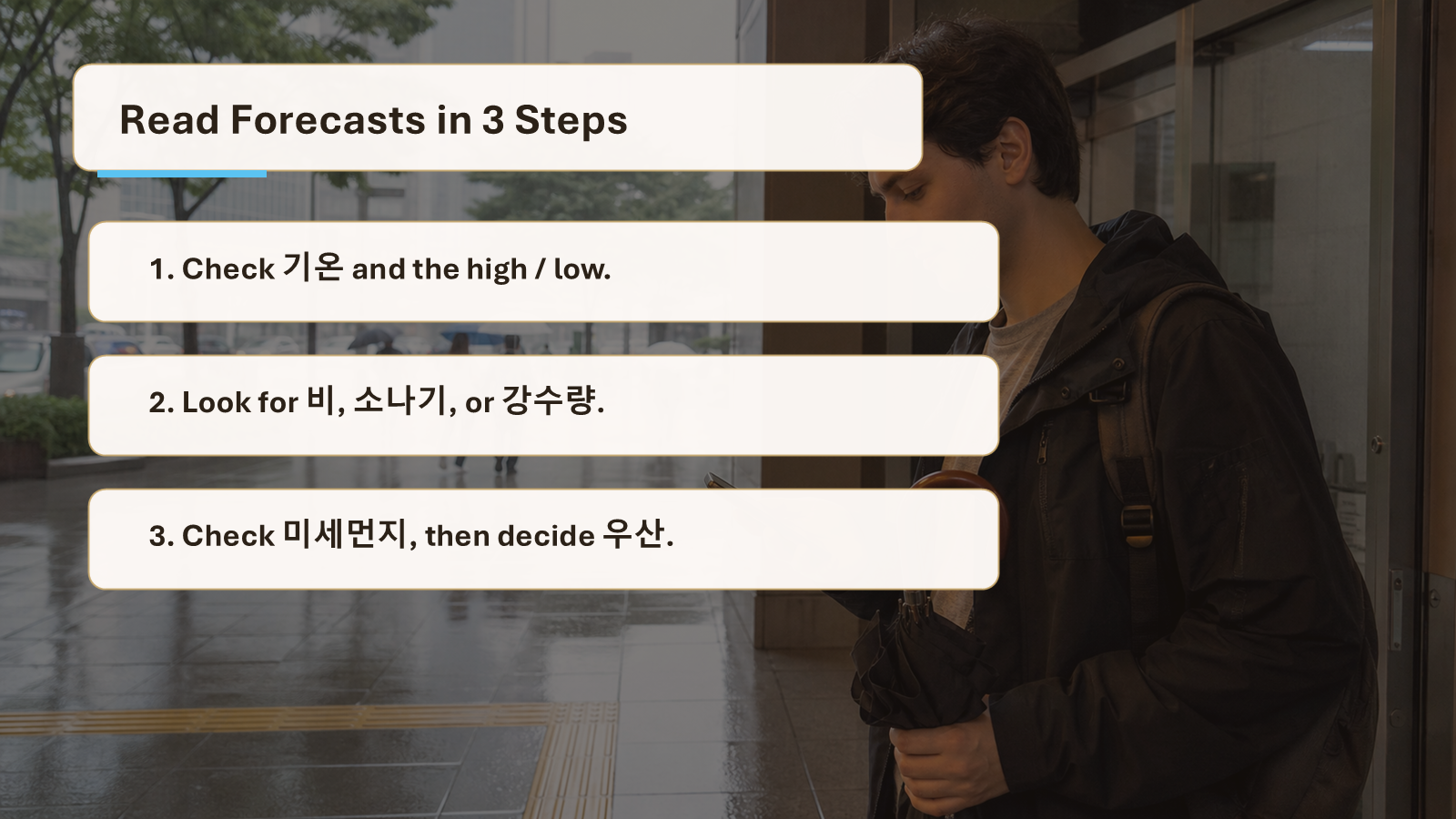
Use a three-step routine when the screen feels busy. First, check 기온, 최고기온, and 최저기온. These words help you choose clothes. If the high and low are far apart, prepare for a change during the day.
Second, look for rain words. If you see 비, expect rain. If you see 소나기, do not assume the whole day will be wet. It may be short, but it can still catch you outside. If 강수량 looks high, the rain may be heavier or longer.
Third, check 미세먼지 and decide 우산. Fine dust is not weather in the same way as rain, but it is part of daily life in Korea. If the fine dust level is bad, many people reduce outdoor time. If rain or showers appear, carry an umbrella before leaving.
This three-step method is useful because it turns reading into action. You are not studying the whole app. You are answering three practical questions. How warm or cold will it be? Will rain interrupt my route? Is the air quality good enough for outdoor time? Once you answer those questions, the Korean screen has done its job.
Slide 5. Mistakes and Practice
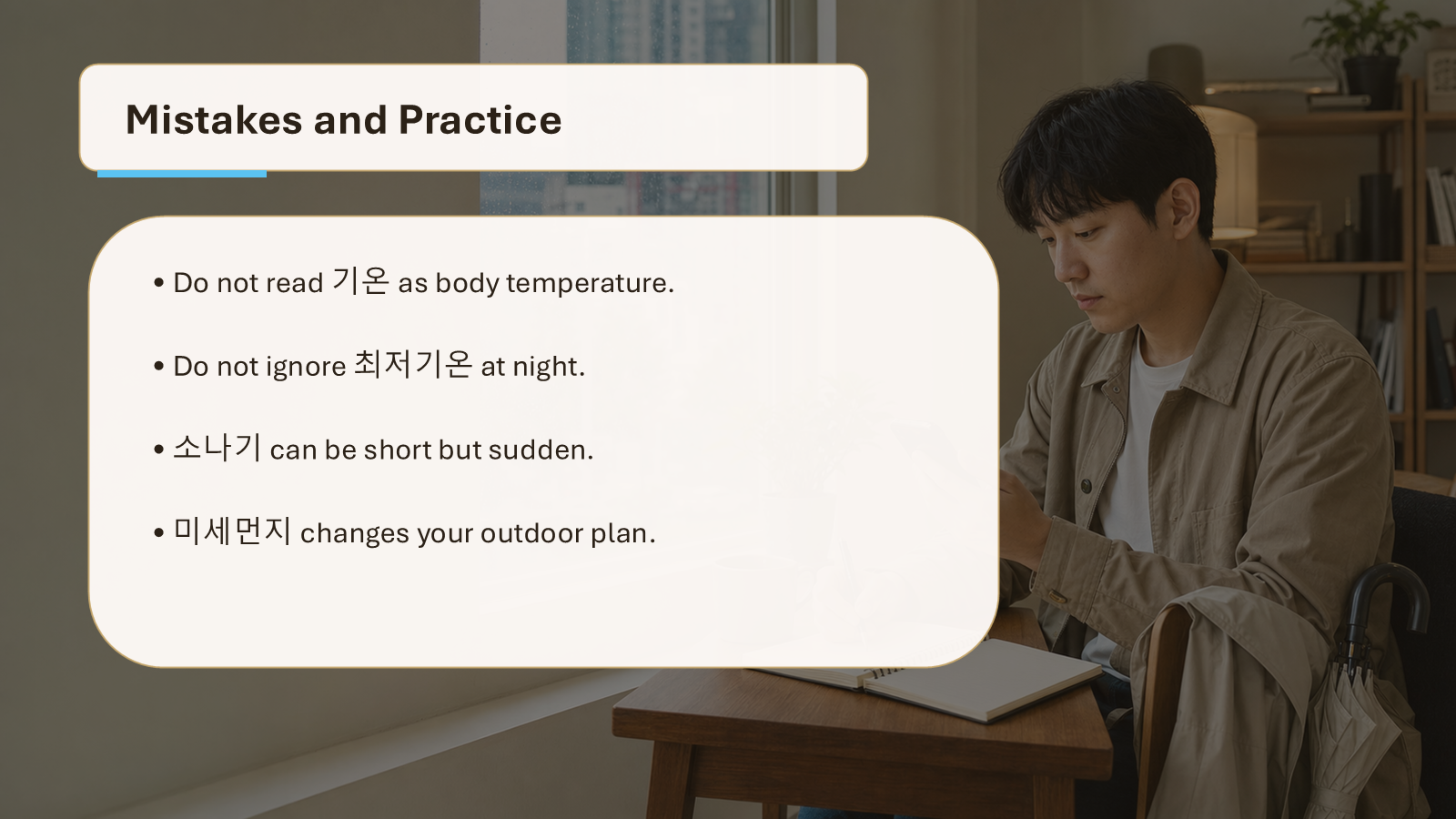
One common mistake is reading 기온 as body temperature. In a weather app, it means air temperature. Body temperature is 체온, which belongs in a medical situation. Another mistake is checking only the current number and ignoring 최저기온. That can be a problem if you return home late.
Do not treat 소나기 exactly like ordinary rain. A shower may be brief, but it can arrive suddenly. Also, do not ignore 미세먼지. A clear sky does not always mean clean air. The safest habit is to read the label first, then connect it to one action: jacket, umbrella, mask, or indoor plan.
Another small mistake is reading 우산 only as a word in a store. In this lesson, it is the action result of the weather check. If the app shows 비 or 소나기, the next question is simple: do you need 우산 today? This keeps the vocabulary tied to real movement.
Practice
Try these quick recognition questions before looking at the answers.
- If you see 최고기온, are you checking the warmest or coldest point of the day?
- If the app says 소나기, should you expect a long rainy season or a sudden shower?
- If 미세먼지 is bad, is the main issue rain or air quality?
Mini scenario: You leave home at 8 a.m. The app shows 최저기온 in the morning, 소나기 in the evening, and bad 미세먼지. A smart choice is to wear layers, carry 우산, and reduce unnecessary outdoor time.
Answer key: 최고기온 is the warmest point. 소나기 means a sudden shower. 미세먼지 is an air quality issue.
Mini Review Table
| If you see… | It usually means… | What to do |
|---|---|---|
| 기온 / 최고기온 / 최저기온 | The app is showing temperature range. | Choose clothes for the whole day. |
| 비 / 소나기 / 강수량 | The app is warning about rain. | Carry 우산 or adjust travel plans. |
| 습도 | The air may feel sticky or heavy. | Expect discomfort in warm weather. |
| 미세먼지 | The air quality may be poor. | Reduce outdoor time if needed. |
Final Takeaway
Korean weather app words become easier when you read them as decision labels. Start with 날씨 or 일기예보. Check 기온, 최고기온, and 최저기온. Then look for 비, 소나기, 강수량, 습도, and 미세먼지. Finally, decide whether you need 우산 before you leave home.