Convenience Store Korean Phrases for Daily Life
Learn practical Daily Korean for Korean convenience stores: finding items, asking prices, paying, bags, receipts, heating food, and polite problem-solving.

1. When to use these phrases
Use This Lesson First
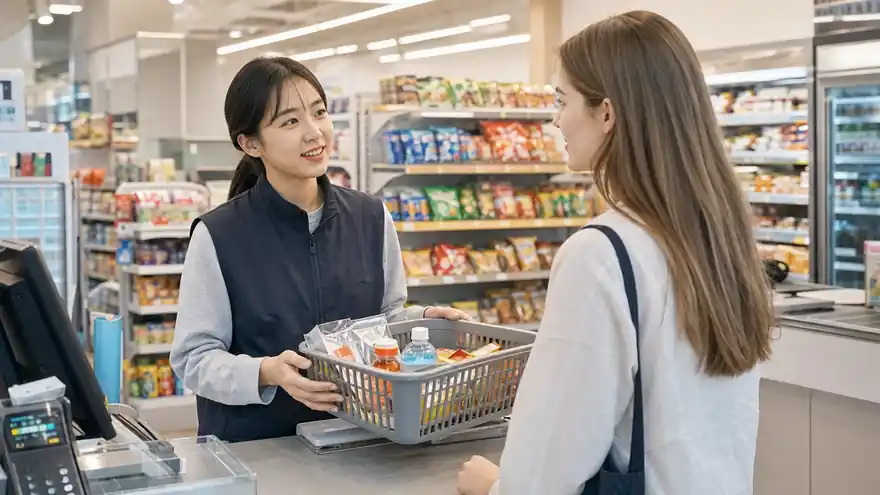
A Korean convenience store is one of the easiest places to practice Daily Korean because the situation is short, repeated, and predictable. You may only need to buy water, ask where coffee is, pay by card, say that you do not need a bag, or ask whether the lunch box can be heated. But if you do not know the small words, the moment can feel fast.
This lesson is a survival guide for the first few weeks of living or traveling in Korea. It teaches the Korean words you will actually hear at the counter, the polite sentence endings that keep the conversation smooth, and the questions that help when you cannot find an item. The goal is not perfect grammar. The goal is to enter the store, buy what you need, and leave without panic.
Core Convenience Store Vocabulary
Before You Enter
Look around before asking. Many stores have a front counter, drink coolers, snack shelves, microwave area, and a small self-service table for chopsticks, spoons, straws, and tissue. If you cannot find something after a short look, ask with 어디예요? It is short, polite enough for daily life, and very useful. Pointing gently at your item or phone translation can help, but always add 주세요 or 있어요 to make the Korean sound complete.
At the Counter
At the counter the worker may ask whether you need a bag or receipt. 봉투 필요하세요? means Do you need a bag? 영수증 드릴까요? means Shall I give you a receipt? If you do not need something, say 괜찮아요 or 필요 없어요. If you do need it, say 주세요 or 필요해요. These short answers are enough in most convenience store conversations.
Payment
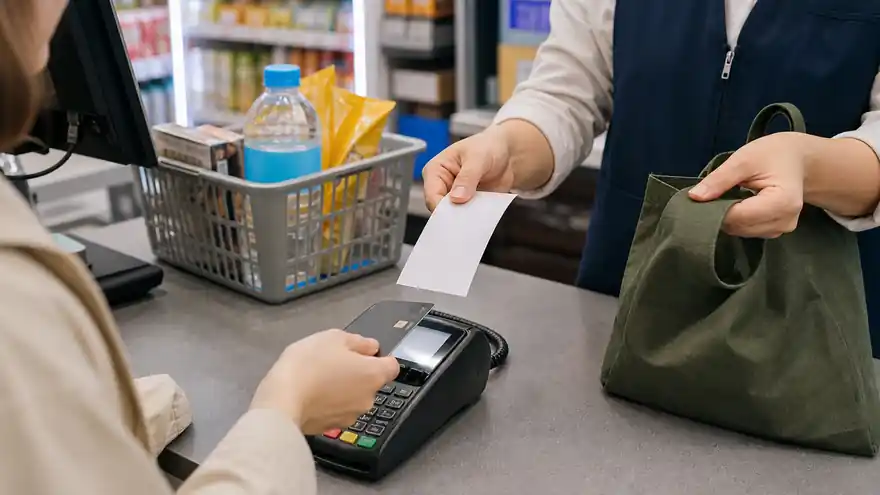
The safest payment sentence is 카드로 결제할게요. It means I will pay by card. If you pay cash, say 현금으로 낼게요. You do not need a long explanation. Place the card or cash calmly, wait for the terminal, and say 네 when the worker confirms. If there is a problem, use 잠시만요 and try again.
Food and Microwave
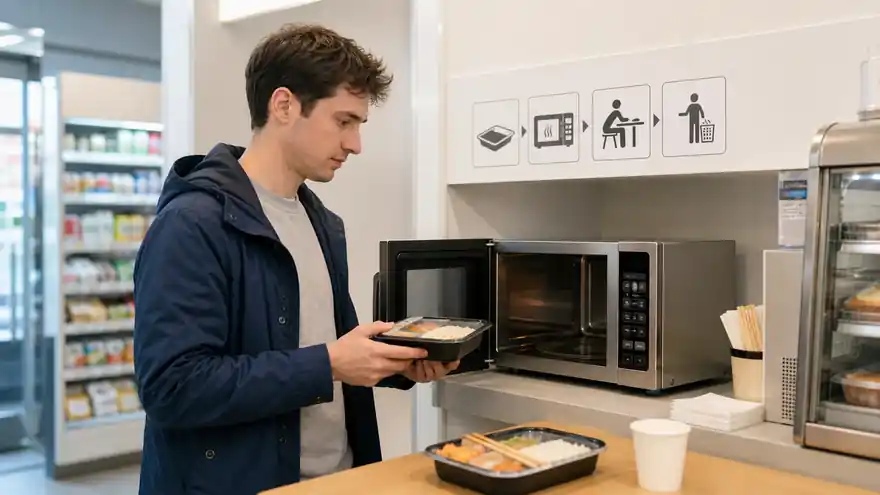
Convenience stores in Korea often sell 도시락, 김밥, 컵라면, and other ready-to-eat food. To ask for heating, say 데워 주세요. To ask if you may use the microwave yourself, say 전자레인지 사용해도 돼요? Keep your question simple. If the worker points to the microwave area, say 감사합니다 and follow the store rule.
Problem Solving
If you bought the wrong item, start softly with 죄송해요 or 저기요 and then say 잘못 샀어요. For exchange, use 교환 가능해요? For refund, use 환불 가능해요? Not every item can be exchanged or refunded, especially food, opened goods, or event products. Your job is to ask calmly and understand the answer.
Phrases You Can Say
Mini Dialogue
Customer: 이거 하나 주세요. Please give me one of these.
Staff: 봉투 필요하세요? Do you need a bag?
Customer: 괜찮아요. 카드로 결제할게요. No, it is okay. I will pay by card.
Staff: 영수증 드릴까요? Would you like a receipt?
Customer: 네, 영수증 주세요. Yes, please give me a receipt.
Practice Routine
Practice by choosing one real convenience store task each day. Day one: buy water and say 물 하나 주세요. Day two: refuse a bag. Day three: ask where coffee is. Day four: ask for chopsticks. Day five: ask to heat a lunch box. Repeat the same short phrases until they feel automatic.
Review and Next Lessons
Next, connect this lesson with Daily Korean lessons for delivery addresses, phone numbers, banks, pharmacies, and hospital reception. The same polite endings appear again and again, so every small convenience store conversation makes the next daily-life task easier.
Twelve Real Store Drills
Drill 1: stand in the aisle or at the counter, say 이거 얼마예요?, and listen for one short answer. If the answer is too fast, smile and say 다시 말해 주세요. The point is to keep the exchange small and repeatable: one item, one question, one polite ending, and one calm response. How much is this?
Drill 2: stand in the aisle or at the counter, say 이거 하나 주세요., and listen for one short answer. If the answer is too fast, smile and say 다시 말해 주세요. The point is to keep the exchange small and repeatable: one item, one question, one polite ending, and one calm response. Please give me one of these.
Drill 3: stand in the aisle or at the counter, say 봉투 필요 없어요., and listen for one short answer. If the answer is too fast, smile and say 다시 말해 주세요. The point is to keep the exchange small and repeatable: one item, one question, one polite ending, and one calm response. I do not need a bag.
Drill 4: stand in the aisle or at the counter, say 영수증 주세요., and listen for one short answer. If the answer is too fast, smile and say 다시 말해 주세요. The point is to keep the exchange small and repeatable: one item, one question, one polite ending, and one calm response. Please give me a receipt.
Drill 5: stand in the aisle or at the counter, say 카드로 결제할게요., and listen for one short answer. If the answer is too fast, smile and say 다시 말해 주세요. The point is to keep the exchange small and repeatable: one item, one question, one polite ending, and one calm response. I will pay by card.
Drill 6: stand in the aisle or at the counter, say 전자레인지 사용해도 돼요?, and listen for one short answer. If the answer is too fast, smile and say 다시 말해 주세요. The point is to keep the exchange small and repeatable: one item, one question, one polite ending, and one calm response. Can I use the microwave?
Drill 7: stand in the aisle or at the counter, say 데워 주세요., and listen for one short answer. If the answer is too fast, smile and say 다시 말해 주세요. The point is to keep the exchange small and repeatable: one item, one question, one polite ending, and one calm response. Please heat it up.
Drill 8: stand in the aisle or at the counter, say 교통카드 충전해 주세요., and listen for one short answer. If the answer is too fast, smile and say 다시 말해 주세요. The point is to keep the exchange small and repeatable: one item, one question, one polite ending, and one calm response. Please top up my transportation card.
Drill 9: stand in the aisle or at the counter, say 교환 가능해요?, and listen for one short answer. If the answer is too fast, smile and say 다시 말해 주세요. The point is to keep the exchange small and repeatable: one item, one question, one polite ending, and one calm response. Can I exchange it?
Drill 10: stand in the aisle or at the counter, say 환불 가능해요?, and listen for one short answer. If the answer is too fast, smile and say 다시 말해 주세요. The point is to keep the exchange small and repeatable: one item, one question, one polite ending, and one calm response. Can I get a refund?
Drill 11: stand in the aisle or at the counter, say 잘못 샀어요., and listen for one short answer. If the answer is too fast, smile and say 다시 말해 주세요. The point is to keep the exchange small and repeatable: one item, one question, one polite ending, and one calm response. I bought the wrong one.
Drill 12: stand in the aisle or at the counter, say 잠시만요., and listen for one short answer. If the answer is too fast, smile and say 다시 말해 주세요. The point is to keep the exchange small and repeatable: one item, one question, one polite ending, and one calm response. One moment, please.
Build a Real Store Routine
For the first week, do not try to memorize every sentence at once. Pick one mission before you enter the store. If the mission is buying water, prepare 물 하나 주세요 and 카드로 결제할게요 before you open the door. If the mission is asking for a bag, prepare 봉투 주세요 or 봉투 필요 없어요. A narrow mission lowers stress because you already know which words you will need.
When the worker answers, listen for only the useful part. If you hear 네, the answer is yes. If you hear 없어요, the item is not available. If you hear 이쪽, 저쪽, or 여기, the worker is showing direction. You do not have to understand the whole sentence. In a convenience store, understanding one key word is often enough to move to the next step.
After leaving the store, review the moment for thirty seconds. Write down the Korean phrase you used, the answer you heard, and the phrase you want to try next time. This tiny review turns one purchase into language practice. After several visits, the counter will feel less like a test and more like a short daily routine.
Word Patterns You Can Reuse in Any Store
The most useful part of convenience store Korean is not one perfect sentence. It is a small set of patterns that you can change quickly. Start with 있어요?, which asks whether something exists or is available. If you know the item word, put it before the question: 물 있어요?, 커피 있어요?, 봉투 있어요?. If you do not know the item word, point politely and ask 이거 있어요? or 이거 어디 있어요?. The grammar is simple, but the situation becomes much easier because the worker knows exactly what help you need.
A second pattern is 어디 있어요?, meaning “Where is it?” Use it when you cannot find an item. In a small store, you do not need a long explanation. Say the item, then the location question: 삼각김밥 어디 있어요?, 우유 어디 있어요?, 전자레인지 어디 있어요?. If the worker answers with a direction you do not catch, use the repair phrase 다시 말해 주세요. That sentence is not only for classrooms. It is a normal survival phrase when the answer is too fast.
A third pattern is 해 주세요, which politely asks someone to do something. In a convenience store you may hear or use 데워 주세요, 봉투 주세요, 영수증 주세요, and 계산해 주세요. You can also remove a request: 봉투는 괜찮아요 means you do not need a bag. These patterns help you sound calm, not demanding.
Three Realistic Mini Scripts
Script one: finding an item. You walk in to buy a ready meal, but you only see drinks. Say 삼각김밥 어디 있어요?. If the worker points and says the answer too quickly, answer 다시 말해 주세요. 저쪽이에요?. This script trains two habits: ask directly and confirm what you understood. You do not need to explain that you are a beginner unless the situation becomes confusing.
Script two: paying and bags. At the counter, place your items down and listen for the price. If you want to pay by card, say 카드로 할게요. If you do not need a bag, say 봉투는 괜찮아요. If you need one, say 봉투 주세요. If you want the receipt, say 영수증 주세요. Practice the sequence as one smooth routine: card, bag, receipt.
Script three: heating food. You buy a lunch box and are not sure whether you should heat it yourself. Ask 이거 데워도 돼요?. If the store worker can help, say 데워 주세요. If they point to the microwave area, ask 전자레인지 어디 있어요?. This is a common moment because many stores have a self-service microwave, but the layout is different in each store.
Common Mistakes and Safer Choices
One common mistake is using only one word with a rising tone, such as “bag?” or “receipt?” That may work, but it can sound abrupt. Add 주세요 when you ask for something and 괜찮아요 when you refuse it. Another mistake is answering too softly at the counter. Convenience stores are noisy, and the cashier may be moving quickly. Speak short Korean clearly: 카드요, 봉투 주세요, 괜찮아요, 영수증 주세요.
Be careful with refund and exchange situations. The words 환불 and 교환 are useful, but store policy may depend on the product, receipt, time, and payment method. A safe beginner sentence is 환불할 수 있어요? or 교환할 수 있어요?. If the answer includes many details, do not pretend to understand. Say 천천히 말해 주세요 or ask someone to help you translate. The goal of this lesson is practical language, not legal or store-policy advice.
Final Ninety-Second Practice
Before you open the app, run this quick practice out loud. First, ask for a location: 물 어디 있어요?, 전자레인지 어디 있어요?. Second, ask for an action: 데워 주세요, 계산해 주세요. Third, handle the counter: 카드로 할게요, 봉투는 괜찮아요, 영수증 주세요. Fourth, handle a problem: 환불할 수 있어요?, 다시 말해 주세요. If you can say these without stopping, you can manage most convenience store visits with beginner Korean.
2. Key vocabulary
convenience store
Beginnercheckout counter
Beginnerstaff member
Beginnercustomer
Beginnerbag
Beginner3. Essential phrases
Practice this lesson in the app
Review these words with multiple-choice questions and weak-Learn Korean.
Practice this lesson →
답글 남기기
Please sign in with Google to comment. Sign in with Google