Korean Apartment Words: A Briefing-Style Lesson
Learn Korean apartment words for practical life in Korea with Korean examples, key meanings, review tables, and BSKorean app practice.
1. When to use these phrases
Use this apartment words lesson first
Apartment Korean should help before you scroll. Start with 집을 구하고 있어요, “I am looking for a place.” Then check money and contract words: 보증금, 월세, 관리비, and 계약서.
| Apartment need | Korean | Meaning |
|---|---|---|
| Looking | 집을 구하고 있어요 | I am looking for a place. |
| Deposit | 보증금은 얼마예요? | How much is the deposit? |
| Monthly rent | 월세는 얼마예요? | How much is the monthly rent? |
| Maintenance fee | 관리비가 포함돼요? | Is the maintenance fee included? |
Before signing, say 계약서를 확인하고 싶어요. For connected home topics, continue with apartment management fee words and housing words.
Korean apartment words guide
Korean apartment words helps learners practice Korean words in real situations. This BSKorean post keeps the lesson clear, scannable, and connected to app practice.
Related lessons
Korean apartment words help foreign residents read building notices, find entrances, understand floors and units, and ask basic housing questions in Korea. This briefing-style lesson focuses on apartment vocabulary used in daily life.
Korean Apartment Words for Building Notices

Opening Situation
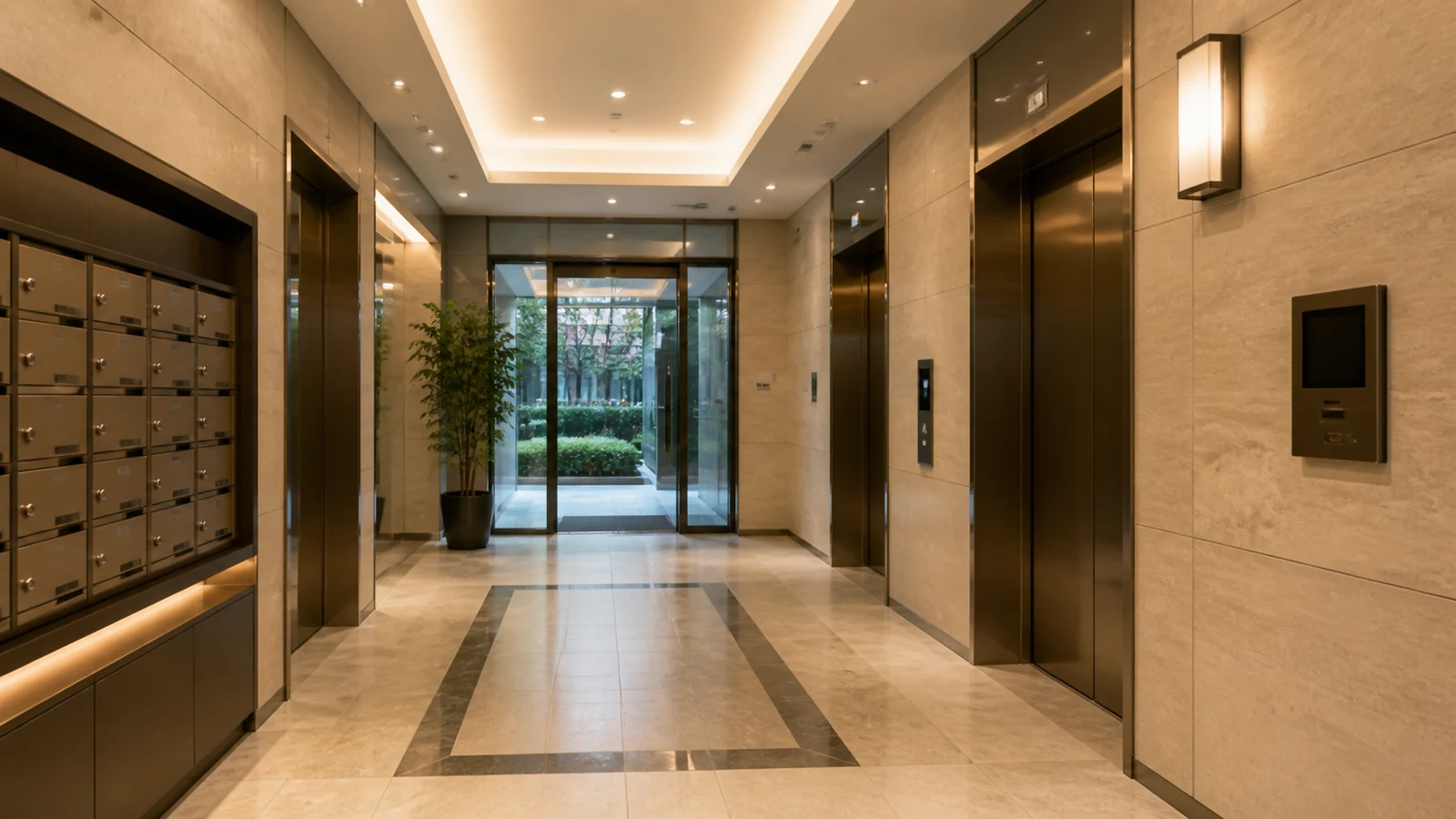
You arrive at a Korean apartment complex for the first time. The address says 103동 1204호, the elevator sign shows 지하주차장, and a notice near the entrance says 관리사무소. You know the street address, but the building itself has its own vocabulary.
This lesson explains Korean apartment words as practical location language. You will learn how Koreans identify building numbers, unit numbers, floors, entrances, parking areas, security offices, parcel rooms, and management offices.
Learning Snapshot
Level: Beginner
Best for: New residents, visitors, delivery users, exchange students
Main skill: Reading Korean apartment signs, addresses, and notices
Study time: 8-10 minutes
This briefing lesson focuses on a real situation rather than a memorized word list. Use the tables, patterns, examples, mistakes, and practice steps together so the Korean words become practical actions.
Why This Topic Matters
Apartment complexes in Korea can be large. One complex may have many buildings, several entrances, underground parking levels, separate parcel areas, and shared facilities. A small mistake with 동 or 호 can send you to the wrong building.
These words matter when you visit a friend, receive delivery food, speak to security, report a repair, or read a notice in the elevator. Apartment Korean is not just address vocabulary. It is daily navigation inside a residential system.
Core Vocabulary Table
| Pattern | Meaning | Example |
|---|---|---|
| Number + 동 | apartment building number | 103동 |
| Number + 호 | unit number | 1204호 |
| Number + 층 | floor number | 12층 |
| Place + 입구 | entrance to a place | 지하주차장 입구 |
| Place + 안내 | information about a place | 분리수거장 안내 |
Patterns help you read new examples without starting from zero. When the noun changes, the structure often stays the same, so you can understand a new sign or question by recognizing the formula.
Real-Life Sign Example
103동 1204호
공동현관
관리사무소 문의
지하주차장 입구
Read the address first: Building 103, Unit 1204. Then check access words. 공동현관 tells you the shared entrance is controlled. 관리사무소 문의 means ask the management office. 지하주차장 입구 means the entrance to underground parking.
The key is to decide what the Korean is asking you to do. In daily life, the best reading is usually a short action: answer yes, choose a direction, pay with a card, wait for pickup, ask the office, or avoid a restricted area.
Common Mistakes
Common Mistake 1: Confusing 동 in addresses with neighborhood 동
Why it happens: Korean addresses also use 동 for neighborhoods, so the same word can feel confusing.
Correct understanding: Inside an apartment complex, 동 usually means building number.
Example: 101동 means Building 101, not a neighborhood named 101.
Common Mistake 2: Reading 호 as floor
Why it happens: Unit numbers often begin with the floor number, such as 1204, so learners guess incorrectly.
Correct understanding: 호 means unit. The floor may be implied by the first digits, but the word itself is unit.
Example: 1204호 is Unit 1204, usually on the 12th floor.
Common Mistake 3: Going to 경비실 for every problem
Why it happens: Security offices are visible and easier to find than the management office.
Correct understanding: For administrative issues, fees, official notices, or facility rules, 관리사무소 is usually the correct place.
Example: A parking direction question may go to 경비실, but a maintenance request may go to 관리사무소.
Step-by-Step Practice
- Step 1. Separate the address into 동 and 호.
- Step 2. Find the correct building entrance before looking for the unit.
- Step 3. Use 층 only after you are in the correct building or elevator.
- Step 4. For notices, identify whether the issue belongs to 관리사무소, 경비실, 주차장, or 분리수거장.
Practice slowly at first. After a few repetitions, try to reduce the Korean into one practical decision. This is how the vocabulary becomes usable outside a lesson page.
For one week, choose three words from this lesson whenever you see a similar place in Korea or in a photo. Say the Korean word first, then say the real action in English. For example, do not only say “this word means exit.” Say “출구 tells me where to leave.” That small habit trains you to connect Korean with movement, payment, access, warning, or choice.
If you are studying outside Korea, use maps, street-view images, apartment listing screenshots, cafe menus, or transportation photos. The goal is not to memorize perfect sentences in isolation. The goal is to recognize the Korean word fast enough to make a simple decision when the situation appears.
Mini Quiz
Question 1
What does 104동 mean?
Answer: Building 104.
Explanation: In an apartment complex, 동 marks the building.
Question 2
What does 805호 mean?
Answer: Unit 805.
Explanation: 호 marks the unit number.
Question 3
Where would you ask about apartment management notices?
Answer: 관리사무소.
Explanation: 관리사무소 is the management office.
Question 4
What is 공동현관?
Answer: The shared secured entrance.
Explanation: It is the common entrance before the apartment hall or elevator.
Review Table
| Korean | Meaning | Best Situation | Beginner Tip |
|---|---|---|---|
| 동 | building | apartment complex address | Find this before the unit. |
| 호 | unit | home or room number | Do not confuse it with floor. |
| 층 | floor | elevator and floor signs | Use after entering the right building. |
| 관리사무소 | management office | notices, fees, repairs | For official apartment issues. |
| 공동현관 | shared entrance | visitor access | May require password or intercom. |
Practice these words again in Korean Learn Korean so you can connect the Korean word to the real situation.
For official Korea travel and daily-life context, check Visit Korea.
Related Lessons
- Korean Housing Words: A Briefing-Style Lesson
- Korean Street Sign Words: A Briefing-Style Lesson
- Korean Subway Sign Vocabulary: A Briefing-Style Lesson
Conclusion
These Korean words become easier when you read them through the situation. Start with the purpose word, check the detail next to it, and turn the whole expression into a simple action. That habit is more useful than translating every word slowly.
2. Key vocabulary
maintenance fee; management fee
Beginnerparking lot
Beginnercontract
Beginnerparking
Beginnermanagement office
Beginner3. Essential phrases
Practice this lesson in the app
Review these words with multiple-choice questions and weak-Learn Korean.
Practice this lesson →