[태그:] Korean trash sorting words

  • วลีภาษาเกาหลีสำหรับการปิดร้านและทำความสะอาดร้านอาหาร

    วลีภาษาเกาหลีสำหรับการปิดร้านและทำความสะอาดร้านอาหาร

    Workplace Korean

    วลีภาษาเกาหลีสำหรับงานปิดร้านและทำความสะอาดร้านอาหาร

    เรียนวลีภาษาเกาหลีสำหรับงานปิดร้านอาหาร เช่น เช็ดโต๊ะ จัดเก้าอี้ ล้างจาน แยกขยะ ตรวจสต็อก และรายงานหัวหน้า
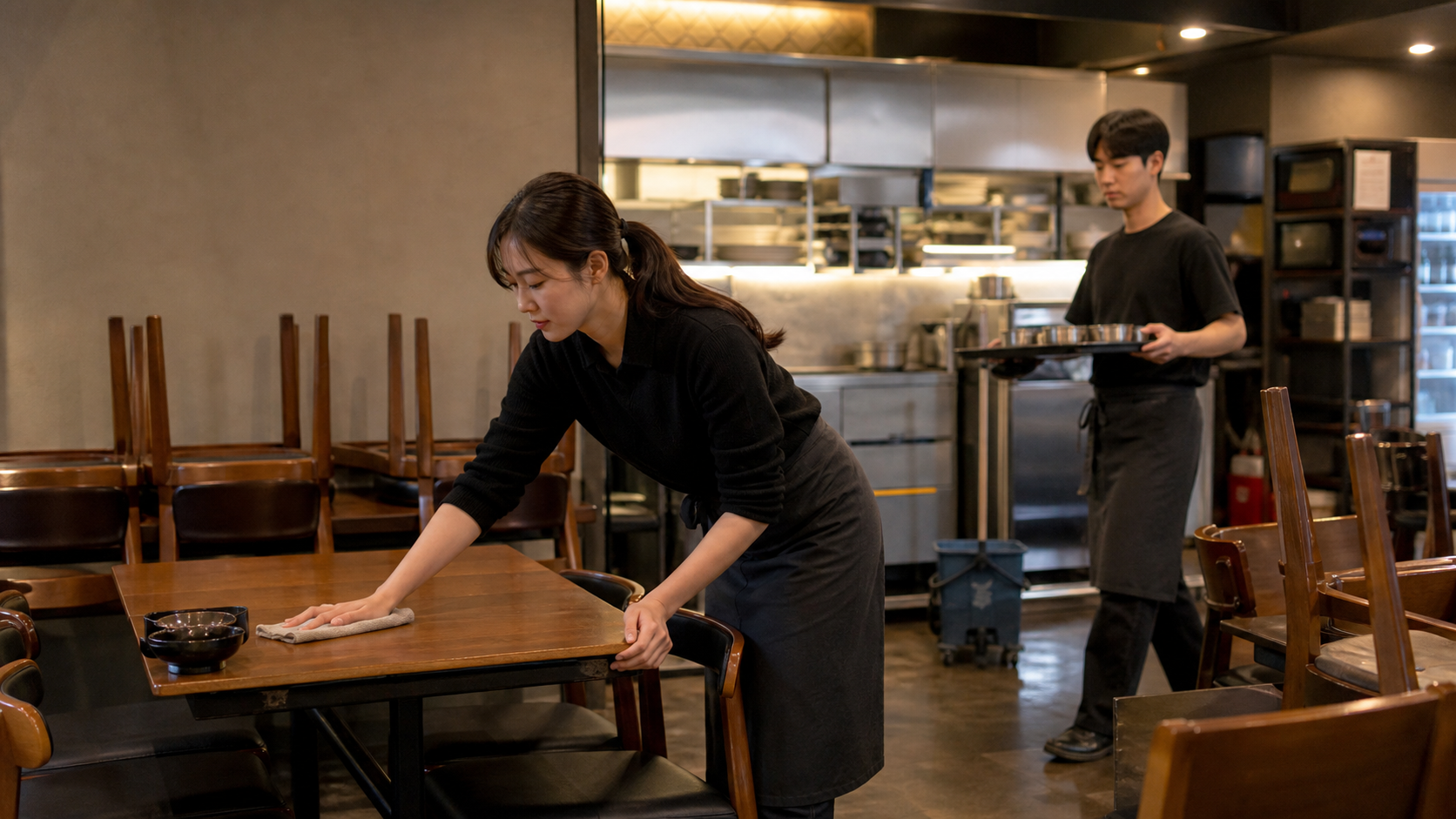
    Restaurant staff closing and cleaning a Korean restaurant after business hours
    Restaurant closing cleanup Korean in a real service work situation.

    Download the PPT briefing for this lesson.

    Short Introduction

    คุณทำงานกะสุดท้ายในร้านอาหารเกาหลี ลูกค้าคนสุดท้ายออกไปแล้ว และผู้จัดการพูดว่า “마감 준비해 주세요.” ร้านปิดสำหรับลูกค้าแล้ว แต่งานของพนักงานยังไม่จบ

    คำสั่งตอนปิดร้านมักสั้น เช่น 테이블 닦아 주세요, 의자 정리해 주세요, 쓰레기 버려 주세요 หรือ 끝나면 보고해 주세요 ให้มองหาสิ่งของและการกระทำก่อน

    บทเรียนนี้สอนวลีภาษาเกาหลีสำหรับงานปิดร้านและทำความสะอาดร้านอาหารสำหรับพนักงานบริการต่างชาติ

    Key Vocabulary

    Korean Romanization English Level Usage Note
    마감 magam closing / end of business Beginner the closing stage after customers leave
    마감 준비 magam junbi closing preparation Beginner getting ready to close the store
    정리 jeongni organizing / putting in order Beginner putting chairs, trays, tools, or stock back in place
    청소 cheongso cleaning Beginner general cleaning of the work area
    닦다 dakda to wipe Beginner wiping tables, counters, or surfaces
    치우다 chiuda to clear away Beginner removing items, trash, or leftover things
    설거지 seolgeoji dishwashing Beginner washing dishes, cups, trays, and utensils
    분리수거 bullisugeo recycling / sorting waste Beginner sorting trash by type
    쓰레기 sseuregi trash Beginner general waste
    음식물 쓰레기 eumsikmul sseuregi food waste Beginner food scraps handled separately in Korea
    테이블 teibeul table Beginner customer table that must be wiped or cleared
    의자 uija chair Beginner chair that may need to be stacked or arranged
    바닥 badak floor Intermediate floor that may need sweeping or mopping
    냉장고 naengjanggo refrigerator Intermediate storage area to check before closing
    유통기한 yutonggihan expiration date Intermediate date to check on ingredients or packaged items
    재고 jaego stock / inventory Intermediate items remaining after work
    확인 hwagin check / confirm Intermediate checking status before finishing
    보고 bogo report Intermediate telling the manager after finishing or finding a problem

    Real Situation

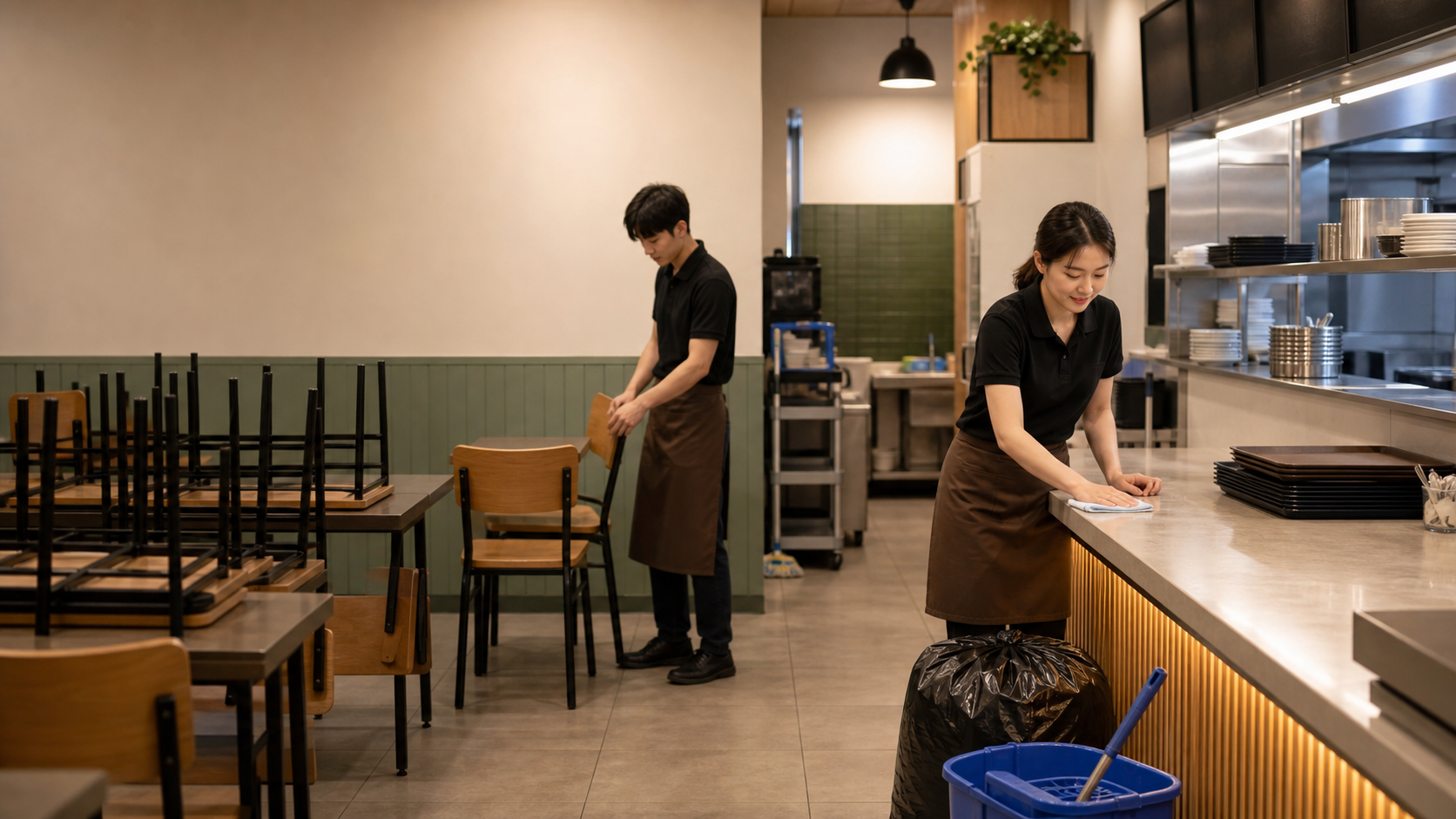
    Restaurant workers wiping tables and organizing chairs during closing cleanup in Korea
    Body situation image for restaurant closing cleanup work.

    งานปิดร้านมักเริ่มจากพื้นที่ลูกค้า: เช็ดโต๊ะ จัดเก้าอี้ เก็บถาด และทิ้งขยะ

    ต่อจากนั้นพนักงานอาจตรวจพื้นที่ครัวหรือเคาน์เตอร์ เช่น จาน แก้ว ตู้เย็น วัตถุดิบ สต็อก และวันหมดอายุ

    ถ้าได้ยิน 끝나면 보고해 주세요 หมายถึงให้รายงานหลังทำงานเสร็จ

    Real Workplace Phrases

    Korean Sentence English Meaning When to Use
    마감 준비해 주세요. Please get ready for closing. When the manager starts closing work.
    테이블 닦아 주세요. Please wipe the tables. When customer tables need cleaning.
    의자 정리해 주세요. Please arrange the chairs. When chairs must be put back or stacked.
    쓰레기 버려 주세요. Please throw away the trash. When trash needs to be removed.
    분리수거 해 주세요. Please sort the recycling. When waste must be separated.
    냉장고 확인해 주세요. Please check the refrigerator. When closing storage areas.
    유통기한 확인해 주세요. Please check the expiration dates. When checking ingredients or stock.
    끝나면 보고해 주세요. Please report when you are finished. When a manager wants a closing update.

    Usage Notes

    마감 หมายถึงช่วงปิดร้านหรือขั้นตอนจบงาน ไม่ใช่แค่ปิดประตูเท่านั้น

    정리 คือจัดให้เป็นระเบียบ, 청소 คือทำความสะอาด, 닦다 คือเช็ดพื้นผิว เช่น โต๊ะหรือเคาน์เตอร์

    분리수거 สำคัญในเกาหลี เพราะต้องแยกขยะทั่วไป รีไซเคิล และ 음식물 쓰레기 หรือเศษอาหาร

    확인 คือการตรวจสอบ ส่วน 보고 คือการรายงาน ทั้งสองคำมักใช้ตอนท้ายงาน

    Read closing instructions as a three-part signal: object, action, and final report. For example, 테이블 닦아 주세요 has the object 테이블 and the action 닦아 주세요. 끝나면 보고해 주세요 tells you to report after finishing.

    Mini Dialogue / บทสนทนาสั้น

    Manager: 마감 준비해 주세요.
    Please get ready for closing.

    Staff: 네, 테이블 닦고 의자 정리하겠습니다.
    Yes, I will wipe the tables and arrange the chairs.

    Manager: 냉장고랑 유통기한도 확인해 주세요.
    Please also check the refrigerator and expiration dates.

    Staff: 끝나면 보고하겠습니다.
    I will report when I am finished.

    Quick Quiz

    1. What does 마감 mean at a restaurant?
      Answer: Closing or end-of-business work.
      마감 is the closing stage after customers leave. Q910001
    2. Which word means to wipe a table or counter?
      Answer: 닦다.
      닦다 is used for wiping surfaces. Q910002
    3. What should you do when you hear 분리수거 해 주세요?
      Answer: Sort the trash or recycling.
      분리수거 means separating waste by type. Q910003
    4. Which phrase means “Please report when you are finished”?
      Answer: 끝나면 보고해 주세요.
      보고 means report. Q910004
    5. Why is 유통기한 important during closing?
      Answer: It helps staff check whether ingredients or packaged items are still usable.
      유통기한 means expiration date. Q910005

    Related Lessons

    บทเรียนที่เกี่ยวข้อง:

    Practice More

    Restaurant worker reviewing Korean service words on a phone after closing
    Review Korean service words after a restaurant closing shift.

    ฝึกคำชุดนี้ได้ใน Learn Korean หรือแอป BSKorean ที่กำลังจะมา

    Practice this word list in Learn Korean. Open the BSKorean app page.

    ??????????????????????????????????

    ???????????????????????????????????????????????????????????????????? ????????????????????? ?? ??? ??? ?????????????????????????????? ? ???? ??????????????????????????????????????????? ???? ???????? ?????????? ??????? ?????? ??????????? ????????????????????????

    ??????????????? ???????????????????? ???????????? ??? ?? ???, ?? ??? ???, ???? ??? ??? ??? ????????????????? ???????????????????? ??, ??, ??, ?? ??????? ??????????????????????????

    Extra Closing Shift Practice

    Korean Romanization English Support Thai Use Note
    ???? ?????. teibeureul dakgetseumnida I will wipe the tables. ?????????????????????????????????????????????
    ?? ???????. uija jeongnihagetseumnida I will organize the chairs. ??????????????????????????????????????????????
    ???? ?? ?????. bullisugeo meonjeo hagetseumnida I will sort the recycling first. ?????????????? ??????? ????? ???????????????
    ??? ???????. naengjanggo hwaginhagetseumnida I will check the refrigerator. ???????????????????????? ????? ??????????????
    ??? ???????. kkeutnamyeon bogohagetseumnida I will report when I am finished. ???????????????????????????????

    English support note: In Korean service workplaces, many instructions are built from a work object and an action. For example, ??? plus ?? becomes ?wipe the table,? and ??? plus ?? becomes ?check the refrigerator.? This makes the sentence easier to understand because you can first look for the object and then the action.

    The word ?? is not only ?closing time.? In a restaurant, it can mean the full closing routine. This includes cleaning customer areas, washing dishes, sorting waste, checking ingredients, checking expiration dates, organizing chairs, and reporting to the manager. If you learn ?? only as a time word, you may miss the work meaning.

    If you are confused, use short polite phrases. ?? ??? ??? means ?Please say that again.? ??? ???? means ?What should I do first?? These questions are useful during closing because several tasks can be given at once, and asking early is better than doing the wrong task.

    English Support Notes for Review

    This English support section is included for learners who use the translated article together with English search terms, workplace training materials, or bilingual study notes. The main lesson is still about practical Korean, but these notes make the closing-cleanup routine easier to reuse in real service work. In a restaurant, closing is not one action. It is a short sequence of repeated tasks: wipe the tables, organize the chairs, wash dishes, sort recycling, remove food waste, check the refrigerator, check expiration dates, check stock, and report to the manager.

    When you hear a Korean instruction during closing, do not wait until you understand every grammar detail. First, listen for the object. The object may be ???, ??, ???, ???, ????, ??, or ????. Second, listen for the action. The action may be ??, ????, ????, ???, ??, or ????. Third, answer with a short polite sentence. Useful answers are ?, ?????, ?, ?????, and ??? ???????. These answers show that you understood the task and will report when finished.

    Closing Korean is also connected to workplace safety and hygiene. If the floor is wet, a coworker may say ?? ?????. If there is food waste, the manager may say ?????? ?? ???. If ingredients are near the expiration date, someone may say ???? ??? ???. These are not advanced academic Korean sentences. They are practical job instructions. A learner should connect each phrase with the physical action that happens in the restaurant.

    A common mistake is translating ?? only as ?deadline.? In many Korean dictionaries, ?? can mean a deadline. In restaurant work, however, ?? often means closing duties or end-of-day work. Another mistake is thinking ?? only means ?summary.? In a workplace, ?? often means arranging, organizing, or putting things back in order. A third mistake is confusing ?? and ??. ?? means to check something. ?? means to report the result to another person. You may need to do both: first ????, then ?????.

    For daily practice, choose five expressions and say them aloud: ???? ?????, ?? ???????, ??? ???????, ???? ?? ?????, ??? ???????. These sentences are short, polite, and realistic. They help a service worker sound cooperative without building long grammar-heavy sentences. If you forget the full sentence, keep the core pattern: noun plus ?????, or noun plus ? ???.

    Use this lesson with Learn Korean after reading. Review the core words as flashcards, then test yourself from Korean to English. If you choose the wrong answer, check the correct meaning and try the word again. The goal is not only to pass a quiz. The goal is to recognize closing-cleanup Korean quickly when a real manager, coworker, or senior staff member says it during a busy shift.

  • Cụm từ tiếng Hàn khi đóng cửa và dọn dẹp nhà hàng

    Cụm từ tiếng Hàn khi đóng cửa và dọn dẹp nhà hàng

    Workplace Korean

    Cụm từ tiếng Hàn khi đóng cửa và dọn dẹp nhà hàng

    Học cụm từ tiếng Hàn khi đóng cửa nhà hàng: lau bàn, xếp ghế, rửa bát, phân loại rác, kiểm tra hàng tồn và báo cáo.

    Restaurant staff closing and cleaning a Korean restaurant after business hours
    Restaurant closing cleanup Korean in a real service work situation.

    Download the PPT briefing for this lesson.

    Short Introduction

    Bạn đang làm ca cuối tại một nhà hàng ở Hàn Quốc. Khách cuối cùng rời đi và quản lý nói: “마감 준비해 주세요.” Nhà hàng đã đóng với khách, nhưng công việc của nhân viên chưa kết thúc.

    Khi đóng cửa, chỉ dẫn tiếng Hàn thường rất ngắn. Bạn có thể nghe 테이블 닦아 주세요, 의자 정리해 주세요, 쓰레기 버려 주세요 hoặc 끝나면 보고해 주세요. Hãy tìm đồ vật và hành động trước.

    Bài học này giúp nhân viên dịch vụ hiểu các cụm từ tiếng Hàn dùng khi đóng cửa và dọn dẹp nhà hàng.

    Key Vocabulary

    Korean Romanization English Level Usage Note
    마감 magam closing / end of business Beginner the closing stage after customers leave
    마감 준비 magam junbi closing preparation Beginner getting ready to close the store
    정리 jeongni organizing / putting in order Beginner putting chairs, trays, tools, or stock back in place
    청소 cheongso cleaning Beginner general cleaning of the work area
    닦다 dakda to wipe Beginner wiping tables, counters, or surfaces
    치우다 chiuda to clear away Beginner removing items, trash, or leftover things
    설거지 seolgeoji dishwashing Beginner washing dishes, cups, trays, and utensils
    분리수거 bullisugeo recycling / sorting waste Beginner sorting trash by type
    쓰레기 sseuregi trash Beginner general waste
    음식물 쓰레기 eumsikmul sseuregi food waste Beginner food scraps handled separately in Korea
    테이블 teibeul table Beginner customer table that must be wiped or cleared
    의자 uija chair Beginner chair that may need to be stacked or arranged
    바닥 badak floor Intermediate floor that may need sweeping or mopping
    냉장고 naengjanggo refrigerator Intermediate storage area to check before closing
    유통기한 yutonggihan expiration date Intermediate date to check on ingredients or packaged items
    재고 jaego stock / inventory Intermediate items remaining after work
    확인 hwagin check / confirm Intermediate checking status before finishing
    보고 bogo report Intermediate telling the manager after finishing or finding a problem

    Real Situation

    Restaurant workers wiping tables and organizing chairs during closing cleanup in Korea
    Body situation image for restaurant closing cleanup work.

    Công việc đóng cửa thường bắt đầu ở khu vực khách: lau bàn, xếp ghế, trả khay và bỏ rác.

    Sau đó nhân viên kiểm tra khu bếp hoặc quầy: bát đĩa, cốc, tủ lạnh, nguyên liệu, hàng tồn và hạn sử dụng.

    Nếu nghe 끝나면 보고해 주세요, quản lý muốn bạn báo cáo sau khi hoàn thành công việc.

    Real Workplace Phrases

    Korean Sentence English Meaning When to Use
    마감 준비해 주세요. Please get ready for closing. When the manager starts closing work.
    테이블 닦아 주세요. Please wipe the tables. When customer tables need cleaning.
    의자 정리해 주세요. Please arrange the chairs. When chairs must be put back or stacked.
    쓰레기 버려 주세요. Please throw away the trash. When trash needs to be removed.
    분리수거 해 주세요. Please sort the recycling. When waste must be separated.
    냉장고 확인해 주세요. Please check the refrigerator. When closing storage areas.
    유통기한 확인해 주세요. Please check the expiration dates. When checking ingredients or stock.
    끝나면 보고해 주세요. Please report when you are finished. When a manager wants a closing update.

    Usage Notes

    마감 là giai đoạn đóng cửa hoặc kết thúc công việc. Trong nhà hàng, nó bao gồm dọn dẹp, sắp xếp, kiểm tra và báo cáo.

    정리 là sắp xếp cho gọn. 청소 là làm sạch. 닦다 là lau bề mặt như bàn hoặc quầy.

    분리수거 rất quan trọng ở Hàn Quốc vì rác thường, rác tái chế và 음식물 쓰레기 hay rác thực phẩm thường được tách riêng.

    확인 nghĩa là kiểm tra, còn 보고 nghĩa là báo cáo. Hai từ này thường xuất hiện ở bước cuối.

    Read closing instructions as a three-part signal: object, action, and final report. For example, 테이블 닦아 주세요 has the object 테이블 and the action 닦아 주세요. 끝나면 보고해 주세요 tells you to report after finishing.

    Mini Dialogue / Hội thoại ngắn

    Manager: 마감 준비해 주세요.
    Please get ready for closing.

    Staff: 네, 테이블 닦고 의자 정리하겠습니다.
    Yes, I will wipe the tables and arrange the chairs.

    Manager: 냉장고랑 유통기한도 확인해 주세요.
    Please also check the refrigerator and expiration dates.

    Staff: 끝나면 보고하겠습니다.
    I will report when I am finished.

    Quick Quiz

    1. What does 마감 mean at a restaurant?
      Answer: Closing or end-of-business work.
      마감 is the closing stage after customers leave. Q910001
    2. Which word means to wipe a table or counter?
      Answer: 닦다.
      닦다 is used for wiping surfaces. Q910002
    3. What should you do when you hear 분리수거 해 주세요?
      Answer: Sort the trash or recycling.
      분리수거 means separating waste by type. Q910003
    4. Which phrase means “Please report when you are finished”?
      Answer: 끝나면 보고해 주세요.
      보고 means report. Q910004
    5. Why is 유통기한 important during closing?
      Answer: It helps staff check whether ingredients or packaged items are still usable.
      유통기한 means expiration date. Q910005

    Related Lessons

    Bài học liên quan:

    Practice More

    Restaurant worker reviewing Korean service words on a phone after closing
    Review Korean service words after a restaurant closing shift.

    Hãy luyện nhóm từ này trong Learn Korean hoặc ứng dụng BSKorean sắp ra mắt.

    Practice this word list in Learn Korean. Open the BSKorean app page.

  • 韓国のレストラン閉店作業で使う韓国語フレーズ

    韓国のレストラン閉店作業で使う韓国語フレーズ

    Workplace Korean

    サービス業向け韓国語レストラン閉店作業フレーズ

    レストラン閉店時に使う韓国語フレーズを学びます。テーブル拭き、椅子の整理、皿洗い、分別、在庫確認、報告を扱います。

    Restaurant staff closing and cleaning a Korean restaurant after business hours
    Restaurant closing cleanup Korean in a real service work situation.

    Download the PPT briefing for this lesson.

    Short Introduction

    韓国のレストランで最後のシフトに入っています。最後のお客様が帰った後、店長が「마감 준비해 주세요」と言います。営業は終わりましたが、スタッフの仕事はまだ残っています。

    閉店作業の指示は短いことが多いです。테이블 닦아 주세요, 의자 정리해 주세요, 쓰레기 버려 주세요, 끝나면 보고해 주세요 のように、物と動作を見つけることが大切です。

    このレッスンでは、サービス業で働く外国人向けに、韓国語のレストラン閉店作業フレーズを整理します。

    Key Vocabulary

    Korean Romanization English Level Usage Note
    마감 magam closing / end of business Beginner the closing stage after customers leave
    마감 준비 magam junbi closing preparation Beginner getting ready to close the store
    정리 jeongni organizing / putting in order Beginner putting chairs, trays, tools, or stock back in place
    청소 cheongso cleaning Beginner general cleaning of the work area
    닦다 dakda to wipe Beginner wiping tables, counters, or surfaces
    치우다 chiuda to clear away Beginner removing items, trash, or leftover things
    설거지 seolgeoji dishwashing Beginner washing dishes, cups, trays, and utensils
    분리수거 bullisugeo recycling / sorting waste Beginner sorting trash by type
    쓰레기 sseuregi trash Beginner general waste
    음식물 쓰레기 eumsikmul sseuregi food waste Beginner food scraps handled separately in Korea
    테이블 teibeul table Beginner customer table that must be wiped or cleared
    의자 uija chair Beginner chair that may need to be stacked or arranged
    바닥 badak floor Intermediate floor that may need sweeping or mopping
    냉장고 naengjanggo refrigerator Intermediate storage area to check before closing
    유통기한 yutonggihan expiration date Intermediate date to check on ingredients or packaged items
    재고 jaego stock / inventory Intermediate items remaining after work
    확인 hwagin check / confirm Intermediate checking status before finishing
    보고 bogo report Intermediate telling the manager after finishing or finding a problem

    Real Situation

    Restaurant workers wiping tables and organizing chairs during closing cleanup in Korea
    Body situation image for restaurant closing cleanup work.

    閉店作業では、まず客席を片付けます。テーブルを拭き、椅子を整え、トレーを戻し、ゴミを捨てます。

    次にキッチンやカウンターを確認します。皿、コップ、冷蔵庫、食材、在庫、賞味期限などをチェックします。

    끝나면 보고해 주세요 と言われたら、掃除の指示ではなく、終わった後に報告してほしいという意味です。

    Real Workplace Phrases

    Korean Sentence English Meaning When to Use
    마감 준비해 주세요. Please get ready for closing. When the manager starts closing work.
    테이블 닦아 주세요. Please wipe the tables. When customer tables need cleaning.
    의자 정리해 주세요. Please arrange the chairs. When chairs must be put back or stacked.
    쓰레기 버려 주세요. Please throw away the trash. When trash needs to be removed.
    분리수거 해 주세요. Please sort the recycling. When waste must be separated.
    냉장고 확인해 주세요. Please check the refrigerator. When closing storage areas.
    유통기한 확인해 주세요. Please check the expiration dates. When checking ingredients or stock.
    끝나면 보고해 주세요. Please report when you are finished. When a manager wants a closing update.

    Usage Notes

    마감 は閉店、締め作業、シフト終わりの作業を表す便利な職場語彙です。

    정리 は整理すること、청소 は掃除すること、닦다 は表面を拭くことです。

    분리수거 は分別回収です。韓国では一般ゴミ、リサイクル、음식물 쓰레기 を分ける場面が多いです。

    확인 は確認、보고 は報告です。閉店作業の最後によく使います。

    Read closing instructions as a three-part signal: object, action, and final report. For example, 테이블 닦아 주세요 has the object 테이블 and the action 닦아 주세요. 끝나면 보고해 주세요 tells you to report after finishing.

    Mini Dialogue / ミニ会話

    Manager: 마감 준비해 주세요.
    Please get ready for closing.

    Staff: 네, 테이블 닦고 의자 정리하겠습니다.
    Yes, I will wipe the tables and arrange the chairs.

    Manager: 냉장고랑 유통기한도 확인해 주세요.
    Please also check the refrigerator and expiration dates.

    Staff: 끝나면 보고하겠습니다.
    I will report when I am finished.

    Quick Quiz

    1. What does 마감 mean at a restaurant?
      Answer: Closing or end-of-business work.
      마감 is the closing stage after customers leave. Q910001
    2. Which word means to wipe a table or counter?
      Answer: 닦다.
      닦다 is used for wiping surfaces. Q910002
    3. What should you do when you hear 분리수거 해 주세요?
      Answer: Sort the trash or recycling.
      분리수거 means separating waste by type. Q910003
    4. Which phrase means “Please report when you are finished”?
      Answer: 끝나면 보고해 주세요.
      보고 means report. Q910004
    5. Why is 유통기한 important during closing?
      Answer: It helps staff check whether ingredients or packaged items are still usable.
      유통기한 means expiration date. Q910005

    Related Lessons

    関連レッスン:

    Practice More

    Restaurant worker reviewing Korean service words on a phone after closing
    Review Korean service words after a restaurant closing shift.

    この単語セットは Learn Korean または今後の BSKorean アプリで練習できます。

    Practice this word list in Learn Korean. Open the BSKorean app page.

    ??????????????

    ????????????????????????????????????????????????????? ?? ??? ??? ?????????????????????????????????????????????

    ????????????????????????????? ??? ?? ???, ?? ??? ???, ??? ??? ??? ?????????????????????????? ??, ??, ??, ?? ????????????????????????????????

    Extra Closing Shift Practice

    Korean Romanization English Support Japanese Use Note
    ???? ?????. teibeureul dakgetseumnida I will wipe the tables. ???????????????????????
    ?? ???????. uija jeongnihagetseumnida I will organize the chairs. ??????????????????????
    ??? ?? ?????. seolgeoji meonjeo hagetseumnida I will do the dishes first. ???????????????????
    ??? ???????. naengjanggo hwaginhagetseumnida I will check the refrigerator. ?????????????????
    ??? ???????. kkeutnamyeon bogohagetseumnida I will report when I am finished. ????????????????????????

    English support note: Korean workplace instructions are often short. A manager may not say a full sentence with every grammar point. Instead, you may hear an object plus an action, such as ??? ?? ???, ???? ? ???, or ?? ??? ???. This is normal in a busy restaurant. Your goal is to identify the action word and the object quickly.

    The word ?? is important because it does not only mean the clock time when the store closes. In service work, ?? can mean the complete closing routine. It may include cleaning the dining area, sorting trash, checking food ingredients, washing dishes, arranging chairs, and reporting to a supervisor. This is why ?? is a practical workplace Korean word.

    If you are not sure what to do first, use a short polite question. ??? ???? means ?What should I do first?? ?? ??? ??? means ?Please say that again.? These two phrases are useful because they help you avoid mistakes during closing, especially when several tasks are given at the same time.

    English Support Notes for Review

    This English support section is included for learners who use the translated article together with English search terms, workplace training materials, or bilingual study notes. The main lesson is still about practical Korean, but these notes make the closing-cleanup routine easier to reuse in real service work. In a restaurant, closing is not one action. It is a short sequence of repeated tasks: wipe the tables, organize the chairs, wash dishes, sort recycling, remove food waste, check the refrigerator, check expiration dates, check stock, and report to the manager.

    When you hear a Korean instruction during closing, do not wait until you understand every grammar detail. First, listen for the object. The object may be ???, ??, ???, ???, ????, ??, or ????. Second, listen for the action. The action may be ??, ????, ????, ???, ??, or ????. Third, answer with a short polite sentence. Useful answers are ?, ?????, ?, ?????, and ??? ???????. These answers show that you understood the task and will report when finished.

    Closing Korean is also connected to workplace safety and hygiene. If the floor is wet, a coworker may say ?? ?????. If there is food waste, the manager may say ?????? ?? ???. If ingredients are near the expiration date, someone may say ???? ??? ???. These are not advanced academic Korean sentences. They are practical job instructions. A learner should connect each phrase with the physical action that happens in the restaurant.

    A common mistake is translating ?? only as ?deadline.? In many Korean dictionaries, ?? can mean a deadline. In restaurant work, however, ?? often means closing duties or end-of-day work. Another mistake is thinking ?? only means ?summary.? In a workplace, ?? often means arranging, organizing, or putting things back in order. A third mistake is confusing ?? and ??. ?? means to check something. ?? means to report the result to another person. You may need to do both: first ????, then ?????.

    For daily practice, choose five expressions and say them aloud: ???? ?????, ?? ???????, ??? ???????, ???? ?? ?????, ??? ???????. These sentences are short, polite, and realistic. They help a service worker sound cooperative without building long grammar-heavy sentences. If you forget the full sentence, keep the core pattern: noun plus ?????, or noun plus ? ???.

    Use this lesson with Learn Korean after reading. Review the core words as flashcards, then test yourself from Korean to English. If you choose the wrong answer, check the correct meaning and try the word again. The goal is not only to pass a quiz. The goal is to recognize closing-cleanup Korean quickly when a real manager, coworker, or senior staff member says it during a busy shift.

  • Frasa Korea untuk Penutupan dan Bersih-Bersih Restoran

    Frasa Korea untuk Penutupan dan Bersih-Bersih Restoran

    Workplace Korean

    Frasa Penutupan dan Bersih-Bersih Restoran Korea untuk Pekerja Layanan

    Pelajari frasa Korea untuk pekerjaan penutupan restoran, membersihkan meja, menata kursi, mencuci piring, memilah sampah, dan melapor.

    Restaurant staff closing and cleaning a Korean restaurant after business hours
    Restaurant closing cleanup Korean in a real service work situation.

    Download the PPT briefing for this lesson.

    Short Introduction

    Anda bekerja shift terakhir di restoran Korea. Pelanggan terakhir sudah pergi, lalu manajer berkata, “마감 준비해 주세요.” Artinya restoran sudah tutup untuk pelanggan, tetapi pekerjaan staf belum selesai.

    Saat penutupan, instruksi Korea biasanya pendek. Anda mungkin mendengar 테이블 닦아 주세요, 의자 정리해 주세요, 쓰레기 버려 주세요, atau 끝나면 보고해 주세요. Fokuslah pada benda dan tindakan.

    Pelajaran ini membantu pekerja layanan memahami frasa penutupan dan bersih-bersih restoran dalam bahasa Korea.

    Key Vocabulary

    Korean Romanization English Level Usage Note
    마감 magam closing / end of business Beginner the closing stage after customers leave
    마감 준비 magam junbi closing preparation Beginner getting ready to close the store
    정리 jeongni organizing / putting in order Beginner putting chairs, trays, tools, or stock back in place
    청소 cheongso cleaning Beginner general cleaning of the work area
    닦다 dakda to wipe Beginner wiping tables, counters, or surfaces
    치우다 chiuda to clear away Beginner removing items, trash, or leftover things
    설거지 seolgeoji dishwashing Beginner washing dishes, cups, trays, and utensils
    분리수거 bullisugeo recycling / sorting waste Beginner sorting trash by type
    쓰레기 sseuregi trash Beginner general waste
    음식물 쓰레기 eumsikmul sseuregi food waste Beginner food scraps handled separately in Korea
    테이블 teibeul table Beginner customer table that must be wiped or cleared
    의자 uija chair Beginner chair that may need to be stacked or arranged
    바닥 badak floor Intermediate floor that may need sweeping or mopping
    냉장고 naengjanggo refrigerator Intermediate storage area to check before closing
    유통기한 yutonggihan expiration date Intermediate date to check on ingredients or packaged items
    재고 jaego stock / inventory Intermediate items remaining after work
    확인 hwagin check / confirm Intermediate checking status before finishing
    보고 bogo report Intermediate telling the manager after finishing or finding a problem

    Real Situation

    Restaurant workers wiping tables and organizing chairs during closing cleanup in Korea
    Body situation image for restaurant closing cleanup work.

    Pekerjaan penutupan biasanya dimulai dari area pelanggan: meja dilap, kursi dirapikan, nampan dikembalikan, dan sampah dibuang.

    Setelah itu, staf memeriksa area dapur atau counter: piring, gelas, alat makan, kulkas, bahan makanan, stok, dan tanggal kedaluwarsa.

    Jika mendengar 끝나면 보고해 주세요, manajer meminta Anda melapor setelah pekerjaan selesai.

    Real Workplace Phrases

    Korean Sentence English Meaning When to Use
    마감 준비해 주세요. Please get ready for closing. When the manager starts closing work.
    테이블 닦아 주세요. Please wipe the tables. When customer tables need cleaning.
    의자 정리해 주세요. Please arrange the chairs. When chairs must be put back or stacked.
    쓰레기 버려 주세요. Please throw away the trash. When trash needs to be removed.
    분리수거 해 주세요. Please sort the recycling. When waste must be separated.
    냉장고 확인해 주세요. Please check the refrigerator. When closing storage areas.
    유통기한 확인해 주세요. Please check the expiration dates. When checking ingredients or stock.
    끝나면 보고해 주세요. Please report when you are finished. When a manager wants a closing update.

    Usage Notes

    마감 berarti tahap penutupan. Di restoran, kata ini mencakup membersihkan, merapikan, memeriksa, dan melapor.

    정리 berarti menata atau merapikan. 청소 berarti membersihkan. 닦다 berarti mengelap permukaan seperti meja atau counter.

    분리수거 penting di Korea karena sampah biasa, daur ulang, dan 음식물 쓰레기 atau sampah makanan sering dipisahkan.

    확인 berarti memeriksa, sedangkan 보고 berarti melapor. Dua kata ini sering muncul di akhir pekerjaan.

    Read closing instructions as a three-part signal: object, action, and final report. For example, 테이블 닦아 주세요 has the object 테이블 and the action 닦아 주세요. 끝나면 보고해 주세요 tells you to report after finishing.

    Mini Dialogue / Dialog Singkat

    Manager: 마감 준비해 주세요.
    Please get ready for closing.

    Staff: 네, 테이블 닦고 의자 정리하겠습니다.
    Yes, I will wipe the tables and arrange the chairs.

    Manager: 냉장고랑 유통기한도 확인해 주세요.
    Please also check the refrigerator and expiration dates.

    Staff: 끝나면 보고하겠습니다.
    I will report when I am finished.

    Quick Quiz

    1. What does 마감 mean at a restaurant?
      Answer: Closing or end-of-business work.
      마감 is the closing stage after customers leave. Q910001
    2. Which word means to wipe a table or counter?
      Answer: 닦다.
      닦다 is used for wiping surfaces. Q910002
    3. What should you do when you hear 분리수거 해 주세요?
      Answer: Sort the trash or recycling.
      분리수거 means separating waste by type. Q910003
    4. Which phrase means “Please report when you are finished”?
      Answer: 끝나면 보고해 주세요.
      보고 means report. Q910004
    5. Why is 유통기한 important during closing?
      Answer: It helps staff check whether ingredients or packaged items are still usable.
      유통기한 means expiration date. Q910005

    Related Lessons

    Pelajaran terkait:

    Practice More

    Restaurant worker reviewing Korean service words on a phone after closing
    Review Korean service words after a restaurant closing shift.

    Latih kelompok kata ini di Learn Korean atau aplikasi BSKorean yang akan datang.

    Practice this word list in Learn Korean. Open the BSKorean app page.

    Briefing Tambahan untuk Pekerja Restoran

    Bagian ini memperluas pelajaran agar pekerja layanan dapat membaca situasi penutupan restoran dengan lebih tenang. Saat manajer berkata ?? ??? ???, fokus pertama bukan menerjemahkan setiap kata, tetapi memahami urutan kerja: membersihkan area pelanggan, merapikan kursi, membuang sampah, memeriksa stok, lalu melapor.

    Dalam shift nyata, instruksi sering datang cepat. Anda mungkin mendengar ??? ?? ???, ?? ??? ???, atau ??? ??? ??? dalam satu menit yang sama. Jika Anda mengenali kata inti seperti ??, ??, ??, dan ??, Anda bisa bertindak tanpa panik.

    Extra Closing Shift Practice

    Korean Romanization English Support Indonesian Use Note
    ???? ?????. teibeureul dakgetseumnida I will wipe the tables. Jawaban sopan ketika menerima tugas membersihkan meja.
    ?? ???????. uija jeongnihagetseumnida I will organize the chairs. Dipakai saat kursi perlu dinaikkan atau dirapikan.
    ??? ??????. sseuregi beorigetseumnida I will throw away the trash. Gunakan setelah memastikan jenis sampah yang benar.
    ???? ?? ?????. bullisugeo meonjeo hagetseumnida I will sort the recycling first. Baik untuk restoran yang memisahkan botol, plastik, dan kardus.
    ??? ???????. kkeutnamyeon bogohagetseumnida I will report when I am finished. Jawaban aman setelah menerima beberapa tugas sekaligus.

    English support note: In Korean workplaces, short instructions often sound like commands, but they can still be polite when they end with ??? or ???. For a beginner, the safest response is not a long sentence. A short confirmation such as ?, ????? or ?, ????? is clear and respectful. If you did not understand the order, ask immediately with ?? ??? ???, which means ?Please say that again.?

    When closing a restaurant, the word ?? can mean more than ?closing time.? It often means the whole end-of-day routine. This may include wiping tables, checking the refrigerator, separating food waste, counting supplies, turning off equipment, and reporting to the manager. That is why this lesson treats ?? as a workplace action word, not only a time word.

    Safety and hygiene matter during closing. If the floor is wet, you may hear ?? ?????. If food waste bags are full, you may hear ?????? ?? ???. These phrases are practical because they connect Korean vocabulary with real tasks. Study them as actions you can perform, not as isolated dictionary words.

  • Korean Restaurant Closing Cleanup Phrases for Service Workers

    Korean Restaurant Closing Cleanup Phrases for Service Workers

    Workplace Korean

    Korean Restaurant Closing Cleanup Phrases for Service Workers

    Learn Korean restaurant closing cleanup phrases for wiping tables, organizing chairs, dishwashing, sorting trash, checking stock, and reporting.

    Restaurant staff closing and cleaning a Korean restaurant after business hours
    Restaurant closing cleanup Korean in a real service work situation.

    Download the PPT briefing for this lesson.

    Short Introduction

    You are working the last shift at a Korean restaurant. The last customer leaves, the open sign is turned off, and your manager says, “마감 준비해 주세요.” You understand that the restaurant is closed, but the work is not finished yet.

    At closing time, Korean instructions are usually short. A manager may say 테이블 닦아 주세요, 의자 정리해 주세요, 쓰레기 버려 주세요, or 끝나면 보고해 주세요. These are not long grammar exercises. They are work signals. If you can find the object and the action, you can understand what to do next.

    This lesson teaches Korean restaurant closing cleanup phrases for service workers. The vocabulary is designed for restaurant, cafe, food court, hotel breakfast, and catering workers who need practical Workplace Korean in Korea.

    Key Vocabulary

    Korean Romanization English Level Usage Note
    마감 magam closing / end of business Beginner the closing stage after customers leave
    마감 준비 magam junbi closing preparation Beginner getting ready to close the store
    정리 jeongni organizing / putting in order Beginner putting chairs, trays, tools, or stock back in place
    청소 cheongso cleaning Beginner general cleaning of the work area
    닦다 dakda to wipe Beginner wiping tables, counters, or surfaces
    치우다 chiuda to clear away Beginner removing items, trash, or leftover things
    설거지 seolgeoji dishwashing Beginner washing dishes, cups, trays, and utensils
    분리수거 bullisugeo recycling / sorting waste Beginner sorting trash by type
    쓰레기 sseuregi trash Beginner general waste
    음식물 쓰레기 eumsikmul sseuregi food waste Beginner food scraps handled separately in Korea
    테이블 teibeul table Beginner customer table that must be wiped or cleared
    의자 uija chair Beginner chair that may need to be stacked or arranged
    바닥 badak floor Intermediate floor that may need sweeping or mopping
    냉장고 naengjanggo refrigerator Intermediate storage area to check before closing
    유통기한 yutonggihan expiration date Intermediate date to check on ingredients or packaged items
    재고 jaego stock / inventory Intermediate items remaining after work
    확인 hwagin check / confirm Intermediate checking status before finishing
    보고 bogo report Intermediate telling the manager after finishing or finding a problem

    Real Situation

    Restaurant workers wiping tables and organizing chairs during closing cleanup in Korea
    Body situation image for restaurant closing cleanup work.

    Closing work in a Korean restaurant usually happens in steps. First, staff clear customer areas. Tables are wiped, chairs are arranged, trays are returned, and leftover trash is removed. Then staff check kitchen or counter areas. Dishes, cups, utensils, refrigerators, ingredients, and stock may need attention.

    The important point is that Korean managers often use an object plus an action. For example, 테이블 닦아 주세요 means “Please wipe the tables.” The object is 테이블, and the action is 닦아 주세요. 의자 정리해 주세요 means “Please arrange the chairs.” The object is 의자, and the action is 정리해 주세요.

    If you hear 끝나면 보고해 주세요, the manager is not asking you to clean something. The manager is asking for a final update after the task is finished. This matters because closing work is connected to safety, hygiene, food storage, and the next day’s preparation.

    Real Workplace Phrases

    Korean Sentence English Meaning When to Use
    마감 준비해 주세요. Please get ready for closing. When the manager starts closing work.
    테이블 닦아 주세요. Please wipe the tables. When customer tables need cleaning.
    의자 정리해 주세요. Please arrange the chairs. When chairs must be put back or stacked.
    쓰레기 버려 주세요. Please throw away the trash. When trash needs to be removed.
    분리수거 해 주세요. Please sort the recycling. When waste must be separated.
    냉장고 확인해 주세요. Please check the refrigerator. When closing storage areas.
    유통기한 확인해 주세요. Please check the expiration dates. When checking ingredients or stock.
    끝나면 보고해 주세요. Please report when you are finished. When a manager wants a closing update.

    Usage Notes

    마감 is a very useful workplace word. It can mean the end of business hours, closing work, or the closing stage of a shift. In a restaurant, 마감 does not only mean “close the door.” It includes cleaning, organizing, checking, and reporting.

    정리 and 청소 are related, but they are not the same. 정리 means putting things in order. You can 정리 chairs, trays, receipts, stock, or the counter area. 청소 means cleaning. You can 청소 the floor, kitchen, restroom, or dining area.

    닦다 is more specific than 청소. It means to wipe. Staff often use it for 테이블, 카운터, 선반, or 바닥 when the surface needs wiping. 치우다 means to clear away or remove something. It is useful for plates, trash, leftover items, or things left on a table.

    분리수거 is especially important in Korea. Trash is often separated into regular trash, recycling, and food waste. If a manager says 음식물 쓰레기 따로 버려 주세요, they mean food waste should be handled separately. This is not just a language point. It is part of daily workplace rules in Korea.

    확인 and 보고 are final-step words. 확인 means check or confirm. 보고 means report. At closing time, you may check the refrigerator, expiration dates, stock, or whether the cleaning is finished. Then you report to the manager.

    Read closing instructions as a three-part signal: object, action, and final report. For example, 테이블 닦아 주세요 has the object 테이블 and the action 닦아 주세요. 끝나면 보고해 주세요 tells you to report after finishing.

    Mini Dialogue

    Manager: 마감 준비해 주세요.
    Please get ready for closing.

    Staff: 네, 테이블 닦고 의자 정리하겠습니다.
    Yes, I will wipe the tables and arrange the chairs.

    Manager: 냉장고랑 유통기한도 확인해 주세요.
    Please also check the refrigerator and expiration dates.

    Staff: 끝나면 보고하겠습니다.
    I will report when I am finished.

    Quick Quiz

    1. What does 마감 mean at a restaurant?
      Answer: Closing or end-of-business work.
      마감 is the closing stage after customers leave. Q910001
    2. Which word means to wipe a table or counter?
      Answer: 닦다.
      닦다 is used for wiping surfaces. Q910002
    3. What should you do when you hear 분리수거 해 주세요?
      Answer: Sort the trash or recycling.
      분리수거 means separating waste by type. Q910003
    4. Which phrase means “Please report when you are finished”?
      Answer: 끝나면 보고해 주세요.
      보고 means report. Q910004
    5. Why is 유통기한 important during closing?
      Answer: It helps staff check whether ingredients or packaged items are still usable.
      유통기한 means expiration date. Q910005

    Related Lessons

    These lessons connect well with closing cleanup work:

    Practice More

    Restaurant worker reviewing Korean service words on a phone after closing
    Review Korean service words after a restaurant closing shift.

    Practice this word group in Learn Korean or in the upcoming BSKorean app.

    Practice this word list in Learn Korean. Open the BSKorean app page.