Korean Restaurant Allergy and Ingredient Questions for Service Workers
Practical Korean phrases for restaurant staff who need to confirm allergies, ingredients, sauces, toppings, broth, oil, and cross-contact before serving food.
1. Key vocabulary
allergy
BeginnerI have an allergy
Beginneringredient
Beginneroriginal ingredient
Beginnerpeanut
Beginner5. When to use these phrases
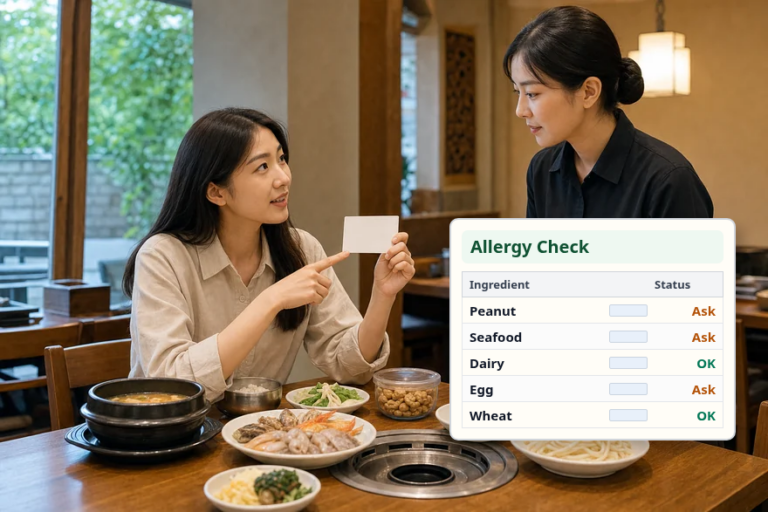
Restaurant allergy questions are not ordinary menu questions. When a customer says 저는 땅콩 알레르기가 있어요, the safest answer is not a quick 괜찮아요. A service worker needs to pause the order, repeat the allergy clearly, check the menu and kitchen information, and answer only after the kitchen can confirm the ingredient risk.
This lesson is for restaurant, cafe, delivery kitchen, and counter staff in Korea. The situation is specific: a customer is already looking at a menu, food may contain hidden sauce or broth, and the worker must speak politely while avoiding promises that the kitchen cannot keep. Use these phrases when you need to ask what ingredient the customer cannot eat, check whether it is in the dish, and pass the information to the kitchen or manager.
Start with the core word 알레르기. A customer may say 알레르기가 있어요, which means they have an allergy. Do not treat that sentence as a preference. Repeat the ingredient and confirm it: 땅콩 알레르기가 있으세요? means, “You have a peanut allergy?” This gives the customer a chance to correct you before the order goes to the kitchen.
The next important word is 재료, ingredient. In restaurants, 재료 does not only mean the visible meat or vegetables. It can include sauce, topping, garnish, broth, oil, powder, batter, seasoning, and prepared paste. For a more detailed check, use 원재료. 원재료 is helpful when you need to check a label, packaged sauce, premade broth, or mixed seasoning.
Use 들어가나요? when asking whether something is included. 이 음식에 땅콩이 들어가나요? means “Does this dish contain peanuts?” You can change the ingredient: 해산물이 들어가나요, 유제품이 들어가나요, 계란이 들어가나요, 밀가루가 들어가나요. This pattern is short, polite, and useful at the table or counter.
If the customer asks for an ingredient to be removed, use 빼 주세요 or 빼 드릴 수 있는지 확인해 볼게요. Be careful. 빼 주세요 is the customer’s request. The worker’s safer response is 확인해 드릴게요 or 주방에 확인하겠습니다. If the ingredient is already inside sauce, broth, oil, or batter, removing the visible ingredient may not make the food safe.
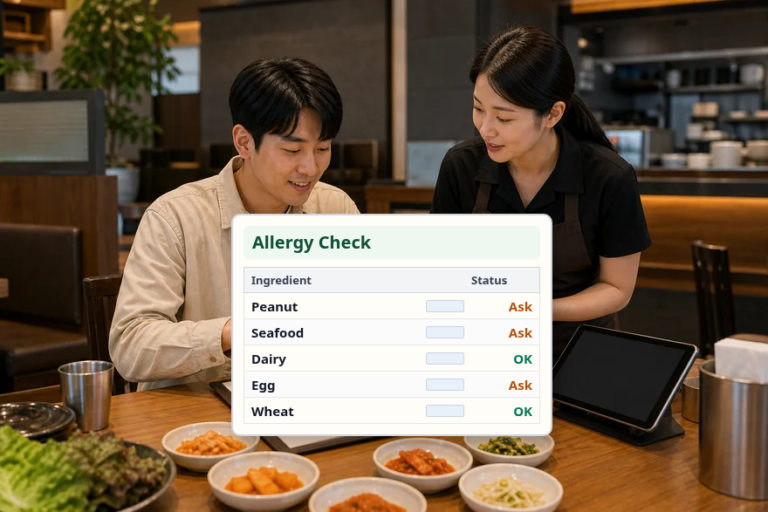
A safe service answer has three steps. First, acknowledge the allergy: 네, 알레르기 있으시군요. Second, check the food: 이 음식에 들어가는지 확인해 드릴게요. Third, pass the information to the kitchen: 손님이 땅콩 알레르기가 있다고 하셨어요. These steps are slower than a quick answer, but they reduce misunderstanding.
When speaking to the kitchen, do not only say 땅콩 빼 주세요. Say the full risk: 손님이 땅콩 알레르기가 있으세요. 소스에도 들어가는지 확인해 주세요. This tells the kitchen that sauce, topping, and prepared ingredients matter. If the customer mentioned severe allergy, add 심한 알레르기라고 하셨어요.
Cross-contact is another important situation. A dish may not list peanuts, but the same tongs, pan, cutting board, fryer oil, or storage container may be used. In Korean, you can explain carefully: 같은 도구를 사용할 수 있어서 완전히 분리하기 어려울 수 있어요. This means the tools may be shared and complete separation may be difficult.
If the kitchen cannot guarantee separation, do not say 괜찮아요. Say 정확히 확인이 어려워서 추천드리기 어렵습니다 or 완전히 안전하다고 말씀드리기는 어렵습니다. These sentences are honest and safer. They may feel less convenient, but allergy communication is about safety first.
Mini dialogue: Customer: 저는 견과류 알레르기가 있어요. Worker: 네, 견과류가 들어가는지 확인해 드릴게요. Customer: 소스에도 들어가나요? Worker: 주방에 다시 확인하고 말씀드리겠습니다. Customer: 빼 줄 수 있나요? Worker: 가능 여부와 같은 도구 사용 여부도 같이 확인하겠습니다.
For seafood questions, use 해산물. 이 국물에 해산물이 들어가나요? is useful because seafood can be hidden in broth. For dairy questions, use 유제품. 소스에 유제품이 들어가나요? For egg, use 계란. 반죽에 계란이 들어가나요? For wheat, use 밀가루. 튀김옷에 밀가루가 들어가나요?
Common mistake one: answering from the picture on the menu. A menu photo does not show broth, oil, seasoning, or premade sauce. Common mistake two: asking only one kitchen worker and forgetting to mark the order. Common mistake three: saying 빼 드릴게요 before confirming whether the ingredient is already mixed into the sauce.
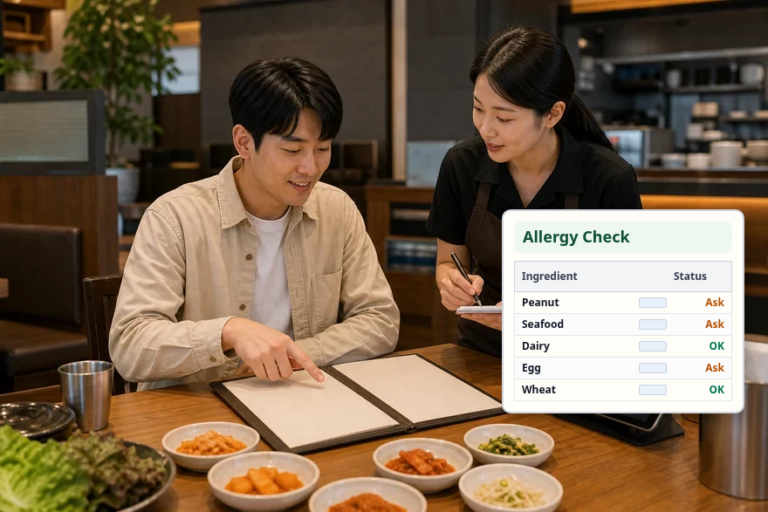
A better workflow is simple. Write or enter the allergy on the order. Repeat the ingredient aloud. Ask the kitchen about sauce, topping, broth, oil, and shared tools. If needed, ask the manager. Return to the customer with a specific answer: 땅콩은 들어가지 않지만 같은 조리 도구를 사용할 수 있습니다, or 소스에 견과류가 들어가서 추천드리기 어렵습니다.
Quick check: Which sentence is safest before you know whether the dish is free of peanuts? The answer is 확인해 드릴게요. Do not choose 괜찮아요, 그냥 드세요. The worker should confirm first, then answer.
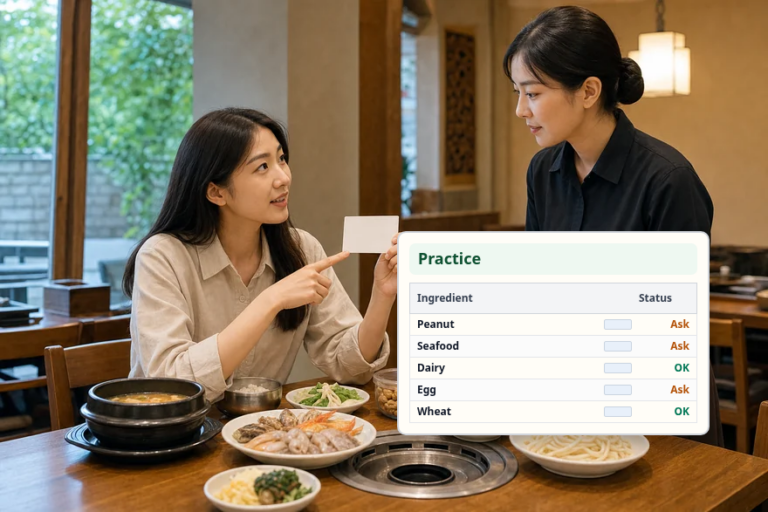
Practice these phrases as a set: 알레르기가 있으세요? 이 음식에 들어가나요? 소스에도 들어가나요? 주방에 확인하겠습니다. 매니저에게 확인하고 말씀드리겠습니다. 완전히 안전하다고 말씀드리기는 어렵습니다. In a real restaurant, these sentences help you sound polite, careful, and responsible while protecting the customer.
Service checklist for a busy shift: when the dining room is full, it is tempting to answer from memory. Do not do that for allergy questions. Read the order, repeat the allergy, and ask the kitchen about the exact dish. If the customer asks about soup, check broth. If the customer asks about fried food, check batter and fryer oil. If the customer asks about noodles, check wheat flour, egg, and sauce. If the customer asks about a salad, check dressing, garnish, nuts, and cheese. A safe answer is specific, not general.
Use different Korean sentences for different moments. At the table, say 잠시만요, 확인해 드릴게요. At the kitchen pass, say 손님이 땅콩 알레르기가 있으세요. 이 메뉴에 땅콩이나 견과류가 들어가나요? When you return to the customer, say 주방에 확인했습니다. 소스에는 견과류가 들어가지 않지만 같은 조리 도구를 사용할 수 있습니다. If the risk is too high, say 추천드리기 어렵습니다 instead of trying to make the sale.
For takeout and delivery orders, write the allergy note clearly. Do not rely on memory after the order is printed. Use a short message such as 땅콩 알레르기 확인 필요 or 해산물 알레르기, 소스 확인. If the order changes, repeat the check. A changed topping, side dish, or sauce can change the allergy risk.
Role practice: one worker plays the customer, one worker plays the hall staff, and one worker plays the kitchen. The customer says 저는 계란 알레르기가 있어요. The hall staff repeats 계란 알레르기가 있으세요? and asks the kitchen 반죽에 계란이 들어가나요? The kitchen answers 들어갑니다 or 들어가지 않지만 같은 도구를 사용합니다. The hall staff returns with a clear answer. Practice until the answer does not sound rushed.
The goal is not to memorize every ingredient in every dish. The goal is to build a safe communication habit: listen, repeat, check, mark the order, confirm the answer, and avoid promises that are not supported by the kitchen. That habit protects the customer and also protects the restaurant team.
Keep learning Korean
Continue with practical BSKorean lessons by topic.
Explore lessons →