BSKorean lesson
Korean Store Payment and Bag Questions for Cashiers
Learn Korean store payment questions for cashiers, including bags, receipts, cards, cash, points, coupons, approval, balance, and refunds.
Service Korean
Korean Store Payment and Bag Questions for Cashiers
Learn practical Korean cashier questions for payment, shopping bags, receipts, points, coupons, card approval, and balance problems at Korean stores.
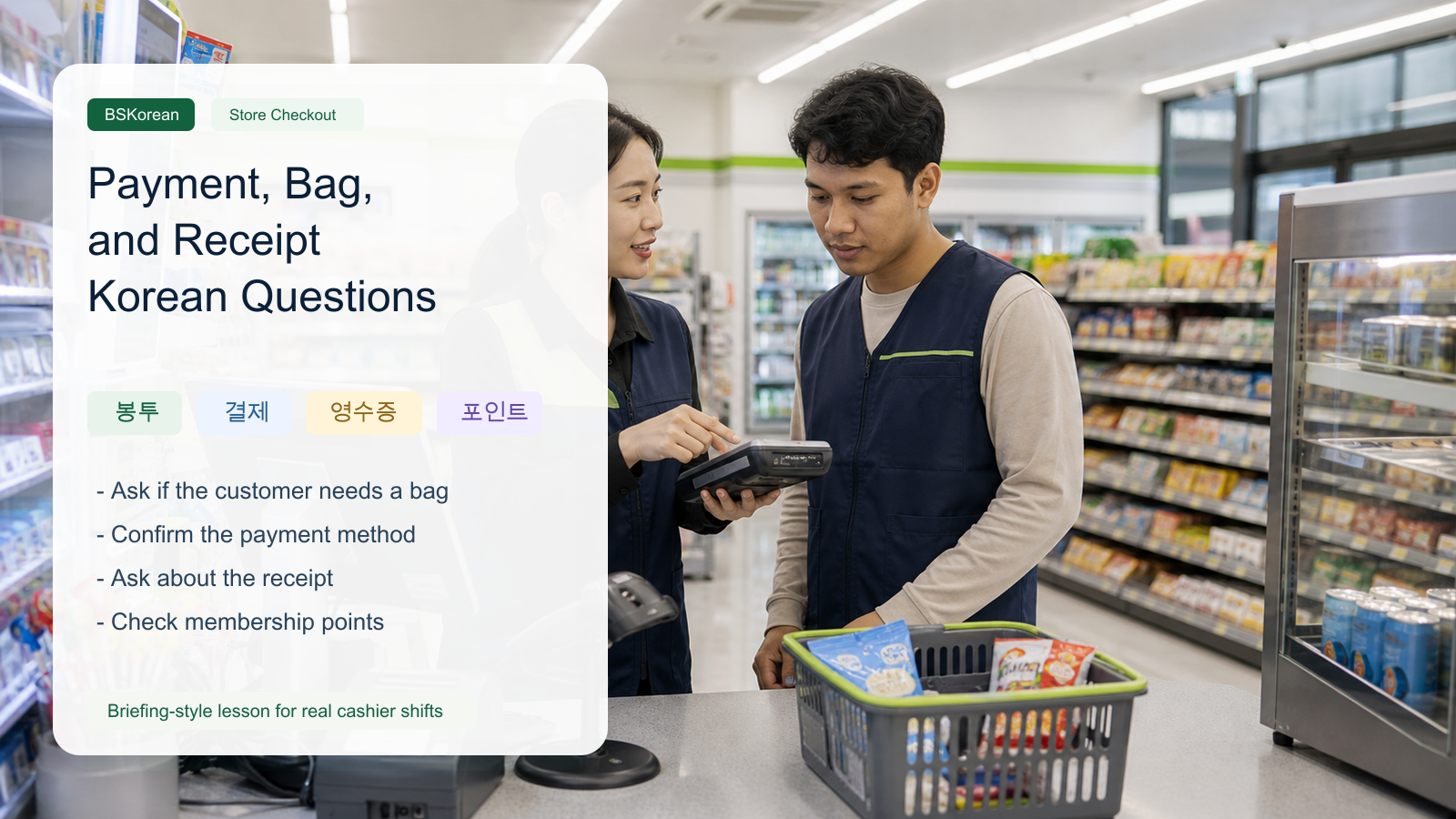
This slide shows the full checkout moment. The cashier has to scan items, ask about a shopping bag, confirm the payment method, handle points or coupons, and offer a receipt. The slide should show a realistic checkout scene with an adult cashier, adult customer, POS screen, card terminal, shopping bag, receipt, coupon, and purchased items so learners can connect each Korean term to an action instead of seeing a decorative image.
Use This First
At a Korean checkout counter, do not start by translating every word on the POS screen. Start with the next cashier action: ask about the bag, confirm the payment method, check points or coupons, then offer the receipt. These short questions keep the line moving and help the customer answer quickly.
Do you need a bag?
Beginner
Would you like me to put it in a bag?
Intermediate
Will you pay by card?
Intermediate
Will you pay in cash?
Intermediate
Situation Path
Ask 봉투 필요하세요? before the final payment step, because the bag may affect the total or the handoff.
Confirm 카드, 현금, or another method before touching the terminal or closing the POS transaction.
Ask about 포인트, 멤버십, 쿠폰, and 영수증 at the right moment so the customer does not need to restart checkout.
If 승인 fails or 잔액 is low, explain the problem calmly and ask the customer to try the next payment action.
Situation Explanation
Today’s Topic
A cashier in Korea needs to ask short, polite questions about bags, payment, points, coupons, receipts, and payment problems without slowing down the line.
Introduction
A customer places three items on the counter of a Korean convenience store. The POS screen is ready, the card terminal is blinking, and there are people waiting behind the customer. You need to ask fast but politely: Do you need a bag? Will you pay by card? Do you have membership points? Do you need a receipt?
This is not just a list of Korean words. It is a real service situation. A cashier has to guide the customer through several small decisions in the correct order. If you ask too late about a coupon, the customer may need a payment cancellation. If you forget to ask about a bag, the customer may ask again after payment. If you do not explain a failed card payment clearly, both the customer and the cashier may feel embarrassed.
The key skill is separating base words from service phrases. A base word such as 봉투 means shopping bag. A service phrase such as 봉투 필요하세요? means Do you need a bag? The Word Bank should store 봉투, 결제, 카드, 현금, 영수증, 포인트, 쿠폰, 할인, 승인, 잔액, and similar reusable terms. Full sentences belong in Core Expressions and Dialogue. This keeps the lesson useful for reading, but also keeps the database clean for quizzes, audio practice, review, and future app content.
Situation Briefing
Korean checkout language is short because the situation is practical and time-sensitive. The cashier is not making conversation. The cashier is moving the transaction forward. Each sentence solves one action: bag, payment method, membership points, coupon, receipt, approval, or problem handling.
The first common question is 봉투 필요하세요? In many Korean stores, shopping bags are not automatically given. Sometimes the bag costs extra. Customers may answer 네, 하나 주세요, 아니요, 괜찮아요, or 그냥 들고 갈게요. A beginner does not need to understand a long answer. Listen for 네, 아니요, 하나, and 괜찮아요.
The second step is payment. 결제 means payment as a process. 계산 is close to checkout or calculation. A cashier may say 카드로 결제하시겠어요? when the customer is holding a card. If the customer uses cash, 현금으로 결제하시겠어요? is clear and polite. A customer may answer 카드로 할게요, 현금으로 할게요, or 삼성페이로 할게요. The pattern N으로 할게요 means I will use N or I will pay with N.
The third step is membership, points, or coupons. 포인트 means points. 적립 means adding or earning points. 멤버십 means membership. So 포인트 적립하시겠어요? means Would you like to earn points? It is not exactly the same as Do you have points? If a customer wants to use a coupon, the cashier may ask 쿠폰 있으세요? or 쿠폰 적용해 드릴까요? Use short questions and wait for the customer's response.
The fourth step is finishing the transaction. When the POS shows approval, 승인 means approval. 결제 승인됐습니다 means The payment was approved. After that, 영수증 드릴까요? is the natural way to offer a receipt. Some customers say 버려 주세요, 괜찮아요, or 주세요. If paying by cash, 거스름돈 여기 있습니다 helps return change clearly.
Payment problems need especially clear language. 잔액이 부족합니다 means The balance is insufficient. 다시 결제해 주시겠어요? means Could you try paying again? These phrases are not rude if said calmly and politely. They explain the problem without blaming the customer. If a payment must be canceled, 취소 is the base word, and 결제 취소해 드릴게요 is the service phrase.
Read this topic as a checkout path. First, bag. Second, payment. Third, points or coupon. Fourth, receipt. Fifth, problem handling if something fails. This order makes the Korean easier to understand and easier to use during a real shift.
PPT Slide Briefing
Cashier counter: payment, bag, receipt, points, and coupon questions

The checkout flow connects bag, payment, points, coupon, and receipt decisions

Review common cashier words after a shift
This slide shows the full checkout moment. The cashier has to scan items, ask about a shopping bag, confirm the payment method, handle points or coupons, and offer a receipt. The slide should show a realistic checkout scene with an adult cashier, adult customer, POS screen, card terminal, shopping bag, receipt, coupon, and purchased items so learners can connect each Korean term to an action instead of seeing a decorative image.
Use this slide to read checkout as a sequence. Each short Korean question helps the cashier finish one decision before moving to the next step. The slide should show a realistic checkout scene with an adult cashier, adult customer, POS screen, card terminal, shopping bag, receipt, coupon, and purchased items so learners can connect each Korean term to an action instead of seeing a decorative image.
This review slide focuses on reusable terms, not long phrases. Terms like 결제, 봉투, 영수증, 포인트, 쿠폰, 승인, and 잔액 can appear in many service jobs. The slide should show a realistic checkout scene with an adult cashier, adult customer, POS screen, card terminal, shopping bag, receipt, coupon, and purchased items so learners can connect each Korean term to an action instead of seeing a decorative image.
Core Expressions
Do you need a bag?
Beginner
Would you like me to put it in a bag?
Intermediate
Will you pay by card?
Intermediate
Will you pay in cash?
Intermediate
Would you like to earn points?
Intermediate
Do you have a membership?
Beginner
Do you have a coupon?
Beginner
Would you like a receipt?
Beginner
The payment was approved.
Advanced
The balance is insufficient.
Intermediate
Could you try paying again?
Intermediate
Here is your change.
Beginner
Word Examples
The Word Bank is only a side reference. The real skill is knowing when each word appears in the checkout sequence. 결제 belongs to the payment step, 봉투 belongs to the carry-out decision, 포인트 and 쿠폰 belong before approval, and 영수증 belongs after payment. Read each word as a cue for the next cashier action.
Store 봉투 as a term. The full question belongs in Core Expressions because it is a service sentence. Connect this term to the exact checkout moment: before payment, during approval, after approval, or during problem handling. That timing is what makes the Korean useful for real cashier work.
결제 is the payment process. It appears in stores, cafes, restaurants, hospitals, kiosks, and apps. Connect this term to the exact checkout moment: before payment, during approval, after approval, or during problem handling. That timing is what makes the Korean useful for real cashier work.
계산 can mean calculation or checkout. At a store counter, it usually means the checkout step. Connect this term to the exact checkout moment: before payment, during approval, after approval, or during problem handling. That timing is what makes the Korean useful for real cashier work.
영수증 is the base word. Do not save 영수증 드릴까요 as a Word Bank term. Connect this term to the exact checkout moment: before payment, during approval, after approval, or during problem handling. That timing is what makes the Korean useful for real cashier work.
포인트 and 적립 often appear together, but they should remain separate reusable terms. Connect this term to the exact checkout moment: before payment, during approval, after approval, or during problem handling. That timing is what makes the Korean useful for real cashier work.
승인 is a formal payment-system word. Beginners may hear it when a card payment finishes. Connect this term to the exact checkout moment: before payment, during approval, after approval, or during problem handling. That timing is what makes the Korean useful for real cashier work.
잔액 often appears in failed card, transport card, app, or prepaid payment situations. Connect this term to the exact checkout moment: before payment, during approval, after approval, or during problem handling. That timing is what makes the Korean useful for real cashier work.
취소 can apply to payment, order, reservation, or coupon use, so it is useful across many lessons. Connect this term to the exact checkout moment: before payment, during approval, after approval, or during problem handling. That timing is what makes the Korean useful for real cashier work.
Review Table
payment. The payment step at a cashier counter, POS, kiosk, or app.
Beginner
checkout. The process of calculating the total and checking out.
Beginner
card. A credit card, debit card, or Korean check card.
Beginner
cash. Cash payment with bills or coins.
Beginner
shopping bag. A bag for purchased items.
Beginner
shopping basket. A basket used while shopping inside a store.
Beginner
receipt. Proof of payment offered after checkout.
Beginner
points. Reward or membership points.
Beginner
point earning. Adding points to a customer account.
Intermediate
membership. A store, brand, or app membership account.
Intermediate
coupon. A paper, app, or barcode discount coupon.
Beginner
discount. A price reduction from a promotion, coupon, or membership.
Intermediate
approval. The POS approval status after card or app payment.
Advanced
cancel. Canceling a payment, item, or transaction.
Intermediate
refund. Returning money after a purchase.
Intermediate
exchange. Exchanging a purchased item according to store rules.
Intermediate
remaining balance. Balance on a card, app, or payment account.
Intermediate
change. Cash change returned after payment.
Intermediate
Conclusion
Store checkout Korean becomes easier when you follow the work sequence. Ask about 봉투 first, confirm 결제, check 포인트 or 쿠폰, then offer 영수증. If there is a problem, use short clear phrases such as 잔액이 부족합니다 or 다시 결제해 주시겠어요.
Keep the Word Bank clean. Put reusable terms such as 봉투, 결제, 카드, 현금, 영수증, 포인트, 적립, 쿠폰, 승인, 잔액, 취소, 환불, and 바코드 in the database. Put full service sentences in Core Expressions and Dialogue. This makes the lesson useful now and reusable later for Word Practice, audio, app quizzes, and review systems.
Practice this word list in Word Practice or in the upcoming BS3001 app.
Key Vocabulary
- 결제
- 계산
- 카드
- 현금
- 봉투
- 장바구니
- 영수증
- 포인트
- 적립
- 멤버십
- 쿠폰
- 할인
- 승인
- 취소
- 환불
- 교환
- 잔액
- 거스름돈
- 바코드
- 서명