BSKorean lesson
Korean Workplace Sick Leave and Absence Phrases for Foreign Workers
Learn Korean sick leave phrases for reporting illness, absence, lateness, and hospital visits at work, with examples and practice.
Workplace Korean
Korean Workplace Sick Leave and Absence Phrases for Foreign Workers
Learn practical Korean workplace phrases for calling in sick, reporting absence, arriving late, giving a reason, and confirming with a manager.
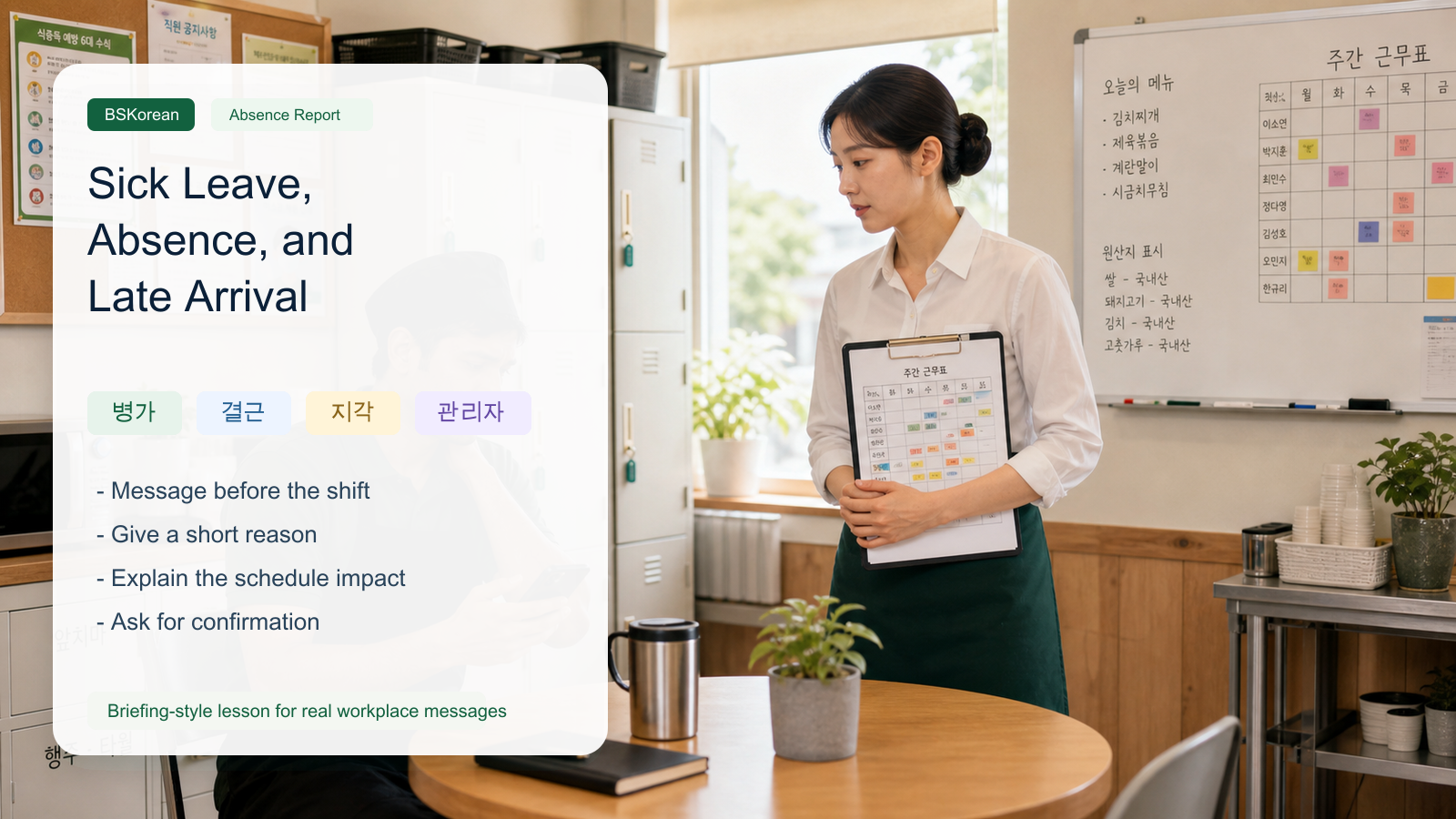
This image places the learner in a real situation: you are still at home, have not arrived at work, and need to send a message to the manager before the shift starts. Notice 병가, 결근, 지각, and 연락 because these words decide what the work message needs to say.
Use This First
If you are sick right now, do not start with a long story. Use a short structure first: say your body is not well, explain the impact on 출근, and ask for permission or confirmation. Example: 오늘 몸이 아파서 출근이 어렵습니다. 병가를 써도 될까요? This pattern is polite, clear, and helps the manager make a fast decision.
I am sick today, so it is difficult to come to work.
Beginner
May I use sick leave today?
Intermediate
I have body aches, so I think I need to rest.
Intermediate
I have a fever, so it is difficult to come to work.
Beginner
Situation Path
Send a message or call before the shift starts. The first sentence should be clear, such as 오늘 몸이 아파서 출근이 어렵습니다 or 지각할 것 같습니다.
Use 증상, 열, 몸살, 두통, 복통, or 병원 to explain enough, but do not write a long medical report.
Choose the correct word: 병가 for sick leave, 결근 if you cannot come, 지각 if you are late, and 조퇴 if you need to leave early.
If you go to a 병원 or do not know your arrival time yet, say 상태를 다시 연락드리겠습니다 so the manager knows you will update them.
Situation Explanation
Today’s Topic
When you feel sick before a work shift in Korea, your message to a manager should not stop at “I am sick.” You need to explain whether you can 출근, will be 지각, will be 결근, need 병가, need to visit a 병원, or will 연락 again after checking your 상태.
Introduction
You wake up before your shift with 몸살, 열, a headache, or stomach pain. Your shift is starting soon, and your 관리자 needs to know whether you can 출근, will be 지각, will be 결근, or need 병가. If you only write 아파요, the manager knows you are sick, but does not know what will happen to the shift.
In a Korean workplace, the most useful information is not the name of every symptom. The useful information is how your condition affects work. A manager may need to check the 근무표, find a 대체 근무자, change task positions, or wait for your update after you go to a 병원. A good message can be short, but it still needs three parts: your condition, the effect on the shift, and the next action.
This lesson teaches Korean sick leave phrases as practical workplace messages, not as a loose vocabulary list. You will learn 병가 for sick leave, 결근 for absence from work, 지각 for lateness, 조퇴 for leaving early, 증상 for symptoms, and 연락 for contact or follow-up. The Word Bank on the right keeps clean DB vocabulary, while the main lesson explains how to turn those words into useful work messages.
Situation Briefing
This situation usually happens through KakaoTalk, a company chat app, a short phone call, or a message to a store manager, supervisor, or team leader. You do not need to write a long medical explanation, but a vague message can make the work shift difficult to manage. The minimum information is the health problem, the impact on 출근, and what you will do next.
The main image shows a worker still at home before the shift, sending a polite message to a manager. This matters because reporting before the shift starts is much better than reporting after you are already late. If you contact the manager early, they can adjust the 근무표, look for a 대체 worker, or wait for your 상태 update after you visit a 병원.
The workplace type also changes how the message is understood. In a restaurant or cafe, lateness can affect opening prep, cashier work, and customer service. In a hotel, absence can affect front desk work, cleaning, or check-in support. In a factory or warehouse, absence can affect the work position, inspection, packing, machines, or safety checks. So this lesson explains not only word meanings but also the order of information a Korean workplace needs.
PPT Slide Briefing
Report sickness before your shift in Korean

Explain symptoms, shift impact, and next action
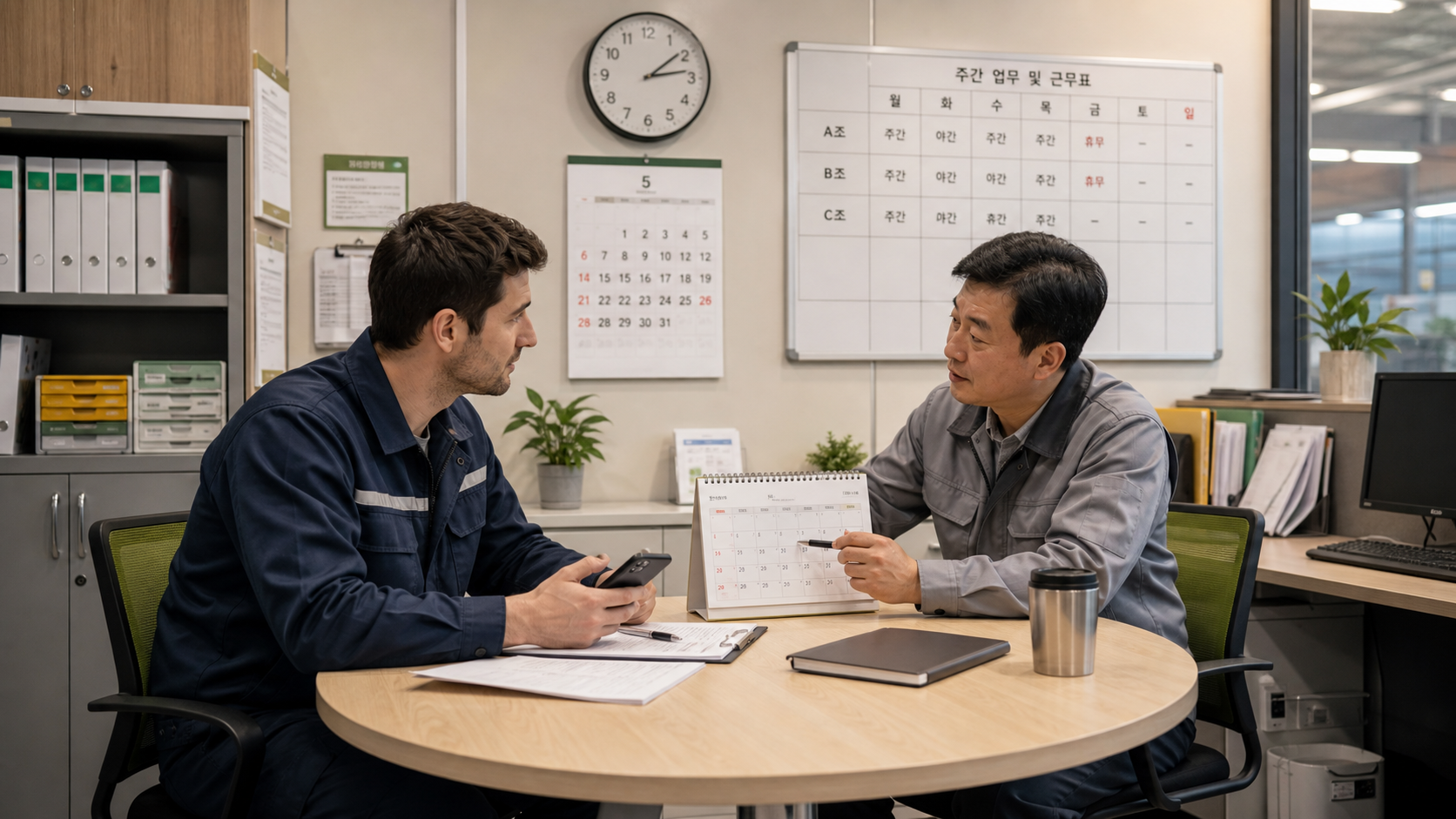
Review the workplace sick-leave message flow
This image places the learner in a real situation: you are still at home, have not arrived at work, and need to send a message to the manager before the shift starts. Notice 병가, 결근, 지각, and 연락 because these words decide what the work message needs to say.
This image shows that a work report is not just “I am sick.” You need to mention 증상, explain whether you can 출근, and ask for 병가 or report 지각 with a polite sentence.
The review image gathers the main decisions: sick leave, absence, lateness, leaving early, hospital visit, and follow-up contact. This is the order to remember when using Korean in a real workplace.
Core Expressions
I am sick today, so it is difficult to come to work.
Beginner
May I use sick leave today?
Intermediate
I have body aches, so I think I need to rest.
Intermediate
I have a fever, so it is difficult to come to work.
Beginner
I think I will be late today.
Beginner
I can arrive around this time.
Beginner
May I go to the hospital or clinic and come back?
Intermediate
I am contacting you because the symptoms are serious.
Advanced
I think I need to be absent from work today.
Intermediate
May I leave work early?
Intermediate
I will contact you again about my condition.
Intermediate
Could you check for a replacement worker?
Advanced
Word Examples
The words in the Word Bank are small building blocks for understanding a sick-leave situation. 병가 means sick leave, 결근 means absence, 지각 means lateness, and 조퇴 means leaving early. But in a real work message, you do not send just one word. You use these words inside polite sentences to report your condition, ask for permission, and give a follow-up plan. Learn the words as action signals, then practice the sentences so you can use them immediately.
Use this when asking for sick leave politely. It is clearer than 그냥 쉴게요 because it shows the reason is health-related.
Use this when you will still come to work but will be late. Add a 도착 time if you know it so the manager can plan.
Use this when you cannot come to the shift. It is an official absence word, so report it as early as possible.
Use this when you are already at work but need to leave early because your condition gets worse. It is different from 병가.
Use this to explain your health condition more formally without giving too many personal details.
Use this when you will update again after resting or visiting a doctor. It keeps communication clear.
Review Table
go to work. To come to work or start a shift.
Beginner
lateness. Arriving late for work.
Beginner
absence from work. Not coming to work on a scheduled day or shift.
Intermediate
sick leave. Leave from work because of illness.
Intermediate
leave early. Leaving work early during a shift.
Intermediate
manager. A person who manages the shift or department.
Beginner
work schedule. A work schedule or shift table.
Intermediate
replacement. A substitute or replacement.
Intermediate
worker on duty. A person working a shift.
Intermediate
reason. A reason in a report or document.
Advanced
symptom. A symptom of illness.
Intermediate
body aches. Flu-like body aches and fatigue.
Beginner
fever. Fever.
Beginner
headache. Headache.
Beginner
stomachache. Stomach pain.
Beginner
hospital or clinic. A hospital or clinic.
Beginner
medical consultation. A doctor visit or medical consultation.
Intermediate
contact. Contact by call or message.
Beginner
Conclusion
When you are sick before a shift in Korea, the most important thing is to contact the manager early and explain the work impact clearly. Remember 병가, 결근, 지각, 조퇴, 증상, and 연락, but do not study them only as isolated words. Use them in short, polite sentences with a clear next step. A good message usually says: I am sick, I can or cannot 출근 today, I need 병가 or will be 지각, and I will 다시 연락드리겠습니다 if my condition changes.
Key Vocabulary
- 출근
- 지각
- 결근
- 병가
- 조퇴
- 관리자
- 근무표
- 대체
- 근무자
- 사유
- 증상
- 몸살
- 열
- 두통
- 복통
- 병원
- 진료
- 연락
- 상태
- 확인