BSKorean lesson
Korean Cafe Pickup and Order Number Phrases for Service Workers
Learn Korean cafe pickup phrases for service workers, including order numbers, vibrating pagers, drink pickup, receipts, and polite service checks.
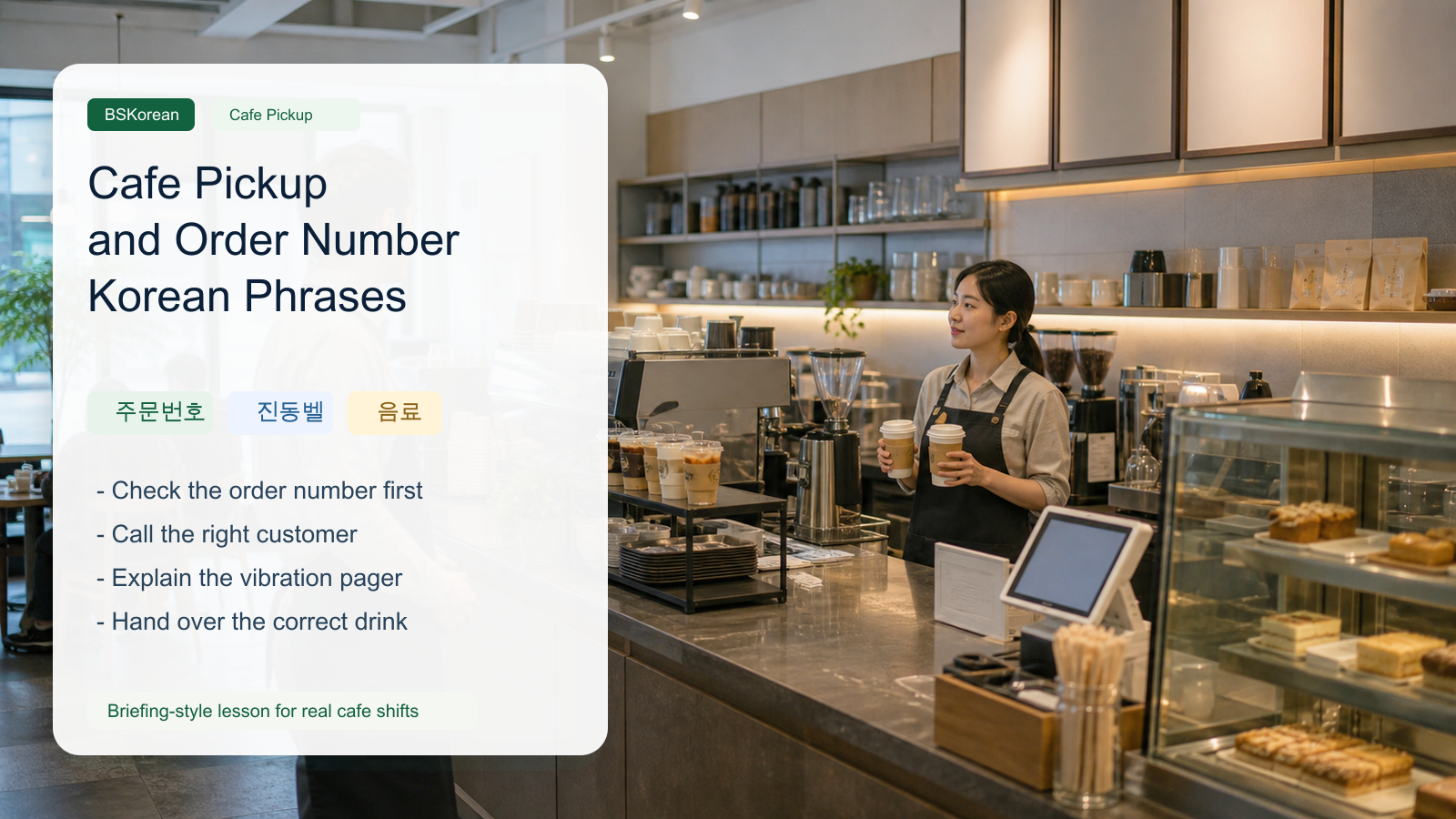
workplace
Korean Cafe Pickup and Order Number Phrases for Service Workers
Learn practical Korean for cafe pickup service: checking order numbers, using vibrating pagers, calling customers, and handing over drinks politely.
This image shows the service situation first. The worker is not only making a drink. They are matching the customer, the order number, the pager, and the finished drink before handoff. The learner should notice the pickup counter, the order number, and the moment before the drink is given to the customer.
Use This First
At a Korean cafe pickup counter, begin with the action that protects the order: check the number before handing over the drink. The learner should first practice the counter flow: ask for the order number, decide whether the drink is ready, explain the waiting method, call the customer, and confirm final handoff details. This gives the worker a practical order to follow during a busy shift, even before every vocabulary item feels automatic.
Please check the order number.
Intermediate
Please come when the pager rings.
Intermediate
Please wait a moment.
Beginner
Your drink is ready.
Beginner
Situation Path
When the customer comes to the pickup counter, say 주문 번호 확인해 주세요. This keeps the worker from handing a similar drink to the wrong customer.
If the drink is not ready, use 잠시만 기다려 주세요. If the cafe uses a vibrating pager, add 진동벨 울리면 오시면 됩니다 so the customer knows what to do next.
When the drink is finished, say 음료 나왔습니다 or add the order number, such as 32번 손님, 음료 나왔습니다. Number calls are clearer in a crowded pickup area.
Before handing over the drink, check 포장, 매장, 얼음, 빨대, and 뚜껑. These small words decide the cup, lid, straw, ice, and takeout setup.
Situation Explanation
Today’s Topic
This lesson teaches Korean cafe pickup phrases for service workers. The goal is to help a learner handle the full pickup-counter flow: check the order number, explain waiting, use a vibrating pager, call the customer, and confirm final drink details.
Introduction
In a Korean cafe, service does not end when the customer pays. Many cafes separate the order counter from the pickup counter. A customer may come back with a receipt, an order number, or a vibrating pager. The worker must check the number, match it with the prepared drink, explain whether the drink is ready, and hand it over politely. If the worker hears the number incorrectly, the wrong drink can go to the wrong person. If the worker explains the vibrating pager poorly, the customer may keep standing near the counter or miss the pickup call. This lesson treats cafe Korean as a real service sequence, not as a loose vocabulary list. Word Bank keeps reusable short words such as 주문, 번호, 확인, 진동벨, 음료, 포장, 빨대, and 뚜껑. Full service sentences such as 주문 번호 확인해 주세요 belong in Core Expressions because they are practical actions, not single database terms.
Situation Briefing
At the pickup counter, the worker reads several signals at once: the number on the receipt, the order screen, the finished drinks, the customers waiting nearby, the vibrating pager, and small final details such as takeout, straw, lid, and ice. In English, ?order number check? may look like one phrase. For a database-first Korean lesson, it should be split into ??, ??, and ??. ?? means order, ?? means number, and ?? means check or confirmation. Together they form the useful service sentence ?? ?? ??? ???, but the Word Bank keeps the parts separate so the same words can be reused in other workplace lessons.
The safest pickup flow is simple but important. First, check the number before touching the finished drink. Second, explain the drink status: if it is not ready, use ??? ??? ???; if the cafe uses a pager, use ??? ??? ??? ???. Third, call the customer when the drink is ready with ?? ????? or 32? ??, ?? ?????. Fourth, check small handoff details such as ??, ??, ??, ??, and ??. These small words decide whether the drink is packed to go, served in store, closed with a lid, or handed over with a straw.
This lesson is built around that work path. The learner should not read the words as a flat list. Each word solves a practical service problem: matching the right customer, preventing a wrong handoff, explaining waiting, and finishing the drink handoff politely. That is why the main article explains the situation, while the right rail keeps the compact Word Bank as a quick reference.
PPT Slide Briefing
Cafe pickup counter: order number, vibrating pager, and drink handoff
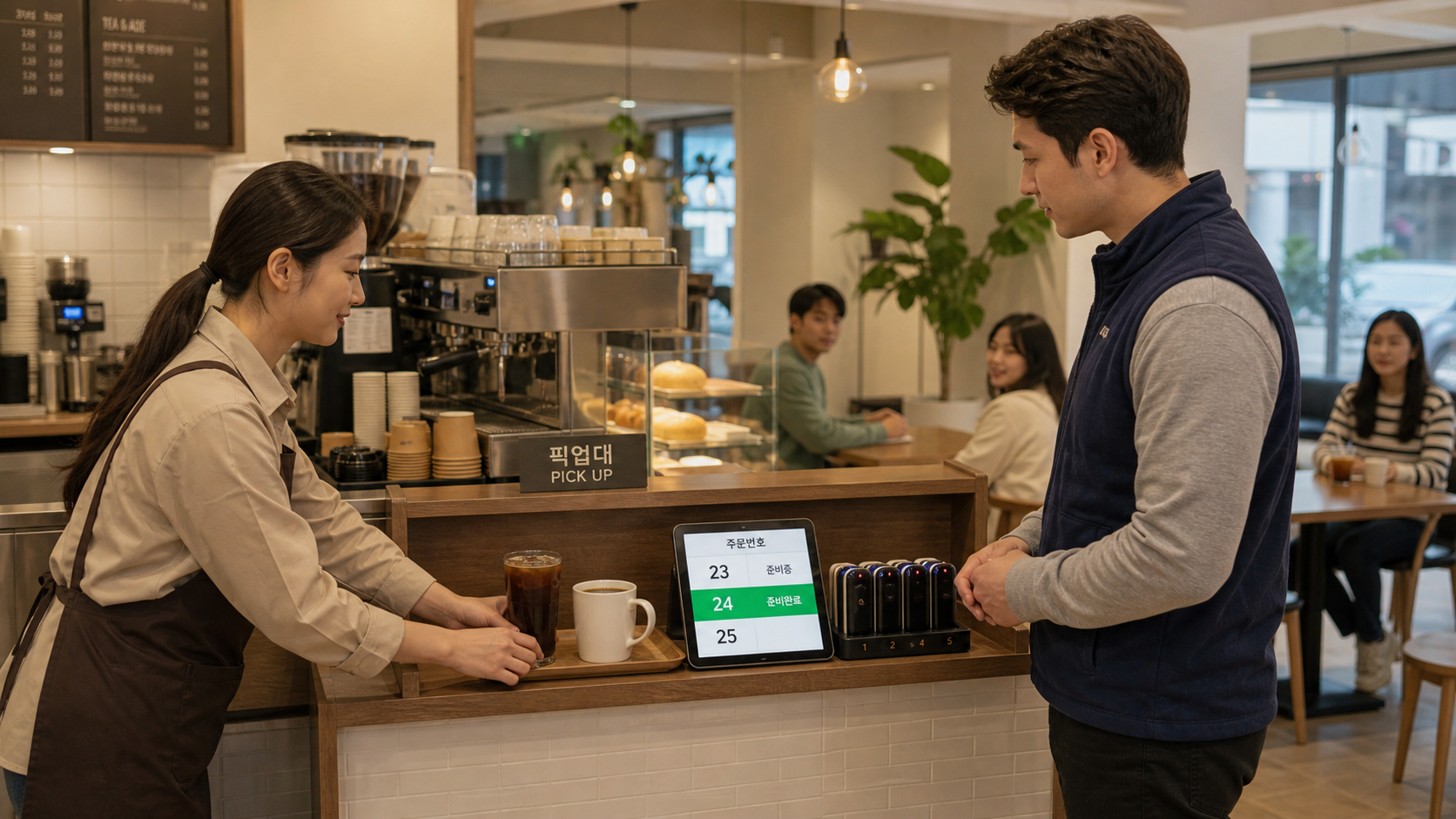
The pickup counter connects the customer, order number, and finished drink
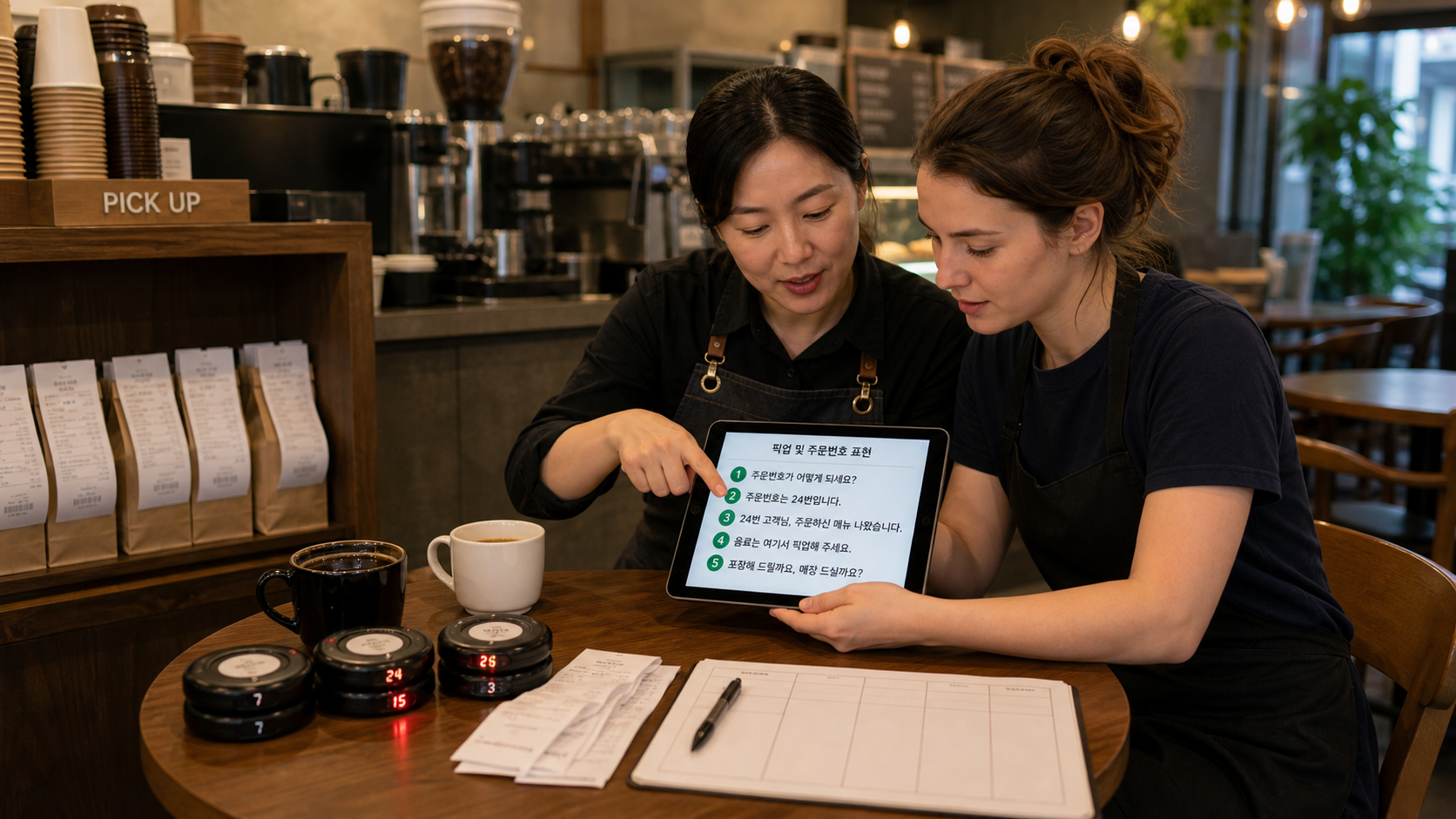
Review the final check before handing over the drink
This image shows the service situation first. The worker is not only making a drink. They are matching the customer, the order number, the pager, and the finished drink before handoff. The learner should notice the pickup counter, the order number, and the moment before the drink is given to the customer.
Use this slide to read the work flow: check the number, watch the pickup screen, listen for the pager, and hand over the correct drink with a short polite phrase. The scene helps learners understand that the number, receipt, and finished drink must be checked together before service is complete.
Before handoff, a worker may confirm the number, drink, takeout or dine-in, straw, lid, and receipt. These small checks prevent common service mistakes. The learner should use this review image to connect small words such as ??, ??, ??, and ?? to the final pickup action.
Core Expressions
Please check the order number.
Intermediate
Please come when the pager rings.
Intermediate
Please wait a moment.
Beginner
Your drink is ready.
Beginner
Customer number 32, your drink is ready.
Intermediate
Could you show me the receipt?
Intermediate
Is it for takeout?
Beginner
Will you have it in the store?
Beginner
Would you like less ice?
Intermediate
Do you need a straw?
Beginner
Would you like me to close the lid?
Intermediate
Please pick it up at the pickup counter.
Intermediate
Word Examples
These usage notes show how short Word Bank terms become real cafe service actions. ?? is connected to the receipt and screen, ?? identifies the customer, and ?? is the safety action before a handoff. The learner should notice which object or action each word points to at the pickup counter, because the same term can later appear in other workplace lessons.
주문 is the reusable DB word. 주문 번호 is a service pattern, so the Word Bank stores 주문 and 번호 separately.
In a cafe, 번호 usually means order number, not phone number. The situation decides the natural meaning.
확인 can be used with 주문, 영수증, 메뉴, 포장, or 결제, so it should stay as a separate reusable term.
진동벨 appears in cafes, food courts, and takeout shops. It tells the customer when to return.
픽업 is a loanword, but it is natural on cafe signs and in staff speech.
완료 often appears on order status screens. It means the order is finished, not that the customer is done drinking.
In cafes, ?? confirms that the drink should be prepared to go. It affects the cup, lid, bag, and handoff style, so it is a small word with a real service consequence.
매장 means the store area. 매장에서 드시나요 asks whether the customer will drink inside.
Review Table
cafe. The service place.
Beginner
pickup. Taking a finished order.
Beginner
order. A customer order.
Beginner
number. A number used to identify an order.
Beginner
check / confirmation. Checking an order, receipt, menu, or detail.
Intermediate
vibrating pager. A pager that vibrates when the drink is ready.
Intermediate
drink. The prepared drink.
Beginner
menu item. The drink or item selected by the customer.
Beginner
customer. A polite service word for a customer.
Beginner
staff member. A person working at the cafe.
Beginner
counter. Cashier or service counter.
Beginner
waiting. A waiting status for a customer or order.
Intermediate
complete. The order is finished.
Intermediate
call. Calling a number or customer.
Intermediate
takeout. Preparing an order to go.
Beginner
store / dine-in area. The store area where customers can sit.
Beginner
receipt. Receipt used to check an order.
Beginner
ice. Ice in a cold drink.
Beginner
Conclusion
Cafe pickup Korean becomes easier when you follow the service path. First, check the order number. Then explain how the customer should wait. Next, call the customer when the drink is ready. Finally, confirm takeout, receipt, straw, lid, ice, or other small details before handoff.
Keep the Word Bank clean. Put reusable terms such as 주문, 번호, 확인, 진동벨, 음료, 포장, 매장, 영수증, 빨대, and 뚜껑 in the Word Bank. Put full service sentences such as 주문 번호 확인해 주세요 and 진동벨 울리면 오시면 됩니다 in the expression and dialogue sections.
Practice this word list in Word Practice or in the upcoming BS3001 app.
Key Vocabulary
- 카페
- 픽업
- 주문
- 번호
- 확인
- 진동벨
- 음료
- 메뉴
- 손님
- 직원
- 카운터
- 대기
- 완료
- 호출
- 포장
- 매장
- 영수증
- 얼음
- 빨대
- 뚜껑