BSKorean lesson
Korean Hotel Front Desk Check-in Phrases for Service Workers
Learn Korean hotel check-in phrases for service workers, including reservations, passports, room keys, Wi-Fi, deposits, breakfast, and checkout.
Service Korean
Korean Hotel Front Desk Check-in Phrases for Service Workers
Learn practical Korean hotel check-in phrases for reservations, passports, room keys, breakfast, Wi-Fi, deposits, and checkout at a front desk.
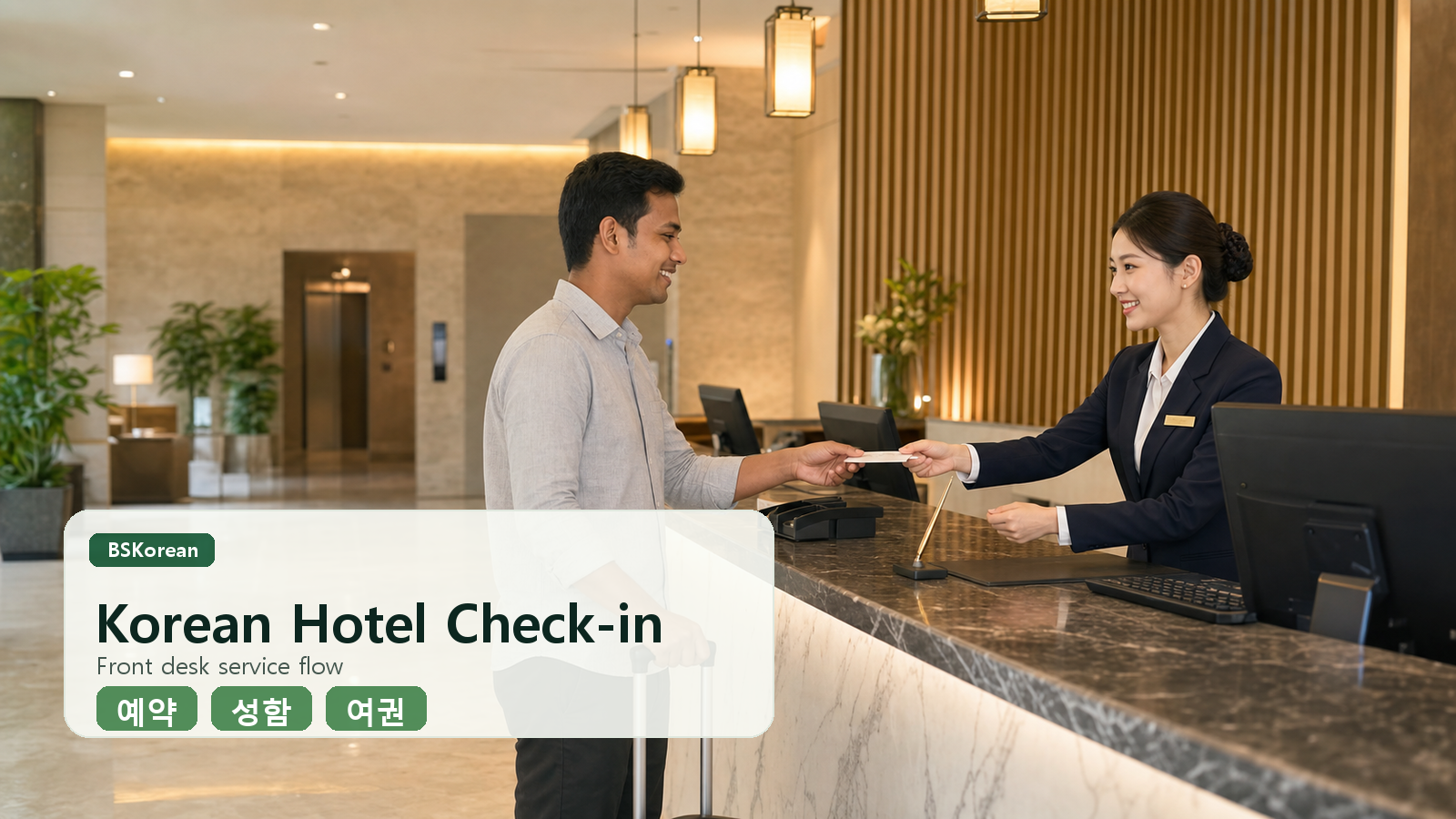
This slide shows the whole check-in situation before the learner studies individual words. The guest is at the front desk, the staff member checks the reservation, and the key card, passport, room number, breakfast information, and Wi-Fi notice are all part of one service flow.
Use This First
Use this check-in flow before memorizing every hotel word. Start with a greeting, confirm the reservation, ask for the name or reservation number, check ID or passport, then explain the room and key card. After that, give only the information the guest needs before leaving the desk.
I will help check your reservation.
Intermediate
May I have your name?
Beginner
Do you have a reservation number?
Intermediate
Please let me check your ID.
Intermediate
Situation Path
Start with 안녕하세요 and 예약 확인 도와드리겠습니다. This tells the guest the service has begun and the staff will search for the booking.
Ask 성함이 어떻게 되세요? first. If the booking does not appear quickly, ask 예약 번호가 있으신가요?
Use 신분증 확인 부탁드립니다 or 여권 확인 부탁드립니다 depending on the guest and hotel policy.
Give the room number with 객실은 1205호입니다 and hand over the card with 카드키는 여기 있습니다.
Explain 조식, 와이파이, 보증금, and 체크아웃 only after the guest has the key information.
Situation Explanation
Today’s Topic
A hotel check-in is a short but information-heavy service moment. A guest may know only a few Korean words, while the staff must confirm the reservation, check identity documents, explain the room number, hand over the key card, and give breakfast, Wi-Fi, deposit, and checkout information in a calm order.
Introduction
You are working at a Korean hotel front desk. A foreign guest arrives with luggage and says they have a reservation. They may show a passport, a booking email, or only a name. Behind the desk, the staff must search the reservation system, check identity information, prepare the key card, and explain the most important hotel rules before the guest goes upstairs.
This lesson teaches Korean hotel check-in phrases as a service flow, not as a random word list. The goal is to help a front desk worker understand what to say first, what information to ask for, and how to explain the next step politely. It is also useful for foreign guests who want to understand common Korean front desk questions.
Situation Briefing
In a Korean hotel, check-in language is usually polite, short, and procedural. The staff does not need to explain the entire hotel system at once. They move through a predictable path: greeting, reservation check, name or reservation number, ID or passport check, room number, key card, breakfast, Wi-Fi, deposit if needed, and checkout time.
The difficult part for learners is that many words appear together. A worker may hear 예약, 확인, 성함, 여권, 객실, 카드키, 조식, 보증금, and 체크아웃 within one minute. If these words are learned only as translations, the situation still feels confusing. The useful skill is to connect each word to the action it controls. 예약 starts the search. 신분증 or 여권 starts identity checking. 객실 and 호 explain the room. 카드키 is the handoff. 조식, 와이파이, 보증금, and 체크아웃 are final information items.
For service workers, tone matters. A phrase like 신분증 주세요 is understandable, but 신분증 확인 부탁드립니다 sounds more professional at a front desk. A short polite sentence reduces pressure on the guest and keeps the interaction moving.
PPT Slide Briefing
Hotel front desk check-in: reservation, passport, key card, and room information
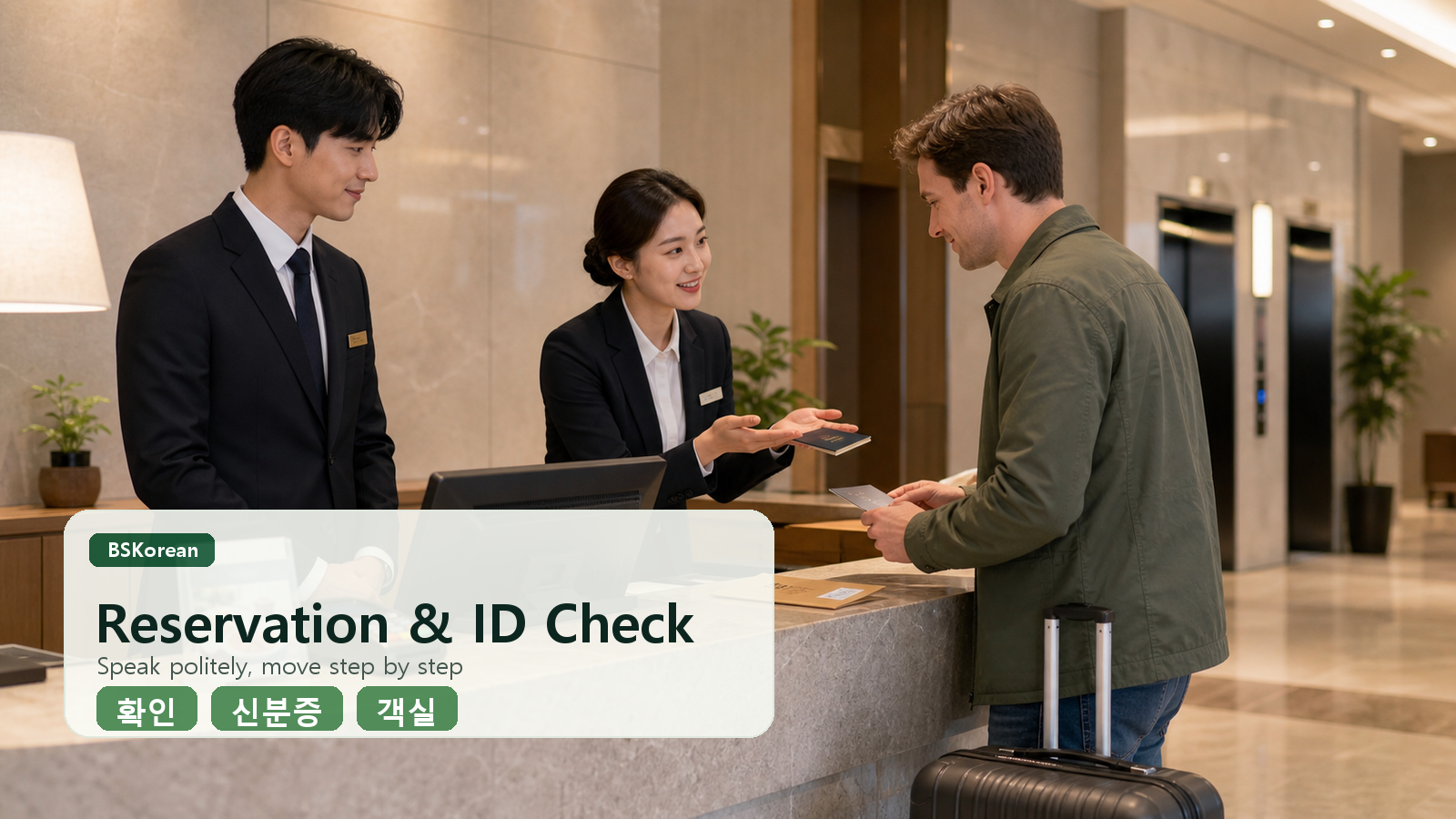
The front desk flow moves from greeting to reservation check and room 안내
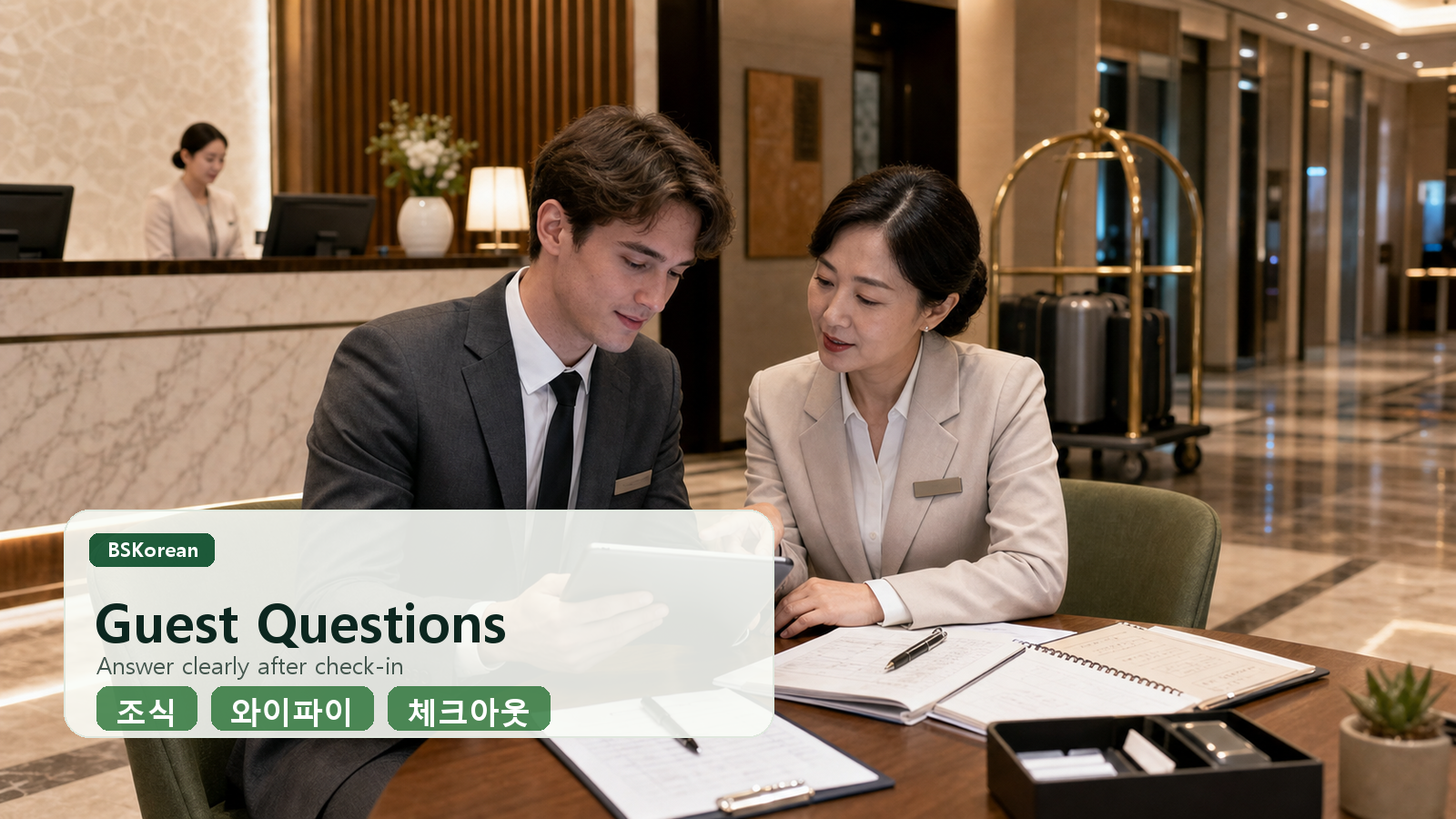
Review what the guest must understand before leaving the front desk
This slide shows the whole check-in situation before the learner studies individual words. The guest is at the front desk, the staff member checks the reservation, and the key card, passport, room number, breakfast information, and Wi-Fi notice are all part of one service flow.
Use this slide to read the order of the work. The staff does not begin with a long explanation. They greet the guest, check the reservation, ask for identification, confirm the room, and then explain the key card, breakfast, Wi-Fi, deposit, and checkout time.
This review image focuses on the information a guest should know before walking away from the desk. The lesson connects each Korean word to a practical front desk action, so the learner can understand the service sequence instead of memorizing isolated words.
Core Expressions
I will help check your reservation.
Intermediate
May I have your name?
Beginner
Do you have a reservation number?
Intermediate
Please let me check your ID.
Intermediate
Please let me check your passport.
Intermediate
Your room is 1205.
Beginner
Here is your key card.
Beginner
You can have breakfast on the second floor.
Intermediate
The Wi-Fi password is on the information sheet.
Intermediate
The deposit will be refunded after checkout.
Advanced
Checkout is at 11 a.m.
Beginner
If you have any questions, please contact the front desk.
Intermediate
Word Examples
These notes connect the compact Word Bank with real hotel-front-desk actions. The learner should not memorize each Korean word as a separate translation only. Instead, they should know which word starts the reservation search, which word asks for a document, which word explains the room, and which words give final guest information.
예약 is the DB word. The full service expression belongs in Core Expressions because the staff is doing an action, not just naming a word.
확인 is reusable with reservations, IDs, passports, payment, and room details. Keep it separate instead of making fake word-list items like 예약확인.
성함 is polite and service-friendly. A hotel worker should usually use 성함 instead of 이름 when speaking to a guest.
신분증 can include a Korean ID card, alien registration card, or other domestic ID depending on the guest.
Hotels may ask foreign guests for a passport. The polite request softens a document check that may otherwise feel too direct.
객실 is more formal than 방 and is common in hotel service speech, room notices, and reservation systems.
Foreign guests may misunderstand 보증금 as an extra fee. Explain that it is refunded after checkout when the room is cleared.
체크아웃 is a loanword, but it is the normal hotel word. Pair it with a time so the guest knows the rule clearly.
Review Table
hotel. The accommodation workplace.
Beginner
front desk. The desk where guests check in and ask questions.
Beginner
staff member. A person working at the hotel.
Beginner
guest / customer. A service word for the person receiving help.
Beginner
reservation. A booking made before arrival.
Beginner
check / confirmation. Checking a reservation, document, or detail.
Intermediate
name. A polite service word for name.
Beginner
reservation number. A number used to find the booking.
Intermediate
ID card. A document used to verify identity.
Beginner
passport. A travel document for foreign guests.
Beginner
guest room. A formal hotel word for room.
Beginner
room. A common everyday word for room.
Beginner
room number unit. The unit attached to room numbers.
Intermediate
floor. Building floor or hotel floor.
Beginner
key card. Card used to enter the room.
Beginner
breakfast. Hotel breakfast.
Beginner
Wi-Fi. Internet access in the hotel.
Beginner
password. Password for Wi-Fi or access.
Beginner
Conclusion
Korean hotel check-in phrases become easier when you read them as a service sequence. Start with 예약 and 확인, then move to 성함, 신분증 or 여권, 객실, 카드키, 조식, 와이파이, 보증금, and 체크아웃. A good front desk interaction is not a long speech. It is a calm order of short polite sentences that help the guest reach the room with the right information.
Key Vocabulary
- 호텔
- 프런트
- 직원
- 고객
- 예약
- 확인
- 성함
- 예약번호
- 신분증
- 여권
- 객실
- 방
- 호
- 층
- 카드키
- 조식
- 와이파이
- 비밀번호
- 보증금
- 환불