10 min read
Korean for Subway, Bus, Taxi, and Asking Directions
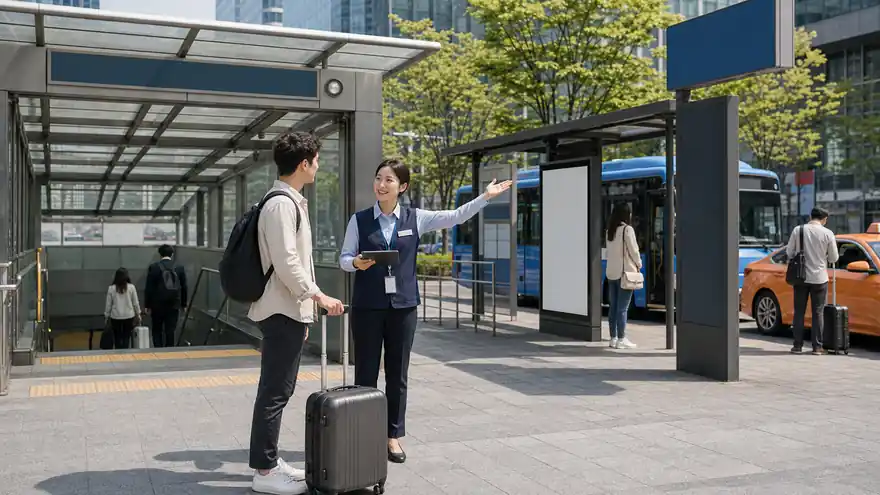
This lesson is for the first day you move around Korea by yourself. You may know the destination on a map, but you still need short Korean sentences for the subway exit, bus stop, taxi driver, transfer corridor, and the final walking direction.
The safest beginner strategy is not to explain the whole route. Ask one action at a time: Where do I board? Which exit? Do I transfer? How many stops? Please go to this address. Then confirm what you heard with one short sentence.
Keep your phone map ready, but do not depend on it alone. A map can show a route, while Korean lets you confirm the exact entrance, stop, platform, fare, and drop-off point.
Move through these cards in the same order as a real trip.
Core transit words
지하철
jihacheol
subway
Use for the train system inside the city.
역
yeok
station
Use with subway or train destinations.
승강장
seunggangjang
platform
Ask this when you are inside the station.
노선
noseon
route, line
Use when checking if a vehicle goes your way.
환승
hwanseung
transfer
Use between subway, bus, or airport rail.
출구
chulgu
exit
The exit decides how far you walk outside.
입구
ipgu
entrance
Useful when finding the subway or bus terminal.
방향
banghyang
direction
Use when left/right is not enough.
왼쪽
oenjjok
left
Confirm after a staff member points.
오른쪽
oreunjjok
right
Say it with exit, stairs, or stop.
직진
jikjin
straight ahead
Good for walking after you exit.
건너편
geonneopyeon
opposite side
Important for bus stops across the street.
정류장
jeongnyujang
bus stop
Use for buses, not subway platforms.
버스
beoseu
bus
Ask where to board and where to get off.
타다
tada
to ride, board
Use with bus, subway, and taxi.
내리다
naerida
to get off
Use before you miss your stop.
요금
yogeum
fare
Useful for taxi or airport bus questions.
교통카드
gyotong kadeu
transit card
Ask whether you can tap it here.
택시
taeksi
taxi
Use with address, fare, and stop point.
목적지
mokjeokji
destination
Good when the address is hard to pronounce.
주소
juso
address
Show it on your phone before speaking.
여기
yeogi
here
Use for this stop, this exit, or this place.
맞다
matda
to be correct
Use it to confirm before you move.
막히다
makida
to be congested
Useful in taxis when time may change.
Subway, bus, taxi, and direction phrases
Subway
지하철역이 어디예요?
jihacheollyeogi eodiyeyo?
Where is the subway station?
Use before you pass the gate or choose an exit.
몇 번 출구로 나가야 해요?
myeot beon chulguro nagaya haeyo?
Which exit should I use?
Use before you pass the gate or choose an exit.
이 노선이 맞나요?
i noseoni mannayo?
Is this the correct line?
Use before you pass the gate or choose an exit.
환승해야 하나요?
hwanseung-haeya hanayo?
Do I need to transfer?
Use before you pass the gate or choose an exit.
몇 정거장 가야 해요?
myeot jeonggeojang gaya haeyo?
How many stops should I go?
Use before you pass the gate or choose an exit.
반대편 승강장인가요?
bandaepyeon seunggangjang-ingayo?
Is it the opposite platform?
Use before you pass the gate or choose an exit.
내릴 역을 알려 주세요.
naeril yeogeul allyeo juseyo.
Please tell me the station where I should get off.
Use before you pass the gate or choose an exit.
교통카드로 탈 수 있나요?
gyotong kadeuro tal su innayo?
Can I ride with a transit card?
Use before you pass the gate or choose an exit.
Bus
버스 정류장이 어디예요?
beoseu jeongnyujang-i eodiyeyo?
Where is the bus stop?
Use at the stop before you board or before you miss your stop.
이 버스가 시내로 가나요?
i beoseuga sinaero ganayo?
Does this bus go downtown?
Use at the stop before you board or before you miss your stop.
여기서 타면 되나요?
yeogiseo tamyeon doenayo?
Can I board here?
Use at the stop before you board or before you miss your stop.
다음 정류장에서 내려야 해요?
daeum jeongnyujang-eseo naeryeoya haeyo?
Should I get off at the next stop?
Use at the stop before you board or before you miss your stop.
내릴 때 벨을 눌러야 하나요?
naeril ttae bereul nulleoya hanayo?
Do I need to press the bell when getting off?
Use at the stop before you board or before you miss your stop.
카드는 여기 찍나요?
kadeuneun yeogi jjingnayo?
Do I tap the card here?
Use at the stop before you board or before you miss your stop.
버스가 언제 와요?
beoseuga eonje wayo?
When does the bus come?
Use at the stop before you board or before you miss your stop.
건너편 정류장인가요?
geonneopyeon jeongnyujang-ingayo?
Is it the bus stop across the street?
Use at the stop before you board or before you miss your stop.
Taxi
이 주소로 가 주세요.
i jusoro ga juseyo.
Please go to this address.
Use after showing your map or address.
이 근처에서 내려 주세요.
i geuncheo-eseo naeryeo juseyo.
Please drop me off near here.
Use after showing your map or address.
얼마나 걸려요?
eolmana geollyeoyo?
How long does it take?
Use after showing your map or address.
요금은 얼마예요?
yogeumeun eolmayeyo?
How much is the fare?
Use after showing your map or address.
카드 결제 돼요?
kadeu gyeolje dwaeyo?
Can I pay by card?
Use after showing your map or address.
여기서 세워 주세요.
yeogiseo sewo juseyo.
Please stop here.
Use after showing your map or address.
길이 많이 막히나요?
giri mani makinayo?
Is there heavy traffic?
Use after showing your map or address.
기사님, 천천히 말씀해 주세요.
gisanim, cheoncheonhi malsseumhae juseyo.
Driver, please speak slowly.
Use after showing your map or address.
Walking directions
왼쪽으로 가면 되나요?
oenjjogeuro gamyeon doenayo?
Should I go left?
Use when someone points and you need to confirm the movement.
오른쪽으로 가면 되나요?
oreunjjogeuro gamyeon doenayo?
Should I go right?
Use when someone points and you need to confirm the movement.
쭉 직진하면 되나요?
jjuk jikjinhameon doenayo?
Should I keep going straight?
Use when someone points and you need to confirm the movement.
건너편인가요?
geonneopyeon-ingayo?
Is it on the opposite side?
Use when someone points and you need to confirm the movement.
길을 건너야 하나요?
gireul geonneoya hanayo?
Do I need to cross the street?
Use when someone points and you need to confirm the movement.
걸어서 얼마나 걸려요?
georeoseo eolmana geollyeoyo?
How long does it take on foot?
Use when someone points and you need to confirm the movement.
지도에 표시해 주세요.
jido-e pyosihae juseyo.
Please mark it on the map.
Use when someone points and you need to confirm the movement.
여기에서 가까워요?
yeogieseo gakkawoyo?
Is it close from here?
Use when someone points and you need to confirm the movement.
Help and confirmation
다시 말씀해 주세요.
dasi malsseumhae juseyo.
Please say it again.
Use when stress is high and short confirmation is safer.
사진으로 보여 주세요.
sajineuro boyeo juseyo.
Please show me with a picture.
Use when stress is high and short confirmation is safer.
여기에 써 주세요.
yeogie sseo juseyo.
Please write it here.
Use when stress is high and short confirmation is safer.
제가 제대로 이해했나요?
jega jedaero ihaehaennayo?
Did I understand correctly?
Use when stress is high and short confirmation is safer.
이쪽이 맞나요?
ijjogi mannayo?
Is this the right way?
Use when stress is high and short confirmation is safer.
도와주세요. 길을 잃었어요.
dowajuseyo. gireul ireosseoyo.
Please help me. I am lost.
Use when stress is high and short confirmation is safer.
Five real transit dialogues

1. Finding the correct subway exit

2. Boarding the right bus

3. Telling a taxi destination

4. Checking walking directions

5. Transfering between vehicles
Situation drills
1. Subway
When: You found the station but not the correct exit.
Say: 몇 번 출구로 나가야 해요?
Why it works: It asks for one clear movement before you move.
2. Subway
When: You are unsure whether to transfer.
Say: 환승해야 하나요?
Why it works: It asks for one clear movement before you move.
3. Subway
When: The platform may be on the other side.
Say: 반대편 승강장인가요?
Why it works: It asks for one clear movement before you move.
4. Bus
When: You need to confirm the bus stop.
Say: 버스 정류장이 어디예요?
Why it works: It asks for one clear movement before you move.
5. Bus
When: You are not sure if you should board here.
Say: 여기서 타면 되나요?
Why it works: It asks for one clear movement before you move.
6. Bus
When: You are close to your stop.
Say: 다음 정류장에서 내려야 해요?
Why it works: It asks for one clear movement before you move.
7. Taxi
When: The address is hard to pronounce.
Say: 이 주소로 가 주세요.
Why it works: It asks for one clear movement before you move.
8. Taxi
When: You want to get out near the building.
Say: 이 근처에서 내려 주세요.
Why it works: It asks for one clear movement before you move.
9. Walking directions
When: The person points but you need to confirm left or right.
Say: 오른쪽으로 가면 되나요?
Why it works: It asks for one clear movement before you move.
10. Walking directions
When: The place is across the street.
Say: 길을 건너야 하나요?
Why it works: It asks for one clear movement before you move.
11. Transfer
When: You must change from subway to bus.
Say: 버스로 환승해야 하나요?
Why it works: It asks for one clear movement before you move.
12. Help and confirmation
When: You are lost and need simple help.
Say: 도와주세요. 길을 잃었어요.
Why it works: It asks for one clear movement before you move.
Sentence patterns
1. N이/가 어디예요?
N-i/ga eodiyeyo?
Where is N?
지하철역이 어디예요?
버스 정류장이 어디예요?
2. 몇 N 가야 해요?
myeot N gaya haeyo?
How many N should I go?
몇 정거장 가야 해요?
몇 분 가야 해요?
3. N로 가 주세요.
N-ro ga juseyo.
Please go to N.
이 주소로 가 주세요.
출구로 가 주세요.
4. N에서 내려 주세요.
N-eseo naeryeo juseyo.
Please let me get off at N.
여기서 내려 주세요.
이 근처에서 내려 주세요.
5. N하면 되나요?
N-hamyeon doenayo?
Should I do N?
직진하면 되나요?
여기서 타면 되나요?
6. N해야 하나요?
N-haeya hanayo?
Do I need to N?
환승해야 하나요?
길을 건너야 하나요?
7. N이/가 맞나요?
N-i/ga mannayo?
Is N correct?
이쪽이 맞나요?
이 노선이 맞나요?
8. N으로 가면 되나요?
N-euro gamyeon doenayo?
Should I go toward N?
왼쪽으로 가면 되나요?
오른쪽으로 가면 되나요?
9. N을/를 알려 주세요.
N-eul/reul allyeo juseyo.
Please tell me N.
내릴 역을 알려 주세요.
정류장을 알려 주세요.
10. N에 표시해 주세요.
N-e pyosihae juseyo.
Please mark it on N.
지도에 표시해 주세요.
여기에 표시해 주세요.
Ten-minute route rehearsal
Practice with a physical gesture. Point to a map, tap a card, look at the platform, or show an address.
Open a map, point to the destination, and say: 이 주소로 가 주세요.
Stand near an imaginary subway entrance and ask which exit you need.
Pretend you are on a platform and ask if this line is correct.
Ask whether you need to transfer before you pass the gate.
At a bus stop, ask whether you can board here.
Pretend the bus is crowded and ask if you should get off at the next stop.
Hold an imaginary transit card and ask where to tap it.
In a taxi, ask how long it takes before asking about fare.
Practice stopping a taxi politely: 여기서 세워 주세요.
Use left/right confirmation after someone points.
Ask whether you need to cross the street.
Ask someone to mark the location on the map.
Say you are lost without giving a long story.
Repeat the answer you heard using 맞나요.
Switch from Korean to pointing when the word is hard.
Finish by saying thank you and moving only after you are sure.
Mistake clinic
1
Do not ask only station name.
Ask the exit too, because the wrong exit can add a long walk.
2
Do not confuse 정류장 and 승강장.
정류장 is for buses; 승강장 is a platform inside a station.
3
Do not board a bus before confirming the side of the road.
Ask 건너편 정류장인가요 if the stop may be across the street.
4
Do not show a taxi driver only a building photo.
Show an address or map pin, then say 이 주소로 가 주세요.
5
Do not pretend you understood a direction.
Repeat it with 이쪽이 맞나요 before walking away.
6
Do not over-explain when lost.
Say 도와주세요. 길을 잃었어요 and show the map.
Mini quiz
You need the correct subway exit.
몇 번 출구로 나가야 해요?
You need the bus stop.
버스 정류장이 어디예요?
You want the taxi to go to your address.
이 주소로 가 주세요.
You need to confirm right direction.
이쪽이 맞나요?
You need to ask if you transfer.
환승해야 하나요?
You are lost.
도와주세요. 길을 잃었어요.
Practice this lesson in the app
Review these words with multiple-choice questions and weak-Learn Korean.
Practice this lesson →