BSKorean lesson
Korean Convenience Store Shift Handover Phrases for Foreign Workers
Learn Korean convenience store shift handover phrases for cash balance, POS issues, inventory, expired items, lost items, and manager reports.
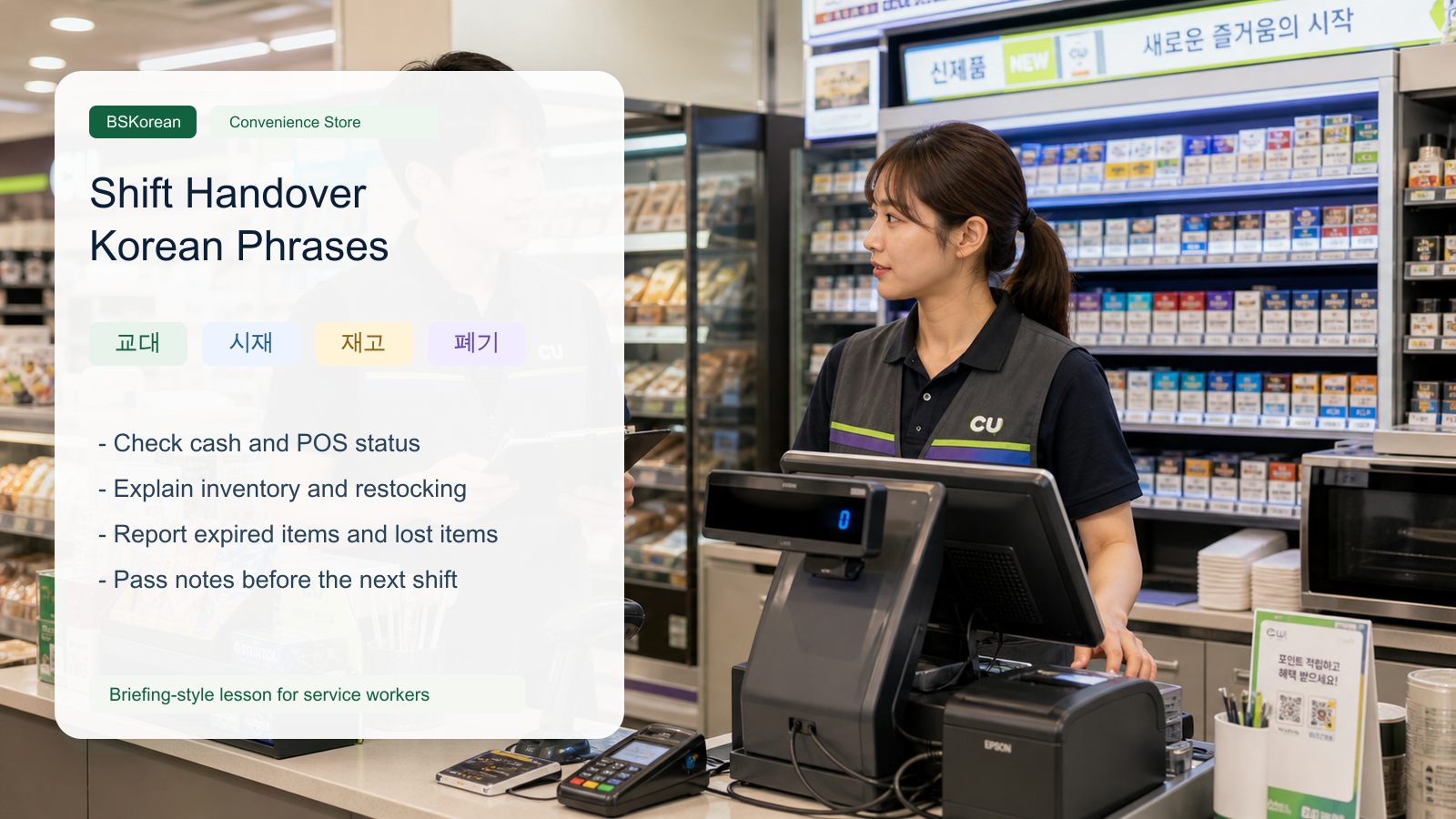
Shift handover before the next worker starts
Korean Convenience Store Shift Handover Phrases for Foreign Workers
You are almost finished with your shift at a Korean convenience store. The next worker asks, 전달사항 있어요? You need to answer quickly, but not vaguely: was the cash balance checked, did the POS have any problem, which products expired, what needs restocking, and did a customer leave anything behind?
This briefing image shows convenience store workers checking POS, inventory, expired products, and handover notes before the next shift begins.
Opening Situation
A convenience store handover is not a long meeting. It often happens while customers are still entering the store, the POS register is still active, and the next worker is already preparing to stand at the counter. Because of that, the most useful Korean is short, ordered, and specific.
The goal is not to make a perfect Korean speech. The goal is to help the next worker understand what must be checked first. If you skip 시재, the next worker may not know whether the cash balance was checked. If you forget to mention 결제 오류, they may be surprised when a customer comes back. If you do not explain where a 분실물 is stored, the item may be handled incorrectly.
This lesson teaches Korean convenience store shift handover phrases as a real work sequence. You will learn the base words, the short phrases, and the order that makes the information useful during a busy shift.
Use This First / Quick Script
If you only have a few seconds, use a short handover script. Start with whether there are notes, then mention cash and POS, products, customer issues, and manager reports.
전달사항 몇 가지 있어요. 시재는 확인했고, 포스기는 이상 없어요. 음료 보충이 필요하고, 분실물은 카운터에 보관했어요.
Natural meaning: “There are a few handover notes. I checked the cash balance, and the POS is fine. Drinks need restocking, and the lost item is kept at the counter.”
If there is no special issue, do not overtalk. A safe short version is: 전달사항 없어요. 시재랑 포스기 확인했습니다. This tells the next worker that there are no special notes, but the important counter checks were still done.
Situation Path
Think of the handover as five steps. This order keeps the next worker from guessing. It also helps you avoid long explanations when the store is busy.
| Step | What to check | Korean keyword |
|---|---|---|
| 1 | Are there any important notes before the next shift starts? | 전달사항 |
| 2 | Are the cash balance and POS register normal? | 시재, 포스기 |
| 3 | Were expired products discarded according to store rules? | 유통기한, 폐기 |
| 4 | Do shelves, fridges, or storage items need restocking? | 재고, 보충, 창고 |
| 5 | Were there customer questions, lost items, or manager reports? | 문의, 분실물, 보고 |
Situation Explanation
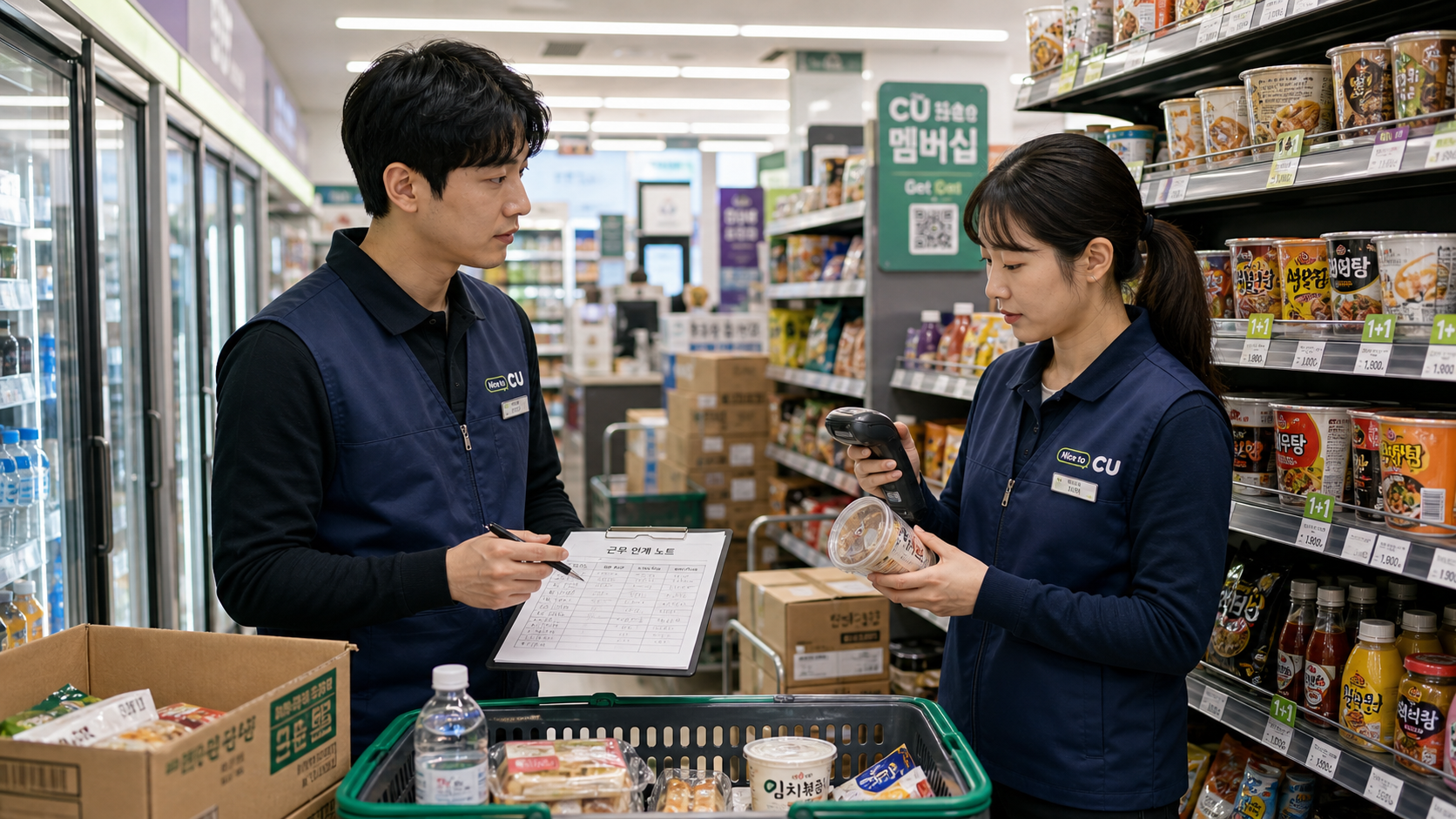
In a real store, handover is connected to the counter, shelves, fridges, storage room, customer questions, and manager instructions. It is not just saying goodbye.
인수인계 is the work word for handover. It means passing information so the next person can continue the work without guessing. In a convenience store, 인수인계 can include cash, POS status, inventory, expired products, lost items, and customer follow-up.
전달사항 means the matters that need to be passed on. The sentence 전달사항 있어요? is natural when a worker asks whether there is anything important before taking over the shift. If you are finishing the shift, you can open with 전달사항 몇 가지 있어요.
시재 sounds formal, but it is a practical cashier word. It does not mean money in general. It means the cash balance in the register. If you are not sure whether it matches, do not say 괜찮아요. A clearer sentence is 시재를 다시 확인해야 해요.
폐기 and 유통기한 are connected to food safety. Convenience stores in Korea often check lunch boxes, milk, bread, drinks, and refrigerated products by time. The next worker needs to know what has already been discarded and what still needs to be checked.
보충 is a useful service-work word because customers notice empty shelves quickly. If drinks are low, do not just say “there are no drinks.” Say 음료 보충이 필요해요. That gives the next worker an action, not just a problem.
Core Expressions
This table is not only for memorization. Read the “When to use” column first. Once you understand the work situation, the Korean phrase becomes easier to remember and easier to use.
| Korean Expression | Meaning | When to use |
|---|---|---|
| 전달사항 있어요. | There are handover notes. | Use this before you give information to the next worker. |
| 전달사항 없어요. | There are no handover notes. | Use this only when there is truly nothing special to report. |
| 시재 확인했습니다. | I checked the cash balance. | Use this after checking the register cash. |
| 포스기는 이상 없어요. | There is no issue with the POS register. | Use this when the POS is working normally. |
| 결제 오류가 한 번 있었어요. | There was one payment error. | Use this when the next worker needs to know about a payment issue. |
| 유통기한 지난 상품은 폐기했습니다. | I discarded the expired products. | Use this after handling expired food or drinks according to store rules. |
| 재고는 창고에 있어요. | The stock is in the storage room. | Use this to tell the next worker where restocking items are. |
| 음료 보충이 필요해요. | Drinks need to be restocked. | Use this when the fridge or drink shelf is still low. |
| 고객 문의가 있었어요. | There was a customer inquiry. | Use this when a customer asked something the next worker may need to continue. |
| 분실물은 카운터에 보관했어요. | The lost item is kept at the counter. | Use this when a customer item was left behind and stored safely. |
| 관리자에게 보고했습니다. | I reported it to the manager. | Use this when a problem has already been reported. |
| 먼저 확인해 주세요. | Please check it first. | Use this when the next worker should verify something before acting. |
Role Expressions
The same information can sound different depending on who is listening. With a coworker, you can be short. With a manager, use clearer reporting language, especially for cash, POS, payment, and customer issues.
| Role | Korean | Usage note |
|---|---|---|
| Worker finishing shift | 전달사항 몇 가지 있어요. | Start with this when there are several important points. It prepares the next worker to listen. |
| Worker starting shift | 시재랑 포스기 먼저 확인할게요. | Use this when you are taking over the counter and need to check cash and POS first. |
| Coworker to coworker | 음료는 창고에 있고, 냉장고는 조금 보충해야 해요. | Between coworkers, the sentence can be short, but the place and action must be clear. |
| Worker to manager | 결제 오류가 있어서 관리자에게 보고했습니다. | For money or system issues, use a clear report instead of casual guessing. |
| Worker to customer | 확인 후 안내드리겠습니다. | Use polite customer-service Korean when the handover affects a customer question. |
Word Examples / Usage Notes
교대 means a shift change. If you hear 교대 시간이에요, it means it is time to change shifts or prepare to finish your current shift.
인수인계 is broader than “tell someone something.” It is work transfer. You may hear 인수인계해 주세요 or 인수인계 받았어요? The content may include money, products, customers, machines, and manager notes.
보충 and 진열 are different. 보충 means adding missing items. 진열 means arranging products on shelves. If drinks are in the 창고 but not in the fridge, the useful sentence is 음료 보충이 필요해요.
문의 means a customer question or inquiry. If a customer asked about refund, promotion, product location, or app payment, tell the next worker: 고객 문의가 있었어요. If the issue is still open, add what the customer may ask again.
오류 means error, but it is too vague by itself. Add the area: 결제 오류, 포스기 오류, or 바코드 오류. The Word Bank stores the base word 오류, while the article explains how it appears in practical phrases.
Review Table
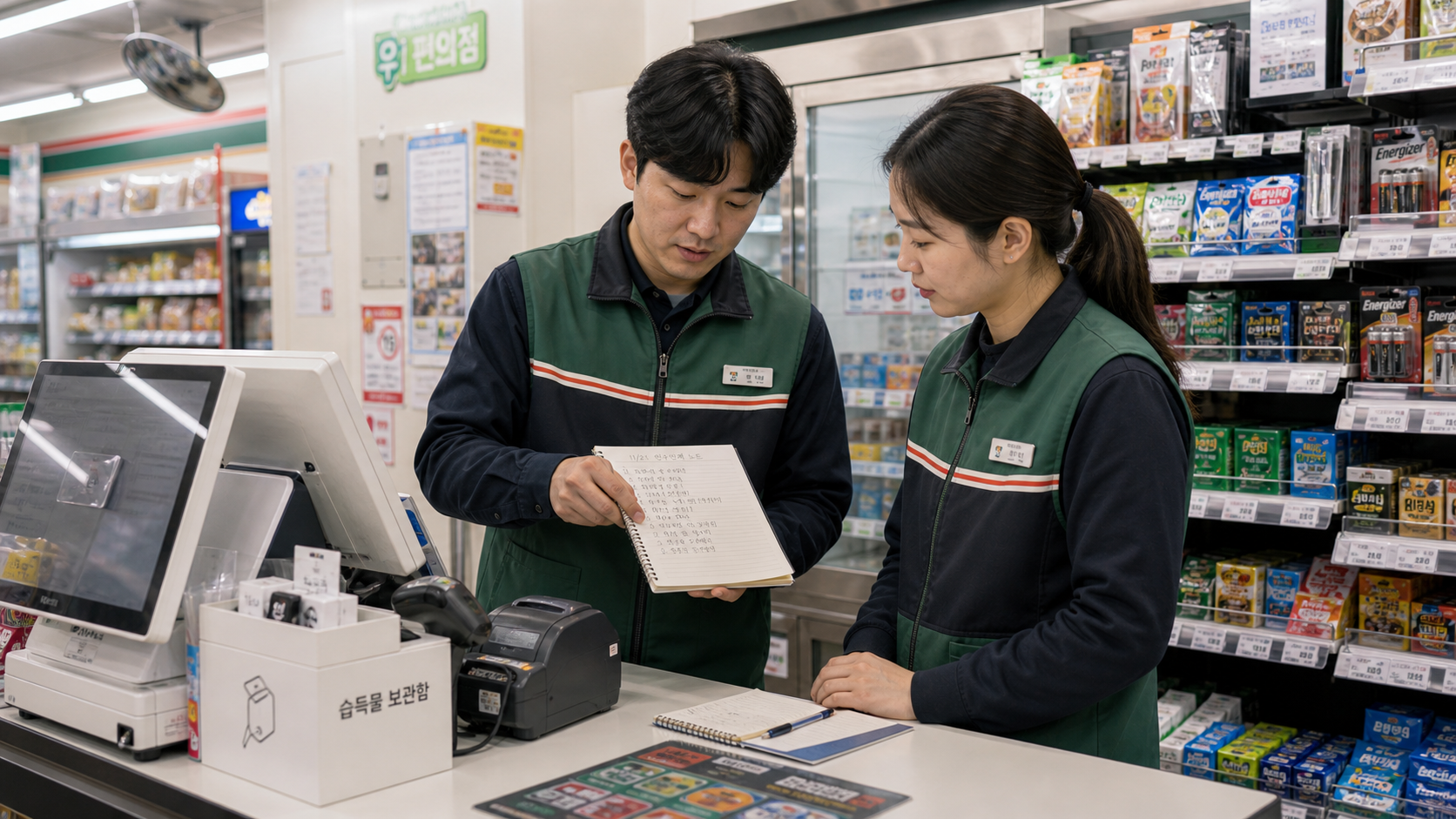
Review after a shift helps you remember these words as part of a work flow, not as isolated vocabulary.
Used when one worker finishes a shift and another worker starts.
Passing work information to the next worker so the shift can continue.
Giving information, requests, warnings, or notes to another person.
One point or item that needs attention in a work note.
The cash amount in the register that must match the sales record.
The cash register or payment system at the counter.
Payment by card, cash, barcode, app, or voucher.
A system, barcode, POS, or payment problem.
Throwing away expired or unsellable products according to store rules.
The sell-by or expiration date printed on food, drinks, and products.
An item sold in the store.
Products available on shelves or in the storage room.
Conclusion
A good convenience store handover does not need to be long. It needs to be ordered. Start with 전달사항, then check 시재 and 포스기. After that, explain 폐기, 재고, 보충, 문의, 분실물, and 보고.
If you use these words in the right situation, the next worker knows what to do immediately. That is the purpose of Korean at work: not complicated grammar, but clear information that keeps the store running safely and professionally.