Briefing Summary
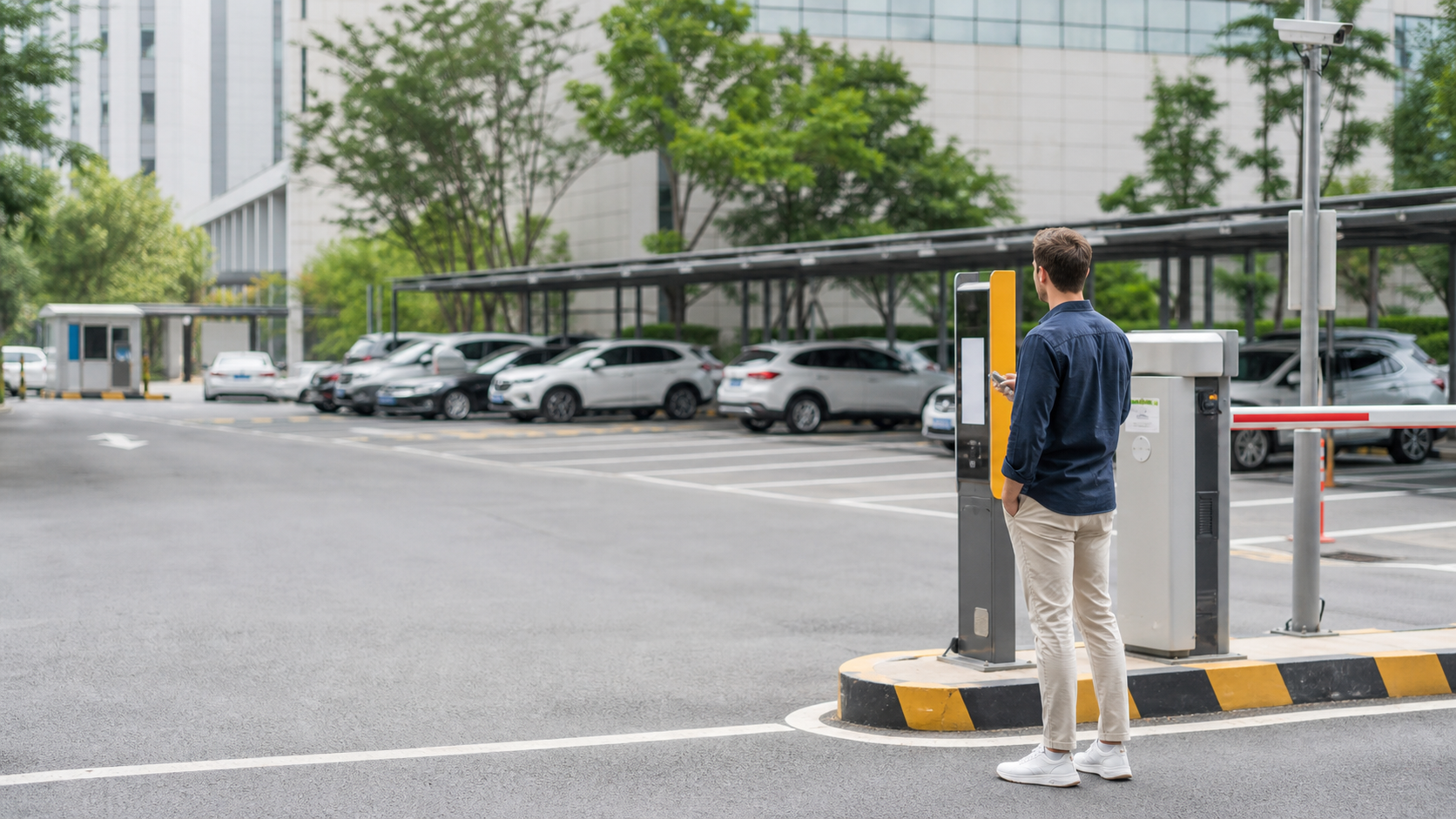
Korean parking lot words help you make fast decisions before you stop the car, pay a fee, or leave a garage. This briefing follows the subway lesson style: read the visible word, connect it to one action, and move step by step. You will learn parking, fee, payment, operating-hour, no-parking, and enforcement words that appear in real Korean parking situations.
Download the complete Korean parking lot words PPT briefing
Slide 1. The Situation
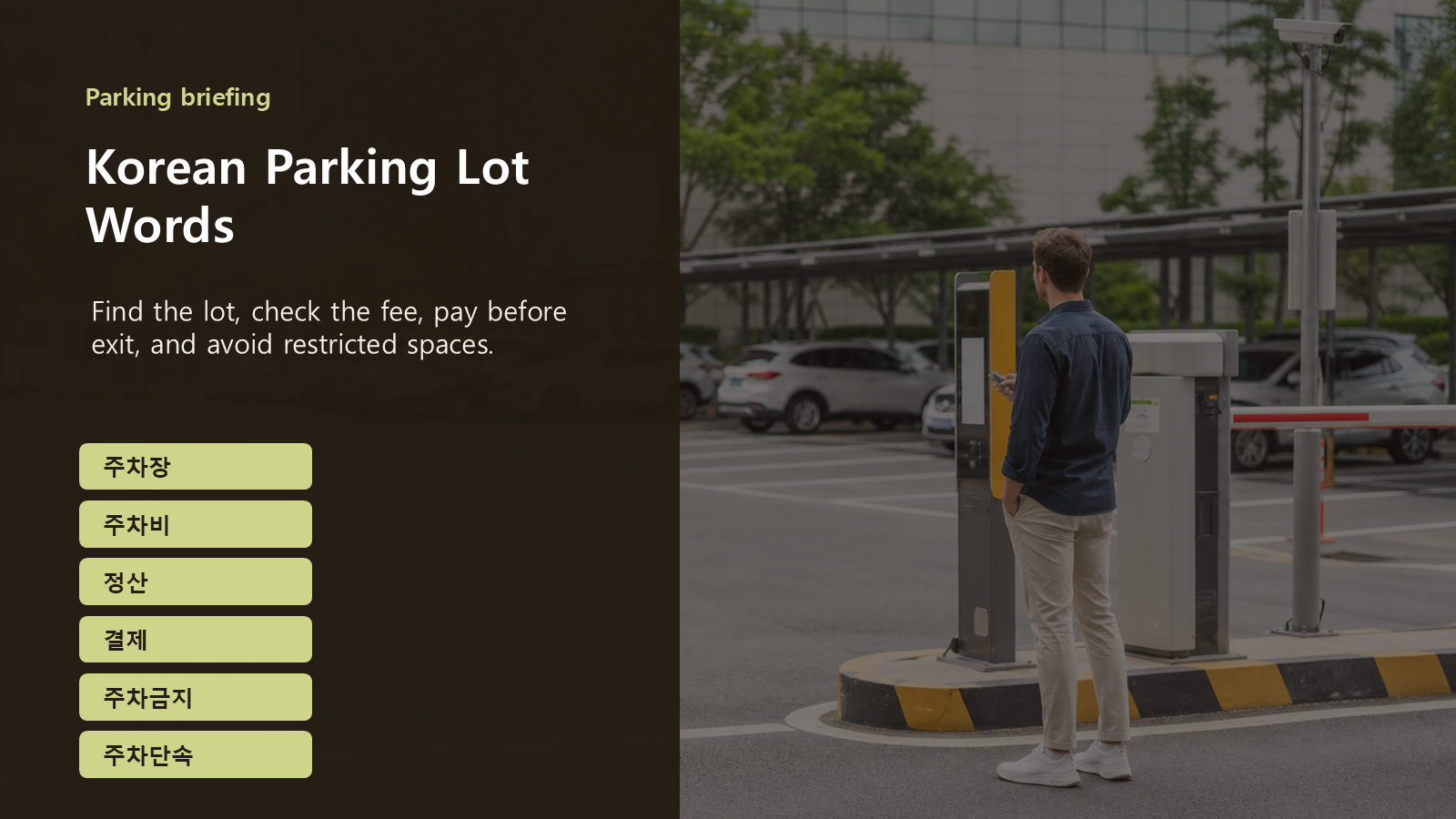
You arrive near a public lot, an apartment garage, or a small paid parking area. The first problem is not grammar. It is choosing the right action from several signs and screens. Start with the biggest location word. If you see 주차장, you are near the parking lot. If you see 주차구역, you need to park inside the marked area.
Next, check whether the space is allowed. 주차금지, 무단주차, and 불법주차 are warning words. They tell you that stopping the car may lead to a fine or towing. A safe beginner rule is simple: location words invite action, but 금지 and 단속 words stop action.
The slide also shows why parking vocabulary is different from a normal word list. You are often reading while moving, carrying bags, or standing beside a machine. That means the lesson must train fast recognition. Learn the few words that change your next step, then ignore extra detail until the car is safely parked or the fee is paid.
Slide 2. Key Parking Lot Words
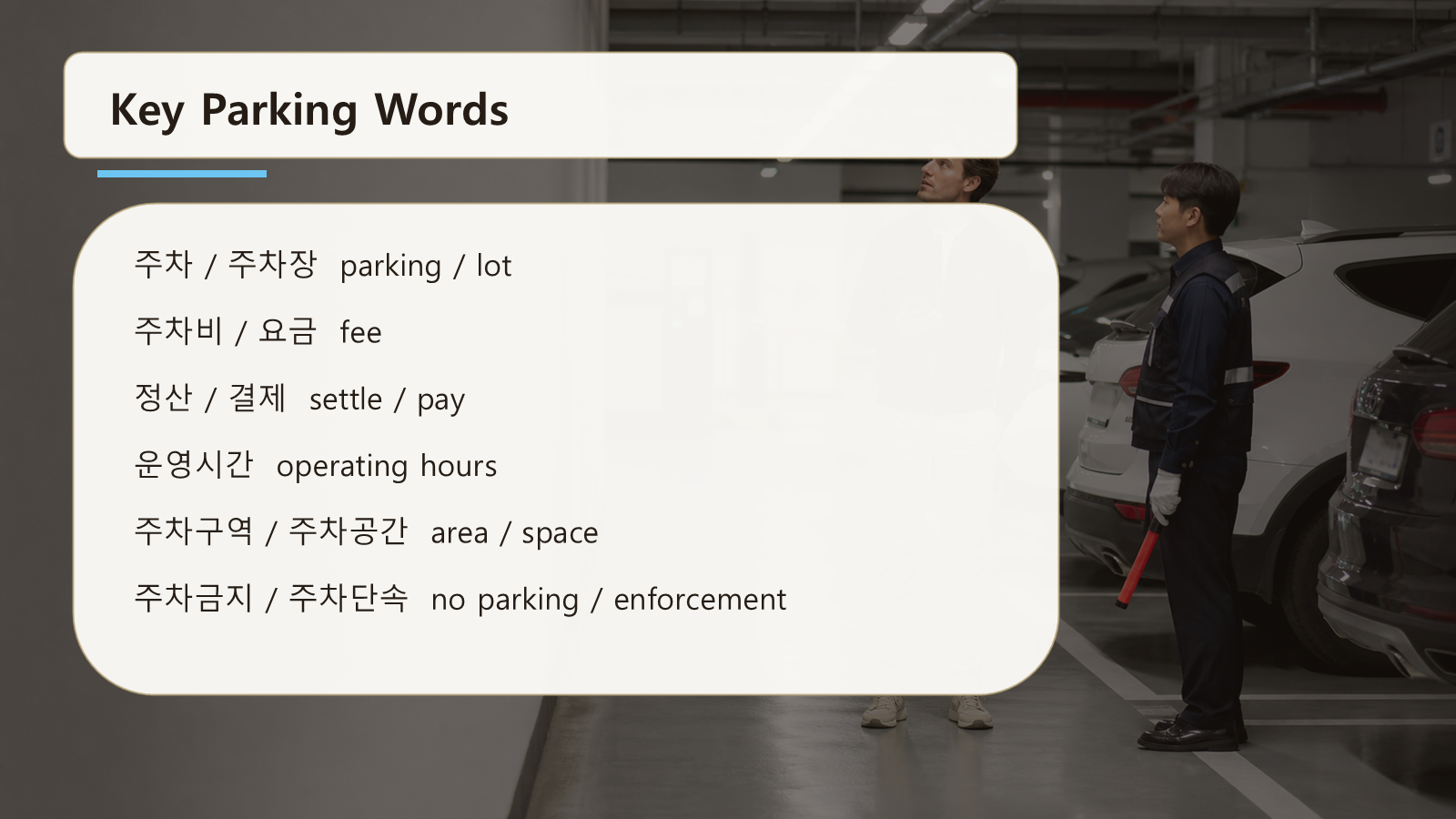
The table below gives fourteen Korean parking lot words from the Wordbook database. They are grouped around what a learner must do: find the lot, read the fee, pay correctly, and avoid restricted parking.
| Korean | Romanization | English | Usage |
|---|---|---|---|
| 주차 | jucha | parking | Use this for the general action of parking a car. |
| 주차장 | juchajang | parking lot | Look for this word when finding a place to park. |
| 주차비 | juchabi | parking fee | This is the amount you pay for parking time. |
| 요금 | yogeum | fee | A general charge shown on signs, screens, or receipts. |
| 정산 | jeongsan | settlement | Use this for paying or settling the parking fee before exit. |
| 결제 | gyeolje | payment | This appears at kiosks, apps, and card payment steps. |
| 운영시간 | unyeong sigan | operating hours | Check this before assuming the lot is open all day. |
| 주차구역 | jucha guyeok | parking area | This marks an allowed or assigned parking area. |
| 주차공간 | jucha gonggan | parking space | Use this for an available spot, not the whole lot. |
| 주차금지 | jucha geumji | no parking | A strict sign telling you not to park there. |
| 불법주차 | bulbeop jucha | illegal parking | This describes parking that breaks the rule or law. |
| 주차단속 | jucha dansok | parking enforcement | This warns that parking rules may be checked or fined. |
| 무단주차 | mudan jucha | unauthorized parking | This means parking without permission in a restricted place. |
| 주차규정 | jucha gyujeong | parking regulation | Use this for posted rules about time, payment, and access. |
Do not try to memorize every parking sentence at once. First, separate place words from money words. 주차장, 주차구역, and 주차공간 tell you where parking may happen. 주차비, 요금, 정산, and 결제 tell you what to pay or press. Finally, warning words tell you where not to park.
This grouping also helps when a sign looks crowded. A parking notice may include hours, prices, vehicle limits, and warnings in one place. Do not read it from the first Korean syllable to the last. Scan for the function word first. If the word is about place, decide where to move. If it is about money, look for the kiosk. If it is a warning, stop and choose another space.
Slide 3. Reading Formulas
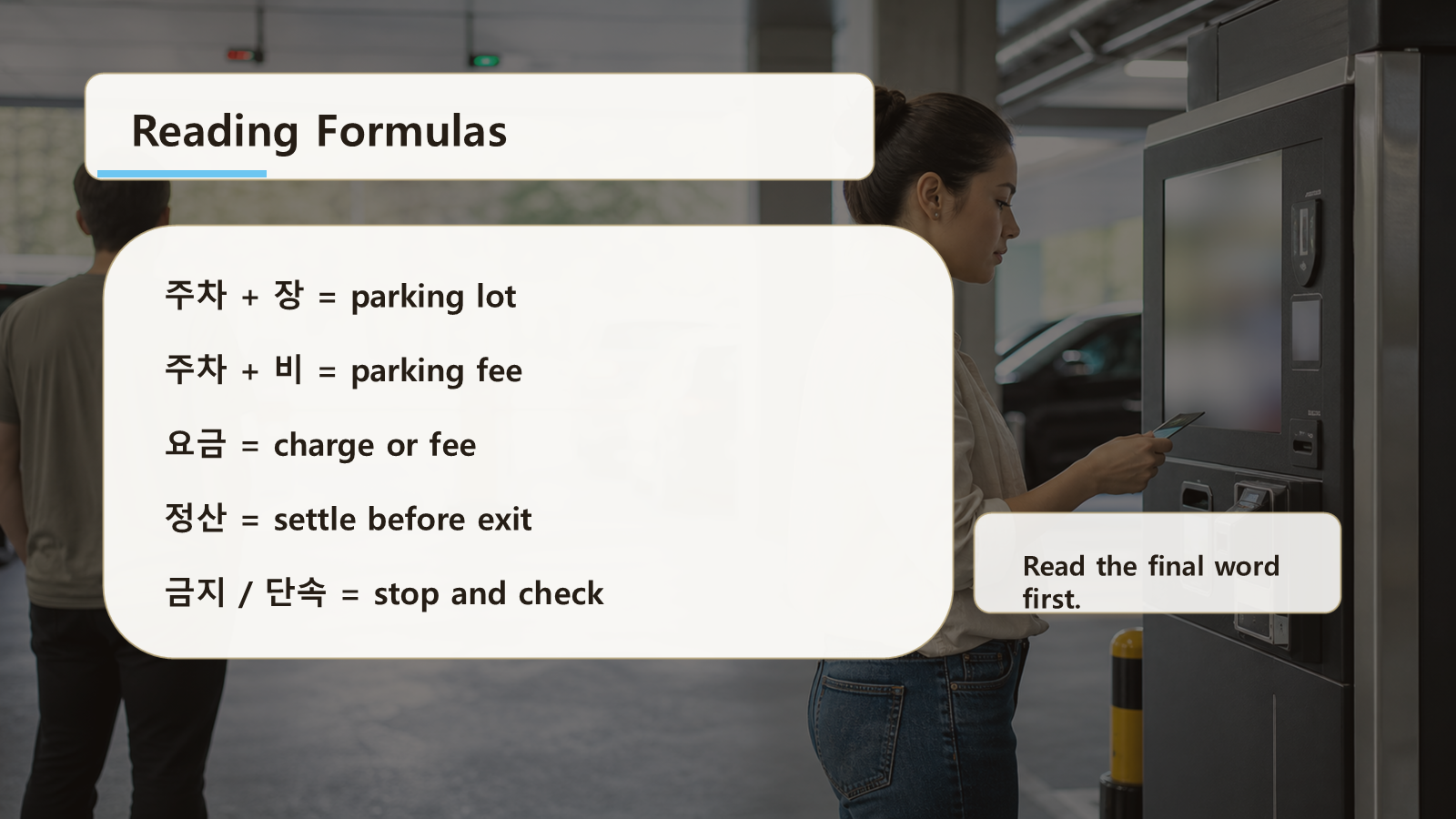
Parking signs often use short noun patterns. The most useful formula is noun + 요금. It points to a fee. When you see 주차비 or 주차 요금, look nearby for the time unit, discount note, or payment machine. You do not need full sentence grammar to understand the demand.
The second formula is noun + 금지. 주차금지 means “no parking.” It is stronger than a suggestion. The third formula is noun + 단속. 주차단속 means parking enforcement, so the rule is actively being checked. These formulas help you read unfamiliar signs quickly. Find the base word, then read the ending word for the action.
For speaking, keep sentences short. Ask 주차장이 어디예요? when you need the lot. Ask 주차비는 얼마예요? when the fee is unclear. Say 카드로 결제할게요. at a payment point.
On machines, read buttons from top to bottom and look for the payment action. You may see card, receipt, discount, or exit words beside the core parking terms. A beginner does not need to master every button. The key is to recognize that 정산 prepares the fee, while 결제 finishes the payment. That difference prevents many exit-lane problems.
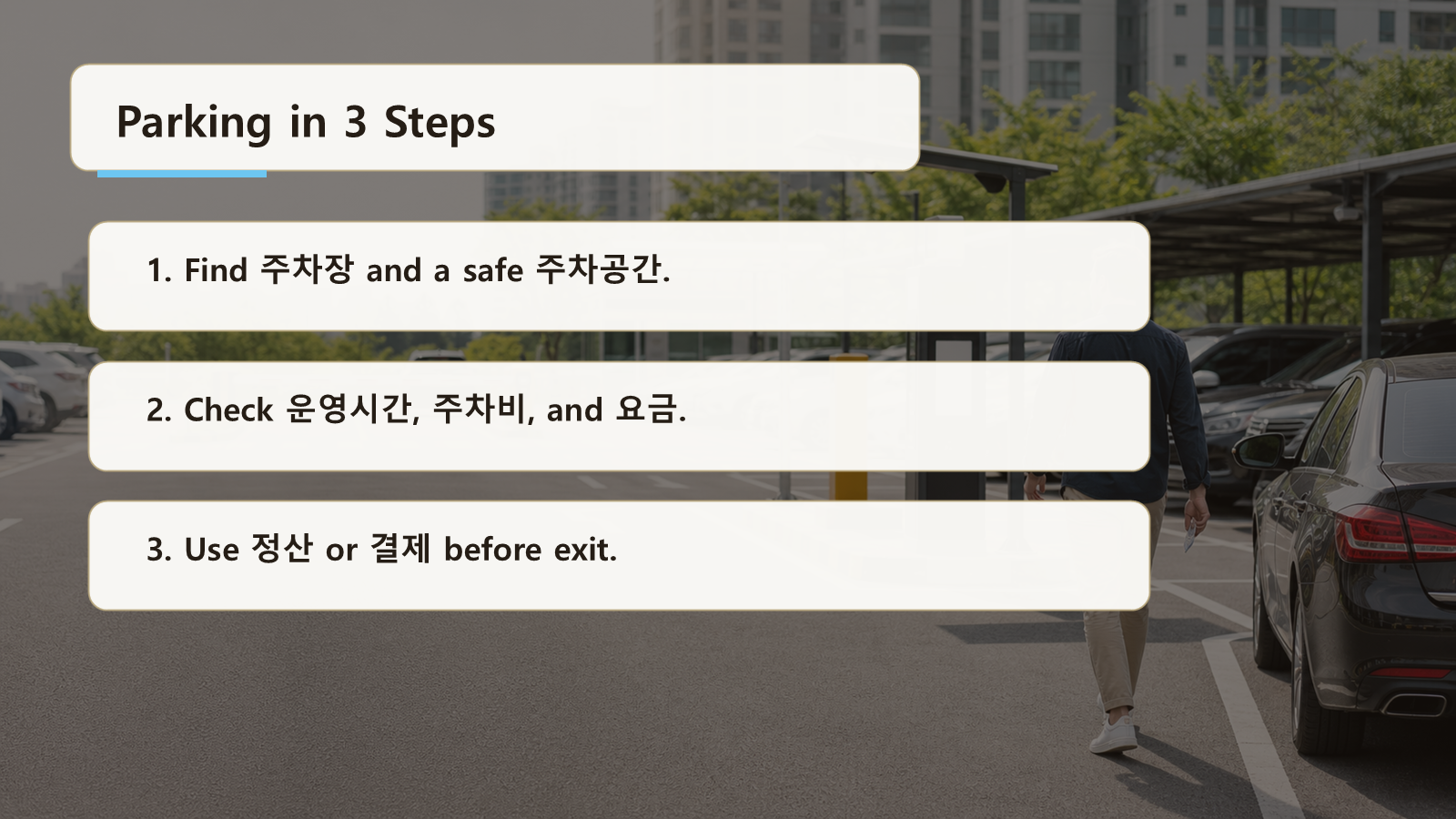
Slide 4. Read Parking Lot Signs in 3 Steps
Step one is place. Look for 주차장, then check whether there is an available 주차공간. If the lot marks special zones, use 주차구역 as your guide. Stay inside the marked space and avoid any area with a restriction word.
Step two is time and fee. Read 운영시간 before assuming the lot is open. Then look for 요금 or 주차비. Some lots charge by the hour. Others need payment before exit. If you see 정산, settle the fee before you drive to the barrier.
Step three is exit. At a kiosk, 결제 means payment. After payment, move toward the exit lane. If the barrier does not open, keep the receipt or call the attendant. Do not reverse into another lane unless the sign clearly allows it.
If you are unsure whether payment is already complete, watch the screen for a receipt, paid amount, or confirmation message. Many Korean parking systems are automated, so staff may not be nearby. In that situation, your safest Korean is short and direct: 정산했어요? means “Did I settle it?” and 결제됐어요? means “Was the payment completed?”
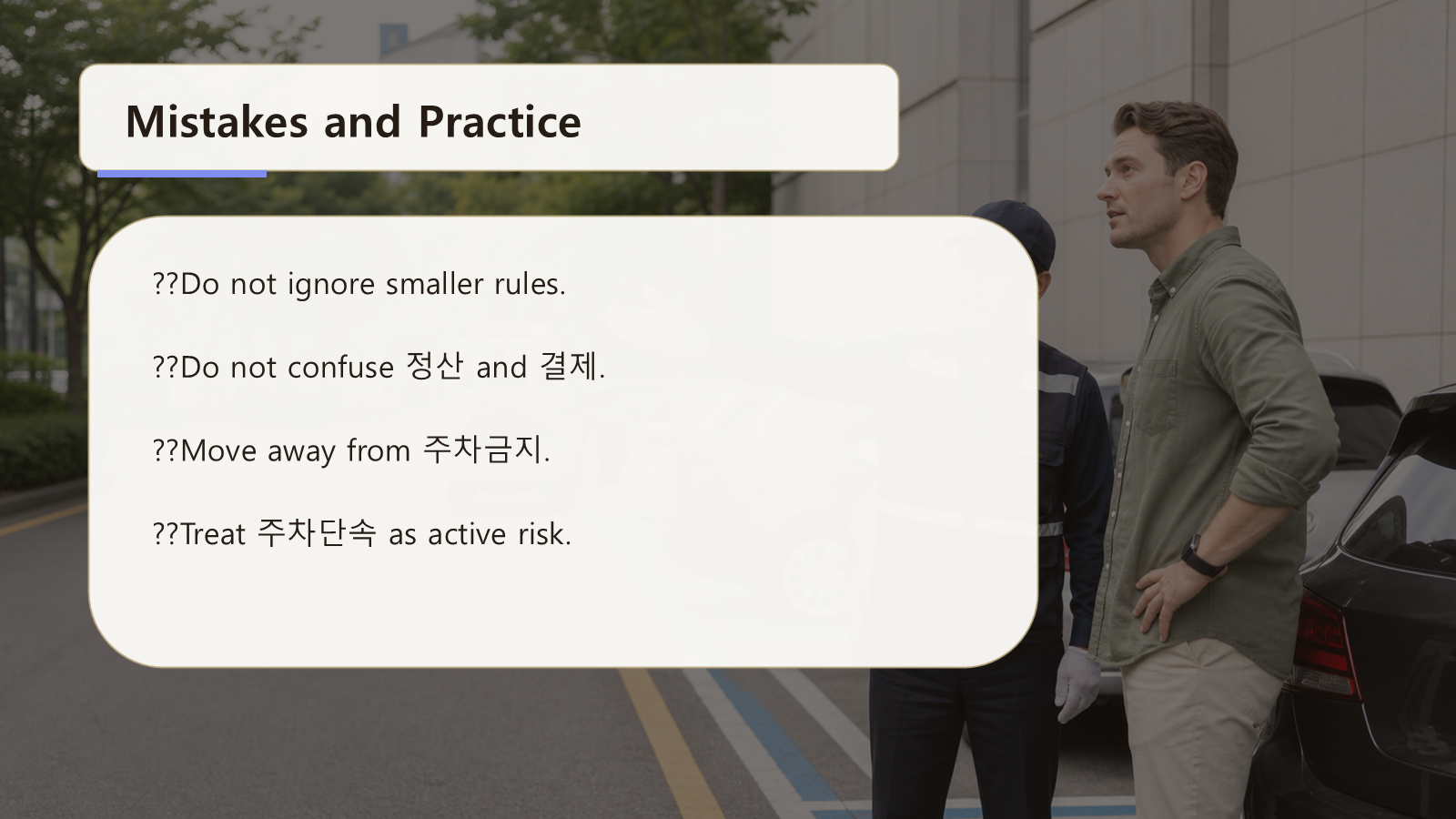
Slide 5. Mistakes and Practice
The first common mistake is reading 주차장 and ignoring the smaller rule beside it. A lot may be open, but one section may still be restricted. Check the words around the arrow or painted space before you park.
The second mistake is confusing 정산 and 결제. They are close, but their timing can feel different. 정산 often means settling the parking fee before exit. 결제 is the payment action itself. If a screen asks for 결제, choose the payment method.
The third mistake is treating warning words as decoration. 주차금지, 불법주차, 무단주차, and 주차단속 are not background text. They tell you the space is risky. Move the car before you start translating every word.
Practice
Answer these quick recognition questions. First, which word tells you not to park: 주차장 or 주차금지? Second, which word points to payment settlement before exit: 정산 or 주차공간? Third, which word means operating hours: 운영시간 or 불법주차?
Mini scenario: you enter a garage and see 운영시간, 주차비, and 정산 near the elevator. The safe reading is: check the hours, note the fee, then settle payment before leaving. Answer key: 주차금지, 정산, and 운영시간.
Mini Review Table
| If you see… | It usually means… | What to do |
|---|---|---|
| 주차장 / 주차구역 | A parking lot or allowed area | Park only inside the marked space. |
| 주차비 / 요금 | A fee or charge | Check the amount and time rule. |
| 정산 / 결제 | Settlement or payment | Use the kiosk, card reader, or app. |
| 주차금지 / 무단주차 | Parking is not allowed | Move the car to another space. |
| 주차단속 | Enforcement may happen | Do not risk the restricted area. |
Final Takeaway
Korean parking lot words become manageable when you read them by function. First find the place. Then read the fee and payment words. Finally, respect warning words before you stop the car. This short order keeps parking signs practical, even when the full notice looks crowded. Use the same order each time, and the signs will feel less scattered during real parking in Korea.