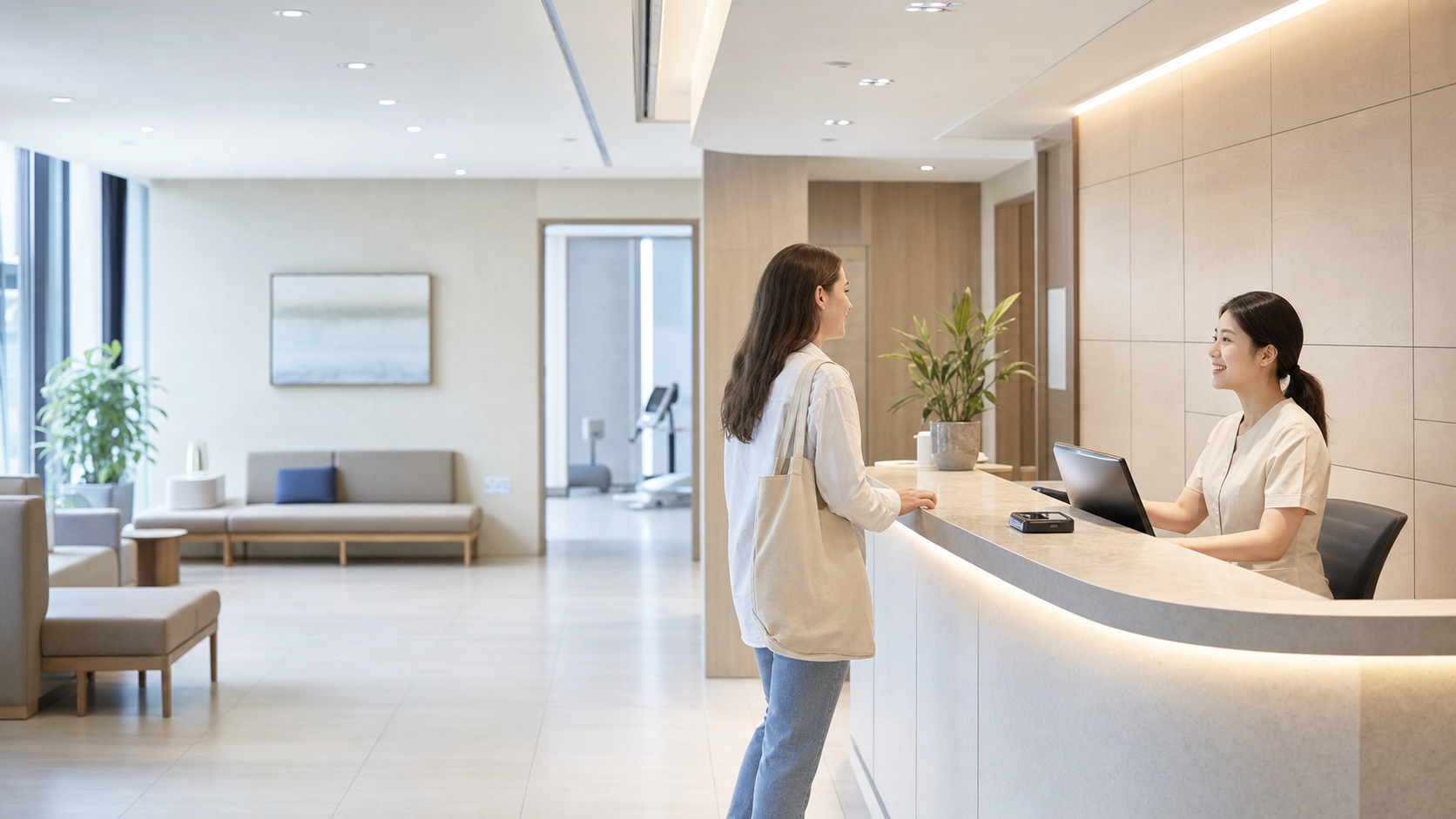
Briefing Summary
Korean hospital reception words help you move through a clinic visit without guessing every sentence. This briefing follows the same sign-reading style as the subway lesson. First, read the visible desk word. Next, match it to one safe action. By the end, you should recognize check-in, ID, appointment, waiting number, consultation, symptoms, fees, prescription, and pharmacy steps in a Korean clinic.
Download the complete Korean hospital reception words PPT briefing
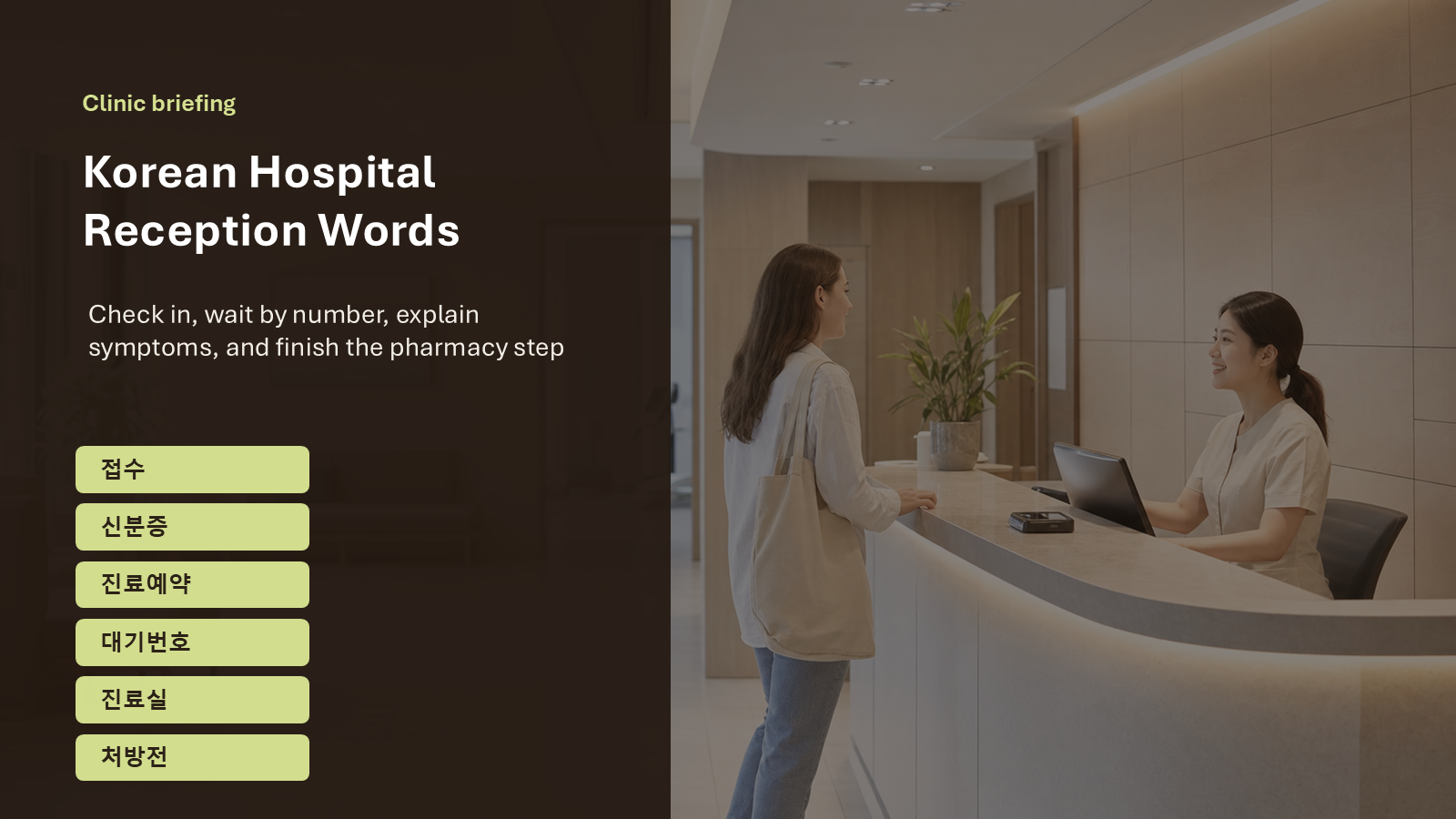
Slide 1. The Situation
You enter a Korean clinic and see several possible starting points. There may be a front desk, a small kiosk, a waiting area, and doors leading to consultation rooms. You do not need to understand every notice. Start by finding 접수 or 접수창구. These words tell you where the visit begins.
After check-in, the staff may ask for 신분증 or confirm your 진료예약. Then you may receive a 대기번호 and move to the 대기실. The lesson treats the clinic like a short route. Each word points to the next action. When you read the route in order, the visit feels much less stressful.
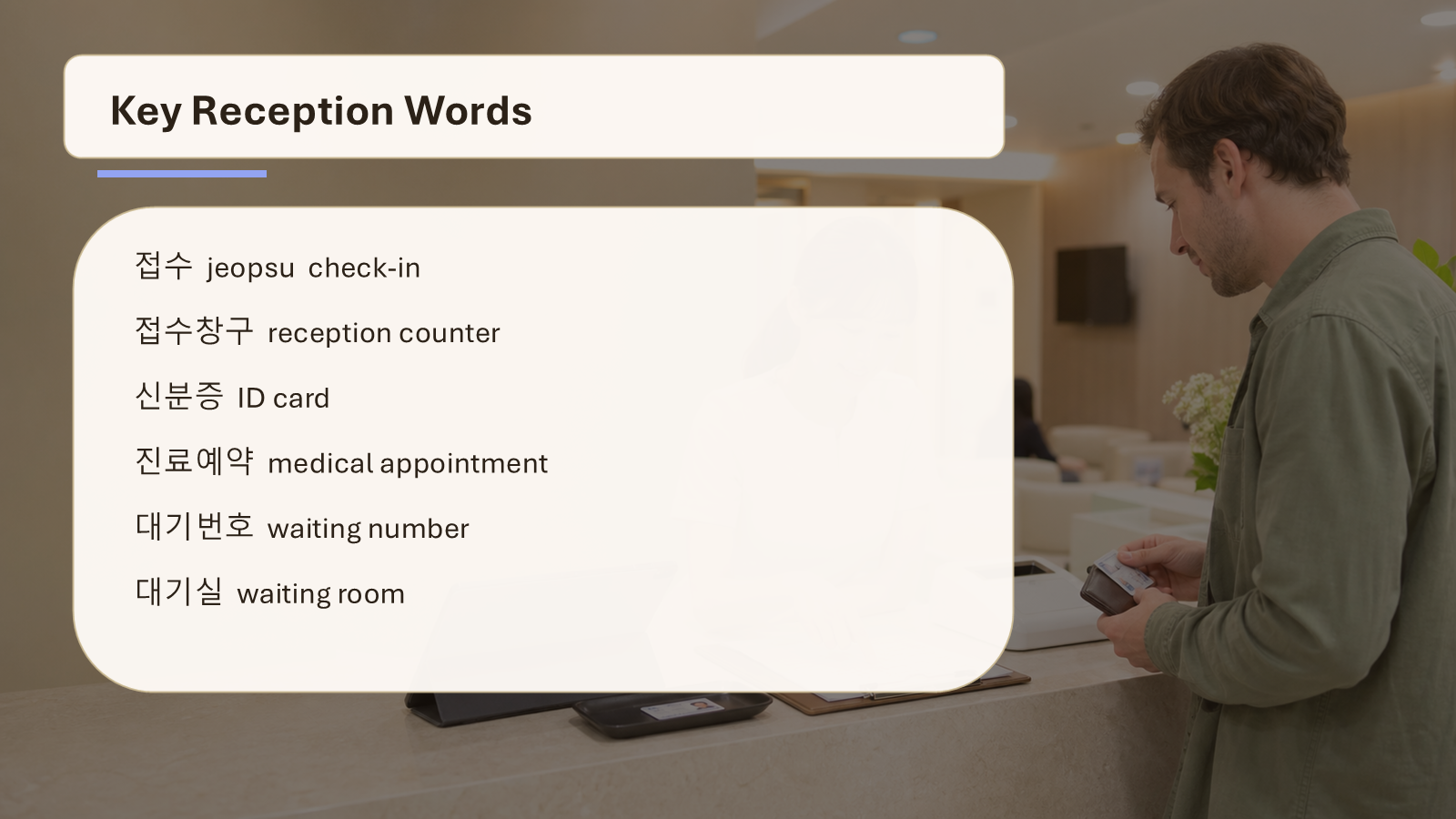
Slide 2. Key Hospital Reception Words
The table below gives thirteen Korean hospital reception words from the Wordbook database. These are not random medical terms. They are the practical words a beginner may see or hear before, during, and right after a basic clinic visit.
| Korean | Romanization | English | Usage |
|---|---|---|---|
| 접수 | jeopsu | registration / check-in | Find this first at the clinic desk or kiosk. |
| 접수창구 | jeopsu changgu | reception counter | This is the desk where the visit begins. |
| 신분증 | sinbunjeung | ID card | Staff may ask for this before registration. |
| 진료예약 | jillyo yeyak | medical appointment | Use this when you booked a clinic visit. |
| 대기번호 | daegi beonho | waiting number | Watch or listen for this number after check-in. |
| 대기실 | daegisil | waiting room | Go here after registration if staff tells you to wait. |
| 진료 | jillyo | medical consultation | This means the doctor visit, not the desk check-in. |
| 진료실 | jillyosil | consultation room | Enter this room when your turn is called. |
| 증상 | jeungsang | symptom | Use this to explain why you came to the clinic. |
| 검사 | geomsa | examination / test | Staff may use this before blood, urine, or simple checks. |
| 처방전 | cheobangjeon | prescription | Take this paper or digital code to the pharmacy. |
| 진료비 | jillyobi | medical fee | This is the amount you pay after the visit. |
| 약국 | yakguk | pharmacy | Go here after the clinic if you receive a prescription. |
접수 and 접수창구 are your starting words. Use them before you explain symptoms or ask about payment. The desk must first know who you are and why you came.
신분증 often appears early because clinics may need to confirm your identity. If you have an appointment, listen for 진료예약. It tells staff that your visit is already booked.
대기번호 and 대기실 help you wait correctly. Watch the number screen, listen for your name, and stay close enough to hear the next instruction.
진료, 진료실, and 증상 belong to the doctor step. Keep symptom sentences short. A clear word like 기침 or 두통 can be added if you know it.
검사, 처방전, 진료비, and 약국 appear near the end. They tell you whether a test, payment, prescription, or pharmacy visit comes next.
If you can only remember a few words, remember the route words first: 접수, 대기번호, 진료실, 진료비, and 약국. These words usually tell you where to move next. The other words help you answer staff questions more calmly.
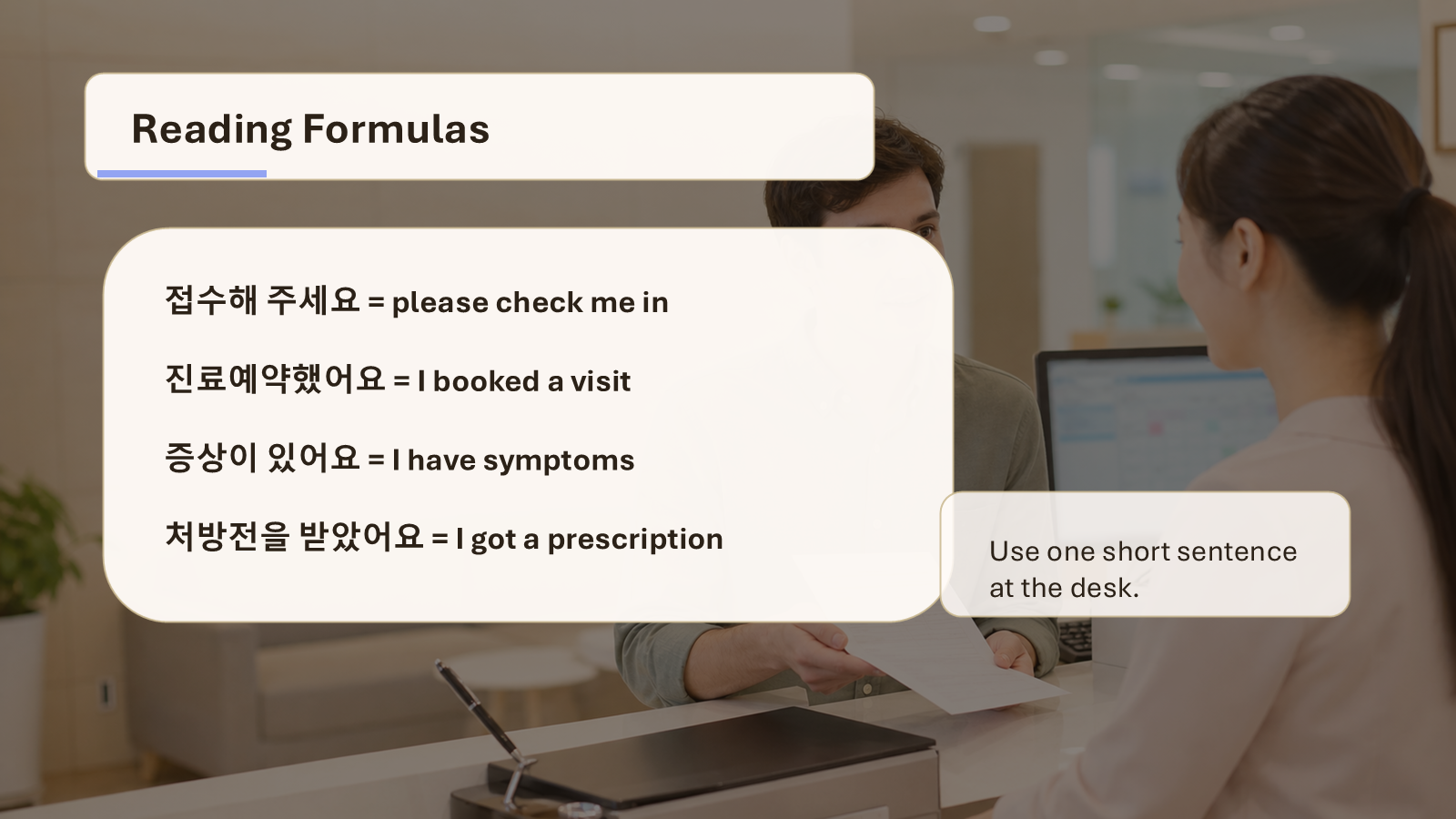
Slide 3. Reading Formulas
Use these formulas as short, safe patterns. They are not full grammar lessons. They are practical clinic sentences that help you respond at the right moment.
Formula 1: 접수 + 해 주세요
접수해 주세요 means “Please check me in.” Use it at the reception counter when you are ready to begin. If you cannot find the desk, ask 접수창구가 어디예요?
Formula 2: 진료예약 + 했어요
진료예약했어요 means “I made a medical appointment.” Say this when the staff asks whether you booked. If you did not book, keep your answer simple and wait for the next instruction.
Formula 3: 증상 + 이/가 있어요
증상이 있어요 means “I have symptoms.” This sentence is useful when you are nervous. You can add one symptom word after it, but the first goal is to explain that you need medical help.
Formula 4: 처방전 + 받았어요
처방전을 받았어요 means “I received a prescription.” This is useful after the consultation, especially when you go to the pharmacy and need to show what the clinic gave you.
Notice that each formula begins with the key clinic word. This makes your Korean easier to understand, even if your full sentence is short. In a busy clinic, short and accurate is better than long and uncertain.
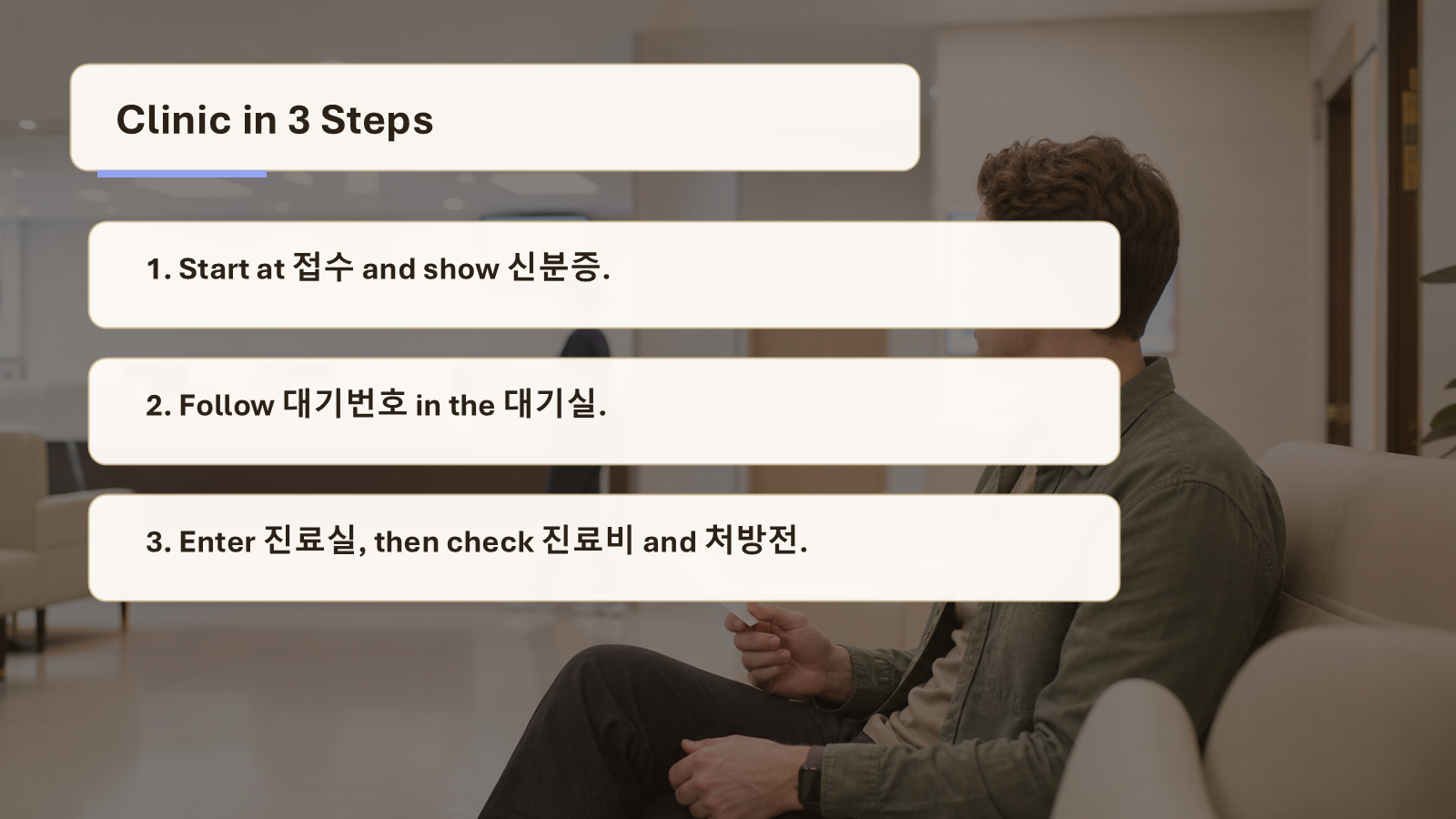
Slide 4. Read Hospital Reception in 3 Steps
Step 1: Start at 접수. Look for the desk, kiosk, or counter sign. If staff asks for 신분증, show your ID. If they ask about 진료예약, answer whether you booked. This step is about identity and visit setup.
Step 2: Follow 대기번호. After registration, check your 대기번호 and move to the 대기실. Do not stand at the desk unless staff asks you to stay there. Waiting correctly prevents confusion and keeps the line moving.
Step 3: Connect 진료 to the next action. When your turn comes, go to the 진료실 and explain your 증상. If staff mentions 검사, a test may come before or after the consultation. At the end, check 진료비, receive the 처방전, and go to the 약국 if needed.
If you miss one sentence, look back at the visible word. Clinic staff often repeat the action word before moving you forward. That repeated word is your anchor, so pause, read it again, and follow the next clear instruction.
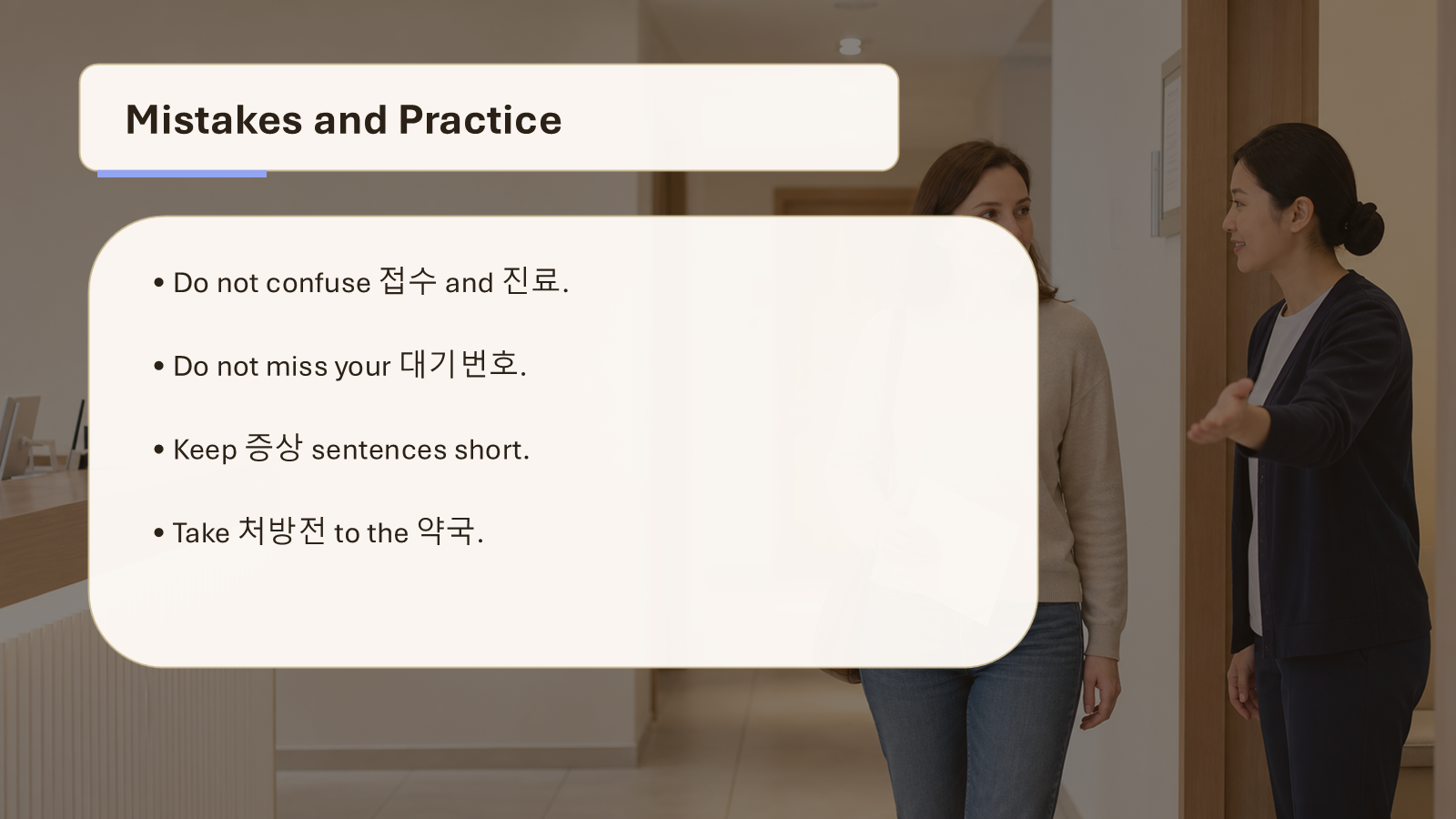
Slide 5. Mistakes and Practice
Mistake 1: Confusing 접수 and 진료
접수 is check-in. 진료 is the medical consultation. If you use 진료 at the desk, staff may still understand, but 접수 is the safer first word.
Mistake 2: Ignoring 대기번호
Many clinics run by number. If you receive a 대기번호, watch the screen or listen carefully. Do not miss your turn by walking too far away.
Mistake 3: Explaining too much at once
At reception, keep your symptom explanation short. Say 증상이 있어요, then add one clear symptom if you can. Save long details for the consultation room.
These mistakes are common because clinics move quickly. However, the fix is simple. Read the action word first, answer with one short sentence, and wait for the next visible or spoken cue.
Practice
Try these quick recognition questions before you visit a clinic.
- You see 접수창구. What should you do first?
- The staff asks for 신분증. What should you show?
- Your screen shows 대기번호. What should you watch next?
Mini scenario: You arrive with no appointment and a sore throat. A safe first sentence is: 접수해 주세요. 증상이 있어요. It means “Please check me in. I have symptoms.”
Answer key: First, check in at the counter. Second, show your ID card. Third, watch or listen for your waiting number, then go when staff calls you.
Mini Review Table
| If you see… | It usually means… | What to do |
|---|---|---|
| 접수 / 접수창구 | Clinic registration starts here. | Check in and prepare your ID. |
| 진료예약 | Appointment information is needed. | Say whether you booked. |
| 대기번호 / 대기실 | You need to wait for your turn. | Watch the number or stay nearby. |
| 진료 / 진료실 | The doctor consultation is next. | Enter when staff calls you. |
| 처방전 / 약국 | Medicine may be the next step. | Take the prescription to a pharmacy. |
Final Takeaway
Korean hospital reception words are easiest when you read them as a sequence. Start with 접수, confirm 신분증 or 진료예약, follow 대기번호, enter 진료실, explain 증상, then check 진료비 and 처방전. You do not need perfect Korean. You need the right word at the right moment.