BSKorean lesson
Korean Restaurant Closing Cleanup Phrases for Service Workers
Learn Korean restaurant closing cleanup phrases for wiping tables, organizing chairs, dishwashing, sorting trash, checking stock, and reporting.
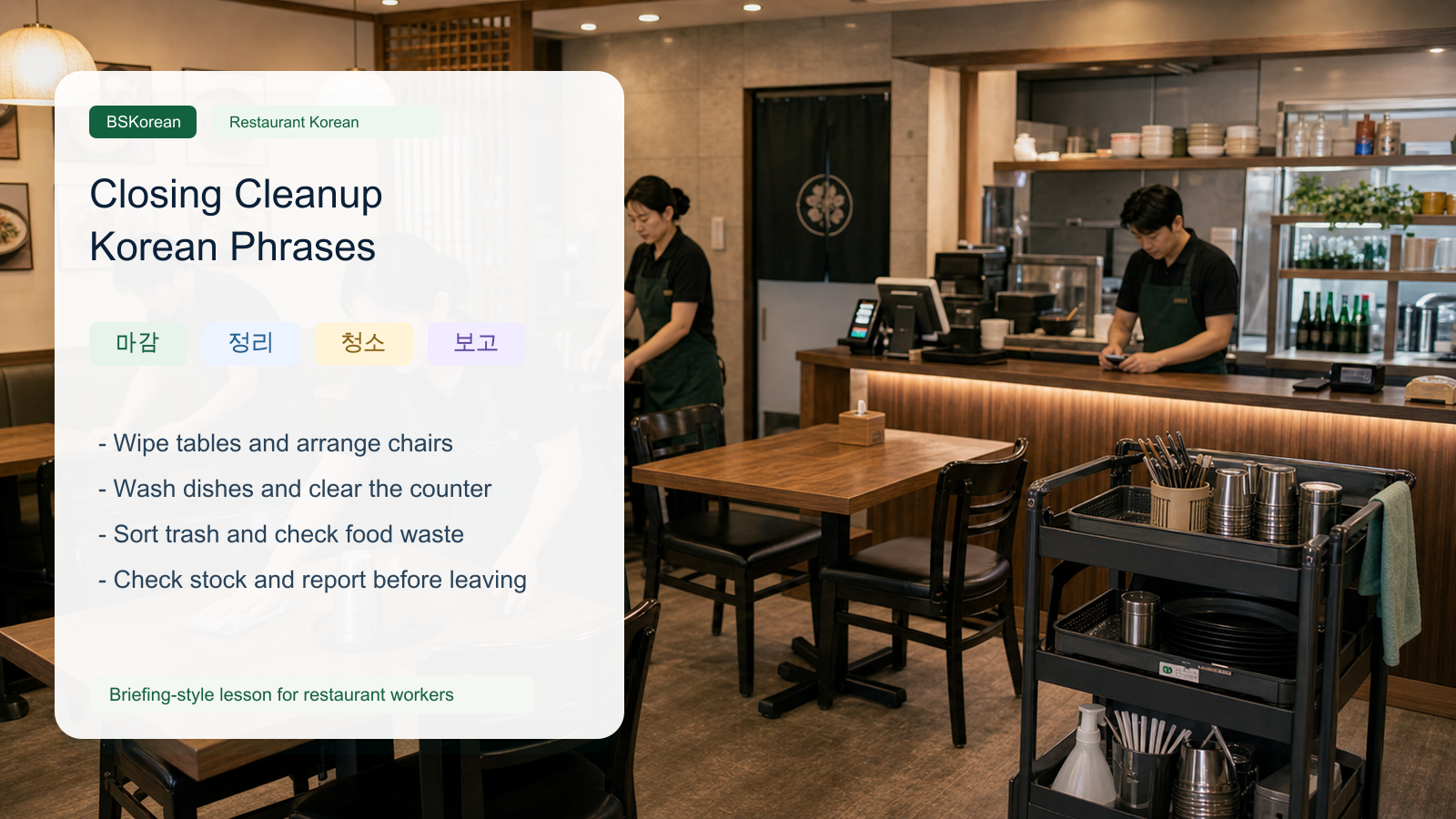
Closing cleanup after the last customer leaves
Korean Restaurant Closing Cleanup Phrases for Service Workers
You are working the last shift at a Korean restaurant. The last customer leaves, the open sign is turned off, and the manager says: 마감 준비해 주세요. The restaurant is closed to customers, but the staff work is not finished yet.
This briefing image shows Korean restaurant workers wiping tables, arranging chairs, sorting waste, checking the work area, and reporting closing tasks.
Opening Situation
When a restaurant closes, new workers often think the main job is to leave. In a Korean restaurant, 마감 usually means the whole end-of-shift process. It can include wiping tables, arranging chairs, washing dishes, checking the refrigerator, checking expiration dates, sorting waste, and reporting to the manager.
The manager’s Korean instructions are usually short. You may hear 테이블 닦아 주세요, 의자 정리해 주세요, 분리수거 해 주세요, or 마감 끝나면 보고해 주세요. These are not long grammar exercises. They are work signals. If you can find the object and the action, you can understand what to do next.
This lesson teaches Korean restaurant closing cleanup phrases as a real work sequence. It is useful for restaurant workers, cafe staff, food court workers, hotel breakfast staff, and other service workers who need practical Korean in Korea.
Use This First / Quick Script
If the manager is checking the closing work, use a short report. A natural order is: what you did in the dining area, whether dishes or kitchen work are finished, whether the refrigerator or stock was checked, and whether you will report after the final step.
테이블 닦고 의자 정리했습니다. 설거지는 끝났고, 냉장고랑 유통기한 확인했습니다. 마무리하고 보고하겠습니다.
Natural meaning: “I wiped the tables and arranged the chairs. The dishes are finished, and I checked the refrigerator and expiration dates. I will finish up and report.”
If you are not done, do not say 끝났어요 too early. A safer sentence is 아직 마무리 중입니다. 끝나면 보고하겠습니다. It tells the manager that you are still finishing and will report when the work is complete.
Situation Path
Think of restaurant closing work as four steps. This order helps you understand short Korean instructions and prevents missed tasks.
| Step | What to do | Korean keyword |
|---|---|---|
| 1 | Clear the dining area: tables, chairs, trays, leftovers. | 테이블, 의자, 정리, 치우다 |
| 2 | Clean work areas: wipe, wash, check the floor. | 청소, 닦다, 설거지, 바닥 |
| 3 | Handle waste and food: general trash, food waste, sorting. | 쓰레기, 음식물 쓰레기, 분리수거 |
| 4 | Final check: refrigerator, expiration date, stock, report. | 냉장고, 유통기한, 재고, 보고 |
Situation Explanation
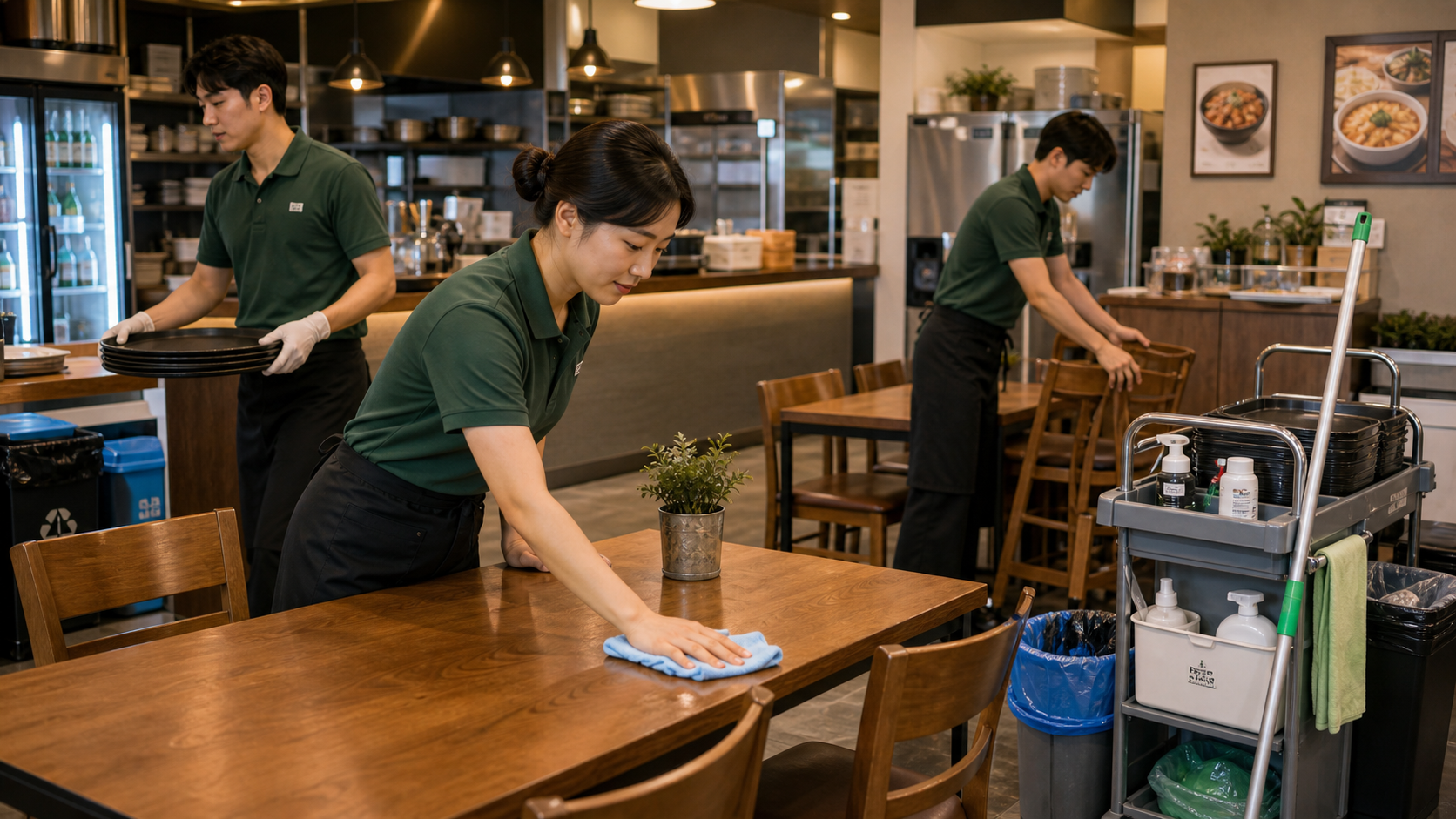
In a real shift, closing is not just wiping tables. Workers need to know which area is finished, which task remains, and which problem needs a report.
마감 is the central word in this lesson. In a restaurant, 마감 is not only “closing.” It means the end-of-shift work stage. If the manager says 마감 준비해 주세요, you need to prepare for the full closing workflow, not just turn off the lights or close the door.
정리 and 청소 are related but different. 정리 means putting things in order. You can 정리 chairs, trays, receipts, stock, or the counter area. 청소 means cleaning. You can 청소 the floor, kitchen, restroom, or dining area.
닦다 is more specific than 청소. It means to wipe a surface. In restaurants, it often appears with 테이블, 카운터, or 바닥. 치우다 means to clear something away from that place. A natural order is to 치우다 first, then 닦다.
분리수거 is very practical in Korea. General trash, recycling, and 음식물 쓰레기 may need separate handling. If the manager says 음식물 쓰레기는 따로 버려 주세요, the key word is 따로, meaning separately.
Finally, notice 확인 and 보고. 확인 means check or confirm. 보고 means report. During closing, you may check 냉장고, 유통기한, 재고, or whether the area is clean. Then you report to the manager so the shift ends clearly.
Core Expressions
This table is not only for memorization. Read the “When to use” column first. Once the work situation is clear, the Korean phrase becomes easier to use during a real shift.
| Korean Expression | Meaning | When to use |
|---|---|---|
| 마감 준비해 주세요. | Please get ready for closing. | Use this when the team is moving from customer service to closing work. |
| 테이블 닦아 주세요. | Please wipe the tables. | Use this when customer tables need to be wiped after guests leave. |
| 의자 정리해 주세요. | Please arrange the chairs. | Use this when chairs need to be put back, raised, stacked, or aligned. |
| 설거지 먼저 해 주세요. | Please do the dishes first. | Use this when dishes, cups, or trays should be handled before other tasks. |
| 쓰레기 버려 주세요. | Please throw away the trash. | Use this for general trash. |
| 분리수거 해 주세요. | Please sort the recycling. | Use this when trash must be separated by type. |
| 음식물 쓰레기는 따로 버려 주세요. | Please throw away food waste separately. | Use this when food waste should be handled separately. |
| 냉장고 확인해 주세요. | Please check the refrigerator. | Use this when ingredients, drinks, or cold storage need a final check. |
| 유통기한 확인했습니다. | I checked the expiration dates. | Use this after checking expiration dates. |
| 재고 확인이 필요해요. | The stock needs to be checked. | Use this when inventory is not yet clear. |
| 마감 끝나면 보고해 주세요. | Please report when closing work is finished. | Use this when a manager needs final confirmation. |
| 마무리하고 보고하겠습니다. | I will finish up and report. | Use this when you are close to finishing and will report after the final step. |
Role Expressions
The same task sounds different depending on who is speaking. Managers often give short instructions. Staff should answer clearly, especially for cleaning, trash, ingredients, and final reporting.
| Role | Korean | Usage note |
|---|---|---|
| Manager to staff | 마감 준비해 주세요. | A short signal that the store is moving from customer service to closing work. |
| Staff to manager | 테이블 닦고 의자 정리하겠습니다. | A clear response that confirms two main dining-area tasks. |
| Kitchen staff | 설거지 먼저 하고 주방 정리하겠습니다. | Useful when the kitchen must finish dishes before deeper cleanup. |
| Hall staff | 홀 정리하고 바닥 확인하겠습니다. | Useful when the worker is responsible for the dining area and floor. |
| Staff to manager | 마무리하고 보고하겠습니다. | A professional way to say you will finish the last step and report. |
Word Examples / Usage Notes
마감 often appears with 준비하다, 끝나다, and 하다. Examples include 마감 준비해 주세요, 마감 끝났어요, and 마감하고 보고해 주세요.
테이블 닦다 and 테이블 치우다 are different. 치우다 means clearing items from the table. 닦다 means wiping the surface. A natural sequence is 먼저 치우고, 그다음 닦다.
분리수거 is not a small side word. Many workplaces in Korea require correct waste sorting. If you are not sure, ask: 이건 어디에 버리면 돼요? It means “Where should I throw this away?”
유통기한 matters for food and drinks. If an ingredient has passed the date, it is not a small mistake. It affects food safety and the trust of the restaurant.
보고 does not need to be long. After finishing, you can say: 마감 끝났습니다. 확인 부탁드립니다. This is polite and suitable for a workplace.
Review Table
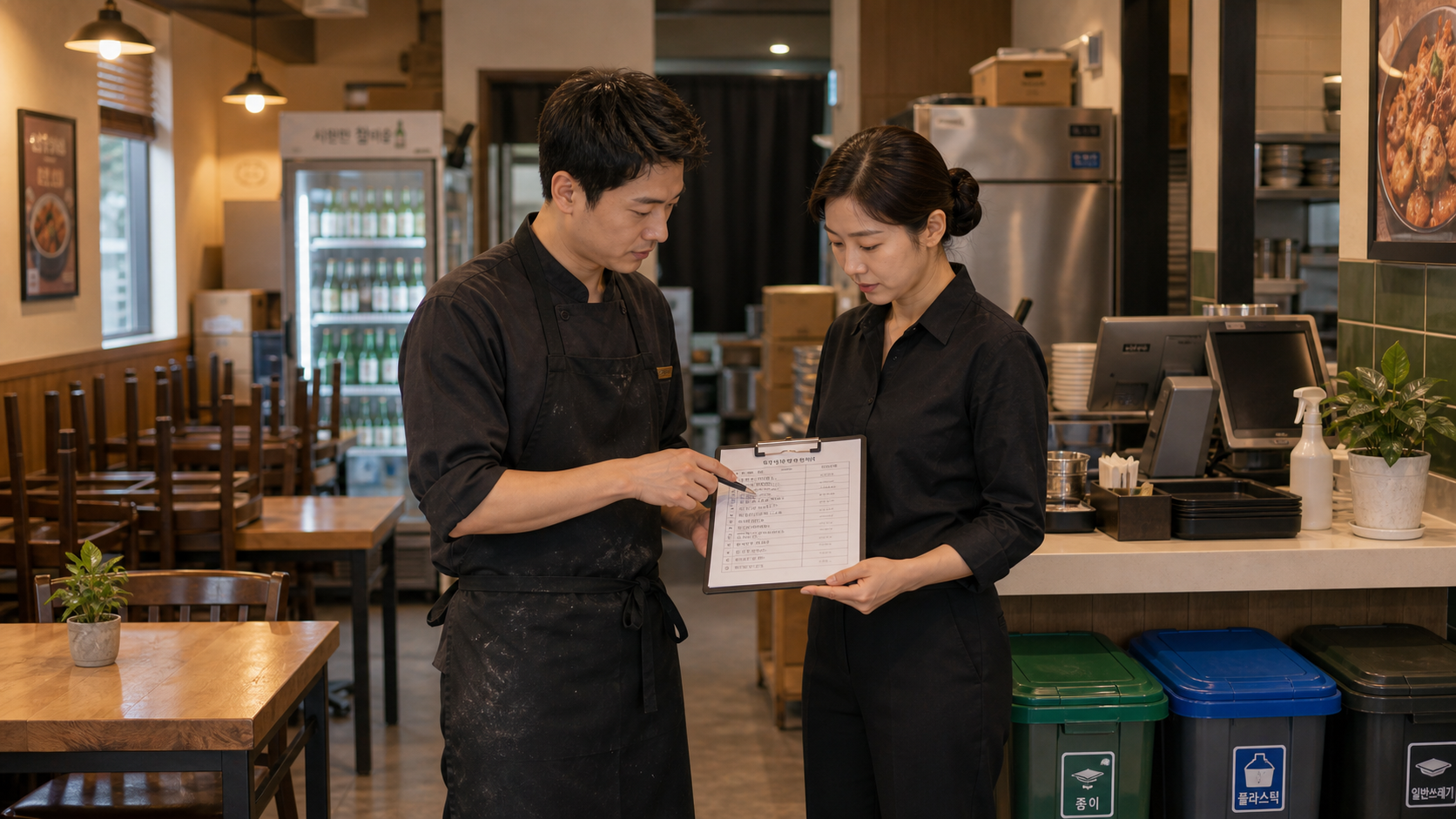
Reviewing by workflow helps you remember words as part of a real situation, not as isolated vocabulary.
The closing stage after customers leave, not only locking the door.
Putting chairs, trays, counters, tools, or work areas back in order.
Cleaning the dining area, kitchen, counter, restroom, or floor.
Wiping tables, counters, surfaces, or floors.
Removing dishes, trash, leftovers, or objects from a table.
Washing dishes, cups, trays, spoons, chopsticks, and utensils.
Sorting waste by type according to Korean workplace rules.
General trash from the dining area or kitchen.
Food waste that is often handled separately in Korea.
A customer table that must be cleared and wiped.
A chair that may need to be arranged, stacked, or moved.
The floor that may need sweeping, mopping, or checking.
Conclusion
When you hear Korean during restaurant closing work, do not start by slowly translating every word. Find two things first: the object and the action. 테이블 connects with 닦다. 의자 connects with 정리. 쓰레기 connects with 버리다. 마감 connects with 보고.
If you understand this workflow, short instructions from a manager become easier to act on. The goal is not to speak long Korean. The goal is to do the right task in the right order and report clearly before the shift ends.