Latihan istilah pabrik membantu pelajar melatih kata bahasa Korea dalam situasi nyata. Artikel BSKorean ini dibuat jelas, mudah dipindai, dan terhubung dengan latihan aplikasi.
Panduan Kosakata bahasa Korea untuk pemeriksaan pabrik
Kosakata bahasa Korea untuk pemeriksaan pabrik membantu pelajar melatih kata bahasa Korea dalam situasi nyata. Artikel BSKorean ini dibuat jelas, mudah dipindai, dan terhubung dengan latihan aplikasi.
Luyện thuật ngữ nhà máy giúp người học luyện từ tiếng Hàn trong tình huống thực tế. Bài BSKorean này giữ nội dung rõ ràng, dễ xem và liên kết với phần luyện tập.
Hướng dẫn Từ vựng tiếng Hàn cho kiểm tra trong nhà máy
Từ vựng tiếng Hàn cho kiểm tra trong nhà máy giúp người học luyện từ tiếng Hàn trong tình huống thực tế. Bài BSKorean này giữ nội dung rõ ràng, dễ xem và liên kết với phần luyện tập.
Factory inspection language is short and direct. Start with 검사해 주세요, “please inspect it.” If something is wrong, use 불량이에요, which means “it is defective.” These two phrases are enough for many line-check situations.
Practice the core inspection set: 검사해 주세요, 불량이에요, 다시 확인해 주세요, and 안전장비가 필요해요. They cover checking, defects, rechecking, and safety equipment.
Korean factory inspection words helps learners practice Korean words in real situations. This BSKorean post keeps the lesson clear, scannable, and connected to app practice.
Korean factory inspection words are important when a supervisor checks products, reports defects, or asks workers to recheck an item. This briefing-style lesson teaches practical inspection vocabulary for real factory communication in Korea.
Korean Factory Inspection Words to Recognize
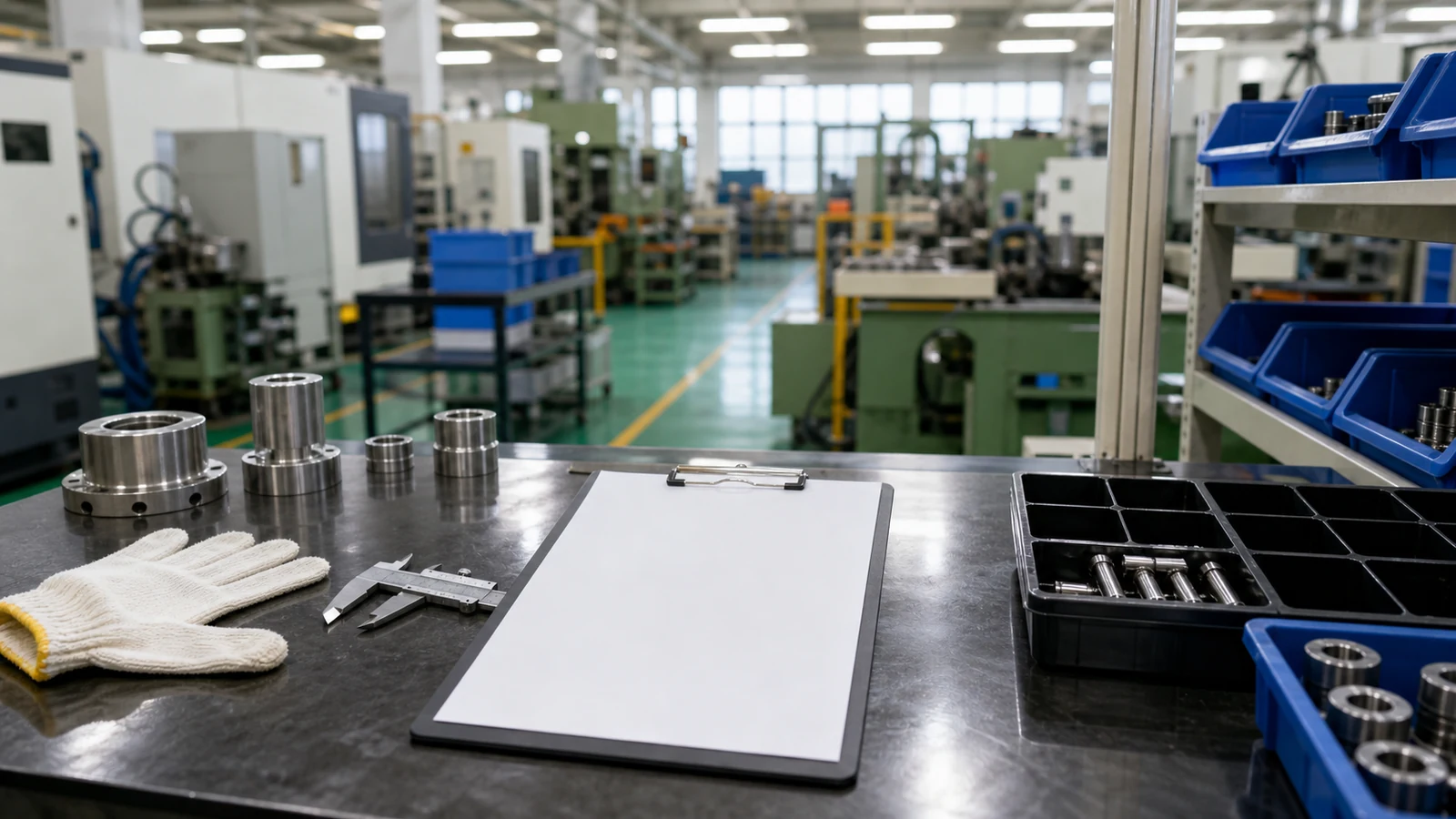
You are standing beside a factory inspection table in Korea. A supervisor points to two trays and says, 양품과 불량품을 분리해 주세요. Another worker says, 외관검사에서 스크래치가 보입니다. You understand some Korean, but the inspection words come quickly.
This lesson teaches practical Korean factory inspection words for foreign workers. The words come from the BSkorean factory vocabulary DB, especially the quality and inspection set. The goal is simple: when you hear a factory inspection word, you should know what to check, what to report, and what action to take next.
Briefing Slides
The PPT below was built with realistic factory situation images first, then Korean learning text was placed on top. Use the slides as a quick briefing before reading the full lesson.
Slide 1. Korean factory inspection words lesson slide with quality and defect vocabulary
Imagine your first day helping with quality checks in a Korean factory. Products move from the production line to the inspection area. Some items are good. Some have scratches, dents, missing parts, or contamination. The supervisor does not explain everything slowly. Instead, you hear short words like 검사, 불량, 합격, 불합격, 선별, and 재검사.
In this situation, the most important skill is not translating every sentence word by word. You need to recognize the inspection word and connect it to the next work action. If you hear 검사, you should check something. If you hear 불량품, you should not mix that item with good products. If you hear 격리, you should keep the problem item separate.
What You Need to Understand
Factory Korean often uses short, direct phrases. A supervisor may say 품질 확인하세요, 샘플검사 하세요, or 불량 보고하세요. These phrases are not long conversations. They are work signals. The noun tells you the object or status, and the verb tells you the action.
This is why factory inspection vocabulary is useful for foreign workers. The same words appear in spoken instructions, inspection sheets, quality reports, defect labels, and workplace notices. Once you recognize the core words, you can understand the workflow more quickly.
Core Vocabulary
Korean
Romanization
English
Level
What it means at work
품질
pumjil
quality
Beginner 1
The condition or standard of a product.
품질관리
pumjilgwanri
quality control
Beginner 1
The system or work of controlling product quality.
검사
geomsa
inspection
Beginner 1
A check or inspection step.
전수검사
jeonsugeomsa
full inspection
Beginner 1
Checking every item, not only a sample.
샘플검사
saempeulgeomsa
sampling inspection
Beginner 1
Checking a sample from a larger lot.
공정검사
gongjeonggeomsa
in-process inspection
Beginner 1
Inspection during the production process.
최종검사
choejonggeomsa
final inspection
Beginner 1
The last inspection before shipment or completion.
외관검사
oegwangeomsa
visual inspection
Beginner 1
Looking at the outside condition of a product.
치수검사
chisugeomsa
dimensional inspection
Beginner 1
Checking size, length, width, or dimensions.
기능검사
gineunggeomsa
functional inspection
Beginner 1
Checking whether the product works correctly.
합격
hapgyeok
pass
Beginner 2
The product or inspection result passes.
불합격
bulhapgyeok
fail
Beginner 2
The product or inspection result fails.
판정
panjeong
judgment
Beginner 2
The decision after inspection.
양품
yangpum
good product
Beginner 2
A good product that can move to the next step.
불량품
bulryangpum
defective product
Beginner 2
A defective product that should not be mixed with good items.
불량
bulryang
defect
Beginner 2
A defect or quality problem.
결함
gyeolham
flaw
Beginner 2
A flaw or fault in the product.
스크래치
seukeuraechi
scratch
Beginner 2
A scratch on the surface.
찍힘
jjikhim
dent
Beginner 2
A dent or mark from impact.
오염
oyeom
contamination
Beginner 2
Contamination, dirt, stain, or unwanted material.
이물
imul
foreign matter
Beginner 2
Foreign matter that should not be inside or on the product.
누락
nurak
missing part
Beginner 2
A missing part, step, or item.
파손
pason
breakage
Beginner 3
Breakage or damage.
격리
gyeokri
quarantine
Intermediate 2
Keeping problem products separate.
선별
seonbyeol
sorting
Intermediate 2
Sorting products by condition.
재검사
jaegeomsa
re-inspection
Intermediate 2
Checking again after a problem or correction.
Real Workplace Phrases
The words above become useful when they are connected to short workplace instructions. The following phrases are common in quality control and inspection work.
Korean Sentence
English Meaning
When to Use
품질을 확인해 주세요.
Please check the quality.
When asking someone to check a product before moving it forward.
샘플검사 먼저 하세요.
Please do the sampling inspection first.
When only selected items need to be checked first.
외관검사에서 스크래치가 보입니다.
A scratch is visible during visual inspection.
When reporting a visible surface problem.
이 제품은 불량품입니다.
This product is defective.
When a product should not be treated as good stock.
양품과 불량품을 분리해 주세요.
Please separate good products and defective products.
When sorting inspected products.
불합격 제품은 격리하세요.
Quarantine failed products.
When failed products must be kept away from good items.
누락된 부품이 있는지 확인하세요.
Check whether any parts are missing.
When inspecting assembly or packaging.
재검사 후 보고해 주세요.
Please report after re-inspection.
When a supervisor asks for confirmation after checking again.
Usage Notes
검사 means the checking step
검사 means inspection or checking. It can be general, but factory work often makes it more specific. 외관검사 checks the outside appearance. 치수검사 checks size or dimensions. 기능검사 checks whether the product works. When you hear a word ending in 검사, ask yourself: “What type of check is required?”
합격 and 불합격 are result words
합격 means pass, and 불합격 means fail. These words can be used for tests, but in a factory they often describe the inspection result. A product can be 합격 if it meets the standard. It can be 불합격 if it does not meet the standard.
양품 and 불량품 describe product status
양품 is a good product. It can usually continue to the next process, packing, or shipment. 불량품 is a defective product. It should be reported, separated, repaired, rechecked, or discarded depending on the workplace rule. Do not mix 불량품 with 양품.
불량 is the problem, 불량품 is the product
불량 can mean the defect or the defective condition. 불량품 means the defective product itself. For example, 스크래치 불량 can mean a scratch defect. 이 제품은 불량품입니다 means this product is defective.
Common Pattern
Pattern
Meaning
Example
N + 확인하세요
Please check N.
품질 확인하세요.
N + 검사하세요
Please inspect N.
치수검사 하세요.
N + 분리해 주세요
Please separate N.
불량품을 분리해 주세요.
N + 보고해 주세요
Please report N.
불량을 보고해 주세요.
N + 재검사하세요
Please inspect N again.
이 제품은 재검사하세요.
In real spoken Korean, workers may shorten these phrases. You might hear 품질 확인, 불량 보고, or 재검사. The shorter form is common when the situation is obvious. For learning, remember the polite full forms first.
Mini Dialogue
Supervisor: 이 제품 외관검사 했어요? Did you do the visual inspection for this product?
Worker: 네, 외관검사에서 스크래치가 보입니다. Yes, a scratch is visible during the visual inspection.
Supervisor: 그러면 불량품으로 분리해 주세요. Then please separate it as a defective product.
Worker: 불합격 제품은 어디에 두면 될까요? Where should I put the failed products?
Supervisor: 저쪽 격리 구역에 두고, 나중에 재검사하세요. Put them in the quarantine area over there, and inspect them again later.
Worker: 네, 격리 후 재검사하겠습니다. Okay, I will quarantine them and re-inspect them.
This dialogue shows the work flow: inspect, find a defect, separate the defective product, quarantine it, and re-inspect it. The Korean is short because the workers are focused on action, not explanation.
Common Mistakes
Common Mistake 1: Treating 불량 and 불량품 as the same word
Why it happens: Both words are connected to defects.
Correct understanding:불량 is the defect or defective condition. 불량품 is the defective product.
Example:스크래치 불량 means a scratch defect. 불량품을 분리해 주세요 means please separate the defective products.
Common Mistake 2: Thinking 합격 and 불합격 only refer to people
Why it happens: Learners often meet these words in tests or exams first.
Correct understanding: In a factory, 합격 and 불합격 can describe an inspection result for a product, part, process, or sample.
Example:샘플검사 합격 means the sample inspection passed.
Common Mistake 3: Ignoring 격리 after a defect is found
Why it happens: Beginners may understand the defect word but miss the next action.
Correct understanding:격리 means the product should be kept separate. This prevents defective products from being mixed with good products.
Example:불합격 제품은 격리하세요 means failed products should be quarantined.
Quick Quiz
1. What does “외관검사” mean? A. visual inspection / B. final inspection / C. missing part Answer: A. visual inspection 외관검사 means checking the outside appearance of a product.
2. A product has a visible dent. Which Korean word is useful? A. 찍힘 / B. 합격 / C. 양품 Answer: A. 찍힘 찍힘 means a dent or impact mark.
3. Which word means “good product”? A. 불량품 / B. 양품 / C. 오염 Answer: B. 양품 양품 is a product that passed inspection or can be treated as good stock.
4. What should you do with failed products if the supervisor says “격리하세요”? A. Mix them with good products / B. Keep them separate / C. Ship them immediately Answer: B. Keep them separate 격리 means quarantine or separation from other products.
5. What does “재검사” mean? A. re-inspection / B. full inspection / C. contamination Answer: A. re-inspection 재검사 means checking again after a problem, correction, or unclear result.
Practice This Lesson
Practice this word list in Learn Korean or in the upcoming BS3001 app.
Korean factory inspection words are easier when you read them as work signals. First, find the inspection type: 외관검사, 치수검사, or 기능검사. Then check the result word: 합격, 불합격, 양품, or 불량품. Finally, take the action: separate, quarantine, report, or re-inspect.
If you work in a Korean factory, these words can help you understand quality instructions faster and avoid mixing good products with defective products.