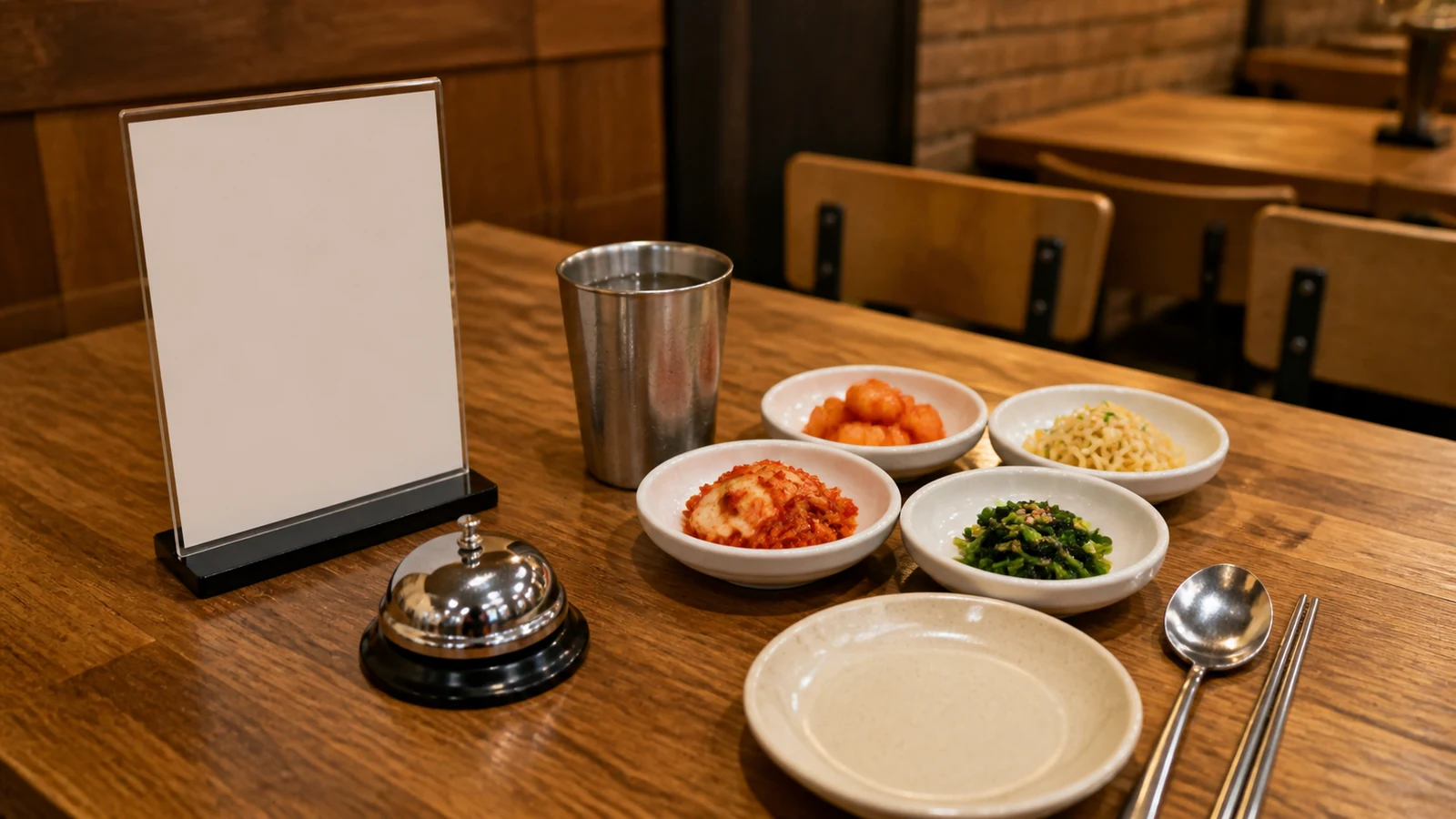
Panduan Kosakata bahasa Korea untuk memesan makanan di restoran
Kosakata bahasa Korea untuk memesan makanan di restoran membantu pelajar melatih kata bahasa Korea dalam situasi nyata. Artikel BSKorean ini dibuat jelas, mudah dipindai, dan terhubung dengan latihan aplikasi.
Hướng dẫn Từ vựng tiếng Hàn cho gọi món ở nhà hàng
Từ vựng tiếng Hàn cho gọi món ở nhà hàng giúp người học luyện từ tiếng Hàn trong tình huống thực tế. Bài BSKorean này giữ nội dung rõ ràng, dễ xem và liên kết với phần luyện tập.
This lesson is for learners who need to order food in Korea without scrolling through a long explanation first. Start with the sentence pattern 이거 하나 주세요, which means “one of this, please.” You can point to the menu, say the item name, or change 하나 to another number.
Five restaurant phrases are useful almost every day: 메뉴판 주세요, 이거 하나 주세요, 덜 맵게 해 주세요, 포장해 주세요, and 계산할게요. They cover asking for the menu, ordering, reducing spice, takeout, and paying.
Need
Korean
Meaning
See the menu
메뉴판 주세요
Please give me the menu.
Order one
이거 하나 주세요
One of this, please.
Less spicy
덜 맵게 해 주세요
Please make it less spicy.
Takeout
포장해 주세요
Please pack it to go.
Pay
계산할게요
I will pay now.
If staff ask a question quickly, answer with one short choice first: 네, 아니요, 포장, or 매장. Then continue with cafe phrases and convenience store words, because the same polite request ending 주세요 appears there too.
Korean restaurant order words guide
Korean restaurant order words helps learners practice Korean words in real situations. This BSKorean post keeps the lesson clear, scannable, and connected to app practice.
Korean restaurant order words help foreign workers and new residents order food, ask for takeout, request water or side dishes, and pay clearly in Korea. This briefing-style lesson focuses on practical words you can use at a real restaurant counter or table.
Korean Restaurant Order Words to Notice First
You are standing at a Korean restaurant counter. The menu is above you, a staff member is waiting, and there may be people behind you. In that moment, Korean does not feel like a textbook. It feels fast, short, and practical.
This lesson uses the PPT visual flow below as the learning path. Each image shows one real restaurant moment, and the explanation under the image teaches the Korean words you need for that moment. The goal is not to memorize a long script. The goal is to recognize the key word, understand the situation, and answer with one short polite phrase.
Visual 1. The full restaurant order situation: ordering food, choosing takeout or dine-in, and paying.
Visual Situation: What Happens at the Counter
The first slide shows a customer and staff member facing each other at a Korean restaurant counter. This is the exact moment when learners often freeze. The staff may ask 주문하시겠어요? (jumunhasigesseoyo?, would you like to order?), 매장에서 드시나요? (maejangeseo deusinayo?, will you eat here?), or 포장해 드릴까요? (pojanghae deurilkkayo?, should I pack it to go?).
The three big words on the slide are the main action words for this situation: 주문 means order, 포장 means takeout or packing, and 계산 means payment or checkout. If you understand these three words, you can follow most restaurant counter conversations in Korea.
Lesson Goal: Listen for the Service Keyword
The second slide shows the learning goal. In a real restaurant, you do not need to understand every word perfectly. You need to catch the keyword. If you hear 주문, the staff is talking about choosing food. If you hear 매장 or 포장, the staff is asking whether you will eat inside or take the food out. If you hear 계산, it is time to pay.
For foreign workers in food service, this same pattern works from the staff side. You can use short, polite questions many times during a shift: 주문하시겠어요?, 매장에서 드시나요?, 포장해 드릴까요?, and 영수증 필요하세요? These phrases are short because the situation already explains most of the meaning.
Key Vocabulary
Dine-In or Takeout: 매장 and 포장
The fourth slide focuses on a common question: 매장에서 드시나요? This means “Will you eat here?” The word 매장 can mean store, but in a restaurant or cafe it often points to the dine-in space. A natural short answer is 여기서 먹을게요 (yeogiseo meogeulgeyo, I will eat here).
If you want takeout, listen for 포장. The phrase 포장해 주세요 means “Please make it takeout.” In factory Korean, 포장 can mean packaging, but in this restaurant scene it means packing food to go. The image shows why the meaning changes: there is a counter, a menu, a customer, and a bag. The situation tells you that 포장 is about takeout.
Common Expressions
Mini Dialogue
Staff: 주문하시겠어요? Jumunhasigesseoyo? Would you like to order?
Customer: 네, 김치찌개 하나 주세요. Ne, gimchijjigae hana juseyo. Yes, one kimchi stew, please.
Staff: 매장에서 드시나요, 포장하시나요? Maejangeseo deusinayo, pojanghasinayo? Will you eat here or take it to go?
Customer: 여기서 먹을게요. Yeogiseo meogeulgeyo. I will eat here.
Staff: 맵기는 괜찮으세요? Maepgineun gwaenchaneuseyo? Is the spiciness okay?
Customer: 조금 덜 맵게 해 주세요. Jogeum deol maepge hae juseyo. Please make it a little less spicy.
Staff: 계산은 카드로 하시나요? Gyesaneun kadeuro hasinayo? Will you pay by card?
Customer: 네, 카드로 할게요. 영수증은 괜찮아요. Ne, kadeuro halgeyo. Yeongsujeungeun gwaenchanayo. Yes, I will pay by card. I do not need a receipt.
Usage Point: Noun or Action + 주세요
The seventh slide teaches the most useful pattern in this lesson. 주세요 means “please give me” or “please do this for me.” You can place a noun before it: 물 주세요 means “Please give me water.” You can also place an action before it: 포장해 주세요 means “Please pack it for takeout.”
Use this pattern carefully. 주세요 alone is polite, but it is not always clear. Add the object or action first: 이거 주세요, 물 좀 주세요, 반찬 더 주세요, 양파 빼 주세요. This makes your request understandable even if your sentence is short.
Common Mistakes
1. Thinking 매장 only means a shop
Why it is confusing: Dictionaries often translate 매장 as store or shop. Correct understanding: In restaurant Korean, 매장에서 드시나요? usually means “Will you eat here?” If you want dine-in, say 여기서 먹을게요.
2. Answering 포장해 드릴까요? with only 네
Why it is confusing:네 means yes, so it may feel enough. Correct understanding: It is clearer to say 네, 포장해 주세요. This confirms that you want takeout.
3. Confusing 주문 and 계산
Why it is confusing: Both words happen at the counter. Correct understanding:주문 means order. 계산 means payment or checkout. First you order, then you pay.
4. Forgetting the action before 주세요
Why it is confusing: Learners remember 주세요, but forget to say what they want. Correct understanding: Use a complete short request: 물 좀 주세요, 이거 하나 주세요, or 양파 빼 주세요.
Quick Quiz
1. What does 주문 mean? A. payment / B. order / C. receipt Answer: B. order. Explanation: 주문 is the main word for ordering food.
2. A staff member asks 매장에서 드시나요? What are they asking? A. Do you need water? / B. Will you eat here? / C. Will you pay by card? Answer: B. Will you eat here. Explanation: 매장에서 points to the dine-in space.
3. You want takeout. What should you say? Answer: 포장해 주세요. Explanation: 포장 means takeout in this restaurant situation.
4. Fill in the blank: 물 좀 ____. Answer: 주세요. Explanation: 물 좀 주세요 means “Please give me some water.”
5. What is the difference between 주문 and 계산? Answer: 주문 means order, and 계산 means payment or checkout. Explanation: 주문 happens when choosing food. 계산 happens when paying.
Quick Review
Korean
Meaning
Best Situation
Beginner Tip
주문
order
choosing food
Listen for 주문하시겠어요?
포장
takeout
food to go
Say 포장해 주세요.
매장
dine-in space / store
eat inside or takeout question
Answer 여기서 먹을게요 if eating inside.
물
water
asking during a meal
물 좀 주세요 is natural.
추가
extra
asking for more
Use with rice, side dishes, sauce, or toppings.
계산
payment
counter checkout
Different from 주문.
영수증
receipt
after payment
Say 괜찮아요 if you do not need it.
Practice More
Practice this word list in Korean Learn Korean or in the upcoming BSkorean app. Start with image recognition first: look at the counter scene and choose the correct Korean action word. Then practice short answers such as 포장해 주세요, 여기서 먹을게요, 카드로 할게요, and 영수증은 괜찮아요.
For official Korea travel and daily-life context, check Visit Korea.
The PPT images show the full restaurant flow: choose food, answer dine-in or takeout, make a short request, pay, and decide about the receipt. When you connect the words to the visual situation, the Korean becomes easier to use. Listen for 주문, 매장, 포장, 계산, and 영수증. Then answer with one short polite phrase.