BSKorean lesson
Korean Factory Packing and Labeling Phrases for Foreign Workers
Learn Korean factory packing phrases for quantity checks, labels, barcode scans, defects, repacking, and outbound preparation at work.
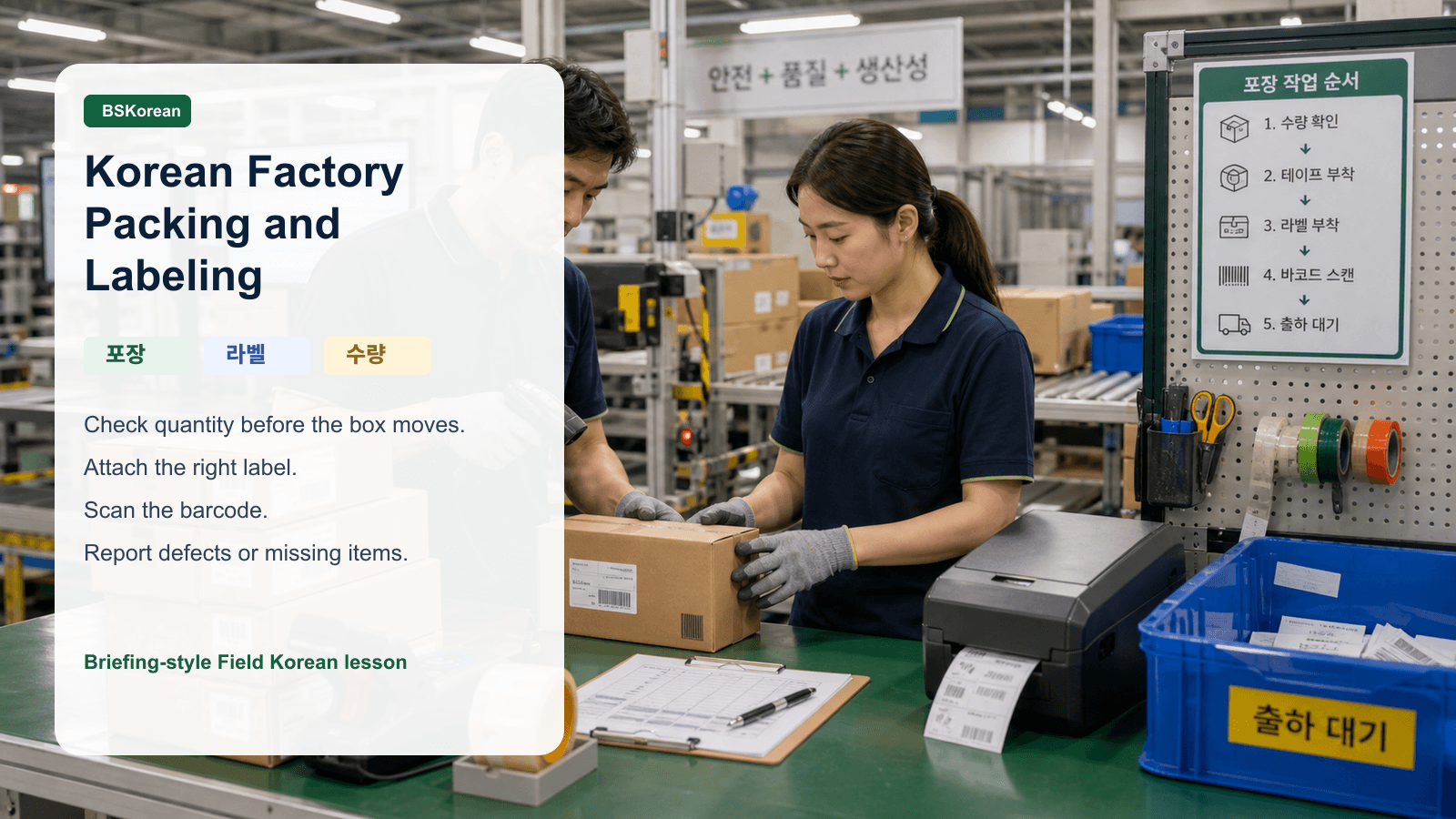
Workplace Korean
Korean Factory Packing and Labeling Phrases for Foreign Workers
Learn Korean factory packing phrases for labels, quantity checks, defects, barcode scans, missing items, repacking, pallets, and shipment readiness.
This slide places the learner at a Korean factory packing table. Adult workers, boxes, labels, a barcode scanner, work documents, and the outbound area are visible. Because the workplace objects are clear, 포장, 라벨, 수량, and 바코드 are not isolated words. They become a work sequence: check the quantity, prepare the box, attach the label, scan the barcode, and move forward only if there is no problem.
Use This First
When you hear a packing instruction, find the action word first. If you hear 수량, start counting or comparing the count. If you hear 라벨, check or attach the label. If you hear 바코드, scan the barcode. If you see 불량, 누락, or 오류, do not guess or keep the box moving. Say 불량이 있습니다 or 오류가 떠서 확인이 필요합니다.
Your first question is simple: is this a checking instruction, a physical work instruction, or a report instruction? 수량, 중량, 송장, and 작업지시서 are things to check. 포장, 테이프, and 적재 are physical work actions. 불량, 누락, and 오류 are signals to stop and report.
Please check the quantity.
Beginner
Please attach the label.
Beginner
I finished packing the box.
Beginner
Please scan the barcode.
Beginner
Situation Path
Look for product name, quantity, destination, label type, barcode, and special notes. 작업지시서 is the document that tells you what must happen before the box is closed.
Use 수량, 중량, 검수, and 불량. Count the items, check the condition, and compare them with the work instruction before the box moves forward.
Use 포장, 박스, 테이프, and 완료. Do not close the box until the count and item condition are correct.
Use 라벨, 송장, 바코드, and 스캔. The label must match the box contents, and the barcode must be readable in the system.
Use 불량, 누락, 오류, 관리자, and 보고. If something is wrong, separate the box and report before outbound shipment.
Situation Explanation
Today’s Topic
This lesson teaches Korean factory packing phrases as real work instructions. You will learn how to understand 수량 확인해 주세요, 라벨 붙여 주세요, 바코드 스캔해 주세요, 불량이 있습니다, and 출고 준비되었습니다 as actions at a packing table.
Introduction
You are standing at a packing table in a Korean factory. Boxes are lined up near the conveyor, a label printer is running, a barcode scanner is beside the work sheet, and a supervisor points at one box and says 수량 확인하고 라벨 붙여 주세요. The sentence is short, but it tells you the work order. First, check the quantity. Then attach the correct label.
This matters because a packing mistake can move very far before anyone notices it. If the quantity is wrong but the label is attached, the box may still move forward with bad data. If the label is wrong, a correct product can be shipped as the wrong item. If the barcode is not scanned, the physical box may move but the system may not know it moved.
This lesson is not a loose factory word list. The right-side Word Bank stores reusable DB terms such as 포장, 라벨, 수량, 바코드, 불량, and 출고. The main article explains what those words make you do in a real packing line, what order to follow, and what to report when something does not match.
Situation Briefing
In Korean factories, packing instructions are often short because the work area moves quickly. You may hear 라벨 붙여 주세요, 바코드 스캔해 주세요, 수량 확인해 주세요, or 불량 빼 주세요. These are not grammar examples. They are movement and quality instructions. A beginner does not need to understand every ending perfectly, but the worker does need to catch the key word and act correctly.
수량 is not just a dictionary word for quantity. At a packing table, 수량 means checking whether the real item count matches the work instruction sheet, label, or system. 라벨 is not just a sticker. A label can carry product name, count, destination, 송장, barcode, and shipment information. 바코드 connects the box to the system. 불량 means the item should not continue as normal stock.
The word 확인 is also important. In a factory context, 확인 is not a casual confirmation. It is a quality control step before the next process. You may see combinations such as 수량 확인, 라벨 확인, 송장 확인, and 작업지시서 확인. In Word Bank, 확인 stays as one true term. Full instructions such as 수량 확인해 주세요 belong in Core Expressions.
Read the images as a work sequence. The worker checks the work instruction sheet, counts the items, closes the box, attaches the label, scans the barcode, places the box on a pallet, and reports defects or missing labels to a supervisor. Once you understand this sequence, short Korean factory instructions become much easier to follow.
PPT Slide Briefing
Read packing instructions as a work sequence
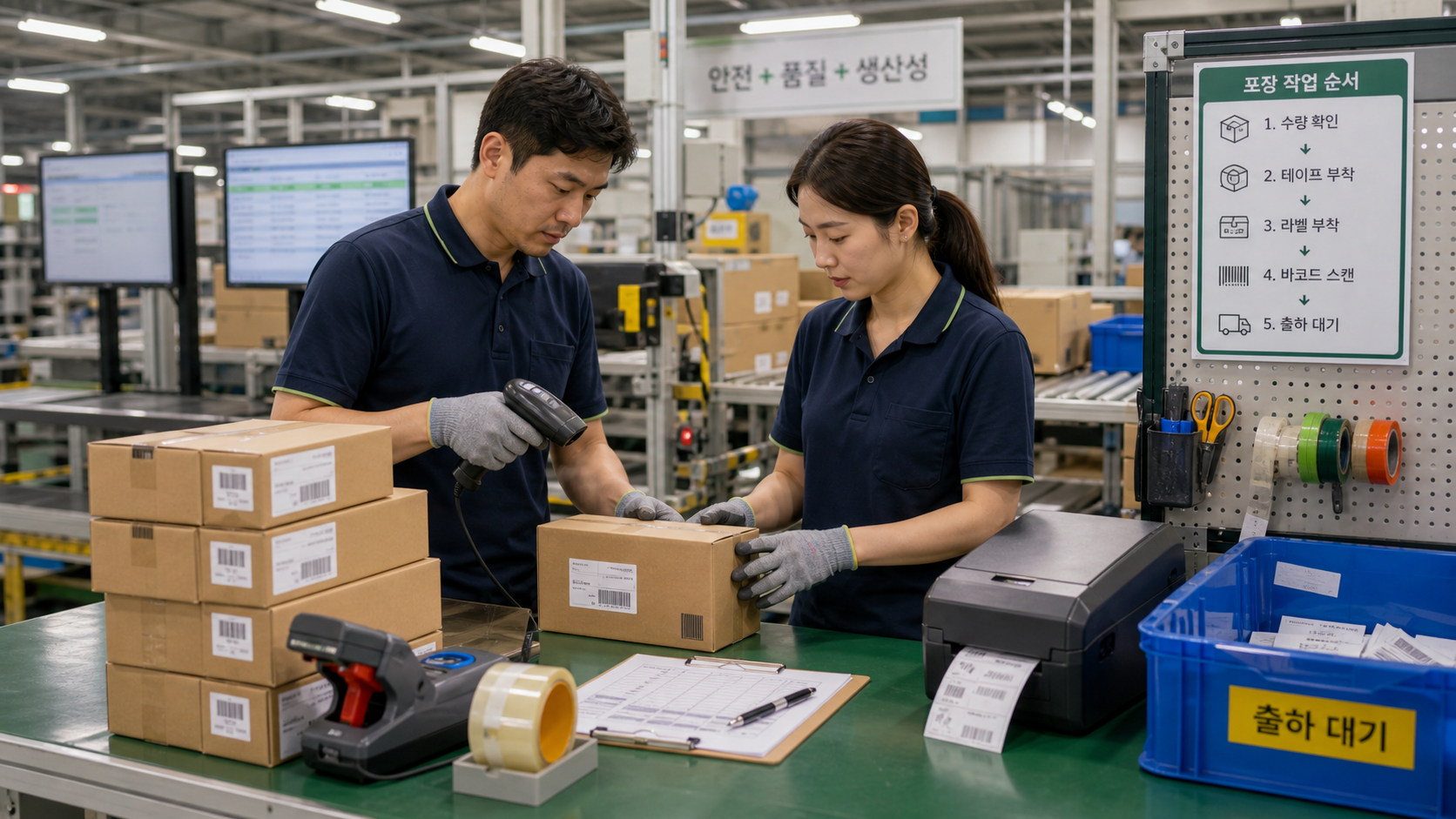
Check quantity, labels, boxes, and barcode
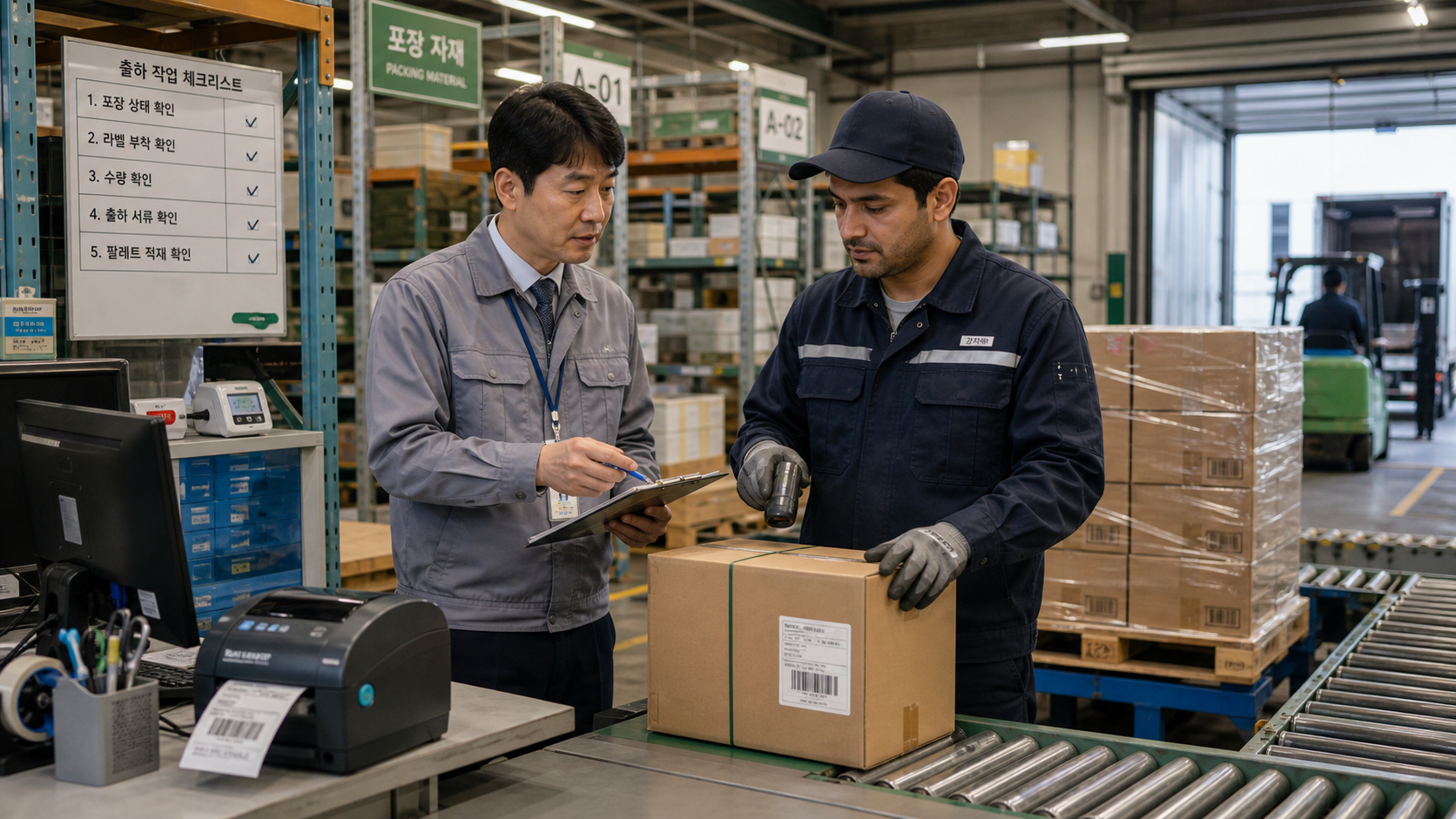
Stop and report before outbound shipment
This slide places the learner at a Korean factory packing table. Adult workers, boxes, labels, a barcode scanner, work documents, and the outbound area are visible. Because the workplace objects are clear, 포장, 라벨, 수량, and 바코드 are not isolated words. They become a work sequence: check the quantity, prepare the box, attach the label, scan the barcode, and move forward only if there is no problem.
This article image shows the real checking point before a box moves forward. 수량 means matching the count. 라벨 means shipment information. 바코드 means system data. 검수 means inspection. The slide helps the learner connect Korean words to hand movements at the packing table.
This review slide focuses on the final decision before 출고. If there is 불량, 누락, 오류, or a wrong 송장, the box should not move forward. A worker can use short reports such as 불량이 있습니다 or 관리자에게 보고하겠습니다. This matters because a small packing mistake can become a shipment mistake.
Core Expressions
Please check the quantity.
Beginner
Please attach the label.
Beginner
I finished packing the box.
Beginner
Please scan the barcode.
Beginner
There is a defect.
Intermediate
The quantity does not match.
Intermediate
The label is missing.
Advanced
Repacking is needed.
Intermediate
It is ready for outbound shipment.
Intermediate
I will report it to the supervisor.
Intermediate
I will check the work instruction sheet.
Advanced
An error appeared, so it needs checking.
Advanced
Word Examples
The Word Bank terms are short DB terms that can be reused in articles, quizzes, audio, review, and the future app. They are not long instructions. 라벨 is one reusable term, but 라벨 붙여 주세요 is a work instruction. 수량 is one reusable term, but 수량이 맞지 않습니다 is a problem report. Learn the small term first, then learn how it becomes a workplace sentence.
This separation keeps the database clean. A phrase like 수량확인 should not appear as one Word Bank term. The true terms are 수량 and 확인. The full sentence 수량 확인해 주세요 is practiced in Core Expressions, Dialogue, and Problem Cases.
수량 is one of the first things to check before a box is closed. If the item count is wrong, a correct-looking label or barcode can still lead to a shipment mistake.
라벨 acts like the identity of the box. It connects the product to the item name, quantity, barcode, 송장, and destination.
바코드 is the doorway into the system record. If scanning fails or is skipped, the physical item may move while the system still shows incomplete work.
불량 is a word that stops the normal flow. A worker can report this short phrase first, then wait for supervisor instructions.
누락 means something required is missing. It can refer to labels, documents, items, parts, or data that should be present.
출고 is the outbound stage. Before 출고, workers should confirm quantity, label, barcode, and box condition.
Review Table
packing. Packing goods so they are ready to move or ship.
Beginner
label. Information attached to a product, box, or pallet.
Beginner
quantity. Item count that must match the instruction or system.
Intermediate
weight. Weight of an item, box, or shipment.
Intermediate
box. Carton or box used for packing.
Beginner
tape. Tape used to close a box.
Beginner
inspection. Checking goods before the next process.
Intermediate
defect. Defective or non-standard item.
Intermediate
missing item. Something required is missing.
Advanced
outbound shipment. Goods leaving a factory or warehouse.
Intermediate
inbound receipt. Goods entering a factory or warehouse.
Intermediate
invoice or waybill. Shipping document or waybill.
Advanced
barcode. Code scanned for product or shipment data.
Beginner
scan. Reading a barcode or label with a scanner.
Beginner
pallet. Platform used to stack and move boxes.
Intermediate
loading or stacking. Loading or stacking goods.
Advanced
repacking. Packing again because of a problem.
Intermediate
completion. A task is finished.
Beginner
Conclusion
Korean factory packing phrases become easier when you connect each word with an action. 포장 means preparing the box correctly. 라벨 means attaching the right information to the right box. 수량 means counting and matching the quantity. 바코드 means scanning so the system reads the box. 불량 means stopping and reporting a quality problem. 출고 means the goods are ready to leave only after the checks are done.
Use this order whenever you hear a short instruction in a Korean factory. First, check the quantity and instruction sheet. Second, pack the box correctly. Third, attach the right label and scan the barcode. Fourth, stop and report defects, missing labels, or system errors before outbound shipment. After reading, practice the same words in Word Practice from Korean to English and English to Korean.
Key Vocabulary
- 포장
- 라벨
- 수량
- 중량
- 박스
- 테이프
- 검수
- 불량
- 누락
- 출고
- 입고
- 송장
- 바코드
- 스캔
- 팔레트
- 적재
- 재포장
- 완료
- 확인
- 관리자