BSKorean lesson
Korean Hotel Cleaning Room Status Phrases for Foreign Workers
Learn Korean hotel cleaning phrases for room status, towels, amenities, stains, lost items, broken facilities, inspection, and front desk reports.
Service Korean
Korean Hotel Cleaning Room Status Phrases for Foreign Workers
Learn practical Korean hotel cleaning phrases for housekeeping shifts: room status, amenities, lost items, stains, broken facilities, and inspection reports.
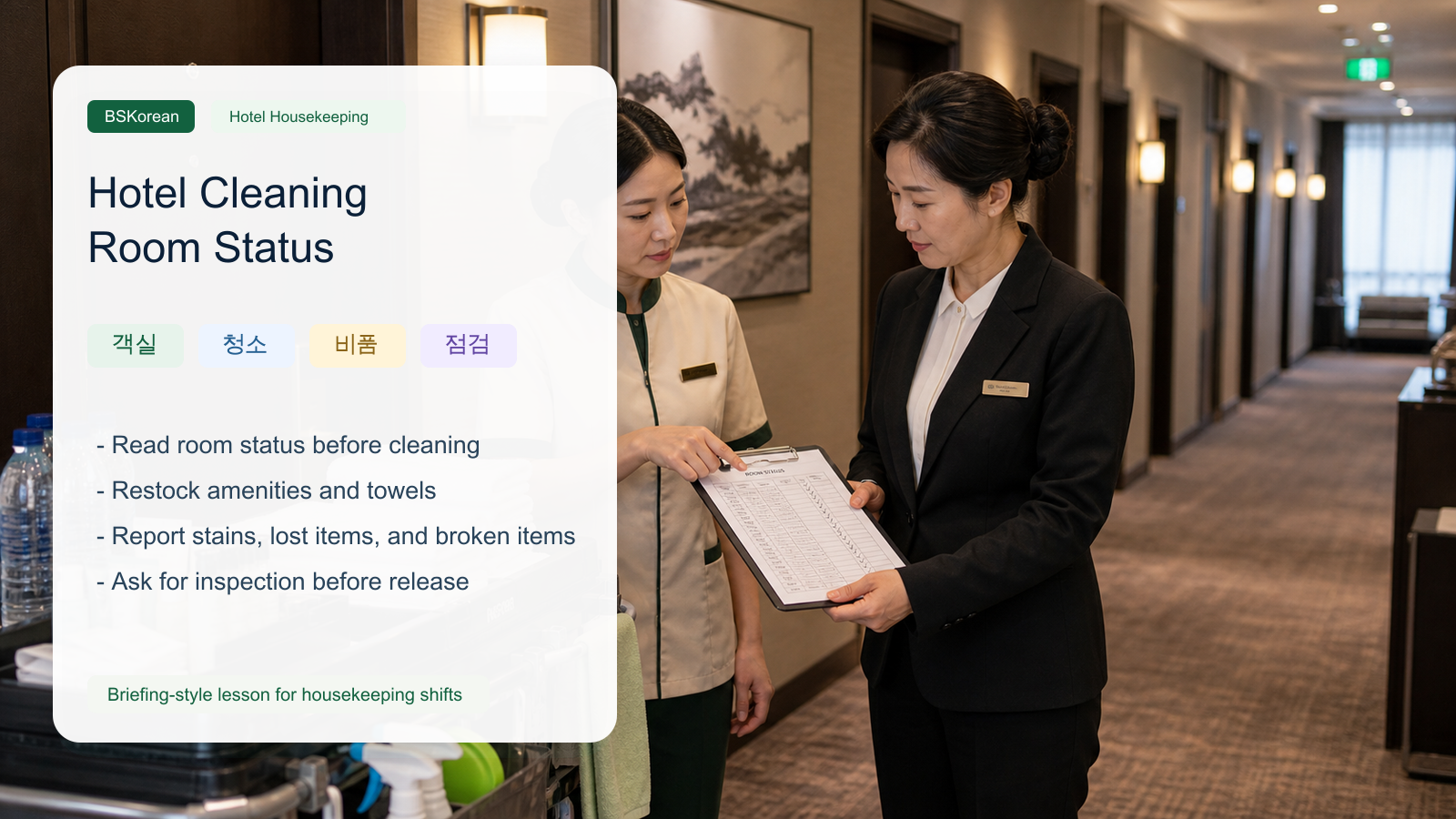
This image shows housekeeping staff and a supervisor in a Korean hotel reviewing a checklist and room status. Learners should notice 객실, 상태, 청소, 수건, 보충, and 보고 because these words shape the work order from checking a room to reporting a problem.
Use This First
Start with the shortest sentence that solves the situation. If the room is not ready, do not rush to say 청소 완료했습니다. Say the problem first: 어메니티가 부족합니다, 얼룩이 있습니다, 고장이 있습니다, or 분실물이 있습니다. Then say the next action: 보충하겠습니다, 교체하겠습니다, 프런트에 보고하겠습니다, or 점검 부탁드립니다. This order makes your report safer and easier for a supervisor to act on.
Please check the room status.
Beginner
Cleaning is complete.
Beginner
I will restock the towels.
Beginner
I will replace the bedding.
Intermediate
Situation Path
Check room status first
Separate refill and replacement
Report guest-facing problems
Send the information to the right place
Ask for inspection when unsure
Situation Explanation
Today’s Topic
Hotel Cleaning Room Status is the workplace situation where hotel housekeeping staff in Korea check a guest room, restock towels or amenities, replace bedding, report stains, lost items, or broken facilities, and ask for inspection before the room is released to the next guest.
Introduction
You are working a housekeeping shift in a Korean hotel. A supervisor asks, 객실 상태 확인했어요? You need to answer quickly and clearly: is the room clean, are the towels ready, are the amenities complete, does the bedding need replacement, and did you find any stains, lost items, or broken facilities? In hotel work, a short accurate report is more useful than a long sentence that does not tell the next action.
This lesson is not just a word list. It teaches a practical reporting flow for foreign workers: check 객실 상태, finish 청소, choose 보충 or 교체, then 보고 if there is a problem. If you say 청소 완료했습니다 too early, the front desk may think the room is ready for a guest even though something still needs attention. The goal is to help you speak in the order that hotel work actually moves.
Situation Briefing
The main situation happens before a room is marked ready for the next guest. Housekeeping staff need to check the guest room, bathroom, bedding, towels, amenities, trash, stains, broken items, and lost items. Words such as 객실, 상태, 청소, 완료, 보충, 교체, 점검, and 보고 are not abstract vocabulary. They are work signals. They tell you whether the room is complete, whether something is missing, whether an item must be replaced, or whether a problem must be reported.
For example, 수건을 보충하겠습니다 means you will add missing towels. 침구를 교체하겠습니다 means old bedding will be replaced with clean bedding. 욕실에 문제가 있습니다 means the bathroom has a problem and the room should not be released yet. 분실물이 있습니다 means a guest item was found and the hotel procedure matters.
If the reporting order is wrong, a small issue can become a guest complaint. This lesson therefore reads the situation like a shift briefing: check the room first, choose the short sentence that matches the problem, then send the information to the front desk, manager, or inspection staff.
PPT Slide Briefing
Hotel cleaning room status briefing
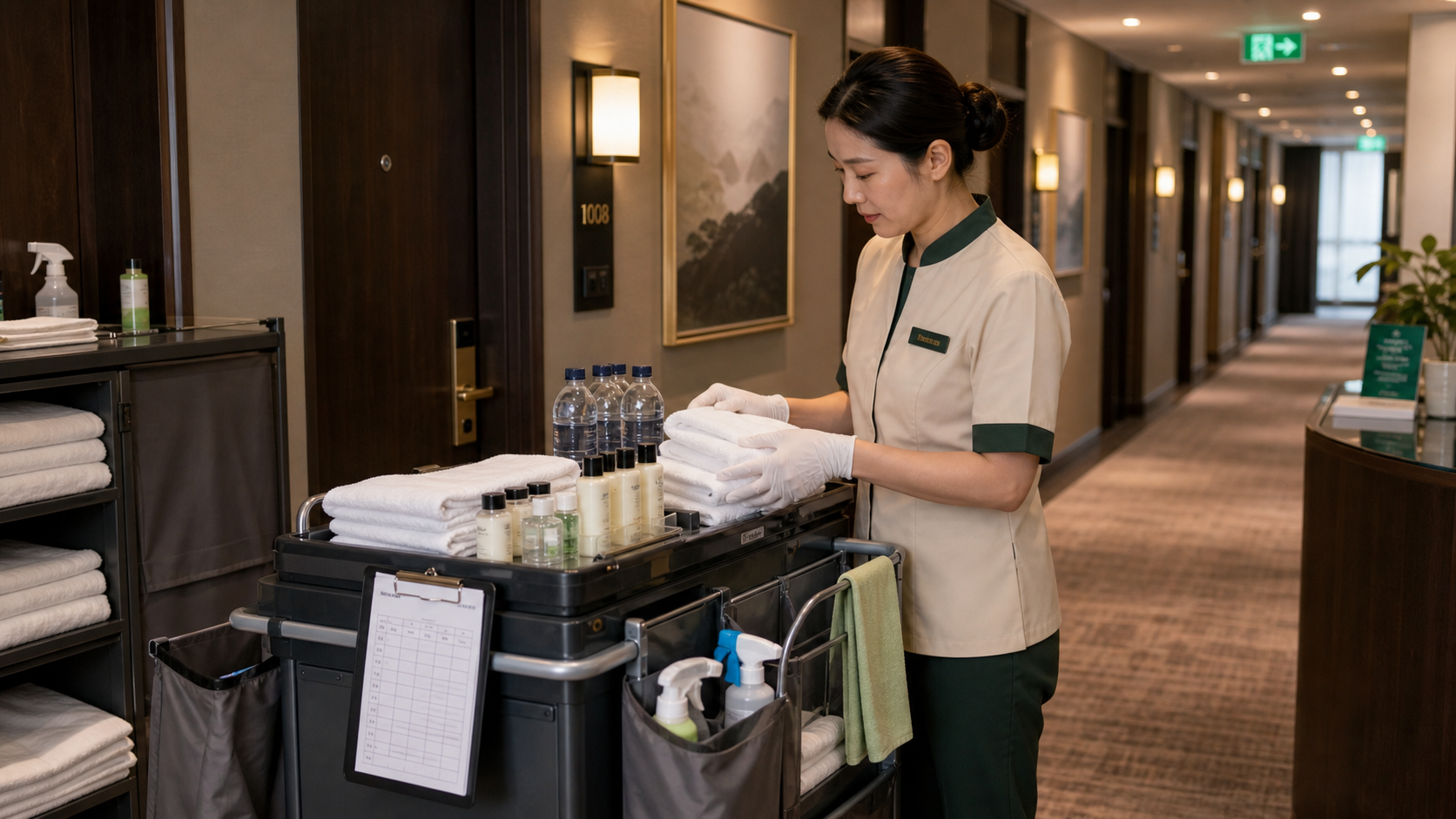
Check supplies and room condition
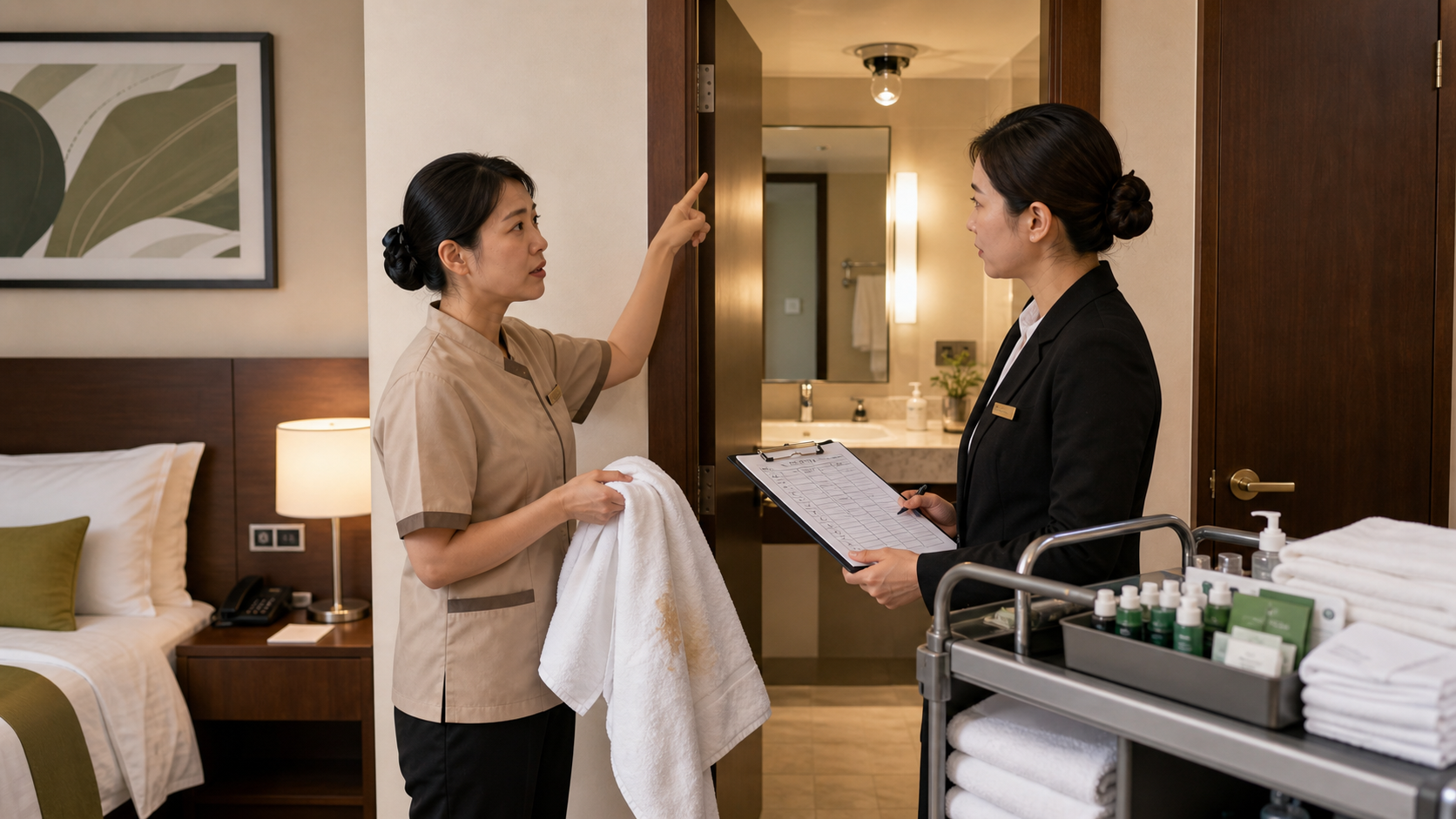
Report problems before releasing the room
This image shows housekeeping staff and a supervisor in a Korean hotel reviewing a checklist and room status. Learners should notice 객실, 상태, 청소, 수건, 보충, and 보고 because these words shape the work order from checking a room to reporting a problem.
This scene connects the vocabulary to real work: checking bedding, bathroom, towels, amenities, trash, stains, and broken items. 보충 is for adding missing items, while 교체 is for replacing old or dirty items with new ones.
This review slide helps learners remember what to do when they find 얼룩, 분실물, or 고장. Before saying a room is complete, the worker should report the issue clearly and request 점검 if a more careful inspection is needed.
Core Expressions
Please check the room status.
Beginner
Cleaning is complete.
Beginner
I will restock the towels.
Beginner
I will replace the bedding.
Intermediate
The amenities are short.
Intermediate
There is a problem in the bathroom.
Intermediate
There is a stain.
Beginner
There is a malfunction.
Intermediate
There is a lost item.
Intermediate
I will report it to the front desk.
Intermediate
Please inspect it.
Advanced
Word Examples
Use this section to connect the compact Word Bank with real hotel work. Do not memorize 객실, 상태, 보충, 교체, 고장, and 보고 as isolated translations. Each word points to a stage of the job: check the room, add supplies, replace items, notice a problem, report it, or request inspection. When you understand the function of the word, short supervisor instructions become easier to follow.
Starting with 객실 makes the location clear and helps the supervisor connect your report to a specific room.
상태 directly affects front desk work. If the status is wrong, a guest may be sent to a room too early.
Use it for towels, amenities, water, and supplies that can be added. Do not use it for replacing dirty items.
This fits bedding or items that are dirty, damaged, or required by hotel standards to be replaced.
Add the location if possible, such as 침구에, 바닥에, or 수건에, so the issue can be handled quickly.
This often needs a report or inspection because it can make the room unavailable for a guest.
This is not ordinary trash. Report it according to hotel procedure so the item can be recorded and returned.
It is more formal than 확인 and fits leaks, damage, smells, or situations that need a manager decision.
Review Table
hotel. Main workplace in this lesson
Beginner
guest room. A guest room in a hotel
Beginner
condition, status. The condition or status of a room
Intermediate
cleaning. Cleaning work
Beginner
completion. A completed work status
Intermediate
inspection. A more careful inspection
Advanced
towel. Towels for guests
Beginner
bedding. Sheets, pillow covers, blankets
Intermediate
amenities. Room supplies such as shampoo, soap, toothbrushes
Intermediate
bathroom. Bathroom inside a guest room
Beginner
trash. Trash that must be removed
Beginner
stain. A stain on fabric, floor, or furniture
Beginner
malfunction. A broken or not-working facility
Intermediate
lost item. A guest item left behind
Intermediate
refill, restock. Adding missing items
Intermediate
replacement. Replacing old items with new ones
Intermediate
organizing, tidying. Tidying a room or work area
Beginner
report. Reporting to a supervisor or front desk
Intermediate
Conclusion
Hotel housekeeping Korean should be short, clear, and tied to real actions. Start with 객실 상태, then decide what needs 보충 and what needs 교체. If there is 얼룩, 고장, or 분실물, report it before saying the room is complete.
When you understand words such as 수건, 침구, 어메니티, 욕실, 문제, 보고, and 점검, you are not only memorizing vocabulary. You are learning how to read a work instruction: check the room, add supplies, replace items, report the problem, and ask for inspection when needed.
Key Vocabulary
- 호텔
- 객실
- 상태
- 청소
- 완료
- 점검
- 수건
- 침구
- 어메니티
- 욕실
- 쓰레기
- 얼룩
- 고장
- 분실물
- 보충
- 교체
- 정리
- 보고
- 프런트
- 고객