BSKorean lesson
Korean Retail Stocking and Price Tag Phrases for Foreign Workers
Learn Korean retail stocking phrases for shelves, stock, price tags, barcodes, sold-out items, promotions, and manager reports.
Service Korean
Korean Retail Stocking and Price Tag Phrases for Foreign Workers
Learn practical Korean for store shifts: restocking shelves, checking price tags, answering stock questions, scanning barcodes, and reporting errors.
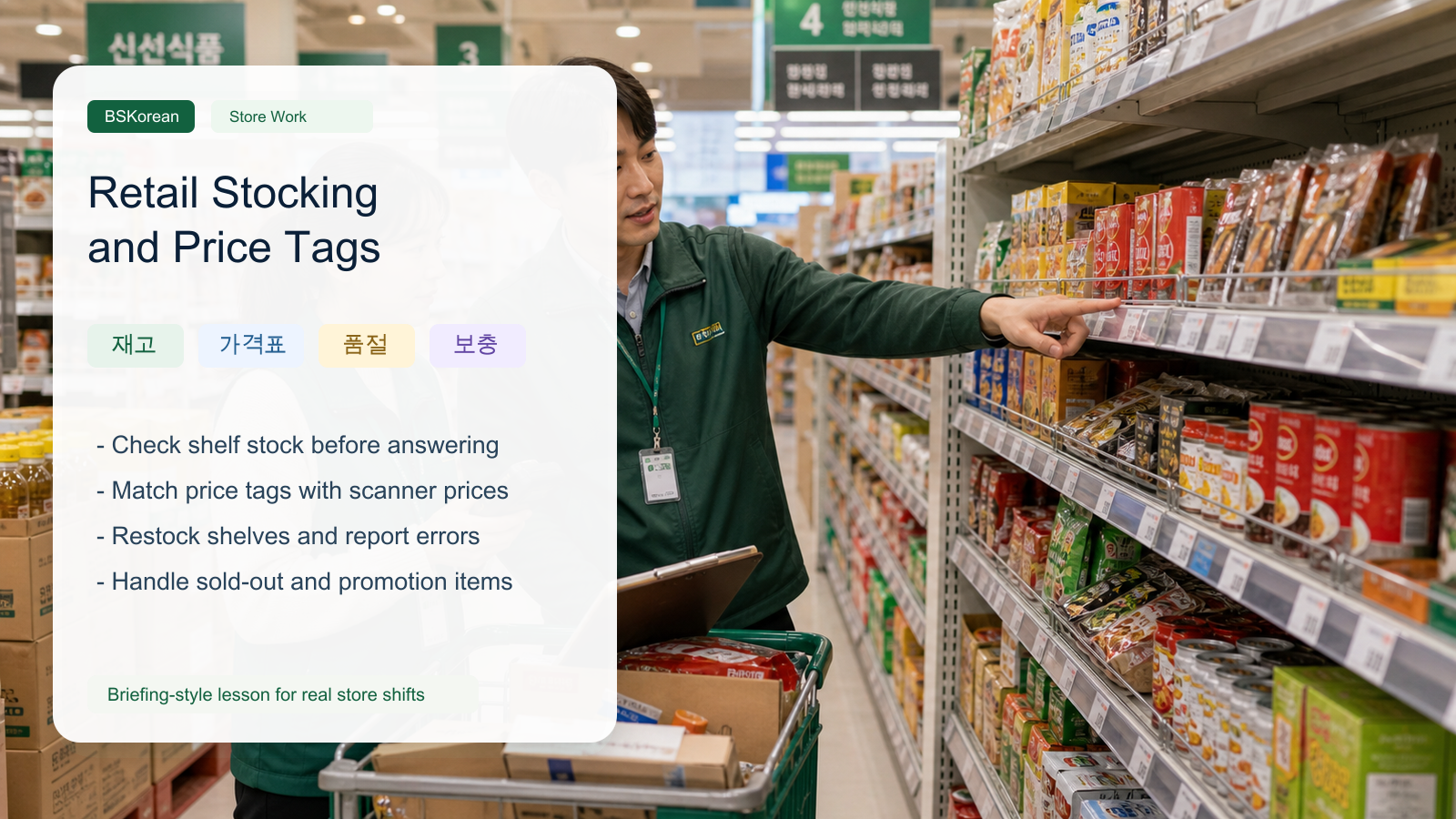
This image shows a Korean mart situation with a worker, shelves, price labels, barcode scanner, product boxes, and a manager. The learner can connect 진열대, 가격표, 재고, 바코드, and 관리자 to real actions during a shift.
Use This First
Use this first when the store gets busy: identify the product, check stock, restock the shelf, check the price tag, and report mismatches. This order is more useful than translating every word one by one. If a customer asks about an item, answer with 확인해 보겠습니다 before you guess. If a supervisor gives an instruction, look for the action word first: 확인, 보충, 스캔, 정리, or 보고.
Please check the price tag.
Beginner
Please restock the display shelf.
Beginner
Is this product in stock?
Beginner
I will check the stock.
Beginner
Situation Path
Listen for 상품, 위치, 매장, or 진열대 first. Before checking stock or price, you need to know which item and which shelf the customer or manager is talking about.
If the shelf is empty, use 재고 and 창고. Do not say 품절 immediately. The item may still exist in the storage room or the store system.
Use 보충, 진열, 정리, and 정돈. After bringing products from storage, place them neatly, keep the label visible, and do not cover promotion signs.
Use 가격표, 할인, 행사, 바코드, and 스캔. The shelf price should match the system or scanner price, especially for promotion items.
Use 오류, 관리자, 확인, and 보고. If the price, barcode, or stock status does not match, report the exact problem instead of deciding alone.
Situation Explanation
Today’s Topic
When you work in a Korean mart, convenience store, or retail shop, short Korean phrases such as 가격표 확인해 주세요, 진열대 보충해 주세요, and 이 상품 재고 있어요 are not random vocabulary. They are work signals for checking stock, restocking shelves, confirming prices, scanning barcodes, and reporting problems to a manager.
Introduction
You are working during a busy evening shift in a Korean store. A customer points to an empty space on the shelf and asks, 이 상품 재고 있어요? At the same time, your supervisor says, 가격표 확인하고 진열대 보충해 주세요. If you only know the English meaning of each word, you may still hesitate because the sentence contains several work actions at once.
This lesson turns those short Korean retail phrases into a clear store-work sequence. First, identify the product and location. Next, check 재고 in the system, on the shelf, or in 창고. Then restock the 진열대 if the item is available. After restocking, check 가격표, 할인, 행사, 바코드, and 유통기한 when needed. If something does not match, report it to 관리자 instead of guessing.
The Word Bank on the right contains clean DB terms such as 재고, 가격표, 품절, 진열대, 보충, 확인, and 보고. The main article explains how those words become real actions during a shift. This is the difference between memorizing a list and understanding what to do when a customer or supervisor speaks quickly.
Situation Briefing
Retail Korean is practical because the words are attached to visible objects: shelves, products, labels, scanners, boxes, storage rooms, and customers. A store worker does not read these words slowly like a textbook sentence. The worker hears a short instruction, looks at the shelf, checks the stock, and decides the next action.
The most common confusion is that a shelf problem often looks simple but affects several systems. An empty shelf may not mean 품절 because more stock may be in 창고. A full shelf may still cause a customer complaint if the 가격표 is wrong. A promotion item may require both 행사 and 할인 checks. A food item may require 유통기한 and 선입선출 before it goes to the front of the shelf.
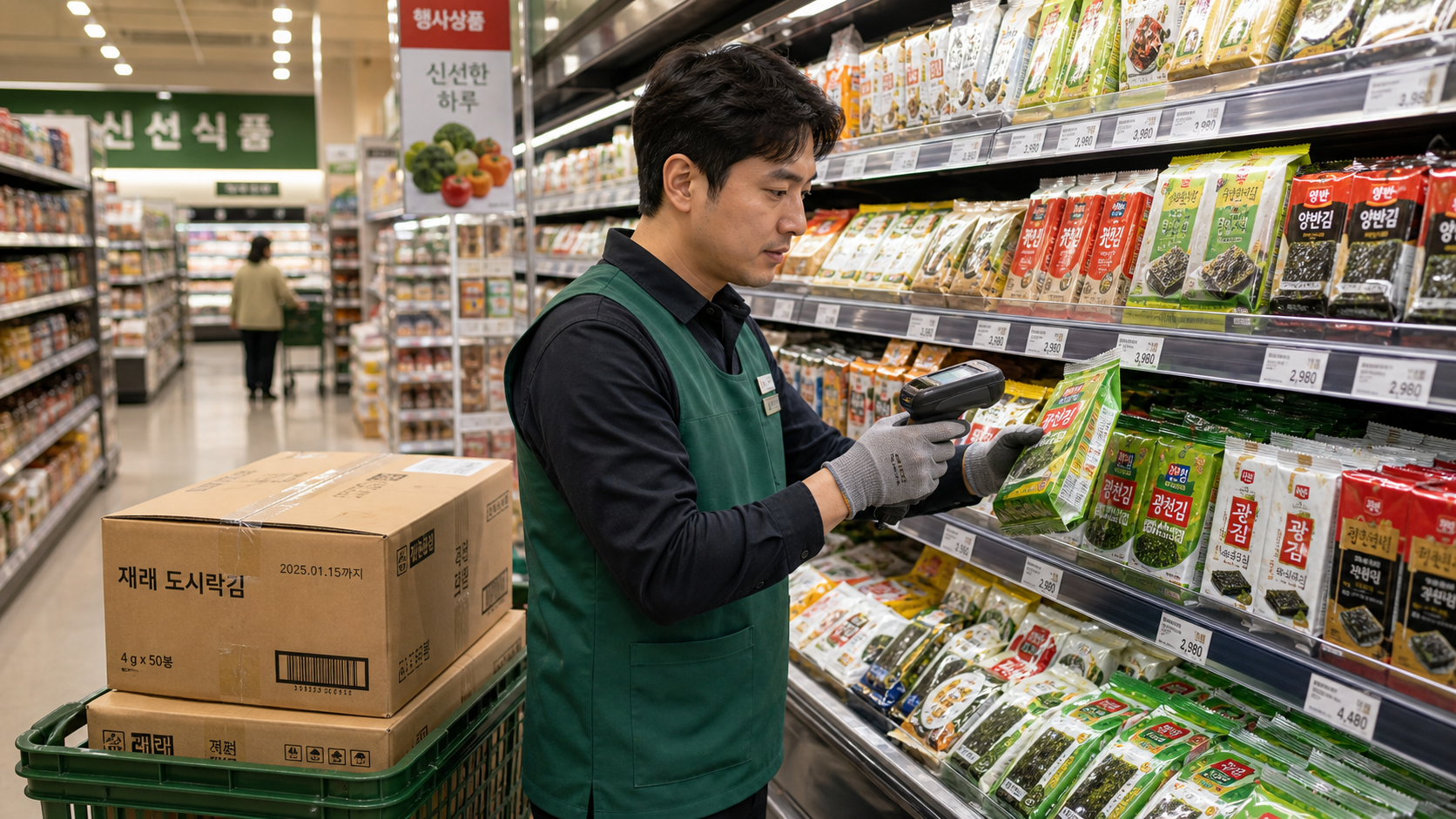
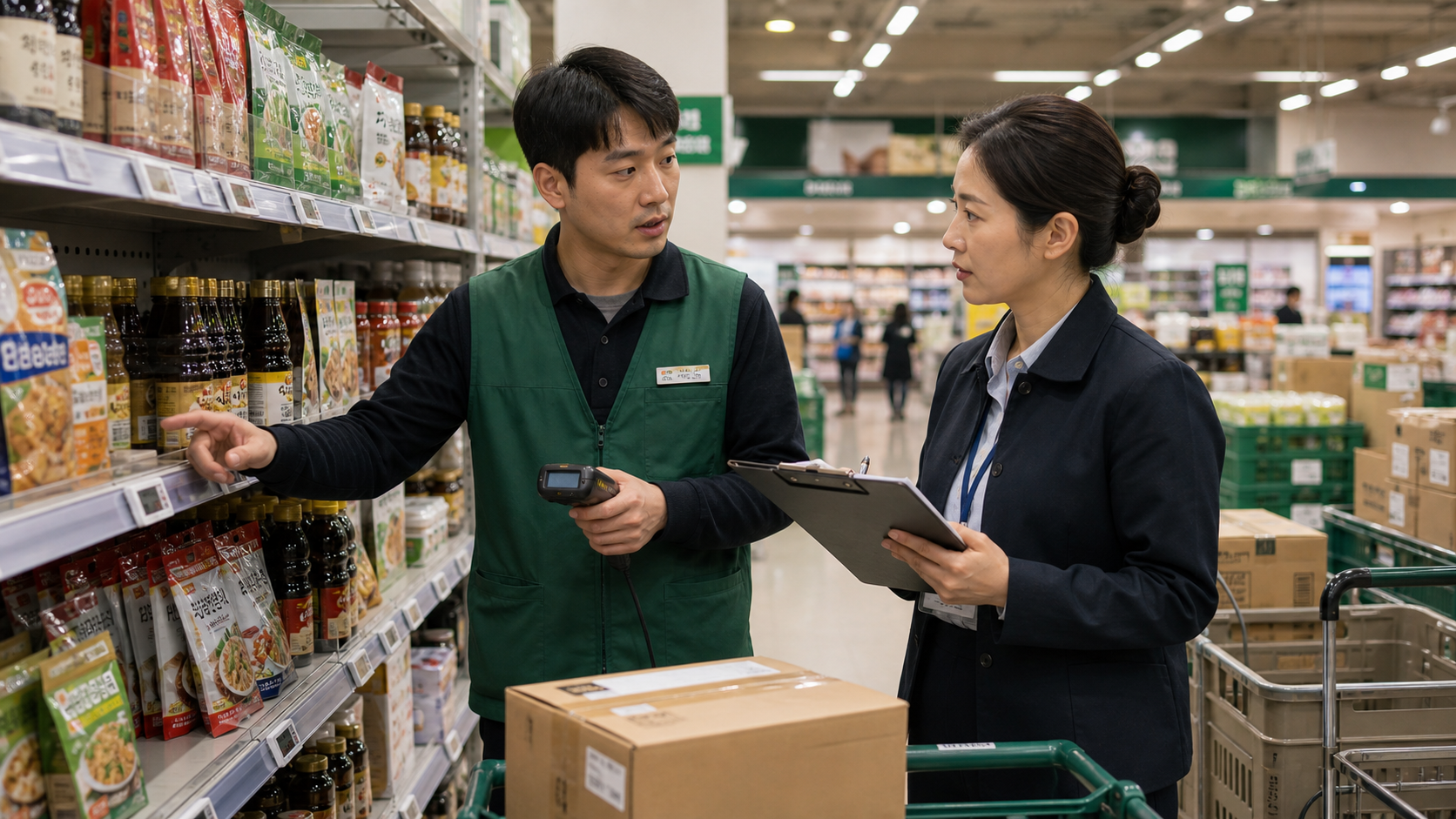
The PPT-style images are used as situation maps. The hero slide shows the whole retail context: a worker, shelves, price labels, a scanner, product boxes, and a manager. The body image focuses on checking stock and shelf labels. The review image shows the decision moment: if the price, barcode, or stock status is unclear, do not guess. Confirm first, then report.
PPT Slide Briefing
Read a retail shelf task as a work sequence
Check stock, shelf, and price labels together
Report price, barcode, or stock problems
This image shows a Korean mart situation with a worker, shelves, price labels, barcode scanner, product boxes, and a manager. The learner can connect 진열대, 가격표, 재고, 바코드, and 관리자 to real actions during a shift.
This body image supports the middle of the article: find 상품, check 위치, see whether the shelf is empty, check 재고, and then restock 진열대. A short manager instruction usually contains both a checking action and a stocking action.
The review image emphasizes the final decision. If 가격표 does not match, 바코드 shows an 오류, or the customer asks about 품절, the worker should confirm first and report to 관리자 instead of guessing.
Core Expressions
Please check the price tag.
Beginner
Please restock the display shelf.
Beginner
Is this product in stock?
Beginner
I will check the stock.
Beginner
There is stock in the storage room.
Intermediate
This item is sold out.
Intermediate
This is a promotion item.
Intermediate
Please check the expiration date.
Intermediate
Please scan the barcode.
Beginner
The price tag does not match.
Intermediate
I will report it to the manager.
Intermediate
Word Examples
The words in the Word Bank are small DB terms, but each one points to a work action. 재고 is not only a noun. During a shift, it means checking the shelf, storage room, or system before answering a customer. 가격표 is not only a label. It is part of preventing checkout complaints. 진열대, 보충, and 정리 are not decoration words; they tell you how to make the shelf usable for customers and staff.
Use this before answering a customer. 재고 may be on the shelf, in storage, or in the system.
Use this when shelf price and scanner or system price are different.
Use only after checking stock. Do not say 품절 just because the shelf looks empty.
Use when a product has a sale event, bundle, or special condition.
Use for food and drinks. It connects directly to shelf safety and store policy.
Use when a price, stock, barcode, or customer issue needs manager attention.
Review Table
store floor. The customer-facing sales area of a store.
Beginner
product display. Placing products where customers can see them.
Intermediate
display shelf. The shelf or fixture that holds products for customers.
Intermediate
product. An item sold in the store.
Beginner
stock. Inventory on the shelf, in storage, or in the system.
Intermediate
storage room. The back room or storage area.
Beginner
sold out. A product is not available for sale.
Intermediate
price tag. A shelf or product label showing the price.
Beginner
discount. A reduced price.
Beginner
promotion. A store promotion or event sale.
Intermediate
expiration date. The date that must be checked for food and drinks.
Intermediate
first in first out. A stock rule that older items move first.
Advanced
restocking. Adding more products to a shelf.
Intermediate
organizing. Putting products or an area in order.
Beginner
tidying. Aligning items neatly.
Intermediate
location. Where an item is placed.
Beginner
customer. A person asking about a product or price.
Beginner
inquiry. A customer question or request.
Intermediate
Conclusion
Korean retail stocking phrases become easier when you read them as work signals. 재고 tells you to check inventory. 가격표 tells you to verify the shelf price. 진열대 tells you where to restock. 품절 should come after checking, not before. 보고 tells you that the issue needs a manager.
In a real store shift, short and accurate Korean is better than a long explanation. Tell customers 재고 확인해 보겠습니다 before guessing. Tell a manager 가격표가 안 맞습니다 when the shelf label and scanner price are different. Use these words as part of a calm sequence: identify, check, restock, verify, and report.
Key Vocabulary
- 매장
- 진열
- 진열대
- 상품
- 재고
- 창고
- 품절
- 가격표
- 할인
- 행사
- 유통기한
- 선입선출
- 보충
- 정리
- 정돈
- 위치
- 고객
- 문의
- 바코드
- 스캔