Panduan Latihan kata pertanian, peternakan, dan perikanan
Latihan kata pertanian, peternakan, dan perikanan membantu pelajar melatih kata bahasa Korea dalam situasi nyata. Artikel BSKorean ini dibuat jelas, mudah dipindai, dan terhubung dengan latihan aplikasi.
Panduan Kosakata bahasa Korea untuk pekerjaan pertanian di Korea
Kosakata bahasa Korea untuk pekerjaan pertanian di Korea membantu pelajar melatih kata bahasa Korea dalam situasi nyata. Artikel BSKorean ini dibuat jelas, mudah dipindai, dan terhubung dengan latihan aplikasi.
Hướng dẫn Luyện từ nông nghiệp, chăn nuôi và thủy sản
Luyện từ nông nghiệp, chăn nuôi và thủy sản giúp người học luyện từ tiếng Hàn trong tình huống thực tế. Bài BSKorean này giữ nội dung rõ ràng, dễ xem và liên kết với phần luyện tập.
Hướng dẫn Từ vựng tiếng Hàn cho công việc nông nghiệp ở Hàn Quốc
Từ vựng tiếng Hàn cho công việc nông nghiệp ở Hàn Quốc giúp người học luyện từ tiếng Hàn trong tình huống thực tế. Bài BSKorean này giữ nội dung rõ ràng, dễ xem và liên kết với phần luyện tập.
This lesson is for foreign farm workers who need to understand the next task, ask for tools, and report safety problems. Start with 오늘 작업은 어디예요?, which means “where is today’s work?” It is a safe question when instructions are unclear.
Learn these first-day phrases: 오늘 작업은 어디예요?, 장갑이 필요해요, 쉬는 시간이 언제예요?, and 다쳤어요. They cover location, gloves, break time, and injury.
Situation
Korean
Meaning
Find the task
오늘 작업은 어디예요?
Where is today’s work?
Ask for gloves
장갑이 필요해요
I need gloves.
Ask break time
쉬는 시간이 언제예요?
When is break time?
Report injury
다쳤어요
I got hurt.
When you do not understand a tool name, point and ask 이거 맞아요?, “is this correct?” If something is dangerous, stop and say 위험해요. Continue with workplace problem report phrases and workplace schedule words to handle workday changes.
Korean agriculture words guide
Korean agriculture words helps learners practice Korean words in real situations. This BSKorean post keeps the lesson clear, scannable, and connected to app practice.
Korean agriculture words help foreign farm workers understand field instructions, tools, crop work, safety notices, and daily tasks in Korea. This lesson connects practical farm vocabulary to real work situations.
Korean Agriculture Words for Real Field Work
You arrive at a farm in Korea early in the morning. A supervisor points toward a greenhouse and says, 하우스 재배 구역으로 가세요. Then you hear words like 모종, 비료, 토양, and 수확물. Even if the work itself is familiar, the Korean words can make the first few minutes confusing.
This lesson teaches practical Korean agriculture words for foreign farm workers. The words come from the BSkorean agriculture, livestock, and fisheries word DB, and this article focuses on the agriculture side: crops, soil, seedlings, fertilizer, greenhouse work, open-field work, weather, and harvested crops.
Briefing PPT
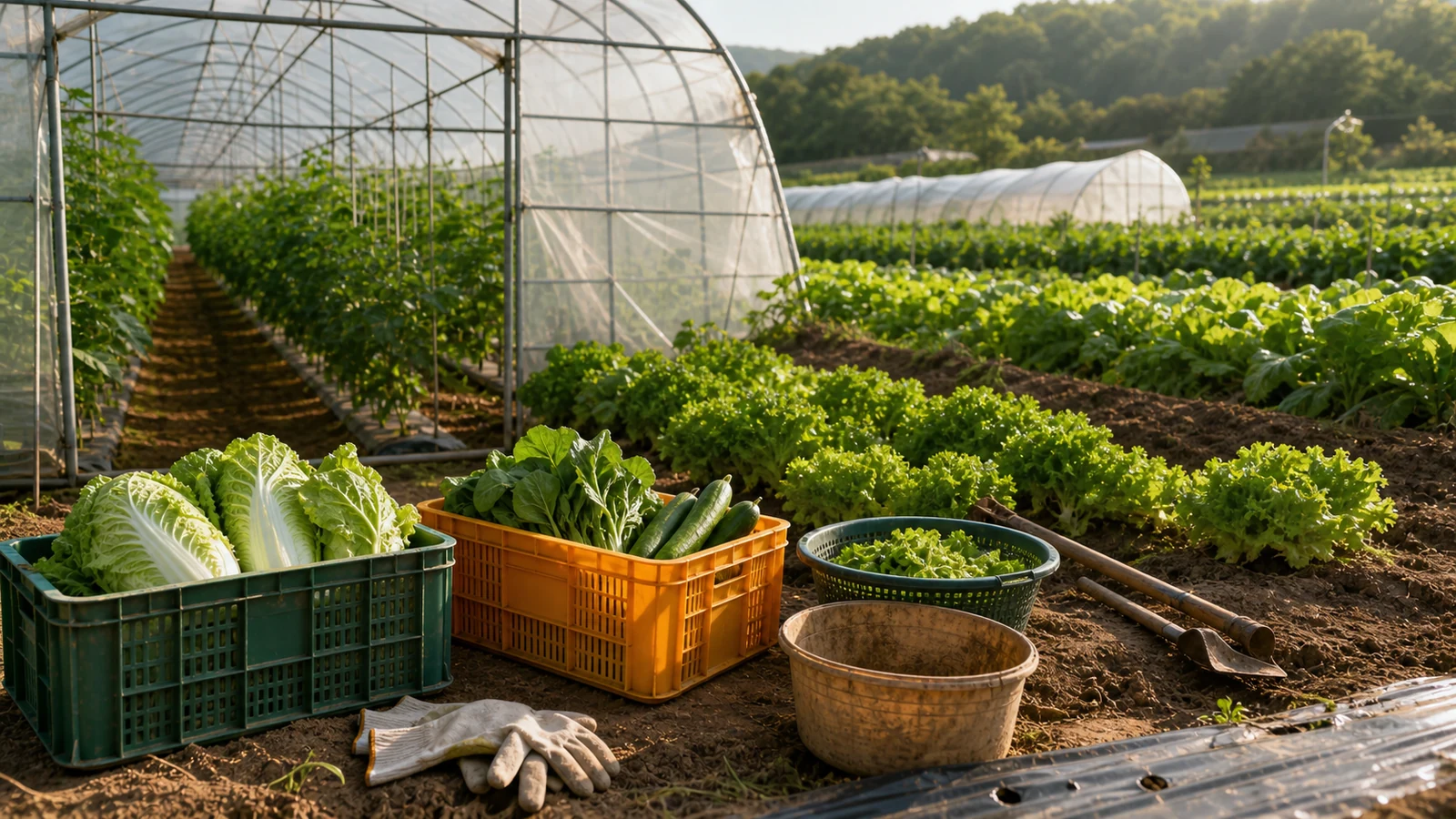
This PPT was rebuilt using realistic farm background images first, then lesson text was placed on top as readable briefing slides.
Korean Agriculture Words title slide for foreign farm workers
Opening Situation
Imagine your first shift at a vegetable farm in Korea. Some workers are inside a greenhouse. Others are working in an open field. One person is checking seedlings, another is preparing fertilizer, and another is sorting harvested vegetables.
In this situation, you do not need to understand a long explanation about agriculture. You need to recognize the words that tell you what object, place, or work step people are talking about. If you hear 모종, look for seedlings. If you hear 비료, the work is about fertilizer. If you hear 수확물, the work is probably about harvested crops that need to be moved, sorted, packed, or checked.
What You Need to Understand
Agriculture Korean is often practical and object-based. A supervisor may use a noun first, then add a short instruction. For example, 모종 확인하세요 means “Check the seedlings.” 비료 준비해 주세요 means “Please prepare the fertilizer.” The important part is not a grammar explanation. The important part is recognizing the core word and connecting it to the real object in front of you.
Farm work also changes depending on location. 하우스 재배 means greenhouse cultivation. 노지 재배 means open-field cultivation. If you know this difference, you can understand whether the instruction is about work inside a greenhouse or outside in the field.
Core Vocabulary
Korean
Romanization
English
Level
What it means at work
농업
nongeop
agriculture
Beginner 1
The general field of agriculture.
농사
nongsa
farming
Beginner 2
The actual work of farming.
농민
nongmin
farm worker
Beginner 2
A farm worker or farmer as a person.
농부
nongbu
farmer
Beginner 1
A farmer, usually a person who grows crops.
농작물
nongjakmul
agricultural crop
Beginner 1
Crops growing in a field or greenhouse.
채소
chaeso
vegetable
Beginner 1
Vegetables grown, packed, or sorted.
하우스 재배
hauseu jaebae
greenhouse cultivation
Beginner 1
Growing crops inside a greenhouse.
노지 재배
noji jaebae
open-field cultivation
Beginner 2
Growing crops outside in an open field.
논
non
rice paddy
Beginner 1
A rice paddy or wet rice field.
흙
heulk
soil
Beginner 1
Soil or dirt you touch and work with.
토양
toyang
soil
Beginner 2
Soil as a more technical growing condition.
비료
biryo
fertilizer
Beginner 1
Fertilizer used to help crops grow.
종자
jongja
seed stock
Beginner 1
Seed stock before planting.
모종
mojong
seedling
Beginner 2
Seedlings ready to be moved or planted.
싹
ssak
sprout
Beginner 2
A sprout that has just started growing.
줄기
julgi
stem
Beginner 1
The stem of a plant.
수확물
suhwakmul
harvested crop
Beginner 2
The crop after harvest.
비
bi
rain
Beginner 1
Rain that can affect field work.
햇빛
haetbit
sunlight
Beginner 1
Sunlight needed for growing crops.
이슬
iseul
dew
Beginner 2
Dew on plants in the morning.
Crop Words You May Hear
Korean
Romanization
English
Level
Workplace note
당근
danggeun
carrot
Beginner 1
Carrot, often sorted by size and condition.
상추
sangchu
lettuce
Beginner 1
Lettuce, often harvested and packed by hand.
오이
oi
cucumber
Beginner 1
Cucumber, common in greenhouse work.
토마토
tomato
tomato
Beginner 1
Tomato, common in greenhouse work.
옥수수
oksusu
corn
Beginner 1
Corn, common in field farming.
Crop names are useful because they often appear in direct work instructions. If someone says 상추 수확물, they are talking about harvested lettuce. If they say 오이 하우스, they may mean the greenhouse where cucumbers are grown. In real farm work, Korean words are often shortened because everyone can see the place and the object.
Common Pattern
The most useful pattern is simple:
Pattern
Meaning
Example
N + 확인하세요
Please check N.
모종 확인하세요.
N + 준비해 주세요
Please prepare N.
비료 준비해 주세요.
N + 분류해 주세요
Please sort N.
수확물 분류해 주세요.
N + 쪽으로 가세요
Please go toward N.
하우스 재배 구역으로 가세요.
In spoken workplace Korean, particles may be dropped. You may hear 모종 확인하세요 instead of 모종을 확인하세요. Both point to the same action: check the seedlings.
Real-Life Dialogue
Dialogue 1: Greenhouse Work
Supervisor: 오늘은 하우스 재배 구역으로 가세요. Oneureun hauseu jaebae guyeogeuro gaseyo. Today, please go to the greenhouse cultivation area.
Worker: 네, 무엇을 확인하면 될까요? Ne, mueoseul hwaginhayeomyeon doelkkayo? Okay. What should I check?
Supervisor: 모종하고 토양 상태를 확인하세요. Mojonghago toyang sangtaereul hwaginhaseyo. Please check the seedlings and the soil condition.
Worker: 네, 확인하겠습니다. Ne, hwaginhagetseumnida. Yes, I will check.
In this dialogue, 하우스 재배 tells you the work area. 모종 tells you the object to check. 토양 tells you that the supervisor cares about the soil condition, not just the plants.
Worker: 어떤 수확물인가요? Eotteon suhwangmuringayo? Which harvested crops?
Supervisor: 상추하고 오이를 먼저 분류해 주세요. Sangchuhago oireul meonjeo bullyuhae juseyo. Please sort the lettuce and cucumbers first.
Worker: 네, 상추부터 하겠습니다. Ne, sangchubuteo hagetseumnida. Okay, I will start with the lettuce.
Here, the key word is 수확물. It does not simply mean “harvest” as an abstract idea. At work, it usually means the actual crops that have already been picked and now need to be moved, sorted, checked, or packed.
Common Mistakes
Common Mistake 1: Thinking 농업 and 농사 are the same in every sentence
Why it happens: Both words are connected to farming.
Correct understanding:농업 is the broad industry or field of agriculture. 농사 is the actual work of farming.
Example:농업 can appear in a category or document. 농사 is more natural when talking about doing farm work.
Common Mistake 2: Reading 하우스 재배 as a normal house
Why it happens: Beginners may connect 하우스 with “house.”
Correct understanding: In farm work, 하우스 재배 usually means greenhouse cultivation. It is about growing crops inside a greenhouse, not a house for people.
Example:하우스 재배 구역 means the greenhouse cultivation area.
Common Mistake 3: Confusing 흙 and 토양
Why it happens: Both words can mean soil.
Correct understanding:흙 is the everyday word for soil or dirt. 토양 sounds more technical and is often used when talking about soil condition, quality, moisture, or management.
Example: A worker may say 흙이 젖었어요, “The soil is wet.” A supervisor may say 토양 상태를 확인하세요, “Check the soil condition.”
Practice Sentences
Korean Expression
Romanization
English Meaning
Level
When to Use
모종을 확인하세요.
mojongeul hwaginhaseyo.
Please check the seedlings.
Beginner 2
A supervisor asks you to check seedlings before planting.
비료를 준비해 주세요.
biryoreul junbihae juseyo.
Please prepare the fertilizer.
Beginner 1
Before field or greenhouse work starts.
하우스 재배 구역으로 가세요.
hauseu jaebae guyeogeuro gaseyo.
Please go to the greenhouse cultivation area.
Beginner 1
A worker is sent to the greenhouse area.
수확물을 분류해 주세요.
suhwangmureul bullyuhae juseyo.
Please sort the harvested crops.
Beginner 2
After harvesting vegetables or fruits.
토양 상태를 확인하세요.
toyang sangtaereul hwaginhaseyo.
Please check the soil condition.
Beginner 2
When soil moisture or condition matters.
비가 오면 작업을 멈추세요.
biga omyeon jageobeul meomchuseyo.
If it rains, stop the work.
Beginner 1
For outdoor field work.
Mini Quiz
Question 1. What does 모종 mean? A. fertilizer B. seedling C. rain Answer: B. 모종 means seedling.
Question 2. You are told 비료를 준비해 주세요. What should you prepare? A. fertilizer B. harvested crops C. sunlight Answer: A. 비료 means fertilizer.
Question 3. Which word means greenhouse cultivation? A. 노지 재배 B. 하우스 재배 C. 수확물 Answer: B. 하우스 재배 means greenhouse cultivation.
Question 4. What is the more technical word for soil condition? A. 흙 B. 토양 C. 이슬 Answer: B. 토양 is often used for soil as a condition or growing environment.
Question 5. You hear 수확물을 분류해 주세요. What action should you do? A. Sort the harvested crops. B. Plant the seeds. C. Stop because of rain. Answer: A. 수확물 means harvested crops, and 분류해 주세요 means please sort.
Practice This Lesson
Practice these and related words in the dedicated Agri-Fishery Learn Korean page.
For farm work in Korea, start with the object word first. 모종 means seedlings. 비료 means fertilizer. 토양 means soil as a growing condition. 수확물 means crops after harvest. 하우스 재배 points to greenhouse cultivation, while 노지 재배 points to open-field cultivation.
If you can connect these words to real objects and places, Korean agriculture instructions become much easier to follow. You do not need to translate every sentence slowly. Listen for the work word, check the object or place, and confirm the action.