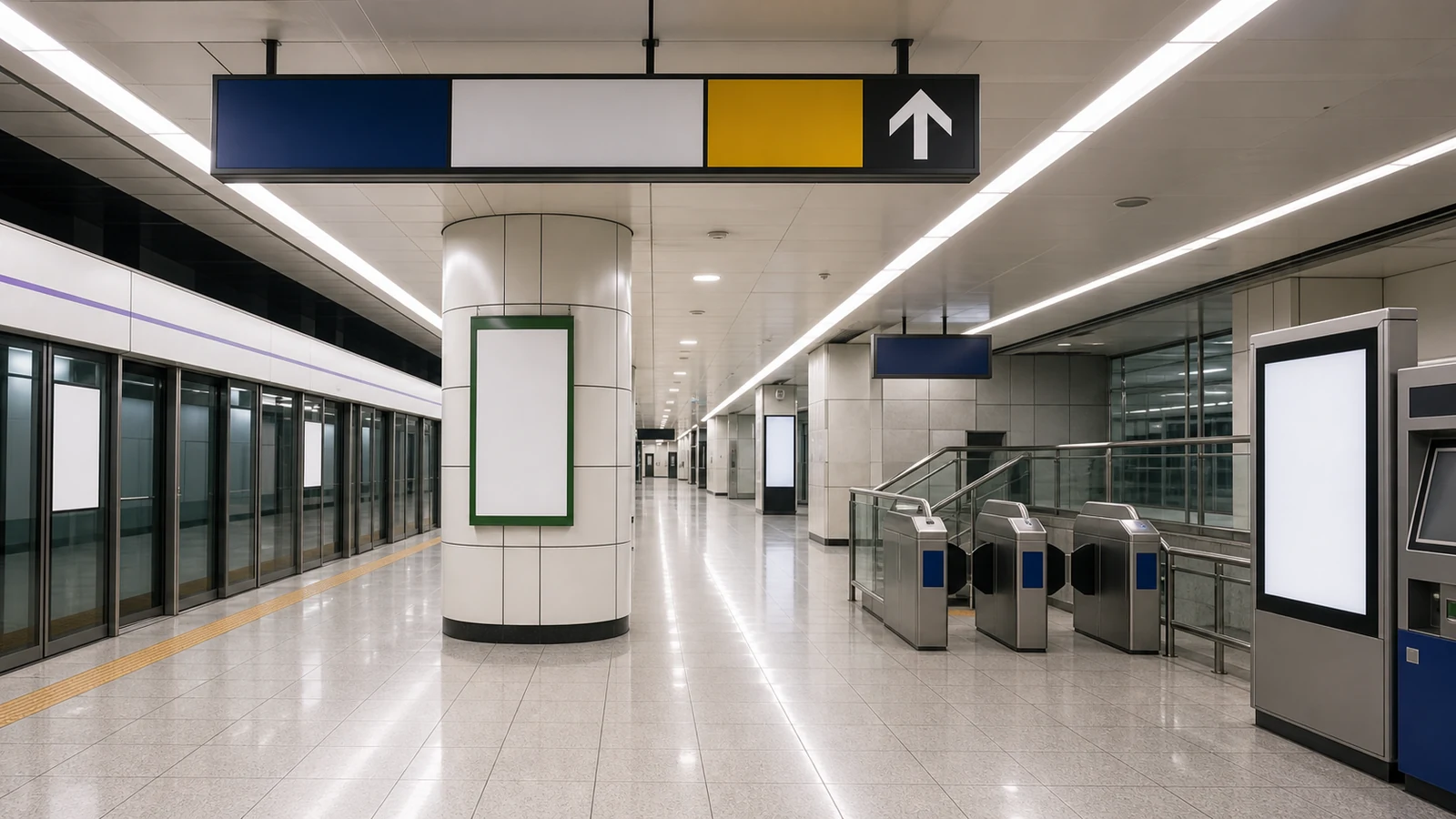
Use this subway sign lesson first
Korean subway signs repeat a small set of words: exit, transfer, platform, direction, line, and card charging. Start with 출구가 어디예요?, “where is the exit?” This question is useful even when you only know the exit number.
Practice four station phrases: 출구가 어디예요?, 환승은 어디에서 해요?, 이 노선 맞아요?, and 교통카드 충전하고 싶어요. They help you find exits, transfer, check the line, and charge a fare card.
| Transit task | Korean | Meaning |
|---|---|---|
| Find exit | 출구가 어디예요? | Where is the exit? |
| Transfer | 환승은 어디에서 해요? | Where do I transfer? |
| Check line | 이 노선 맞아요? | Is this the right line? |
| Charge card | 교통카드 충전하고 싶어요 | I want to charge my transit card. |
Look for numbers and arrows first, then read the Korean word beside them. If you need help from staff, show the destination on your phone and ask 여기 가고 싶어요. For related daily movement language, study convenience store transit card phrases and transport sign words.
Korean subway sign vocabulary guide
Korean subway sign vocabulary helps learners practice Korean words in real situations. This BSKorean post keeps the lesson clear, scannable, and connected to app practice.
Related lessons
Korean subway sign vocabulary helps you read exits, transfers, platforms, directions, and station notices when you ride the subway in Korea. This lesson teaches the signs by function, not by grammar rules.
Korean Subway Sign Vocabulary by Function

Download the updated Korean subway sign vocabulary PPT briefing
Opening Situation
You are standing inside a Korean subway station. Above you, several arrows point in different directions. One sign says 출구. Another says 환승. A platform sign shows 강남 방면, and a smaller facility sign points toward 화장실.
If you try to translate every word on every sign, the station can feel confusing. But Korean subway signs are not written like long sentences. They are designed to help people move. Your job is to find the word that tells you what to do next.
This lesson teaches Korean subway sign vocabulary as movement signals. Instead of memorizing isolated words, you will learn how to read the sign, identify the purpose, check the detail, and follow the arrow.
Learning Snapshot
| Best for | Travelers, foreign residents, exchange students, and new subway users in Korea |
|---|---|
| Main skill | Reading Korean subway signs by function, number, direction, and arrow |
| Study time | 8-10 minutes |
| Practice focus | Exit, transfer, direction, platform, restroom, elevator, and line signs |
Why This Topic Matters
Many Korean learners know that 출구 means exit. The problem begins when the word appears with numbers, arrows, line colors, and other signs at the same time. For example, 3번 출구 오른쪽 is not just a vocabulary phrase. It is an instruction: Exit 3 is on the right.
Subway signs also mix Korean words with symbols. You may see a train icon, a line number, an arrow, a restroom icon, and a place name on one board. The fastest way to understand the sign is to read it in this order: purpose word, detail, direction.
Core Vocabulary Table
| Korean | Romanization | Basic Meaning | Natural Meaning | Where You See It | Example |
|---|---|---|---|---|---|
| 출구 | chulgu | exit | way out of the station | subway station, building | 2번 출구 |
| 환승 | hwanseung | transfer | change to another line | subway passage, bus system | 2호선 환승 |
| 방면 | bangmyeon | direction | toward a station or area | platform signs, line signs | 강남 방면 |
| 승강장 | seunggangjang | platform | place where you board the train | train and subway stations | 승강장 가는 길 |
| 화장실 | hwajangsil | restroom | toilet or restroom facility | station, mall, building | 화장실 오른쪽 |
| 엘리베이터 | ellibeiteo | elevator | lift for moving between floors | station, apartment, building | 엘리베이터 왼쪽 |
| 에스컬레이터 | eseukeolleiteo | escalator | moving stairs | station entrances and platforms | 에스컬레이터 이용 |
| 개찰구 | gaechalgu | ticket gate | gate where you tap your card | station entrance area | 개찰구 앞 |
| 직진 | jikjin | straight | go straight ahead | direction signs | 직진 후 오른쪽 |
| 오른쪽 | oreunjjok | right | right side | direction signs, spoken directions | 화장실 오른쪽 |
| 왼쪽 | oenjjok | left | left side | direction signs, spoken directions | 승강장 왼쪽 |
| 가는 길 | ganeun gil | way to | path toward a place | station, hospital, public building | 출구 가는 길 |
How Koreans Actually Use These Words
출구 is usually combined with a number. 2번 출구 means Exit 2, and people often use exit numbers when meeting friends or finding nearby buildings. If someone says 3번 출구로 나오세요, they mean you should come out through Exit 3, not just any exit.
환승 means transfer. In a subway station, it usually means you should stay inside the transit system and follow the transfer passage. Do not confuse it with leaving the station. If you want to leave, look for 출구.
방면 tells direction. 강남 방면 means toward Gangnam. It does not always mean you are at Gangnam now. When you choose a platform, this word helps you know which side goes toward your destination.
승강장 is the platform, not the ticket gate. If a sign says 승강장 가는 길, it is guiding you toward the place where trains arrive and depart.
Sign Patterns
Korean subway signs follow predictable patterns. Learning these patterns is faster than trying to translate each sign as a full sentence.
| Pattern | Meaning | Example |
|---|---|---|
| Number + 번 출구 | Exit number | 3번 출구 = Exit 3 |
| Line number + 호선 환승 | Transfer to that line | 2호선 환승 = Transfer to Line 2 |
| Station or place + 방면 | Toward that direction | 강남 방면 = Toward Gangnam |
| Place + 가는 길 | Way to that place | 승강장 가는 길 = Way to the platform |
| Place + 오른쪽 / 왼쪽 | Place on the right or left | 화장실 오른쪽 = Restroom on the right |
Real-Life Sign Example
Imagine you see this sign inside a station:
3번 출구 오른쪽
Exit 3, right side
Read it in three steps. First, find the purpose word: 출구. The sign is about leaving the station. Second, check the detail: 3번. You need Exit 3. Third, follow the direction: 오른쪽. Your action is simple: go right for Exit 3.
Here is another example:
2호선 환승 직진
Transfer to Line 2, go straight
The purpose word is 환승. The detail is 2호선. The direction is 직진. You should stay inside the station and go straight to transfer to Line 2.
Common Mistakes
Common Mistake 1: Thinking 방면 is the current station
Why it happens: Beginners often read every Korean word on a sign as a place name.
Correct understanding: 방면 means toward or in the direction of. 서울역 방면 means toward Seoul Station, not necessarily that you are at Seoul Station.
Common Mistake 2: Thinking 환승 means exit
Why it happens: Transfer passages can look like long exits because they lead through halls and stairs.
Correct understanding: 환승 usually means you are changing lines inside the subway system. To leave the station, look for 출구.
Common Mistake 3: Ignoring exit numbers
Why it happens: In some countries, any exit near the destination may feel close enough.
Correct understanding: In Korea, different exits often lead to different sides of a large road or underground shopping area. If someone says 5번 출구, the number matters.
Step-by-Step Practice
Use this method whenever you read a Korean subway sign.
- Find the purpose word. Look for words like 출구, 환승, 승강장, 화장실, or 엘리베이터.
- Check the detail. Look for a number, line number, station name, or facility name.
- Follow the arrow or direction word. Use 오른쪽, 왼쪽, 직진, 위, 아래, or the arrow icon.
Mini Quiz
- 3번 출구 means what?
Answer: Exit 3. The number is 3번, and 출구 means exit. - You see 2호선 환승. Should you leave the station?
Answer: No. 환승 means transfer to Line 2. - 강남 방면 means what?
Answer: Toward Gangnam. 방면 shows direction. - You want the restroom and see 화장실 왼쪽. What should you do?
Answer: Go left. 화장실 means restroom, and 왼쪽 means left. - 승강장 가는 길 means what?
Answer: Way to the platform. 승강장 is the platform, and 가는 길 means way to.
Review Table
| Korean | Meaning | Best Situation | Beginner Tip |
|---|---|---|---|
| 출구 | exit | leaving a station or building | Look for the exit number |
| 환승 | transfer | changing subway lines | Check the line number |
| 방면 | toward | choosing direction or platform | It means direction, not current location |
| 승강장 | platform | finding where trains arrive | It is not the ticket gate |
| 화장실 | restroom | finding a facility | Follow the arrow or side word |
| 직진 | straight | following a route | Keep going forward |
Practice This Lesson
Practice these words in the Korean Learn Korean tool. Use the Signs & Notices or travel-related subway word set, then review the words you miss.
Practice Korean subway sign vocabulary
Practice these words again in Korean Learn Korean so you can connect the Korean word to the real situation.
For official Korea travel and daily-life context, check Visit Korea.
Related Lessons
- Korean Street Sign Words: A Briefing-Style Lesson
- Korean Apartment Words: A Briefing-Style Lesson
- Korean ATM Words: A Briefing-Style Lesson
Conclusion
Korean subway signs become much easier when you read them as action signals. Start with the purpose word: 출구, 환승, 방면, 승강장, or 화장실. Then check the number, line, station name, or facility next to it. Finally, follow the arrow.
You do not need to understand every Korean word in the station. You need to understand what the sign is asking you to do next.