Korean for Asking and Understanding Pharmacy Dosage Instructions
Learn Korean for pharmacy dosage instructions: how often, how many pills, before or after meals, side effects, storage, and polite confirmation.
1. When to use these phrases
Korean for Asking and Understanding Pharmacy Dosage Instructions
10 min read
What This Lesson Covers
A pharmacy conversation is short, but the information can be important: how often to take a medicine, how many pills to take, whether it is before or after meals, how many days to continue, and what warning to remember. This lesson is a language lesson, not medical advice. The goal is to help you ask clear questions and repeat back what you understood.
The safest speaking order is simple: say that you do not understand, ask one narrow question, repeat the answer in your own words, and ask the pharmacist to confirm it. You do not need advanced grammar. You need the small Korean words that control time, amount, and caution.
Never practice with real patient numbers, private medical history, prescription details, or medicine names from another person. Use made-up examples and follow the pharmacist, doctor, and official label for real medicine.
The Pharmacy Conversation Map
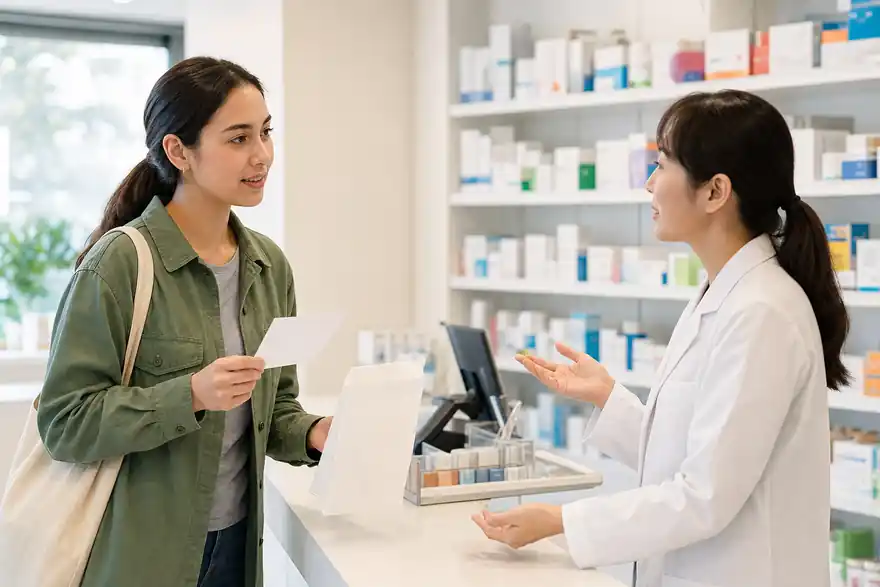
At the counter, you may hand over a prescription or ask for over-the-counter medicine. The pharmacist may explain the medicine quickly while pointing to a bag or label. Listen for five anchors: frequency, amount, meal timing, duration, and warning.
Frequency answers the question 하루에 몇 번, meaning how many times a day. Amount answers 한 번에 몇 알, meaning how many pills at one time. Meal timing uses 식전, 식후, 공복, and 잠자기 전. Duration uses 며칠 동안. Warnings may mention sleepiness, driving, alcohol, allergy, storage, or not chewing the pill.
When you miss one part, do not ask a huge question such as “I do not understand everything.” Ask the missing part only: 식전이에요, 식후예요? or 하루에 몇 번이에요?. This makes the conversation shorter and clearer.
The words in this lesson are common language-learning examples. Real instructions can differ by medicine and person, so always confirm your actual medicine with a pharmacist.
Core Pharmacy Vocabulary
| Korean | Pronunciation | Meaning | Practice note |
|---|---|---|---|
| 약국 | yakguk | pharmacy | Make one safe sample sentence with this word; do not use real prescription or patient details. |
| 약사 | yaksa | pharmacist | Make one safe sample sentence with this word; do not use real prescription or patient details. |
| 처방전 | cheobangjeon | prescription | Make one safe sample sentence with this word; do not use real prescription or patient details. |
| 약 | yak | medicine | Make one safe sample sentence with this word; do not use real prescription or patient details. |
| 복용 | bogyong | taking medicine | Make one safe sample sentence with this word; do not use real prescription or patient details. |
| 복용법 | bogyongbeop | dosage instructions | Make one safe sample sentence with this word; do not use real prescription or patient details. |
| 용량 | yongnyang | dose/amount | Make one safe sample sentence with this word; do not use real prescription or patient details. |
| 횟수 | hoet-su | number of times | Make one safe sample sentence with this word; do not use real prescription or patient details. |
| 하루 | haru | one day | Make one safe sample sentence with this word; do not use real prescription or patient details. |
| 하루에 한 번 | harue han beon | once a day | Make one safe sample sentence with this word; do not use real prescription or patient details. |
| 하루에 두 번 | harue du beon | twice a day | Make one safe sample sentence with this word; do not use real prescription or patient details. |
| 하루에 세 번 | harue se beon | three times a day | Make one safe sample sentence with this word; do not use real prescription or patient details. |
| 아침 | achim | morning | Make one safe sample sentence with this word; do not use real prescription or patient details. |
| 점심 | jeomsim | lunch/noon | Make one safe sample sentence with this word; do not use real prescription or patient details. |
| 저녁 | jeonyeok | evening | Make one safe sample sentence with this word; do not use real prescription or patient details. |
| 식전 | sikjeon | before meals | Make one safe sample sentence with this word; do not use real prescription or patient details. |
| 식후 | sikhu | after meals | Make one safe sample sentence with this word; do not use real prescription or patient details. |
| 공복 | gongbok | empty stomach | Make one safe sample sentence with this word; do not use real prescription or patient details. |
| 잠자기 전 | jamjagi jeon | before bedtime | Make one safe sample sentence with this word; do not use real prescription or patient details. |
| 한 알 | han al | one pill | Make one safe sample sentence with this word; do not use real prescription or patient details. |
| 두 알 | du al | two pills | Make one safe sample sentence with this word; do not use real prescription or patient details. |
| 정 | jeong | tablet | Make one safe sample sentence with this word; do not use real prescription or patient details. |
| 캡슐 | kaepsyul | capsule | Make one safe sample sentence with this word; do not use real prescription or patient details. |
| 시럽 | sireop | syrup | Make one safe sample sentence with this word; do not use real prescription or patient details. |
| 연고 | yeongo | ointment | Make one safe sample sentence with this word; do not use real prescription or patient details. |
| 안약 | anyak | eye drops | Make one safe sample sentence with this word; do not use real prescription or patient details. |
| 감기약 | gamgiyak | cold medicine | Make one safe sample sentence with this word; do not use real prescription or patient details. |
| 진통제 | jintongje | pain reliever | Make one safe sample sentence with this word; do not use real prescription or patient details. |
| 소화제 | sohwaje | digestive medicine | Make one safe sample sentence with this word; do not use real prescription or patient details. |
| 알레르기 | allereugi | allergy | Make one safe sample sentence with this word; do not use real prescription or patient details. |
| 부작용 | bujagyong | side effect | Make one safe sample sentence with this word; do not use real prescription or patient details. |
| 주의사항 | juui sahang | precautions | Make one safe sample sentence with this word; do not use real prescription or patient details. |
| 보관 | bogwan | storage | Make one safe sample sentence with this word; do not use real prescription or patient details. |
| 냉장 보관 | naengjang bogwan | refrigerated storage | Make one safe sample sentence with this word; do not use real prescription or patient details. |
| 물과 함께 | mulgwa hamkke | with water | Make one safe sample sentence with this word; do not use real prescription or patient details. |
| 씹지 마세요 | ssipji maseyo | do not chew | Make one safe sample sentence with this word; do not use real prescription or patient details. |
| 졸릴 수 있어요 | jollil su isseoyo | it may make you sleepy | Make one safe sample sentence with this word; do not use real prescription or patient details. |
| 운전 | unjeon | driving | Make one safe sample sentence with this word; do not use real prescription or patient details. |
| 같이 먹어도 돼요? | gachi meogeodo dwaeyo? | Can I take it together? | Make one safe sample sentence with this word; do not use real prescription or patient details. |
| 다시 말해 주세요 | dasi malhae juseyo | Please say it again. | Make one safe sample sentence with this word; do not use real prescription or patient details. |
| 천천히 말해 주세요 | cheoncheonhi malhae juseyo | Please speak slowly. | Make one safe sample sentence with this word; do not use real prescription or patient details. |
| 써 주세요 | sseo juseyo | Please write it down. | Make one safe sample sentence with this word; do not use real prescription or patient details. |
| 확인해 주세요 | hwaginhae juseyo | Please confirm. | Make one safe sample sentence with this word; do not use real prescription or patient details. |
| 약 봉투 | yak bongtu | medicine bag | Make one safe sample sentence with this word; do not use real prescription or patient details. |
| 라벨 | label | label | Make one safe sample sentence with this word; do not use real prescription or patient details. |
| 기간 | gigan | duration/period | Make one safe sample sentence with this word; do not use real prescription or patient details. |
| 과다 복용 | gwada bogyong | overdose | Make one safe sample sentence with this word; do not use real prescription or patient details. |
Dosage Grammar That Changes the Meaning
하루에 means “in one day.” Put the number of times after it: 하루에 한 번, 하루에 두 번, 하루에 세 번. If you only hear 한 번 without the full sentence, ask whether it means once a day or once at a specific time.
한 번에 means “at one time.” This is different from 하루에. 하루에 두 번 is frequency; 한 번에 두 알 is amount. Many learners mix these up, so practice them as a pair.
식전 and 식후 are short but important. If you are not sure which one you heard, ask again immediately: 식전이에요, 식후예요? Do not guess from memory after leaving the pharmacy.
며칠 동안 asks the period. If the pharmacist says a number of days, repeat it back with 맞아요? For example: 사흘 동안 먹어요, 맞아요? This is a language strategy, not a medical decision.
아플 때만 means “only when it hurts.” This phrase is useful for asking whether something is taken regularly or only when needed. Because the answer depends on the medicine, always let the pharmacist answer.
How to Read a Medicine Bag Without Guessing
A medicine bag or label may show several clues, but your job as a learner is not to interpret everything alone. Use the bag as a checklist for questions. If you see or hear a time word, ask about timing. If you see or hear an amount word, ask about quantity.
Check whether the instruction is about a regular schedule, such as morning and evening, or a condition, such as only when pain appears. These are very different patterns in Korean, and they change how you should understand the sentence.
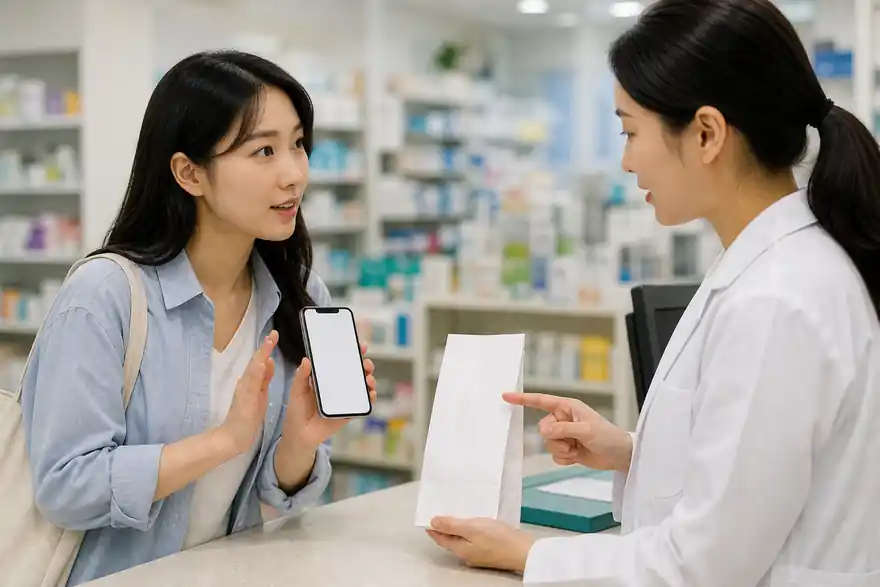
If the pharmacist writes something for you, read it back. A useful confirmation sentence is 제가 맞게 이해했는지 확인해 주세요. It is polite, clear, and gives the pharmacist a chance to correct one part.
Useful Pharmacy Phrases
| Korean phrase | Meaning | Use |
|---|---|---|
| 이 약은 어떻게 먹어요? | How do I take this medicine? | Use the sentence exactly, then wait for the pharmacist's answer and confirm the key words. |
| 하루에 몇 번 먹어요? | How many times a day do I take it? | Use the sentence exactly, then wait for the pharmacist's answer and confirm the key words. |
| 한 번에 몇 알 먹어요? | How many pills at one time? | Use the sentence exactly, then wait for the pharmacist's answer and confirm the key words. |
| 식전이에요, 식후예요? | Is it before meals or after meals? | Use the sentence exactly, then wait for the pharmacist's answer and confirm the key words. |
| 며칠 동안 먹어요? | For how many days do I take it? | Use the sentence exactly, then wait for the pharmacist's answer and confirm the key words. |
| 물과 함께 먹으면 돼요? | Can I take it with water? | Use the sentence exactly, then wait for the pharmacist's answer and confirm the key words. |
| 다른 약이랑 같이 먹어도 돼요? | Can I take it with other medicine? | Use the sentence exactly, then wait for the pharmacist's answer and confirm the key words. |
| 알레르기가 있어요. | I have an allergy. | Use the sentence exactly, then wait for the pharmacist's answer and confirm the key words. |
| 부작용이 있어요? | Are there side effects? | Use the sentence exactly, then wait for the pharmacist's answer and confirm the key words. |
| 졸릴 수 있어요? | Can it make me sleepy? | Use the sentence exactly, then wait for the pharmacist's answer and confirm the key words. |
| 운전해도 돼요? | Can I drive? | Use the sentence exactly, then wait for the pharmacist's answer and confirm the key words. |
| 냉장 보관해야 해요? | Do I need to keep it in the fridge? | Use the sentence exactly, then wait for the pharmacist's answer and confirm the key words. |
| 까먹으면 어떻게 해요? | What should I do if I forget a dose? | Use the sentence exactly, then wait for the pharmacist's answer and confirm the key words. |
| 술 마셔도 돼요? | Can I drink alcohol? | Use the sentence exactly, then wait for the pharmacist's answer and confirm the key words. |
| 임신 중이에요. | I am pregnant. | Use the sentence exactly, then wait for the pharmacist's answer and confirm the key words. |
| 수유 중이에요. | I am breastfeeding. | Use the sentence exactly, then wait for the pharmacist's answer and confirm the key words. |
| 이 말이 무슨 뜻이에요? | What does this word mean? | Use the sentence exactly, then wait for the pharmacist's answer and confirm the key words. |
| 다시 한 번 말해 주세요. | Please say it one more time. | Use the sentence exactly, then wait for the pharmacist's answer and confirm the key words. |
| 천천히 말해 주세요. | Please speak slowly. | Use the sentence exactly, then wait for the pharmacist's answer and confirm the key words. |
| 종이에 써 주세요. | Please write it on paper. | Use the sentence exactly, then wait for the pharmacist's answer and confirm the key words. |
| 제가 맞게 이해했는지 확인해 주세요. | Please check whether I understood correctly. | Use the sentence exactly, then wait for the pharmacist's answer and confirm the key words. |
| 아침, 점심, 저녁에 먹으면 돼요? | Should I take it morning, lunch, and evening? | Use the sentence exactly, then wait for the pharmacist's answer and confirm the key words. |
| 아플 때만 먹어요? | Do I take it only when it hurts? | Use the sentence exactly, then wait for the pharmacist's answer and confirm the key words. |
| 계속 먹어야 해요? | Do I need to keep taking it? | Use the sentence exactly, then wait for the pharmacist's answer and confirm the key words. |
Four Practical Dialogues
The dialogues below are practice scripts. Replace the details with safe made-up examples in class, and use real instructions only with the pharmacist in front of you.
Prescription pickup
| 손님 | 처방전 여기 있어요. | Here is my prescription. |
| 약사 | 이 약은 하루에 두 번, 식후에 한 알 드세요. | Take one pill twice a day after meals. |
| 손님 | 하루에 두 번, 식후에 한 알, 맞아요? | Twice a day, one pill after meals, correct? |
Before or after meals
| 손님 | 식전이에요, 식후예요? | Is it before meals or after meals? |
| 약사 | 식후에 드세요. 속이 불편하면 다시 문의해 주세요. | Take it after meals. If your stomach feels uncomfortable, ask again. |
| 손님 | 네, 식후에 먹을게요. | Okay, I will take it after meals. |
Side effect and driving concern
| 손님 | 이 약은 졸릴 수 있어요? | Can this medicine make me sleepy? |
| 약사 | 네, 졸릴 수 있어요. 운전은 조심하세요. | Yes, it may. Be careful with driving. |
| 손님 | 주의사항을 종이에 써 주세요. | Please write the precautions on paper. |
Other medicine and allergy
| 손님 | 다른 약이랑 같이 먹어도 돼요? | Can I take it with other medicine? |
| 손님 | 알레르기가 있어요. | I have an allergy. |
| 약사 | 어떤 약을 드시고 있는지 알려 주세요. | Please tell me what medicine you are taking. |
When You Do Not Understand
First, stop the conversation politely. Use 잠깐만요 or 죄송하지만 다시 말해 주세요. This is better than nodding when you are unsure.
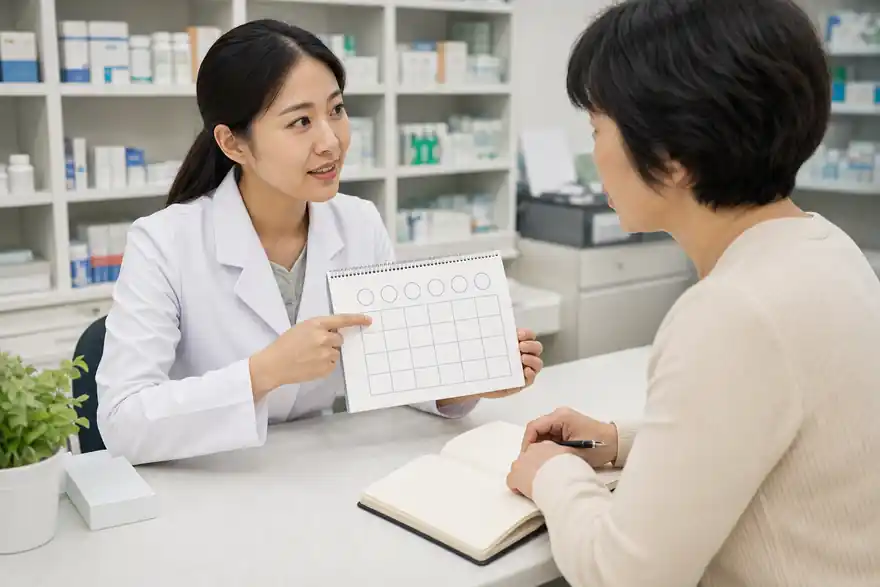
Second, choose one missing category: frequency, amount, meal timing, duration, warning, or storage. Ask only that category. One precise question is easier for the pharmacist to answer.
Third, repeat the answer in a short Korean sentence. For example: 하루에 두 번, 식후에 한 알, 맞아요? You are not giving advice; you are checking whether you understood.
Fourth, ask for written support if needed: 종이에 써 주세요. Written help is especially useful when you are tired, worried, or dealing with several medicines.
Finally, if you have allergy, pregnancy, breastfeeding, another medicine, alcohol, or driving concerns, say the concern directly and let the pharmacist decide what information is relevant.
Practice Routine
Use this routine to make the lesson heavier than simple memorization. Read each Korean sentence, cover the translation, say the meaning, then ask the confirmation question aloud.
| Korean phrase | Meaning | Use |
|---|---|---|
| 하루에 한 번 먹어요. | once a day | Say the Korean, then ask: 맞아요? |
| 하루에 두 번 먹어요. | twice a day | Say the Korean, then ask: 맞아요? |
| 하루에 세 번 먹어요. | three times a day | Say the Korean, then ask: 맞아요? |
| 한 번에 한 알 먹어요. | one pill at a time | Say the Korean, then ask: 맞아요? |
| 한 번에 두 알 먹어요. | two pills at a time | Say the Korean, then ask: 맞아요? |
| 식전에 먹어요. | before meals | Say the Korean, then ask: 맞아요? |
| 식후에 먹어요. | after meals | Say the Korean, then ask: 맞아요? |
| 공복에 먹어요. | on an empty stomach | Say the Korean, then ask: 맞아요? |
| 잠자기 전에 먹어요. | before bedtime | Say the Korean, then ask: 맞아요? |
| 며칠 동안 먹어요? | for how many days | Say the Korean, then ask: 맞아요? |
| 부작용이 있어요? | are there side effects | Say the Korean, then ask: 맞아요? |
| 냉장 보관해야 해요? | keep refrigerated | Say the Korean, then ask: 맞아요? |
| 졸릴 수 있어요? | may cause sleepiness | Say the Korean, then ask: 맞아요? |
| 다른 약이랑 같이 먹어도 돼요? | take with other medicine | Say the Korean, then ask: 맞아요? |
| 제가 맞게 이해했는지 확인해 주세요. | please check my understanding | Say the Korean, then ask: 맞아요? |
Final Safety Boundary
This post teaches Korean communication, not diagnosis, dosage selection, or treatment. For real medicine, follow the pharmacist, doctor, official label, and local emergency guidance.
A good learner does not pretend to understand. A good learner asks again, writes down the key words, and checks the schedule before leaving the pharmacy.
Your success target is simple: before you leave, you can say the frequency, amount, meal timing, duration, and one warning in your own words.
- Can I say the frequency: 하루에 몇 번?
- Can I say the amount: 한 번에 몇 알?
- Can I say the meal timing: 식전 or 식후?
- Can I say the period: 며칠 동안?
- Can I name one warning: 졸림, 운전, 보관, 알레르기?
- Did I ask for writing if I was unsure?
2. Key vocabulary
pharmacy
Beginnerpharmacist
Beginnerprescription
Beginnermedicine
Beginnertaking medicine
Beginner3. Essential phrases
7. Related practical Korean lessons
 Practical Korean
Korean for School Notices and Parent Guidance
6월 19, 2026
Practical Korean
Korean for School Notices and Parent Guidance
6월 19, 2026
 Practical Korean
Korean for Community Centers and Document Issuance
6월 19, 2026
Practical Korean
Korean for Community Centers and Document Issuance
6월 19, 2026
 Practical Korean
Korean for Mobile Phone, Internet, and Repair Consultations
6월 19, 2026
Practical Korean
Korean for Mobile Phone, Internet, and Repair Consultations
6월 19, 2026
 Practical Korean
Korean for Trash Sorting and Apartment Notices
6월 19, 2026
Practical Korean
Korean for Trash Sorting and Apartment Notices
6월 19, 2026
Practice this lesson in the app
Review these words with multiple-choice questions and weak-Learn Korean.
Practice this lesson →
답글 남기기
Please sign in with Google to comment. Sign in with Google