[태그:] Korean absence phrases

  • Cụm từ tiếng Hàn để xin nghỉ ốm, báo vắng mặt và đi muộn

    Cụm từ tiếng Hàn để xin nghỉ ốm, báo vắng mặt và đi muộn

    Workplace Korean

    Cụm từ tiếng Hàn để xin nghỉ ốm, báo vắng mặt và đi muộn

    Học cụm từ tiếng Hàn để báo ốm, đi muộn, vắng mặt, về sớm, đi khám, kiểm tra lịch làm việc và liên lạc với quản lý.

    Worker reporting sick leave and absence to a Korean supervisor
    Cụm từ tiếng Hàn để xin nghỉ ốm, báo vắng mặt và đi muộn

    Download the PPT briefing for this lesson.

    Giới thiệu ngắn

    Bạn thức dậy trước ca làm và thấy người rất mệt. Cổ họng đau, có thể bị sốt, và giờ làm sắp bắt đầu. Bạn cần liên lạc với quản lý bằng tiếng Hàn.

    Trong công việc, chỉ nói 아파요 có thể chưa đủ rõ. Quản lý cần biết bạn sẽ đi muộn, vắng mặt, về sớm, đi khám hay sẽ liên lạc lại sau khi khám.

    Bài học này dạy cụm từ tiếng Hàn để báo nghỉ ốm, vắng mặt và đi muộn cho lao động nước ngoài ở nhà hàng, khách sạn, nhà máy, cửa hàng, vệ sinh và các nơi làm việc khác tại Hàn Quốc.

    Từ vựng chính

    Korean Romanization English Meaning Level Usage Note
    결근 gyeolgeun absence from work Intermediate Not coming to work on a scheduled workday.
    지각 jigak lateness Beginner Arriving later than the scheduled start time.
    조퇴 jotoe leaving work early Intermediate Leaving before the scheduled finish time.
    병가 byeongga sick leave Intermediate Leave because of sickness or medical treatment.
    연차 yeoncha annual leave Intermediate Paid annual leave, usually planned in advance.
    휴가 hyuga leave / vacation Beginner General leave or vacation time away from work.
    몸살 momsal body aches / flu-like sickness Intermediate A common way to describe feeling sick with body aches.
    감기 gamgi cold Beginner A common cold.
    yeol fever Beginner High body temperature.
    병원 byeongwon hospital / clinic Beginner Where you go for medical care.
    진료 jillyo medical consultation Intermediate Seeing a doctor or receiving medical care.
    yak medicine Beginner Medicine or medication.
    연락 yeollak contact Beginner Calling, texting, or notifying someone.
    보고 bogo report Intermediate Reporting a situation to a manager or supervisor.
    근무표 geunmupyo work schedule Intermediate The schedule showing shifts and working days.
    교대 gyodae shift change Intermediate Changing shifts or replacing a shift.
    대체 근무 daeche geunmu replacement work / cover shift Advanced Work done by another person to cover a missing shift.
    출근 chulgeun come to work / start work Beginner Going to work or starting the workday.
    퇴근 toegeun leave work / finish work Beginner Leaving after work is finished.
    확인 hwagin check / confirm Beginner Making sure information is correct.
    관리자 gwallija manager / supervisor Intermediate The person responsible for the shift or workplace.
    사유 sayu reason Advanced The formal reason for absence, lateness, or leave.

    Tình huống làm việc

    Worker checking a phone and shift schedule in a Korean staff room
    Workplace schedule and absence reporting scene in Korea.

    Tiếng Hàn về nghỉ ốm và vắng mặt quan trọng vì lịch làm việc phụ thuộc vào báo cáo rõ ràng. Nếu bạn đi muộn hoặc nghỉ, quản lý có thể phải điều chỉnh 근무표 hoặc tìm 대체 근무.

    Một tin nhắn tốt có ba phần: lý do, vấn đề với ca làm hôm nay và cách liên lạc tiếp theo. 몸이 안 좋아서 오늘 출근이 어렵습니다 cho biết cả lý do và vấn đề công việc.

    Hãy dùng ngôn ngữ lịch sự và trực tiếp. Không cần giải thích quá dài. Các từ 결근, 지각, 조퇴, 병가, 병원, 진료, 연락 và 확인 thường rất hữu ích.

    Cụm từ thường dùng

    Korean Expression Romanization Meaning When to Use
    몸이 안 좋습니다. mom-i an jotseumnida. Tôi không khỏe. Absence / sick leave report
    오늘 출근이 어렵습니다. oneul chulgeun-i eoryeopseumnida. Hôm nay tôi khó đi làm được. Absence / sick leave report
    지각할 것 같습니다. jigak-hal geot gatseumnida. Có lẽ tôi sẽ đến muộn. Absence / sick leave report
    조퇴해도 될까요? jotoe-haedo doelkkayo? Tôi có thể về sớm được không? Absence / sick leave report
    병원에 다녀오겠습니다. byeongwon-e danyeoogetseumnida. Tôi sẽ đi bệnh viện/phòng khám rồi quay lại. Absence / sick leave report
    진료 받고 연락드리겠습니다. jillyo batgo yeollak deurigetseumnida. Tôi sẽ liên lạc sau khi khám bác sĩ. Absence / sick leave report
    근무표 확인 부탁드립니다. geunmupyo hwagin butakdeurimnida. Vui lòng kiểm tra lịch làm việc. Absence / sick leave report
    대체 근무가 필요합니다. daeche geunmu-ga piryo-hamnida. Cần người làm thay ca. Absence / sick leave report
    관리자에게 보고했습니다. gwallija-ege bogo-haetseumnida. Tôi đã báo cáo với quản lý. Absence / sick leave report
    내일 정상 출근하겠습니다. naeil jeongsang chulgeun-hagetseumnida. Ngày mai tôi sẽ đi làm bình thường. Absence / sick leave report

    Ghi chú cách dùng

    결근 nghĩa là không đi làm vào ngày đã có lịch. Từ này trang trọng hơn 못 가요 và phù hợp khi nói với quản lý.

    지각 nghĩa là đi muộn. Nếu biết sẽ muộn, hãy báo trước giờ bắt đầu. 지각할 것 같습니다 là cách báo lịch sự.

    조퇴 nghĩa là về sớm sau khi đã đến làm. 병가 là nghỉ ốm, còn 연차 là nghỉ phép năm thường được lên kế hoạch trước.

    진료 받고 연락드리겠습니다 là cụm rất hữu ích. Nó cho biết bạn sẽ đi khám và liên lạc lại sau.

    Hội thoại ngắn

    Worker: 몸이 안 좋아서 오늘 출근이 어렵습니다.
    Tôi không khỏe nên hôm nay khó đi làm được.

    Manager: 병원에 가야 하나요?
    Bạn cần đi bệnh viện/phòng khám không?

    Worker: 네, 진료 받고 연락드리겠습니다.
    Vâng, tôi sẽ liên lạc sau khi khám bác sĩ.

    Manager: 알겠습니다. 근무표 확인하겠습니다.
    Được rồi. Tôi sẽ kiểm tra lịch làm việc.

    Worker: 내일 정상 출근하겠습니다.
    Ngày mai tôi sẽ đi làm bình thường.

    Lỗi thường gặp

    1. Chỉ nói 아파요
      아파요 nghĩa là đau hoặc bị ốm, nhưng không nói rõ ca làm sẽ thế nào. Hãy thêm 오늘 출근이 어렵습니다, 지각할 것 같습니다 hoặc 조퇴해도 될까요.
    2. Báo quá muộn
      Ở nhiều nơi làm việc tại Hàn Quốc, báo muộn làm ảnh hưởng lịch làm việc. Hãy liên lạc càng sớm càng tốt.
    3. Nhầm 병가 và 연차
      병가 là nghỉ ốm. 연차 là nghỉ phép năm. Quy định mỗi nơi có thể khác nhau.

    Câu luyện tập

    1. 몸이 안 좋습니다.
      mom-i an jotseumnida.
      Tôi không khỏe.
    2. 오늘 출근이 어렵습니다.
      oneul chulgeun-i eoryeopseumnida.
      Hôm nay tôi khó đi làm được.
    3. 지각할 것 같습니다.
      jigak-hal geot gatseumnida.
      Có lẽ tôi sẽ đến muộn.
    4. 조퇴해도 될까요?
      jotoe-haedo doelkkayo?
      Tôi có thể về sớm được không?
    5. 병원에 다녀오겠습니다.
      byeongwon-e danyeoogetseumnida.
      Tôi sẽ đi bệnh viện/phòng khám rồi quay lại.
    6. 진료 받고 연락드리겠습니다.
      jillyo batgo yeollak deurigetseumnida.
      Tôi sẽ liên lạc sau khi khám bác sĩ.
    7. 근무표 확인 부탁드립니다.
      geunmupyo hwagin butakdeurimnida.
      Vui lòng kiểm tra lịch làm việc.
    8. 대체 근무가 필요합니다.
      daeche geunmu-ga piryo-hamnida.
      Cần người làm thay ca.

    Câu hỏi nhanh

    1. Question 1. Từ nào nghĩa là vắng mặt ở nơi làm việc?
      Answer: 결근 nghĩa là vắng mặt/không đi làm.
    2. Question 2. 지각할 것 같습니다 nghĩa là gì?
      Answer: Có lẽ tôi sẽ đến muộn.
    3. Question 3. Nếu cần về sớm, dùng cụm nào?
      Answer: 조퇴해도 될까요?
    4. Question 4. 병가 và 연차 khác nhau thế nào?
      Answer: 병가 là nghỉ ốm. 연차 là nghỉ phép năm.
    5. Question 5. Vì sao 진료 받고 연락드리겠습니다 hữu ích?
      Answer: Vì nó cho biết bạn sẽ đi khám và liên lạc lại sau.

    Bài học liên quan

    Luyện tập thêm
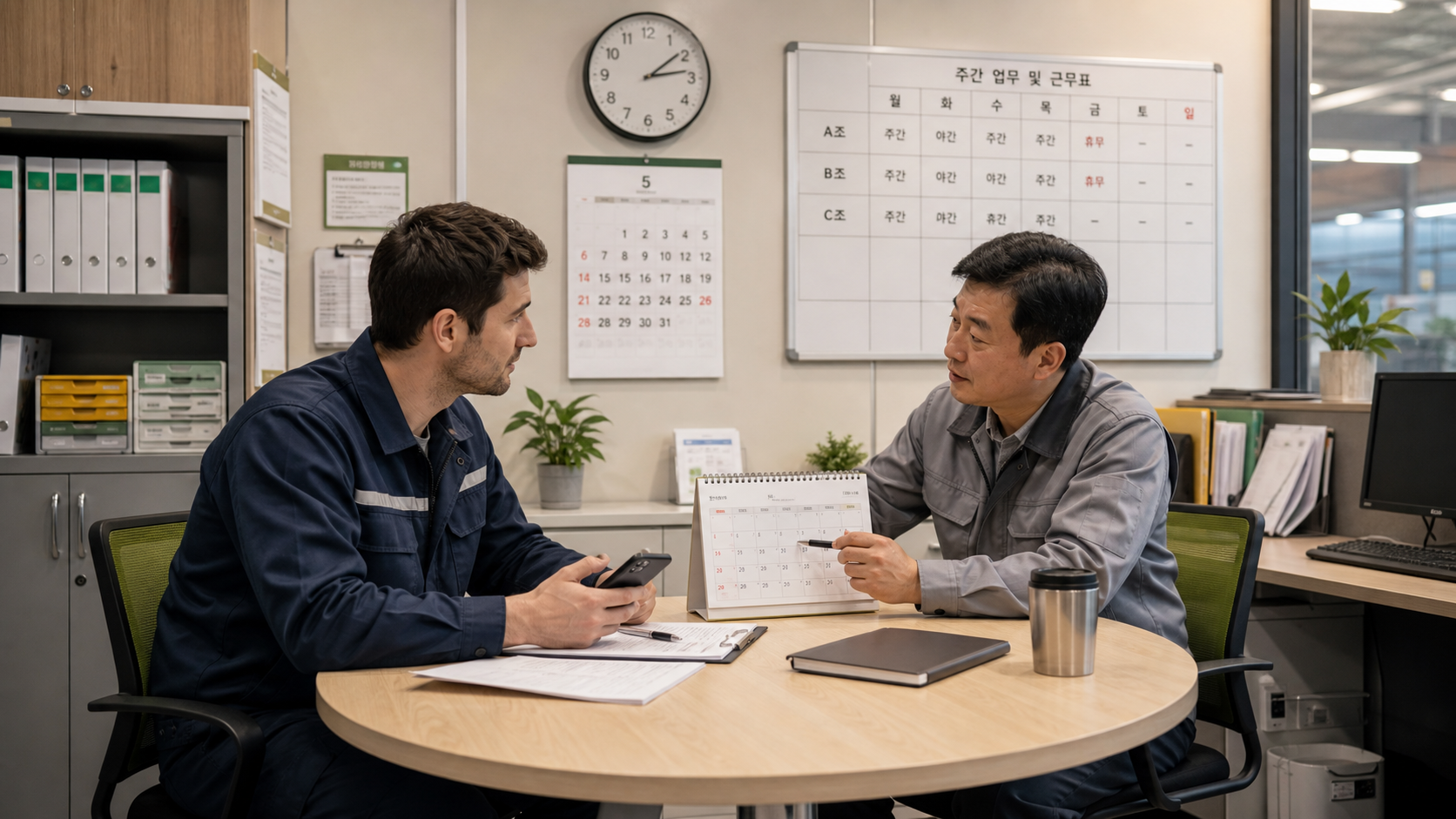
    Supervisor and worker reviewing absence and schedule change in Korea
    Review sick leave and absence Korean after a workplace schedule change.

    Practice this word list in Korean Learn Korean or in the upcoming BSKorean app.

    Tóm tắt nhanh

    Cụm từ tiếng Hàn để báo nghỉ ốm hoặc vắng mặt sẽ dễ hơn nếu bạn báo theo ba bước: lý do, vấn đề với ca làm và liên lạc tiếp theo. Hãy dùng 몸이 안 좋습니다, 오늘 출근이 어렵습니다, 지각할 것 같습니다 hoặc 조퇴해도 될까요 tùy tình huống.

  • วลีเกาหลีสำหรับลาป่วย ขาดงาน และมาสายในที่ทำงาน

    วลีเกาหลีสำหรับลาป่วย ขาดงาน และมาสายในที่ทำงาน

    Workplace Korean

    วลีเกาหลีสำหรับลาป่วย ขาดงาน และมาสายในที่ทำงาน

    เรียนวลีเกาหลีสำหรับแจ้งป่วย มาสาย ขาดงาน กลับก่อนเวลา ไปโรงพยาบาล ตรวจตารางงาน และติดต่อผู้จัดการในที่ทำงาน

    Worker reporting sick leave and absence to a Korean supervisor
    วลีเกาหลีสำหรับลาป่วย ขาดงาน และมาสายในที่ทำงาน

    Download the PPT briefing for this lesson.

    บทนำสั้น

    คุณตื่นก่อนเวลาเข้างานและรู้สึกไม่สบาย ตัวหนัก เจ็บคอ หรืออาจมีไข้ ที่ทำงานใกล้เริ่มงานแล้ว คุณต้องติดต่อผู้จัดการเป็นภาษาเกาหลี

    ในสถานการณ์ทำงาน การพูดแค่ 아파요 อาจไม่พอ ผู้จัดการต้องรู้ว่าคุณจะมาสาย ขาดงาน กลับก่อนเวลา ไปพบแพทย์ หรือจะติดต่อกลับหลังตรวจ

    บทเรียนนี้สอนวลีเกาหลีสำหรับคนทำงานต่างชาติที่ต้องแจ้งลาป่วย ขาดงาน หรือมาสายในร้านอาหาร โรงแรม โรงงาน ร้านค้า งานทำความสะอาด และที่ทำงานอื่นในเกาหลี

    คำศัพท์สำคัญ

    Korean Romanization English Meaning Level Usage Note
    결근 gyeolgeun absence from work Intermediate Not coming to work on a scheduled workday.
    지각 jigak lateness Beginner Arriving later than the scheduled start time.
    조퇴 jotoe leaving work early Intermediate Leaving before the scheduled finish time.
    병가 byeongga sick leave Intermediate Leave because of sickness or medical treatment.
    연차 yeoncha annual leave Intermediate Paid annual leave, usually planned in advance.
    휴가 hyuga leave / vacation Beginner General leave or vacation time away from work.
    몸살 momsal body aches / flu-like sickness Intermediate A common way to describe feeling sick with body aches.
    감기 gamgi cold Beginner A common cold.
    yeol fever Beginner High body temperature.
    병원 byeongwon hospital / clinic Beginner Where you go for medical care.
    진료 jillyo medical consultation Intermediate Seeing a doctor or receiving medical care.
    yak medicine Beginner Medicine or medication.
    연락 yeollak contact Beginner Calling, texting, or notifying someone.
    보고 bogo report Intermediate Reporting a situation to a manager or supervisor.
    근무표 geunmupyo work schedule Intermediate The schedule showing shifts and working days.
    교대 gyodae shift change Intermediate Changing shifts or replacing a shift.
    대체 근무 daeche geunmu replacement work / cover shift Advanced Work done by another person to cover a missing shift.
    출근 chulgeun come to work / start work Beginner Going to work or starting the workday.
    퇴근 toegeun leave work / finish work Beginner Leaving after work is finished.
    확인 hwagin check / confirm Beginner Making sure information is correct.
    관리자 gwallija manager / supervisor Intermediate The person responsible for the shift or workplace.
    사유 sayu reason Advanced The formal reason for absence, lateness, or leave.

    สถานการณ์ทำงาน

    Worker checking a phone and shift schedule in a Korean staff room
    Workplace schedule and absence reporting scene in Korea.

    ภาษาเกาหลีสำหรับการลาป่วยและขาดงานสำคัญเพราะเกี่ยวข้องกับตารางงาน ถ้าคุณมาสายหรือขาดงาน ผู้จัดการอาจต้องปรับ 근무표 หรือหา 대체 근무

    ข้อความที่ดีควรมีสามส่วน คือ เหตุผล ปัญหากับงานวันนี้ และการติดต่อกลับ เช่น 몸이 안 좋아서 오늘 출근이 어렵습니다

    ใช้ภาษาสุภาพและตรงประเด็น ไม่ต้องอธิบายยาว คำอย่าง 결근, 지각, 조퇴, 병가, 병원, 진료, 연락 และ 확인 มักเพียงพอ

    วลีที่ใช้บ่อย

    Korean Expression Romanization Meaning When to Use
    몸이 안 좋습니다. mom-i an jotseumnida. รู้สึกไม่ค่อยสบาย Absence / sick leave report
    오늘 출근이 어렵습니다. oneul chulgeun-i eoryeopseumnida. วันนี้ไปทำงานได้ยาก Absence / sick leave report
    지각할 것 같습니다. jigak-hal geot gatseumnida. น่าจะไปสาย Absence / sick leave report
    조퇴해도 될까요? jotoe-haedo doelkkayo? ขอกลับก่อนเวลาได้ไหม Absence / sick leave report
    병원에 다녀오겠습니다. byeongwon-e danyeoogetseumnida. จะไปโรงพยาบาล/คลินิกแล้วกลับมา Absence / sick leave report
    진료 받고 연락드리겠습니다. jillyo batgo yeollak deurigetseumnida. พบแพทย์แล้วจะติดต่อกลับ Absence / sick leave report
    근무표 확인 부탁드립니다. geunmupyo hwagin butakdeurimnida. กรุณาตรวจตารางงาน Absence / sick leave report
    대체 근무가 필요합니다. daeche geunmu-ga piryo-hamnida. จำเป็นต้องมีคนทำงานแทน Absence / sick leave report
    관리자에게 보고했습니다. gwallija-ege bogo-haetseumnida. รายงานให้ผู้จัดการแล้ว Absence / sick leave report
    내일 정상 출근하겠습니다. naeil jeongsang chulgeun-hagetseumnida. พรุ่งนี้จะไปทำงานตามปกติ Absence / sick leave report

    วิธีใช้และข้อควรระวัง

    결근 หมายถึงไม่มาทำงานในวันที่มีตารางงาน เป็นคำที่เป็นทางการกว่า 못 가요 และเหมาะกับการคุยกับผู้จัดการ

    지각 หมายถึงมาสาย ถ้ารู้ว่าจะมาสาย ควรแจ้งก่อนเวลาเริ่มงาน 지각할 것 같습니다 เป็นประโยคแจ้งที่สุภาพ

    조퇴 หมายถึงกลับก่อนเวลาหลังจากมาทำงานแล้ว 병가 คือการลาป่วย ส่วน 연차 คือวันลาประจำปีที่มักวางแผนล่วงหน้า

    진료 받고 연락드리겠습니다 เป็นประโยคติดตามผลที่ดี แปลว่าจะไปพบแพทย์แล้วติดต่อกลับ

    บทสนทนาสั้น

    Worker: 몸이 안 좋아서 오늘 출근이 어렵습니다.
    ไม่สบาย วันนี้ไปทำงานได้ยาก

    Manager: 병원에 가야 하나요?
    ต้องไปโรงพยาบาล/คลินิกไหม

    Worker: 네, 진료 받고 연락드리겠습니다.
    ครับ/ค่ะ พบแพทย์แล้วจะติดต่อกลับ

    Manager: 알겠습니다. 근무표 확인하겠습니다.
    เข้าใจแล้ว จะตรวจตารางงาน

    Worker: 내일 정상 출근하겠습니다.
    พรุ่งนี้จะไปทำงานตามปกติ

    ข้อผิดพลาดที่พบบ่อย

    1. พูดแค่ 아파요
      아파요 แปลว่าป่วยหรือเจ็บ แต่ไม่บอกว่างานวันนี้จะเป็นอย่างไร ให้เพิ่ม 오늘 출근이 어렵습니다, 지각할 것 같습니다 หรือ 조퇴해도 될까요
    2. แจ้งช้าเกินไป
      ในที่ทำงานเกาหลี การแจ้งช้าทำให้ตารางงานมีปัญหา ควรติดต่อให้เร็วที่สุด
    3. สับสนระหว่าง 병가 และ 연차
      병가 คือการลาป่วย ส่วน 연차 คือวันลาประจำปี กฎของแต่ละที่ทำงานอาจต่างกัน

    ประโยคฝึก

    1. 몸이 안 좋습니다.
      mom-i an jotseumnida.
      รู้สึกไม่ค่อยสบาย
    2. 오늘 출근이 어렵습니다.
      oneul chulgeun-i eoryeopseumnida.
      วันนี้ไปทำงานได้ยาก
    3. 지각할 것 같습니다.
      jigak-hal geot gatseumnida.
      น่าจะไปสาย
    4. 조퇴해도 될까요?
      jotoe-haedo doelkkayo?
      ขอกลับก่อนเวลาได้ไหม
    5. 병원에 다녀오겠습니다.
      byeongwon-e danyeoogetseumnida.
      จะไปโรงพยาบาล/คลินิกแล้วกลับมา
    6. 진료 받고 연락드리겠습니다.
      jillyo batgo yeollak deurigetseumnida.
      พบแพทย์แล้วจะติดต่อกลับ
    7. 근무표 확인 부탁드립니다.
      geunmupyo hwagin butakdeurimnida.
      กรุณาตรวจตารางงาน
    8. 대체 근무가 필요합니다.
      daeche geunmu-ga piryo-hamnida.
      จำเป็นต้องมีคนทำงานแทน

    แบบทดสอบสั้น

    1. Question 1. คำใดหมายถึงขาดงาน
      Answer: 결근 หมายถึงขาดงาน
    2. Question 2. 지각할 것 같습니다 แปลว่าอะไร
      Answer: น่าจะมาสาย
    3. Question 3. ถ้าต้องการกลับก่อนเวลา ใช้วลีใด
      Answer: 조퇴해도 될까요?
    4. Question 4. 병가 กับ 연차 ต่างกันอย่างไร
      Answer: 병가 คือการลาป่วย ส่วน 연차 คือวันลาประจำปี
    5. Question 5. ทำไม 진료 받고 연락드리겠습니다 จึงมีประโยชน์
      Answer: เพราะบอกว่าจะพบแพทย์แล้วติดต่อกลับ

    บทเรียนที่เกี่ยวข้อง

    ฝึกเพิ่มเติม

    Supervisor and worker reviewing absence and schedule change in Korea
    Review sick leave and absence Korean after a workplace schedule change.

    Practice this word list in Korean Learn Korean or in the upcoming BSKorean app.

    สรุปทบทวน

    วลีเกาหลีสำหรับขาดงานหรือลาป่วยจะง่ายขึ้นถ้ารายงานเป็นสามขั้นตอน คือ เหตุผล ปัญหากับงาน และการติดต่อกลับ ใช้ 몸이 안 좋습니다, 오늘 출근이 어렵습니다, 지각할 것 같습니다 หรือ 조퇴해도 될까요 ตามสถานการณ์

  • 外国人労働者のための韓国語:病欠・欠勤・遅刻の伝え方

    外国人労働者のための韓国語:病欠・欠勤・遅刻の伝え方

    Workplace Korean

    外国人労働者のための韓国語:病欠・欠勤・遅刻の伝え方

    韓国の職場で体調不良、遅刻、欠勤、早退、病院受診、勤務表確認、管理者への連絡を伝える韓国語フレーズを学びます。

    Worker reporting sick leave and absence to a Korean supervisor
    外国人労働者のための韓国語:病欠・欠勤・遅刻の伝え方

    Download the PPT briefing for this lesson.

    短い導入

    出勤前に起きたら、体が重く、喉も痛く、熱があるかもしれません。職場の開始時間が近づいています。韓国語で管理者に連絡する必要があります。

    この場面で 아파요 だけを言うと、職場では情報が足りないことがあります。遅刻なのか、欠勤なのか、早退なのか、病院に行くのか、あとで連絡するのかを伝える必要があります。

    このレッスンでは、韓国のレストラン、ホテル、工場、店舗、清掃などで働く外国人のために、病欠、欠勤、遅刻を伝える韓国語を学びます。

    重要語彙

    Korean Romanization English Meaning Level Usage Note
    결근 gyeolgeun absence from work Intermediate Not coming to work on a scheduled workday.
    지각 jigak lateness Beginner Arriving later than the scheduled start time.
    조퇴 jotoe leaving work early Intermediate Leaving before the scheduled finish time.
    병가 byeongga sick leave Intermediate Leave because of sickness or medical treatment.
    연차 yeoncha annual leave Intermediate Paid annual leave, usually planned in advance.
    휴가 hyuga leave / vacation Beginner General leave or vacation time away from work.
    몸살 momsal body aches / flu-like sickness Intermediate A common way to describe feeling sick with body aches.
    감기 gamgi cold Beginner A common cold.
    yeol fever Beginner High body temperature.
    병원 byeongwon hospital / clinic Beginner Where you go for medical care.
    진료 jillyo medical consultation Intermediate Seeing a doctor or receiving medical care.
    yak medicine Beginner Medicine or medication.
    연락 yeollak contact Beginner Calling, texting, or notifying someone.
    보고 bogo report Intermediate Reporting a situation to a manager or supervisor.
    근무표 geunmupyo work schedule Intermediate The schedule showing shifts and working days.
    교대 gyodae shift change Intermediate Changing shifts or replacing a shift.
    대체 근무 daeche geunmu replacement work / cover shift Advanced Work done by another person to cover a missing shift.
    출근 chulgeun come to work / start work Beginner Going to work or starting the workday.
    퇴근 toegeun leave work / finish work Beginner Leaving after work is finished.
    확인 hwagin check / confirm Beginner Making sure information is correct.
    관리자 gwallija manager / supervisor Intermediate The person responsible for the shift or workplace.
    사유 sayu reason Advanced The formal reason for absence, lateness, or leave.

    場面説明

    Worker checking a phone and shift schedule in a Korean staff room
    Workplace schedule and absence reporting scene in Korea.

    病欠や欠勤の韓国語は、勤務表と人員配置に関係します。遅刻や欠勤があると、管理者は 근무표 を調整したり 대체 근무 を探したりします。

    よい連絡は、理由、今日の勤務への影響、次の連絡の三つを含みます。몸이 안 좋아서 오늘 출근이 어렵습니다 は理由と勤務への影響を同時に伝えます。

    長い説明は必要ありません。결근, 지각, 조퇴, 병가, 병원, 진료, 연락, 확인 などを使って、短く丁寧に伝えます。

    よく使う表現

    Korean Expression Romanization Meaning When to Use
    몸이 안 좋습니다. mom-i an jotseumnida. 体調がよくありません。 Absence / sick leave report
    오늘 출근이 어렵습니다. oneul chulgeun-i eoryeopseumnida. 今日は出勤が難しいです。 Absence / sick leave report
    지각할 것 같습니다. jigak-hal geot gatseumnida. 遅刻しそうです。 Absence / sick leave report
    조퇴해도 될까요? jotoe-haedo doelkkayo? 早退してもよろしいですか。 Absence / sick leave report
    병원에 다녀오겠습니다. byeongwon-e danyeoogetseumnida. 病院に行ってきます。 Absence / sick leave report
    진료 받고 연락드리겠습니다. jillyo batgo yeollak deurigetseumnida. 診察を受けてから連絡します。 Absence / sick leave report
    근무표 확인 부탁드립니다. geunmupyo hwagin butakdeurimnida. 勤務表の確認をお願いします。 Absence / sick leave report
    대체 근무가 필요합니다. daeche geunmu-ga piryo-hamnida. 代替勤務が必要です。 Absence / sick leave report
    관리자에게 보고했습니다. gwallija-ege bogo-haetseumnida. 管理者に報告しました。 Absence / sick leave report
    내일 정상 출근하겠습니다. naeil jeongsang chulgeun-hagetseumnida. 明日は通常どおり出勤します。 Absence / sick leave report

    使い方の注意

    결근 は予定された勤務日に出勤しないことです。못 가요 より職場向けで、管理者に話す時に使いやすいです。

    지각 は遅刻です。遅れそうだと分かったら、開始時間の前に連絡します。지각할 것 같습니다 は自然な報告表現です。

    조퇴 は出勤後に早く帰ることです。병가 は病気による休暇、연차 は通常事前に予定する年次休暇です。

    진료 받고 연락드리겠습니다 は、病院で診察を受けた後にもう一度連絡すると伝える便利な表現です。

    ミニ会話

    Worker: 몸이 안 좋아서 오늘 출근이 어렵습니다.
    体調が悪いので、今日は出勤が難しいです。

    Manager: 병원에 가야 하나요?
    病院に行く必要がありますか。

    Worker: 네, 진료 받고 연락드리겠습니다.
    はい、診察を受けてから連絡します。

    Manager: 알겠습니다. 근무표 확인하겠습니다.
    分かりました。勤務表を確認します。

    Worker: 내일 정상 출근하겠습니다.
    明日は通常どおり出勤します。

    よくある間違い

    1. 아파요 だけで終わる
      아파요 は体調不良を表しますが、勤務をどうするのかは分かりません。오늘 출근이 어렵습니다 や 지각할 것 같습니다 を加えます。
    2. 連絡が遅すぎる
      韓国の職場では、遅い連絡が勤務表に影響します。できるだけ早く連絡しましょう。
    3. 병가 と 연차 を混同する
      병가 は病気による休暇、연차 は年次休暇です。職場の規則に従って正しい言葉を使います。

    練習文

    1. 몸이 안 좋습니다.
      mom-i an jotseumnida.
      体調がよくありません。
    2. 오늘 출근이 어렵습니다.
      oneul chulgeun-i eoryeopseumnida.
      今日は出勤が難しいです。
    3. 지각할 것 같습니다.
      jigak-hal geot gatseumnida.
      遅刻しそうです。
    4. 조퇴해도 될까요?
      jotoe-haedo doelkkayo?
      早退してもよろしいですか。
    5. 병원에 다녀오겠습니다.
      byeongwon-e danyeoogetseumnida.
      病院に行ってきます。
    6. 진료 받고 연락드리겠습니다.
      jillyo batgo yeollak deurigetseumnida.
      診察を受けてから連絡します。
    7. 근무표 확인 부탁드립니다.
      geunmupyo hwagin butakdeurimnida.
      勤務表の確認をお願いします。
    8. 대체 근무가 필요합니다.
      daeche geunmu-ga piryo-hamnida.
      代替勤務が必要です。

    クイッククイズ

    1. Question 1. 결근 は何という意味ですか。
      Answer: 欠勤、仕事を休むことです。
    2. Question 2. 지각할 것 같습니다 は何という意味ですか。
      Answer: 遅刻しそうです。
    3. Question 3. 早退したい時に使う表現は何ですか。
      Answer: 조퇴해도 될까요?
    4. Question 4. 병가 と 연차 の違いは何ですか。
      Answer: 병가 は病気休暇、연차 は年次休暇です。
    5. Question 5. 진료 받고 연락드리겠습니다 はなぜ便利ですか。
      Answer: 診察後にもう一度連絡すると伝えられるからです。

    関連レッスン

    さらに練習

    Supervisor and worker reviewing absence and schedule change in Korea
    Review sick leave and absence Korean after a workplace schedule change.

    Practice this word list in Korean Learn Korean or in the upcoming BSKorean app.

    クイックレビュー

    韓国語で欠勤や病欠を伝える時は、理由、勤務への影響、次の連絡の順で言うと分かりやすくなります。몸이 안 좋습니다, 오늘 출근이 어렵습니다, 지각할 것 같습니다, 조퇴해도 될까요 を状況に合わせて使いましょう。

  • Frasa Korea untuk Sakit, Izin, dan Tidak Masuk Kerja

    Frasa Korea untuk Sakit, Izin, dan Tidak Masuk Kerja

    Workplace Korean

    Frasa Korea untuk Sakit, Izin, dan Tidak Masuk Kerja

    Pelajari frasa Korea untuk sakit, terlambat, tidak masuk kerja, pulang lebih awal, pergi ke klinik, cek jadwal, dan melapor ke manajer.

    Worker reporting sick leave and absence to a Korean supervisor
    Frasa Korea untuk Sakit, Izin, dan Tidak Masuk Kerja

    Download the PPT briefing for this lesson.

    Pengantar Singkat

    Anda bangun sebelum shift dan badan terasa berat. Tenggorokan sakit, mungkin demam, dan tempat kerja akan segera mulai. Anda perlu menghubungi manajer dalam bahasa Korea.

    Dalam situasi kerja, mengatakan 아파요 saja sering terlalu umum. Manajer perlu tahu apakah Anda terlambat, tidak masuk, pulang lebih awal, pergi ke klinik, atau akan menghubungi lagi setelah diperiksa.

    Pelajaran ini mengajarkan frasa Korea untuk izin sakit, terlambat, dan tidak masuk kerja bagi pekerja asing di restoran, hotel, pabrik, toko, cleaning, dan tempat kerja lain di Korea.

    Kosakata Utama

    Korean Romanization English Meaning Level Usage Note
    결근 gyeolgeun absence from work Intermediate Not coming to work on a scheduled workday.
    지각 jigak lateness Beginner Arriving later than the scheduled start time.
    조퇴 jotoe leaving work early Intermediate Leaving before the scheduled finish time.
    병가 byeongga sick leave Intermediate Leave because of sickness or medical treatment.
    연차 yeoncha annual leave Intermediate Paid annual leave, usually planned in advance.
    휴가 hyuga leave / vacation Beginner General leave or vacation time away from work.
    몸살 momsal body aches / flu-like sickness Intermediate A common way to describe feeling sick with body aches.
    감기 gamgi cold Beginner A common cold.
    yeol fever Beginner High body temperature.
    병원 byeongwon hospital / clinic Beginner Where you go for medical care.
    진료 jillyo medical consultation Intermediate Seeing a doctor or receiving medical care.
    yak medicine Beginner Medicine or medication.
    연락 yeollak contact Beginner Calling, texting, or notifying someone.
    보고 bogo report Intermediate Reporting a situation to a manager or supervisor.
    근무표 geunmupyo work schedule Intermediate The schedule showing shifts and working days.
    교대 gyodae shift change Intermediate Changing shifts or replacing a shift.
    대체 근무 daeche geunmu replacement work / cover shift Advanced Work done by another person to cover a missing shift.
    출근 chulgeun come to work / start work Beginner Going to work or starting the workday.
    퇴근 toegeun leave work / finish work Beginner Leaving after work is finished.
    확인 hwagin check / confirm Beginner Making sure information is correct.
    관리자 gwallija manager / supervisor Intermediate The person responsible for the shift or workplace.
    사유 sayu reason Advanced The formal reason for absence, lateness, or leave.

    Situasi Kerja

    Worker checking a phone and shift schedule in a Korean staff room
    Workplace schedule and absence reporting scene in Korea.

    Frasa sakit dan izin kerja penting karena jadwal kerja bergantung pada laporan yang jelas. Jika Anda terlambat atau tidak masuk, manajer mungkin perlu mengubah 근무표 atau mencari 대체 근무.

    Pesan yang baik memiliki tiga bagian: alasan, masalah kerja hari itu, dan tindak lanjut. Contohnya 몸이 안 좋아서 오늘 출근이 어렵습니다.

    Gunakan bahasa yang sopan dan langsung. Tidak perlu penjelasan panjang. Kata seperti 결근, 지각, 조퇴, 병가, 병원, 진료, 연락, dan 확인 biasanya cukup.

    Ekspresi Umum

    Korean Expression Romanization Meaning When to Use
    몸이 안 좋습니다. mom-i an jotseumnida. Saya sedang tidak enak badan. Absence / sick leave report
    오늘 출근이 어렵습니다. oneul chulgeun-i eoryeopseumnida. Hari ini saya sulit masuk kerja. Absence / sick leave report
    지각할 것 같습니다. jigak-hal geot gatseumnida. Sepertinya saya akan terlambat. Absence / sick leave report
    조퇴해도 될까요? jotoe-haedo doelkkayo? Bolehkah saya pulang lebih awal? Absence / sick leave report
    병원에 다녀오겠습니다. byeongwon-e danyeoogetseumnida. Saya akan pergi ke klinik/rumah sakit lalu kembali. Absence / sick leave report
    진료 받고 연락드리겠습니다. jillyo batgo yeollak deurigetseumnida. Saya akan menghubungi setelah diperiksa dokter. Absence / sick leave report
    근무표 확인 부탁드립니다. geunmupyo hwagin butakdeurimnida. Mohon cek jadwal kerja. Absence / sick leave report
    대체 근무가 필요합니다. daeche geunmu-ga piryo-hamnida. Perlu pengganti shift. Absence / sick leave report
    관리자에게 보고했습니다. gwallija-ege bogo-haetseumnida. Saya sudah melapor kepada manajer. Absence / sick leave report
    내일 정상 출근하겠습니다. naeil jeongsang chulgeun-hagetseumnida. Besok saya akan masuk kerja seperti biasa. Absence / sick leave report

    Catatan Penggunaan

    결근 berarti tidak masuk pada hari kerja yang sudah dijadwalkan. Kata ini lebih formal daripada 못 가요 dan cocok saat berbicara dengan manajer.

    지각 berarti terlambat. Jika Anda tahu akan terlambat, laporkan sebelum jam mulai. 지각할 것 같습니다 lebih baik daripada menunggu sampai shift sudah dimulai.

    조퇴 berarti pulang lebih awal setelah sudah datang bekerja. 병가 berarti izin sakit, sedangkan 연차 adalah cuti tahunan yang biasanya direncanakan.

    진료 받고 연락드리겠습니다 berguna sebagai tindak lanjut. Artinya Anda akan diperiksa dokter dan menghubungi lagi.

    Dialog Singkat

    Worker: 몸이 안 좋아서 오늘 출근이 어렵습니다.
    Saya tidak enak badan, jadi hari ini sulit masuk kerja.

    Manager: 병원에 가야 하나요?
    Apakah perlu pergi ke klinik/rumah sakit?

    Worker: 네, 진료 받고 연락드리겠습니다.
    Ya, saya akan menghubungi setelah diperiksa dokter.

    Manager: 알겠습니다. 근무표 확인하겠습니다.
    Baik. Saya akan cek jadwal kerja.

    Worker: 내일 정상 출근하겠습니다.
    Besok saya akan masuk kerja seperti biasa.

    Kesalahan Umum

    1. Hanya mengatakan 아파요
      아파요 berarti sakit, tetapi tidak menjelaskan apa yang terjadi pada shift Anda. Tambahkan 오늘 출근이 어렵습니다, 지각할 것 같습니다, atau 조퇴해도 될까요.
    2. Melapor terlalu terlambat
      Di banyak tempat kerja Korea, laporan terlambat membuat jadwal bermasalah. Hubungi manajer sedini mungkin.
    3. Mencampur 병가 dan 연차
      병가 adalah izin sakit. 연차 adalah cuti tahunan. Aturan tiap tempat kerja bisa berbeda, jadi gunakan kata yang tepat.

    Kalimat Latihan

    1. 몸이 안 좋습니다.
      mom-i an jotseumnida.
      Saya sedang tidak enak badan.
    2. 오늘 출근이 어렵습니다.
      oneul chulgeun-i eoryeopseumnida.
      Hari ini saya sulit masuk kerja.
    3. 지각할 것 같습니다.
      jigak-hal geot gatseumnida.
      Sepertinya saya akan terlambat.
    4. 조퇴해도 될까요?
      jotoe-haedo doelkkayo?
      Bolehkah saya pulang lebih awal?
    5. 병원에 다녀오겠습니다.
      byeongwon-e danyeoogetseumnida.
      Saya akan pergi ke klinik/rumah sakit lalu kembali.
    6. 진료 받고 연락드리겠습니다.
      jillyo batgo yeollak deurigetseumnida.
      Saya akan menghubungi setelah diperiksa dokter.
    7. 근무표 확인 부탁드립니다.
      geunmupyo hwagin butakdeurimnida.
      Mohon cek jadwal kerja.
    8. 대체 근무가 필요합니다.
      daeche geunmu-ga piryo-hamnida.
      Perlu pengganti shift.

    Kuis Cepat

    1. Question 1. Kata apa yang berarti tidak masuk kerja?
      Answer: 결근 berarti tidak masuk kerja.
    2. Question 2. Apa arti 지각할 것 같습니다?
      Answer: Sepertinya saya akan terlambat.
    3. Question 3. Frasa apa untuk meminta pulang lebih awal?
      Answer: 조퇴해도 될까요?
    4. Question 4. Apa perbedaan 병가 dan 연차?
      Answer: 병가 adalah izin sakit. 연차 adalah cuti tahunan.
    5. Question 5. Mengapa 진료 받고 연락드리겠습니다 berguna?
      Answer: Karena memberi tahu manajer bahwa Anda akan diperiksa dan menghubungi lagi.

    Pelajaran Terkait

    Latihan Lanjutan

    Supervisor and worker reviewing absence and schedule change in Korea
    Review sick leave and absence Korean after a workplace schedule change.

    Practice this word list in Korean Learn Korean or in the upcoming BSKorean app.

    Ringkasan Cepat

    Frasa Korea untuk sakit dan izin kerja lebih mudah jika dilaporkan dalam tiga langkah: alasan, masalah kerja, dan tindak lanjut. Gunakan 몸이 안 좋습니다, 오늘 출근이 어렵습니다, 지각할 것 같습니다, atau 조퇴해도 될까요 sesuai situasi.

  • Korean Workplace Sick Leave and Absence Phrases for Foreign Workers

    Korean Workplace Sick Leave and Absence Phrases for Foreign Workers

    Workplace Korean

    Korean Workplace Sick Leave and Absence Phrases for Foreign Workers

    Learn Korean sick leave phrases for reporting illness, lateness, absence, early leave, hospital visits, schedule checks, and manager follow-up at work.

    Worker reporting sick leave and absence to a Korean supervisor
    Korean Workplace Sick Leave and Absence Phrases for Foreign Workers

    Download the PPT briefing for this lesson.

    Short Introduction

    You wake up before your shift and your body feels heavy. Your throat hurts, you may have a fever, and your workplace opens soon. You need to contact your manager in Korean.

    In this situation, saying only 아파요 can be too vague for work. Your manager needs to know whether you will be late, absent, leave early, visit a clinic, or contact them again after treatment.

    This lesson teaches Korean sick leave phrases for foreign workers in restaurants, hotels, factories, stores, cleaning jobs, and other workplaces in Korea.

    The goal is not to explain your whole medical condition. The goal is to give your workplace enough information to protect the shift, check the schedule, and decide what should happen next.

    Key Vocabulary

    Korean Romanization English Meaning Level Usage Note
    결근 gyeolgeun absence from work Intermediate Not coming to work on a scheduled workday.
    지각 jigak lateness Beginner Arriving later than the scheduled start time.
    조퇴 jotoe leaving work early Intermediate Leaving before the scheduled finish time.
    병가 byeongga sick leave Intermediate Leave because of sickness or medical treatment.
    연차 yeoncha annual leave Intermediate Paid annual leave, usually planned in advance.
    휴가 hyuga leave / vacation Beginner General leave or vacation time away from work.
    몸살 momsal body aches / flu-like sickness Intermediate A common way to describe feeling sick with body aches.
    감기 gamgi cold Beginner A common cold.
    yeol fever Beginner High body temperature.
    병원 byeongwon hospital / clinic Beginner Where you go for medical care.
    진료 jillyo medical consultation Intermediate Seeing a doctor or receiving medical care.
    yak medicine Beginner Medicine or medication.
    연락 yeollak contact Beginner Calling, texting, or notifying someone.
    보고 bogo report Intermediate Reporting a situation to a manager or supervisor.
    근무표 geunmupyo work schedule Intermediate The schedule showing shifts and working days.
    교대 gyodae shift change Intermediate Changing shifts or replacing a shift.
    대체 근무 daeche geunmu replacement work / cover shift Advanced Work done by another person to cover a missing shift.
    출근 chulgeun come to work / start work Beginner Going to work or starting the workday.
    퇴근 toegeun leave work / finish work Beginner Leaving after work is finished.
    확인 hwagin check / confirm Beginner Making sure information is correct.
    관리자 gwallija manager / supervisor Intermediate The person responsible for the shift or workplace.
    사유 sayu reason Advanced The formal reason for absence, lateness, or leave.

    Situation Briefing

    Worker checking a phone and shift schedule in a Korean staff room
    Workplace schedule and absence reporting scene in Korea.

    Absence and sick leave Korean is important because work schedules depend on clear reporting. If you are late or absent, the manager may need to adjust the 근무표, find 대체 근무, or tell another worker to cover your position.

    A good message has three parts: the reason, the work problem, and the follow-up. For example, 몸이 안 좋아서 오늘 출근이 어렵습니다 gives both the reason and the work problem.

    Use polite and direct language. You do not need a long explanation. A short message with 결근, 지각, 조퇴, 병가, 병원, 진료, 연락, and 확인 is usually enough.

    In a service job, one missing worker can affect opening, cleaning, delivery, checkout, or customer service. In a field or factory job, absence can affect safety, machine operation, packing, inspection, loading, or handover. This is why Korean workplace sick leave messages should be short, early, and specific.

    A safe reporting formula is: condition + work impact + next action. For example: 몸이 안 좋습니다. 오늘 출근이 어렵습니다. 진료 받고 연락드리겠습니다. This sounds polite, clear, and useful for a manager.

    Common Expressions

    Korean Expression Romanization Meaning When to Use
    몸이 안 좋습니다. mom-i an jotseumnida. I do not feel well. Absence / sick leave report
    오늘 출근이 어렵습니다. oneul chulgeun-i eoryeopseumnida. I cannot come to work today. Absence / sick leave report
    지각할 것 같습니다. jigak-hal geot gatseumnida. I think I will be late. Absence / sick leave report
    조퇴해도 될까요? jotoe-haedo doelkkayo? May I leave early? Absence / sick leave report
    병원에 다녀오겠습니다. byeongwon-e danyeoogetseumnida. I will go to the hospital or clinic and come back. Absence / sick leave report
    진료 받고 연락드리겠습니다. jillyo batgo yeollak deurigetseumnida. I will contact you after seeing the doctor. Absence / sick leave report
    근무표 확인 부탁드립니다. geunmupyo hwagin butakdeurimnida. Please check the work schedule. Absence / sick leave report
    대체 근무가 필요합니다. daeche geunmu-ga piryo-hamnida. A replacement shift is needed. Absence / sick leave report
    관리자에게 보고했습니다. gwallija-ege bogo-haetseumnida. I reported it to the manager. Absence / sick leave report
    내일 정상 출근하겠습니다. naeil jeongsang chulgeun-hagetseumnida. I will come to work normally tomorrow. Absence / sick leave report

    Usage Notes

    결근 means you do not come to work on a scheduled workday. It sounds more formal than simply saying 못 가요, so it is useful when talking to a manager.

    지각 means being late. If you know you will be late, report before the start time. 지각할 것 같습니다 is safer than waiting until after the shift begins.

    조퇴 means leaving early after you already came to work. 병가 is leave because of sickness, while 연차 is planned annual leave. Do not use 연차 when you suddenly cannot work because you are sick unless your workplace tells you to use annual leave.

    진료 받고 연락드리겠습니다 is a useful follow-up phrase. It tells the manager that you will see a doctor and contact them again.

    관리자에게 보고했습니다 is useful when you already told the responsible person. If a coworker asks why you are not on the floor, you can say 관리자에게 보고했습니다 instead of repeating private health details.

    대체 근무 is an advanced workplace phrase. You may hear it when a manager says another person needs to cover your shift. You do not need to use it in every message, but you should understand it when the workplace discusses schedule changes.

    사유 is a formal word for reason. In a casual chat, people may ask 왜요? But on a form, in a manager message, or in a schedule record, you may see 결근 사유, 지각 사유, or 조퇴 사유.

    Mini Dialogue

    Worker: 몸이 안 좋아서 오늘 출근이 어렵습니다.
    I do not feel well, so I cannot come to work today.

    Manager: 병원에 가야 하나요?
    Do you need to go to the hospital or clinic?

    Worker: 네, 진료 받고 연락드리겠습니다.
    Yes, I will contact you after seeing the doctor.

    Manager: 알겠습니다. 근무표 확인하겠습니다.
    Understood. I will check the work schedule.

    Worker: 내일 정상 출근하겠습니다.
    I will come to work normally tomorrow.

    Common Mistakes

    1. Saying only 아파요
      아파요 means “I am sick” or “it hurts,” but it does not tell the manager what will happen to your shift. Add 오늘 출근이 어렵습니다, 지각할 것 같습니다, or 조퇴해도 될까요.
    2. Reporting too late
      In many Korean workplaces, late reporting creates schedule problems. Send a message as early as possible so the manager can adjust the 근무표.
    3. Confusing 병가 and 연차
      병가 is sick leave. 연차 is annual leave. The rules depend on the workplace, so use the correct word and follow the manager’s instruction.
    4. Using casual language with a supervisor
      괜찮으면 오늘 못 가요 can sound too casual. Use polite workplace Korean such as 오늘 출근이 어렵습니다 or 진료 받고 연락드리겠습니다.
    5. Forgetting the follow-up
      If you go to a clinic, tell the manager what you will do next. 진료 받고 연락드리겠습니다 gives a clear next step and reduces confusion.

    Practice Sentences

    1. 몸이 안 좋습니다.
      mom-i an jotseumnida.
      I do not feel well.
    2. 오늘 출근이 어렵습니다.
      oneul chulgeun-i eoryeopseumnida.
      I cannot come to work today.
    3. 지각할 것 같습니다.
      jigak-hal geot gatseumnida.
      I think I will be late.
    4. 조퇴해도 될까요?
      jotoe-haedo doelkkayo?
      May I leave early?
    5. 병원에 다녀오겠습니다.
      byeongwon-e danyeoogetseumnida.
      I will go to the hospital or clinic and come back.
    6. 진료 받고 연락드리겠습니다.
      jillyo batgo yeollak deurigetseumnida.
      I will contact you after seeing the doctor.
    7. 근무표 확인 부탁드립니다.
      geunmupyo hwagin butakdeurimnida.
      Please check the work schedule.
    8. 대체 근무가 필요합니다.
      daeche geunmu-ga piryo-hamnida.
      A replacement shift is needed.

    Quick Quiz

    1. Question 1. Which word means absence from work?
      Answer: 결근 means absence from work.
    2. Question 2. What does 지각할 것 같습니다 mean?
      Answer: It means “I think I will be late.”
    3. Question 3. Which phrase should you use if you need to leave early?
      Answer: 조퇴해도 될까요?
    4. Question 4. What is the difference between 병가 and 연차?
      Answer: 병가 is sick leave. 연차 is annual leave.
    5. Question 5. Why should you say 진료 받고 연락드리겠습니다?
      Answer: It tells the manager that you will see a doctor and follow up later.

    Related Lessons

    Practice More

    Supervisor and worker reviewing absence and schedule change in Korea
    Review sick leave and absence Korean after a workplace schedule change.

    Practice this word list in Korean Learn Korean or in the upcoming BSKorean app.

    Quick Review

    Korean workplace absence phrases become easier when you report the situation in three steps: reason, work problem, and follow-up. Use 몸이 안 좋습니다, 오늘 출근이 어렵습니다, 지각할 것 같습니다, or 조퇴해도 될까요. Then mention 병원, 진료, 연락, and 근무표 if needed.