[태그:] Korean learning article

  • Korean Delivery App Words: A Briefing-Style Lesson

    Korean Delivery App Words: A Briefing-Style Lesson

    Use this delivery app lesson first

    Delivery app Korean starts with the address and order status. Learn 배달 주소, 주문했어요, 도착 예정, and 문 앞에 놓아 주세요 before you need to message the rider.

    Delivery need Korean Meaning
    Address 배달 주소 Delivery address
    Ordered 주문했어요 I placed an order.
    Arrival 도착 예정 Expected arrival
    Door drop-off 문 앞에 놓아 주세요 Please leave it at the door.

    If the food or item is wrong, save the order number and receipt. For everyday shopping words, continue with convenience store checkout words and mobile phone store words.

    Korean delivery app words guide

    Korean delivery app words helps learners practice Korean words in real situations. This BSKorean post keeps the lesson clear, scannable, and connected to app practice.

    Practice in the BSKorean app

    Related lessons

    Briefing Summary

    Korean delivery app words help you order food without reading every line on the screen. In this lesson, you will follow a five-slide briefing from choosing a menu to checking the delivery address, payment, requests, and arrival time. The goal is simple: recognize the words that change what you tap next.

    Download the complete Korean delivery app words PPT briefing

    Text-free illustration for Korean delivery app words on BSKorean.
    Slide 1 introduces the delivery situation.

    Slide 1. The Situation

    You are at home in Korea, hungry, and using a delivery app. The screen may look busy, but most decisions follow a clear order. First, you choose a restaurant and a menu. Then you check the cart, coupon, delivery address, requests, payment, delivery fee, and arrival time. This slide shows the final moment at the door because that is the whole point of the app flow. You are not studying abstract vocabulary. You are reading enough Korean to make the delivery reach the right place.

    For beginners, the safest habit is to read labels by function. If a word changes the food, price, address, or time, pause and check it. If it only describes a promotion or extra detail, you can return to it later.

    Slide 2. Key Delivery App Words

    This slide turns the app screen into a small map. These Korean delivery app words appear before or after payment, so they are worth learning as one set. Read the table from left to right, then connect each word to the action it controls.

    Korean Romanization English Usage
    배달 baedal delivery Use this as the broad label for food delivery or delivered items.
    주문 jumun order This marks the order itself, not the food category.
    메뉴 menyu menu Look for this before choosing a dish or a set.
    장바구니 jangbaguni shopping cart This is the app basket where selected items wait before payment.
    쿠폰 kupon coupon Apps often show this near payment, discount, or event banners.
    할인 harin discount Read this before payment to see whether the price went down.
    결제 gyeolje payment This is the final payment step, usually after checking the cart.
    결제수단 gyeolje sudan payment method This asks how you will pay, such as card, app pay, or cash.
    배송지 baesongji delivery address Check this carefully before paying because it controls where the order goes.
    요청사항 yocheong sahang requests Use this field for short instructions, such as sauce, utensils, or door delivery.
    도착시간 dochak sigan arrival time This tells when the order or rider is expected to arrive.
    취소요청 chwiso yocheong cancellation request This is used when you ask to cancel after an order has been sent.
    배송비 baesongbi delivery fee This is the extra fee added for delivery or shipping.

    배달 is the broad idea of delivery. 주문 is the order you are making. 메뉴 is where the food choice begins. 장바구니 holds the items before you pay. After that, 결제, 결제수단, and 배송지 become important because they affect money and location.

    Think of the words in small groups. 메뉴 and 장바구니 belong to the choosing stage. 쿠폰, 할인, 배송비, and 결제 belong to the price stage. 배송지, 요청사항, and 도착시간 belong to the delivery stage. This grouping is useful because Korean apps often move quickly from one screen to the next.

    When you see a familiar word, do not tap immediately. First, ask what the word controls. Does it change the food? Does it change the address? Does it change the amount you will pay? This habit protects beginners from the two most common delivery mistakes: paying with the wrong address or accepting a final price they did not check.

    Slide 3. Reading Formulas

    Delivery apps often use short labels instead of full sentences. That is helpful for learners. A label tells you what kind of information follows. For example, 메뉴 선택 means menu selection. 쿠폰 적용 means coupon application. 결제수단 선택 asks you to choose a payment method. The pattern is usually noun plus action.

    Formula 1: item + 선택

    When you see 선택, the app wants you to choose something. It may be a menu, option, address, or payment method.

    Formula 2: coupon or discount + 적용

    적용 means apply. In delivery apps, it often appears with 쿠폰 or 할인.

    Formula 3: delivery + time or fee

    도착시간 and 배송비 both change your decision. One affects when you eat. The other affects the final price.

    Many labels also combine a noun with a short action word. 확인 means check or confirm. 입력 means enter. 변경 means change. Even if those action words are not in today’s main table, you will often see them next to the selected vocabulary. For example, 배송지 확인 asks you to check the delivery address. 요청사항 입력 asks you to enter a request.

    For learners, this formula style is good news. You do not need to read a long Korean sentence to understand the task. Find the main noun first, then read the action after it. If the noun is 결제수단, the app is about payment. If the noun is 도착시간, the app is about timing.

    Slide 4. Read Delivery App in 3 Steps

    Use this slide when the screen feels crowded. Step one is the food decision. Read 메뉴, then move the item into 장바구니. Do not rush to payment before checking the quantity and options. Step two is the delivery decision. Confirm 배송지, add 요청사항 if needed, and look at 도착시간. Step three is the money decision. Look for 쿠폰, 할인, 배송비, 결제수단, and finally 결제.

    This order reduces mistakes because it follows the real order process. Food first, place and time second, money last. If you only memorize words, the screen still feels noisy. If you read by step, the app becomes manageable.

    The three-step method also works when the app updates after payment. Once the order is accepted, you will no longer focus on 메뉴 or 장바구니. Your attention moves to 도착시간, delivery status, and possible messages from the rider or restaurant. If something is wrong, read carefully before tapping 취소요청. A request is not the same as a confirmed cancellation.

    If you are ordering at night or from a new address, slow down at the delivery detail step. Apartment names, building numbers, and room numbers matter in Korea. A correct 배송지 saves more time than any coupon.

    Slide 5. Mistakes and Practice

    The first common mistake is confusing 배송지 with your current location. The app may save an old address, so always check it before payment. The second mistake is ignoring 배송비. The food price and final price can differ after fees. The third mistake is writing long requests in 요청사항. Keep requests short and practical.

    Also, remember that 취소요청 is only a request. It does not always mean the order has already been cancelled. If the restaurant already accepted the order, cancellation may not work. Read the next message carefully before ordering again.

    A quieter mistake is missing the difference between a menu price and the final payment price. Delivery apps may add 배송비 after the food is already in the cart. They may also remove a 할인 if the order does not meet a condition. Before you tap the final 결제 button, pause and scan the price area one more time.

    For 요청사항, short messages are safer. “No utensils,” “leave at door,” or “less spicy” are the kinds of requests that work well. Long explanations can be misunderstood. If the request is important, use simple wording and check whether the restaurant accepts it.

    Practice

    Answer these quickly. 1. If you see 결제수단, what should you choose? 2. If you see 배송지, what should you check? 3. If you see 쿠폰 적용, what action is the app offering?

    Mini scenario: You order dinner, but the final price is higher than expected. Check 배송비 first. Then check whether a 쿠폰 or 할인 was applied. Answer key: 1. A payment method. 2. The delivery address. 3. Applying a coupon.

    Try one more screen-reading routine. Before payment, say the steps in English: food, address, request, price, payment. Then point to the Korean labels that match those steps. This keeps the practice practical and fast.

    Mini Review Table

    If you see… It usually means… What to do
    메뉴 / 장바구니 You are choosing food. Check the item and quantity.
    배송지 / 요청사항 The app needs delivery details. Confirm address and short instructions.
    쿠폰 / 할인 A price reduction may be available. Apply it before payment.
    결제 / 결제수단 You are at the payment step. Choose how to pay and confirm.
    도착시간 / 취소요청 The order is moving or changing. Check the status before tapping again.

    Final Takeaway

    Korean delivery app words are easiest when you read them as a flow. Choose the food, check the cart, confirm the address, apply discounts, pay, then watch the arrival time. You do not need perfect Korean to order safely. You need to recognize the labels that control food, place, money, and time.

    Related Lessons

  • Korean Weather App Words: A Briefing-Style Lesson

    Korean Weather App Words: A Briefing-Style Lesson

    Use this weather app lesson first

    Korean weather apps use short words. Start with 비가 와요, “it is raining,” 눈이 와요, “it is snowing,” and 미세먼지가 심해요, “the fine dust is bad.”

    Weather need Korean Meaning
    Rain 비가 와요 It is raining.
    Snow 눈이 와요 It is snowing.
    Fine dust 미세먼지가 심해요 The fine dust is bad.
    Umbrella 우산이 필요해요 I need an umbrella.

    For daily planning, also learn 오늘 추워요 and 오늘 더워요. Related outside lessons: convenience store words and bus stop sign vocabulary.

    Korean weather app words guide

    Korean weather app words helps learners practice Korean words in real situations. This BSKorean post keeps the lesson clear, scannable, and connected to app practice.

    Practice in the BSKorean app

    Related lessons

    Briefing Summary

    Korean weather app words help you check the day before you leave home in Korea. A weather screen may look crowded, but most of the useful information comes from a few repeated labels. In this briefing, you will read forecast words, temperature labels, rain words, humidity, fine dust, and the practical umbrella signal. The goal is simple: check the screen, understand the risk, and decide what to carry.

    Download the complete Korean weather app words PPT briefing

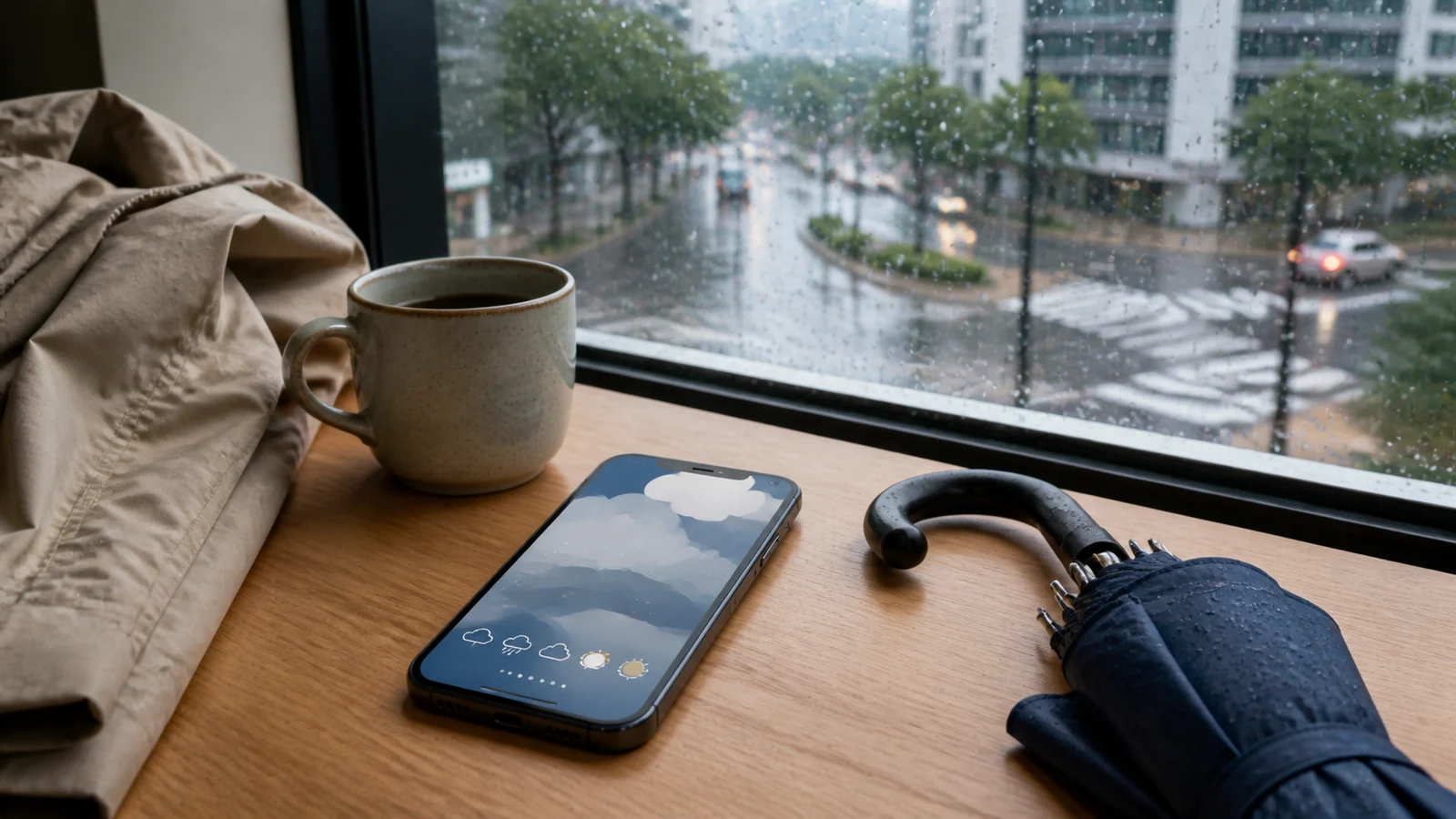
    Text-free illustration for Korean weather app words on BSKorean.
    Slide 1 introduces Korean weather app words before leaving home.

    Slide 1. The Situation

    You are about to leave an apartment lobby in Korea. Outside, the pavement is wet, the sky is gray, and people are moving carefully. Before you step out, you check a weather app. You do not need to understand every line. First, find the main weather word, then the temperature, then the rain or air quality signal.

    This is why the lesson starts with a photo briefing. The image shows a real daily decision, not a grammar exercise. A learner checks the phone before choosing a jacket, mask, or umbrella. In Korea, the weather screen often affects small choices: whether to walk, take a bus, carry an umbrella, or avoid outdoor time when fine dust is bad.

    Think of the screen as a checklist. The top area usually gives the general condition. The middle area often gives numbers, such as temperature or rainfall. Lower sections may show air quality, hourly changes, or warnings. If you read the labels in this order, the screen becomes much less stressful.

    Slide 2. Key Weather App Words

    The key words below come from the Bs3001 Wordbook database. Learn them as screen labels first. Many weather apps show a short Korean word beside a number, icon, or warning color.

    Korean Romanization English Usage
    날씨 nalssi weather Main word for weather screens and daily talk.
    일기예보 ilgiyebo weather forecast Use this for future weather information.
    기상정보 gisang jeongbo weather information Formal label for weather data or notices.
    기온 gion air temperature Temperature of the outside air.
    최고기온 choego gion highest temperature The warmest expected temperature.
    최저기온 choejeo gion lowest temperature The coldest expected temperature.
    강수량 gangsuryang rainfall amount How much rain is expected or recorded.
    습도 seupdo humidity How humid the air feels.
    미세먼지 mise meonji fine dust Air quality word often shown in Korea.
    bi rain Simple rain word for icons and forecasts.
    소나기 sonagi shower A short sudden rain shower.
    우산 usan umbrella The practical item to carry when rain is likely.

    Notice the order. The first three words tell you what kind of screen you are reading. The next three words show the temperature range. The last six words help you decide what to do outside. This is more useful than memorizing a long list without a situation.

    When you study the table, say the Korean word first, then the English meaning. Do not start with a full sentence yet. A weather app usually gives you short signals, not conversation. For example, 기온 plus a number is enough to understand the temperature. plus an afternoon time is enough to prepare for rain later.

    The words also group naturally. 날씨, 일기예보, and 기상정보 tell you the type of information. 기온, 최고기온, and 최저기온 tell you the temperature range. , 소나기, and 강수량 tell you how rain may affect your movement.

    Slide 3. Reading Formulas

    Weather app Korean often works like a formula. You see a label, then a number, level, or short result. For example, 현재 기온 means current air temperature. If you see 18도 beside it, you can read the key idea without building a full sentence.

    최고기온 and 최저기온 are also label words. They show the daily high and low. This matters because the current temperature may not tell the whole story. A morning can be cool, but the day may become warm. A night can become much colder than the afternoon.

    For rain, focus on , 소나기, and 강수량. 비 is the simple rain word. 소나기 warns you about a sudden shower. 강수량 gives more detail about the amount of rain. Then check 습도 and 미세먼지. They affect comfort and outdoor plans, even when it is not raining.

    Be careful with English habits. Some learners see one weather icon and skip the Korean label. That works only until the icon is unclear. Korean labels give the precise clue. A cloud icon may feel simple, but 소나기, 강수량, and 미세먼지 each change your plan in a different way.

    Slide 4. Read Weather App in 3 Steps

    Use a three-step routine when the screen feels busy. First, check 기온, 최고기온, and 최저기온. These words help you choose clothes. If the high and low are far apart, prepare for a change during the day.

    Second, look for rain words. If you see , expect rain. If you see 소나기, do not assume the whole day will be wet. It may be short, but it can still catch you outside. If 강수량 looks high, the rain may be heavier or longer.

    Third, check 미세먼지 and decide 우산. Fine dust is not weather in the same way as rain, but it is part of daily life in Korea. If the fine dust level is bad, many people reduce outdoor time. If rain or showers appear, carry an umbrella before leaving.

    This three-step method is useful because it turns reading into action. You are not studying the whole app. You are answering three practical questions. How warm or cold will it be? Will rain interrupt my route? Is the air quality good enough for outdoor time? Once you answer those questions, the Korean screen has done its job.

    Slide 5. Mistakes and Practice

    One common mistake is reading 기온 as body temperature. In a weather app, it means air temperature. Body temperature is 체온, which belongs in a medical situation. Another mistake is checking only the current number and ignoring 최저기온. That can be a problem if you return home late.

    Do not treat 소나기 exactly like ordinary rain. A shower may be brief, but it can arrive suddenly. Also, do not ignore 미세먼지. A clear sky does not always mean clean air. The safest habit is to read the label first, then connect it to one action: jacket, umbrella, mask, or indoor plan.

    Another small mistake is reading 우산 only as a word in a store. In this lesson, it is the action result of the weather check. If the app shows 비 or 소나기, the next question is simple: do you need 우산 today? This keeps the vocabulary tied to real movement.

    Practice

    Try these quick recognition questions before looking at the answers.

    1. If you see 최고기온, are you checking the warmest or coldest point of the day?
    2. If the app says 소나기, should you expect a long rainy season or a sudden shower?
    3. If 미세먼지 is bad, is the main issue rain or air quality?

    Mini scenario: You leave home at 8 a.m. The app shows 최저기온 in the morning, 소나기 in the evening, and bad 미세먼지. A smart choice is to wear layers, carry 우산, and reduce unnecessary outdoor time.

    Answer key: 최고기온 is the warmest point. 소나기 means a sudden shower. 미세먼지 is an air quality issue.

    Mini Review Table

    If you see… It usually means… What to do
    기온 / 최고기온 / 최저기온 The app is showing temperature range. Choose clothes for the whole day.
    비 / 소나기 / 강수량 The app is warning about rain. Carry 우산 or adjust travel plans.
    습도 The air may feel sticky or heavy. Expect discomfort in warm weather.
    미세먼지 The air quality may be poor. Reduce outdoor time if needed.

    Final Takeaway

    Korean weather app words become easier when you read them as decision labels. Start with 날씨 or 일기예보. Check 기온, 최고기온, and 최저기온. Then look for 비, 소나기, 강수량, 습도, and 미세먼지. Finally, decide whether you need 우산 before you leave home.

    Related Lessons

  • Korean Hotel Check-In Words: A Briefing-Style Lesson

    Korean Hotel Check-In Words: A Briefing-Style Lesson

    Use this hotel check-in lesson first

    At a Korean hotel desk, begin with 예약했어요, “I have a reservation,” or 체크인하고 싶어요, “I want to check in.” Keep your passport or ID ready if staff ask.

    Hotel task Korean Meaning
    Reservation 예약했어요 I have a reservation.
    Check in 체크인하고 싶어요 I want to check in.
    Passport 여권 여기 있어요 Here is my passport.
    Breakfast 조식 포함이에요? Is breakfast included?

    Before leaving the desk, ask 체크아웃은 몇 시예요?. For travel documents and direction language, continue with airport immigration words and public office words.

    Korean hotel check-in words guide

    Korean hotel check-in words helps learners practice Korean words in real situations. This BSKorean post keeps the lesson clear, scannable, and connected to app practice.

    Practice in the BSKorean app

    Related lessons

    Briefing Summary

    Korean hotel check-in words help you move through a Korean hotel front desk without guessing every sentence. This briefing follows the five photo slides in the PPT: arrival, reservation check, key card handoff, room details, and final review. The goal is practical. You should know which word starts the process, which word asks for ID, and which words tell you room, breakfast, and checkout information.

    Best for Travelers, exchange students, and first-time hotel guests in Korea
    Main skill Reading and answering front desk Korean in order
    Study time 8-10 minutes
    Practice focus Reservation, ID, room, breakfast, and checkout signals

    For broader trip planning, the official VISITKOREA accommodations page can help you choose where to stay before you practice the front desk words below.

    Download the complete Korean hotel check-in words PPT file

    Text-free illustration for Korean hotel check-in words on BSKorean.
    Slide 1 shows the hotel front desk situation.

    Slide 1. The Situation

    You arrive at a hotel in Korea with luggage. The receptionist may greet you, ask for your reservation name, request identification, and explain several details quickly. This is the moment shown in the first photo slide. The desk looks simple, but the Korean can move fast because the staff follows a set process.

    Do not try to translate every sentence. Korean hotel check-in words work best when you read the situation by function. First, look for or say 체크인. This tells the staff that you are starting the arrival process. Then connect 예약 to your booking and 신분증 to your passport or ID card. After that, listen for 객실, 조식, and 퇴실. These words give the details you need before leaving the desk.

    Slide 2. Key Hotel Check-In Words

    The second photo slide focuses on the reservation and ID moment. The table below gives the six Korean hotel check-in words you should recognize first. Each word is tied to a real front desk action.

    Korean Romanization English Usage
    체크인 chekeuin check-in Use this when you arrive and start the hotel process.
    예약 yeyak reservation This connects your name to a booked room.
    신분증 sinbunjeung ID card Staff may ask for this before giving the room key.
    객실 gaeksil guest room This word appears with room number or room type.
    조식 josik breakfast Use this to check whether breakfast is included.
    퇴실 toesil checkout This tells you when to leave the room.

    Korean Hotel Check-In Words at the Desk

    체크인 is the first action word. Say 체크인하려고요 when you want to check in.

    예약 tells staff that you already booked a room. Use 예약했어요 before giving your name.

    신분증 means ID. In a hotel, this may mean a passport or another official card.

    객실 usually comes before room information. Listen for the number, floor, or room type after it.

    조식 is useful before you leave the desk. It may include a time, place, or extra fee.

    퇴실 belongs to the end of your stay. Do not confuse it with 체크인.

    Slide 3. Reading Formulas

    The third slide uses the key card photo to show the moment when words become short desk sentences. Korean hotel staff do not need a long explanation from you. A clear formula is usually enough.

    Formula 1: 예약 + 했어요

    예약했어요. means “I made a reservation.” Use it first if the staff asks your name or booking status.

    Formula 2: 체크인 + 하려고요

    체크인하려고요. means “I would like to check in.” It is a safe opening sentence at the counter.

    Formula 3: 조식 + 포함돼요?

    조식 포함돼요? means “Is breakfast included?” Ask this before you walk away from the desk.

    Formula 4: 퇴실 + 몇 시예요?

    퇴실 몇 시예요? means “What time is checkout?” This short question prevents a common travel mistake.

    These formulas work because they put the important word first. If the receptionist is busy, start with the word they need: 예약, 체크인, 조식, or 퇴실. Then add the short ending.

    Slide 4. Read Hotel Check-In in 3 Steps

    The fourth photo slide shows the traveler checking details after receiving the key card. This is the right time to organize the front desk information in three steps.

    Step 1. Start with 예약 or 체크인. If you booked ahead, say 예약했어요. If the staff is ready but has not asked a question, say 체크인하려고요. You may hear 예약자 성함이 어떻게 되세요? This asks for the reservation name.

    Step 2. Respond to 신분증. If you hear 신분증 보여 주세요, show your passport or ID. You may also hear 여권, which means passport. This step usually happens before the room key is issued.

    Step 3. Confirm 객실, 조식, and 퇴실. After the booking is confirmed, listen for the room number, breakfast information, and checkout time. If one detail is unclear, ask one short question. 조식 포함돼요? and 퇴실 몇 시예요? are enough.

    Slide 5. Mistakes and Practice

    The final photo slide is a review scene. The traveler has the key card and phone, but still needs to avoid three common mistakes.

    Mistake 1: Confusing 체크인 and 퇴실

    체크인 is arrival. 퇴실 is leaving. If you mix them up, the staff may think you are asking about departure instead of arrival.

    Mistake 2: Missing 신분증

    If the staff asks for 신분증, show your passport or official ID. Do not continue explaining your reservation first.

    Mistake 3: Ignoring 조식 details

    Breakfast may have a time, floor, or extra charge. Ask 조식 포함돼요? if the booking page was unclear.

    Hotel Korean becomes easier when you follow the service order. Say why you are there, show what the staff asks for, then confirm the details that affect your stay.

    Practice

    Try these quick recognition questions before your next hotel stay.

    1. You hear 신분증 보여 주세요. What should you show?
    2. The staff says 객실은 1208호입니다. What information did you hear?
    3. You want to know whether breakfast is included. Which word should you use?

    Mini scenario: You arrive at the front desk. A safe opening is 예약했어요. 체크인하려고요. This means “I made a reservation. I would like to check in.”

    Answer key: First, show your ID or passport. Second, you heard the room number. Third, use 조식 and ask 조식 포함돼요?

    Mini Review Table

    If you see… It usually means… What to do
    체크인 The arrival process starts. Go to the front desk.
    예약 Your booking is being checked. Give your name or booking details.
    신분증 ID is needed. Show your passport or ID card.
    객실 Room information is coming. Listen for the room number.
    조식 Breakfast information matters. Ask if it is included.
    퇴실 Checkout time is being explained. Confirm the time before leaving.

    Final Takeaway

    Korean hotel check-in words work best as a sequence. Start with 체크인 and 예약, respond to 신분증, then confirm 객실, 조식, and 퇴실. You do not need long Korean at the desk. You need the right word at the right moment, plus one short question when a detail is unclear.

    Related Lessons

  • Korean Restaurant Order Words for Foreign Workers

    Korean Restaurant Order Words for Foreign Workers

    Use this restaurant order lesson first

    This lesson is for learners who need to order food in Korea without scrolling through a long explanation first. Start with the sentence pattern 이거 하나 주세요, which means “one of this, please.” You can point to the menu, say the item name, or change 하나 to another number.

    Five restaurant phrases are useful almost every day: 메뉴판 주세요, 이거 하나 주세요, 덜 맵게 해 주세요, 포장해 주세요, and 계산할게요. They cover asking for the menu, ordering, reducing spice, takeout, and paying.

    NeedKoreanMeaning
    See the menu메뉴판 주세요Please give me the menu.
    Order one이거 하나 주세요One of this, please.
    Less spicy덜 맵게 해 주세요Please make it less spicy.
    Takeout포장해 주세요Please pack it to go.
    Pay계산할게요I will pay now.

    If staff ask a question quickly, answer with one short choice first: , 아니요, 포장, or 매장. Then continue with cafe phrases and convenience store words, because the same polite request ending 주세요 appears there too.

    Korean restaurant order words guide

    Korean restaurant order words helps learners practice Korean words in real situations. This BSKorean post keeps the lesson clear, scannable, and connected to app practice.

    Practice in the BSKorean app

    Related lessons

    Korean restaurant order words help foreign workers and new residents order food, ask for takeout, request water or side dishes, and pay clearly in Korea. This briefing-style lesson focuses on practical words you can use at a real restaurant counter or table.

    Korean Restaurant Order Words to Notice First

    You are standing at a Korean restaurant counter. The menu is above you, a staff member is waiting, and there may be people behind you. In that moment, Korean does not feel like a textbook. It feels fast, short, and practical.

    This lesson uses the PPT visual flow below as the learning path. Each image shows one real restaurant moment, and the explanation under the image teaches the Korean words you need for that moment. The goal is not to memorize a long script. The goal is to recognize the key word, understand the situation, and answer with one short polite phrase.

    Text-free illustration for Korean restaurant order words on BSKorean.
    Visual 1. The full restaurant order situation: ordering food, choosing takeout or dine-in, and paying.

    Visual Situation: What Happens at the Counter

    The first slide shows a customer and staff member facing each other at a Korean restaurant counter. This is the exact moment when learners often freeze. The staff may ask 주문하시겠어요? (jumunhasigesseoyo?, would you like to order?), 매장에서 드시나요? (maejangeseo deusinayo?, will you eat here?), or 포장해 드릴까요? (pojanghae deurilkkayo?, should I pack it to go?).

    The three big words on the slide are the main action words for this situation: 주문 means order, 포장 means takeout or packing, and 계산 means payment or checkout. If you understand these three words, you can follow most restaurant counter conversations in Korea.

    Lesson Goal: Listen for the Service Keyword

    The second slide shows the learning goal. In a real restaurant, you do not need to understand every word perfectly. You need to catch the keyword. If you hear 주문, the staff is talking about choosing food. If you hear 매장 or 포장, the staff is asking whether you will eat inside or take the food out. If you hear 계산, it is time to pay.

    For foreign workers in food service, this same pattern works from the staff side. You can use short, polite questions many times during a shift: 주문하시겠어요?, 매장에서 드시나요?, 포장해 드릴까요?, and 영수증 필요하세요? These phrases are short because the situation already explains most of the meaning.

    Key Vocabulary

    Dine-In or Takeout: 매장 and 포장

    The fourth slide focuses on a common question: 매장에서 드시나요? This means “Will you eat here?” The word 매장 can mean store, but in a restaurant or cafe it often points to the dine-in space. A natural short answer is 여기서 먹을게요 (yeogiseo meogeulgeyo, I will eat here).

    If you want takeout, listen for 포장. The phrase 포장해 주세요 means “Please make it takeout.” In factory Korean, 포장 can mean packaging, but in this restaurant scene it means packing food to go. The image shows why the meaning changes: there is a counter, a menu, a customer, and a bag. The situation tells you that 포장 is about takeout.

    Common Expressions

    Mini Dialogue

    Staff: 주문하시겠어요?
    Jumunhasigesseoyo?
    Would you like to order?

    Customer: 네, 김치찌개 하나 주세요.
    Ne, gimchijjigae hana juseyo.
    Yes, one kimchi stew, please.

    Staff: 매장에서 드시나요, 포장하시나요?
    Maejangeseo deusinayo, pojanghasinayo?
    Will you eat here or take it to go?

    Customer: 여기서 먹을게요.
    Yeogiseo meogeulgeyo.
    I will eat here.

    Staff: 맵기는 괜찮으세요?
    Maepgineun gwaenchaneuseyo?
    Is the spiciness okay?

    Customer: 조금 덜 맵게 해 주세요.
    Jogeum deol maepge hae juseyo.
    Please make it a little less spicy.

    Staff: 계산은 카드로 하시나요?
    Gyesaneun kadeuro hasinayo?
    Will you pay by card?

    Customer: 네, 카드로 할게요. 영수증은 괜찮아요.
    Ne, kadeuro halgeyo. Yeongsujeungeun gwaenchanayo.
    Yes, I will pay by card. I do not need a receipt.

    Usage Point: Noun or Action + 주세요

    The seventh slide teaches the most useful pattern in this lesson. 주세요 means “please give me” or “please do this for me.” You can place a noun before it: 물 주세요 means “Please give me water.” You can also place an action before it: 포장해 주세요 means “Please pack it for takeout.”

    Use this pattern carefully. 주세요 alone is polite, but it is not always clear. Add the object or action first: 이거 주세요, 물 좀 주세요, 반찬 더 주세요, 양파 빼 주세요. This makes your request understandable even if your sentence is short.

    Common Mistakes

    1. Thinking 매장 only means a shop

    Why it is confusing: Dictionaries often translate 매장 as store or shop. Correct understanding: In restaurant Korean, 매장에서 드시나요? usually means “Will you eat here?” If you want dine-in, say 여기서 먹을게요.

    2. Answering 포장해 드릴까요? with only 네

    Why it is confusing: means yes, so it may feel enough. Correct understanding: It is clearer to say 네, 포장해 주세요. This confirms that you want takeout.

    3. Confusing 주문 and 계산

    Why it is confusing: Both words happen at the counter. Correct understanding: 주문 means order. 계산 means payment or checkout. First you order, then you pay.

    4. Forgetting the action before 주세요

    Why it is confusing: Learners remember 주세요, but forget to say what they want. Correct understanding: Use a complete short request: 물 좀 주세요, 이거 하나 주세요, or 양파 빼 주세요.

    Quick Quiz

    1. What does 주문 mean?
    A. payment / B. order / C. receipt
    Answer: B. order. Explanation: 주문 is the main word for ordering food.

    2. A staff member asks 매장에서 드시나요? What are they asking?
    A. Do you need water? / B. Will you eat here? / C. Will you pay by card?
    Answer: B. Will you eat here. Explanation: 매장에서 points to the dine-in space.

    3. You want takeout. What should you say?
    Answer: 포장해 주세요. Explanation: 포장 means takeout in this restaurant situation.

    4. Fill in the blank: 물 좀 ____.
    Answer: 주세요. Explanation: 물 좀 주세요 means “Please give me some water.”

    5. What is the difference between 주문 and 계산?
    Answer: 주문 means order, and 계산 means payment or checkout. Explanation: 주문 happens when choosing food. 계산 happens when paying.

    Quick Review

    KoreanMeaningBest SituationBeginner Tip
    주문orderchoosing foodListen for 주문하시겠어요?
    포장takeoutfood to goSay 포장해 주세요.
    매장dine-in space / storeeat inside or takeout questionAnswer 여기서 먹을게요 if eating inside.
    waterasking during a meal물 좀 주세요 is natural.
    추가extraasking for moreUse with rice, side dishes, sauce, or toppings.
    계산paymentcounter checkoutDifferent from 주문.
    영수증receiptafter paymentSay 괜찮아요 if you do not need it.

    Practice More

    Practice this word list in Korean Learn Korean or in the upcoming BSkorean app. Start with image recognition first: look at the counter scene and choose the correct Korean action word. Then practice short answers such as 포장해 주세요, 여기서 먹을게요, 카드로 할게요, and 영수증은 괜찮아요.

    For official Korea travel and daily-life context, check Visit Korea.

    Related Lessons

    Conclusion

    The PPT images show the full restaurant flow: choose food, answer dine-in or takeout, make a short request, pay, and decide about the receipt. When you connect the words to the visual situation, the Korean becomes easier to use. Listen for 주문, 매장, 포장, 계산, and 영수증. Then answer with one short polite phrase.

    Practice these Korean words in the BSKorean app

    After reading this lesson, continue with the BSKorean practical Korean app guide or open the BSKorean practice app to review words by level and real-life situation.

  • Korean Factory Inspection Words for Foreign Workers

    Korean Factory Inspection Words for Foreign Workers

    Use this factory inspection lesson first

    Factory inspection language is short and direct. Start with 검사해 주세요, “please inspect it.” If something is wrong, use 불량이에요, which means “it is defective.” These two phrases are enough for many line-check situations.

    Practice the core inspection set: 검사해 주세요, 불량이에요, 다시 확인해 주세요, and 안전장비가 필요해요. They cover checking, defects, rechecking, and safety equipment.

    Inspection needKoreanMeaning
    Ask for check검사해 주세요Please inspect it.
    Defect불량이에요It is defective.
    Confirm again다시 확인해 주세요Please check again.
    Safety equipment안전장비가 필요해요I need safety equipment.

    If you are not sure whether a product passed, ask 이거 통과예요?, “did this pass?” For emergency and safety vocabulary, continue with fire emergency sign words and construction site safety instructions.

    Korean factory inspection words guide

    Korean factory inspection words helps learners practice Korean words in real situations. This BSKorean post keeps the lesson clear, scannable, and connected to app practice.

    Practice in the BSKorean app

    Related lessons

    Korean factory inspection words are important when a supervisor checks products, reports defects, or asks workers to recheck an item. This briefing-style lesson teaches practical inspection vocabulary for real factory communication in Korea.

    Korean Factory Inspection Words to Recognize

    You are standing beside a factory inspection table in Korea. A supervisor points to two trays and says, 양품과 불량품을 분리해 주세요. Another worker says, 외관검사에서 스크래치가 보입니다. You understand some Korean, but the inspection words come quickly.

    This lesson teaches practical Korean factory inspection words for foreign workers. The words come from the BSkorean factory vocabulary DB, especially the quality and inspection set. The goal is simple: when you hear a factory inspection word, you should know what to check, what to report, and what action to take next.

    Briefing Slides

    The PPT below was built with realistic factory situation images first, then Korean learning text was placed on top. Use the slides as a quick briefing before reading the full lesson.

    Text-free illustration for Korean factory inspection words on BSKorean.
    Slide 1. Korean factory inspection words lesson slide with quality and defect vocabulary

    Download the PPT briefing

    Opening Situation

    Imagine your first day helping with quality checks in a Korean factory. Products move from the production line to the inspection area. Some items are good. Some have scratches, dents, missing parts, or contamination. The supervisor does not explain everything slowly. Instead, you hear short words like 검사, 불량, 합격, 불합격, 선별, and 재검사.

    In this situation, the most important skill is not translating every sentence word by word. You need to recognize the inspection word and connect it to the next work action. If you hear 검사, you should check something. If you hear 불량품, you should not mix that item with good products. If you hear 격리, you should keep the problem item separate.

    What You Need to Understand

    Factory Korean often uses short, direct phrases. A supervisor may say 품질 확인하세요, 샘플검사 하세요, or 불량 보고하세요. These phrases are not long conversations. They are work signals. The noun tells you the object or status, and the verb tells you the action.

    This is why factory inspection vocabulary is useful for foreign workers. The same words appear in spoken instructions, inspection sheets, quality reports, defect labels, and workplace notices. Once you recognize the core words, you can understand the workflow more quickly.

    Core Vocabulary

    KoreanRomanizationEnglishLevelWhat it means at work
    품질pumjilqualityBeginner 1The condition or standard of a product.
    품질관리pumjilgwanriquality controlBeginner 1The system or work of controlling product quality.
    검사geomsainspectionBeginner 1A check or inspection step.
    전수검사jeonsugeomsafull inspectionBeginner 1Checking every item, not only a sample.
    샘플검사saempeulgeomsasampling inspectionBeginner 1Checking a sample from a larger lot.
    공정검사gongjeonggeomsain-process inspectionBeginner 1Inspection during the production process.
    최종검사choejonggeomsafinal inspectionBeginner 1The last inspection before shipment or completion.
    외관검사oegwangeomsavisual inspectionBeginner 1Looking at the outside condition of a product.
    치수검사chisugeomsadimensional inspectionBeginner 1Checking size, length, width, or dimensions.
    기능검사gineunggeomsafunctional inspectionBeginner 1Checking whether the product works correctly.
    합격hapgyeokpassBeginner 2The product or inspection result passes.
    불합격bulhapgyeokfailBeginner 2The product or inspection result fails.
    판정panjeongjudgmentBeginner 2The decision after inspection.
    양품yangpumgood productBeginner 2A good product that can move to the next step.
    불량품bulryangpumdefective productBeginner 2A defective product that should not be mixed with good items.
    불량bulryangdefectBeginner 2A defect or quality problem.
    결함gyeolhamflawBeginner 2A flaw or fault in the product.
    스크래치seukeuraechiscratchBeginner 2A scratch on the surface.
    찍힘jjikhimdentBeginner 2A dent or mark from impact.
    오염oyeomcontaminationBeginner 2Contamination, dirt, stain, or unwanted material.
    이물imulforeign matterBeginner 2Foreign matter that should not be inside or on the product.
    누락nurakmissing partBeginner 2A missing part, step, or item.
    파손pasonbreakageBeginner 3Breakage or damage.
    격리gyeokriquarantineIntermediate 2Keeping problem products separate.
    선별seonbyeolsortingIntermediate 2Sorting products by condition.
    재검사jaegeomsare-inspectionIntermediate 2Checking again after a problem or correction.

    Real Workplace Phrases

    The words above become useful when they are connected to short workplace instructions. The following phrases are common in quality control and inspection work.

    Korean SentenceEnglish MeaningWhen to Use
    품질을 확인해 주세요.Please check the quality.When asking someone to check a product before moving it forward.
    샘플검사 먼저 하세요.Please do the sampling inspection first.When only selected items need to be checked first.
    외관검사에서 스크래치가 보입니다.A scratch is visible during visual inspection.When reporting a visible surface problem.
    이 제품은 불량품입니다.This product is defective.When a product should not be treated as good stock.
    양품과 불량품을 분리해 주세요.Please separate good products and defective products.When sorting inspected products.
    불합격 제품은 격리하세요.Quarantine failed products.When failed products must be kept away from good items.
    누락된 부품이 있는지 확인하세요.Check whether any parts are missing.When inspecting assembly or packaging.
    재검사 후 보고해 주세요.Please report after re-inspection.When a supervisor asks for confirmation after checking again.

    Usage Notes

    검사 means the checking step

    검사 means inspection or checking. It can be general, but factory work often makes it more specific. 외관검사 checks the outside appearance. 치수검사 checks size or dimensions. 기능검사 checks whether the product works. When you hear a word ending in 검사, ask yourself: “What type of check is required?”

    합격 and 불합격 are result words

    합격 means pass, and 불합격 means fail. These words can be used for tests, but in a factory they often describe the inspection result. A product can be 합격 if it meets the standard. It can be 불합격 if it does not meet the standard.

    양품 and 불량품 describe product status

    양품 is a good product. It can usually continue to the next process, packing, or shipment. 불량품 is a defective product. It should be reported, separated, repaired, rechecked, or discarded depending on the workplace rule. Do not mix 불량품 with 양품.

    불량 is the problem, 불량품 is the product

    불량 can mean the defect or the defective condition. 불량품 means the defective product itself. For example, 스크래치 불량 can mean a scratch defect. 이 제품은 불량품입니다 means this product is defective.

    Common Pattern

    PatternMeaningExample
    N + 확인하세요Please check N.품질 확인하세요.
    N + 검사하세요Please inspect N.치수검사 하세요.
    N + 분리해 주세요Please separate N.불량품을 분리해 주세요.
    N + 보고해 주세요Please report N.불량을 보고해 주세요.
    N + 재검사하세요Please inspect N again.이 제품은 재검사하세요.

    In real spoken Korean, workers may shorten these phrases. You might hear 품질 확인, 불량 보고, or 재검사. The shorter form is common when the situation is obvious. For learning, remember the polite full forms first.

    Mini Dialogue

    Supervisor: 이 제품 외관검사 했어요?
    Did you do the visual inspection for this product?

    Worker: 네, 외관검사에서 스크래치가 보입니다.
    Yes, a scratch is visible during the visual inspection.

    Supervisor: 그러면 불량품으로 분리해 주세요.
    Then please separate it as a defective product.

    Worker: 불합격 제품은 어디에 두면 될까요?
    Where should I put the failed products?

    Supervisor: 저쪽 격리 구역에 두고, 나중에 재검사하세요.
    Put them in the quarantine area over there, and inspect them again later.

    Worker: 네, 격리 후 재검사하겠습니다.
    Okay, I will quarantine them and re-inspect them.

    This dialogue shows the work flow: inspect, find a defect, separate the defective product, quarantine it, and re-inspect it. The Korean is short because the workers are focused on action, not explanation.

    Common Mistakes

    Common Mistake 1: Treating 불량 and 불량품 as the same word

    Why it happens: Both words are connected to defects.

    Correct understanding: 불량 is the defect or defective condition. 불량품 is the defective product.

    Example: 스크래치 불량 means a scratch defect. 불량품을 분리해 주세요 means please separate the defective products.

    Common Mistake 2: Thinking 합격 and 불합격 only refer to people

    Why it happens: Learners often meet these words in tests or exams first.

    Correct understanding: In a factory, 합격 and 불합격 can describe an inspection result for a product, part, process, or sample.

    Example: 샘플검사 합격 means the sample inspection passed.

    Common Mistake 3: Ignoring 격리 after a defect is found

    Why it happens: Beginners may understand the defect word but miss the next action.

    Correct understanding: 격리 means the product should be kept separate. This prevents defective products from being mixed with good products.

    Example: 불합격 제품은 격리하세요 means failed products should be quarantined.

    Quick Quiz

    1. What does “외관검사” mean?
    A. visual inspection / B. final inspection / C. missing part
    Answer: A. visual inspection
    외관검사 means checking the outside appearance of a product.

    2. A product has a visible dent. Which Korean word is useful?
    A. 찍힘 / B. 합격 / C. 양품
    Answer: A. 찍힘
    찍힘 means a dent or impact mark.

    3. Which word means “good product”?
    A. 불량품 / B. 양품 / C. 오염
    Answer: B. 양품
    양품 is a product that passed inspection or can be treated as good stock.

    4. What should you do with failed products if the supervisor says “격리하세요”?
    A. Mix them with good products / B. Keep them separate / C. Ship them immediately
    Answer: B. Keep them separate
    격리 means quarantine or separation from other products.

    5. What does “재검사” mean?
    A. re-inspection / B. full inspection / C. contamination
    Answer: A. re-inspection
    재검사 means checking again after a problem, correction, or unclear result.

    Practice This Lesson

    Practice this word list in Learn Korean or in the upcoming BS3001 app.

    Practice Factory Inspection Words

    Practice these words again in Korean Learn Korean so you can connect the Korean word to the real situation.

    For official employment and workplace information in Korea, check the English site of the Ministry of Employment and Labor.

    Related Lessons

    Conclusion

    Korean factory inspection words are easier when you read them as work signals. First, find the inspection type: 외관검사, 치수검사, or 기능검사. Then check the result word: 합격, 불합격, 양품, or 불량품. Finally, take the action: separate, quarantine, report, or re-inspect.

    If you work in a Korean factory, these words can help you understand quality instructions faster and avoid mixing good products with defective products.

    Practice these Korean words in the BSKorean app

    After reading this lesson, continue with the BSKorean practical Korean app guide or open the BSKorean practice app to review words by level and real-life situation.

  • Korean Pharmacy Words for Buying Cold Medicine

    Korean Pharmacy Words for Buying Cold Medicine

    Use these pharmacy phrases first

    At a Korean pharmacy, say the symptom first, then ask how to take the medicine. These phrases help before you scroll.

    Korean Use it for
    감기약 cold medicine
    진통제 pain reliever
    알레르기 allergy
    처방전 prescription
    하루에 몇 번 how many times a day
    이 약은 어떻게 먹어요? How do I take this medicine?
    Customer 감기약 있어요?
    Pharmacist 증상이 어떻게 되세요?
    Customer 열이 있어요. 이 약은 어떻게 먹어요?

    Safety note: tell the pharmacist about allergies, pregnancy, other medicine, or a child patient before buying medicine.

    Use this pharmacy lesson first

    At a Korean pharmacy, say your symptom first and then ask for medicine. The simplest request is 감기약 주세요, “please give me cold medicine.” If you have a specific symptom, add it before the request.

    Use these safe pharmacy phrases: 감기약 주세요, 기침이 나요, 열이 있어요, 하루에 몇 번 먹어요?, and 알레르기가 있어요. They cover medicine, cough, fever, dosage, and allergies.

    Need Korean Meaning
    Cold medicine 감기약 주세요 Please give me cold medicine.
    Cough 기침이 나요 I have a cough.
    Fever 열이 있어요 I have a fever.
    Dosage 하루에 몇 번 먹어요? How many times a day do I take it?
    Allergy 알레르기가 있어요 I have an allergy.

    Before leaving, repeat the dosage and check whether to take the medicine before or after meals. If you also need a bag or receipt, the same counter phrases appear in convenience store words. For official health paperwork, continue with public office words.

    Korean pharmacy words guide

    Korean pharmacy words helps learners practice Korean words in real situations. This BSKorean post keeps the lesson clear, scannable, and connected to app practice.

    Practice in the BSKorean app

    Related lessons

    Korean pharmacy words are useful when you need cold medicine, explain symptoms, ask about dosage, or understand simple instructions from a pharmacist in Korea. This lesson keeps the language practical for real pharmacy visits.

    Korean Pharmacy Words for Cold Medicine

    Text-free illustration for Korean pharmacy words on BSKorean.
    Korean pharmacy words title slide with a realistic Korean pharmacy scene

    You walk into a Korean pharmacy after work. Your throat hurts, your nose is running, and you still need to get through tomorrow morning. The pharmacist asks, 어디가 불편하세요? You know they are asking what is wrong, but you do not know how to explain your symptoms in simple Korean.

    This lesson helps you handle that exact moment. You will learn Korean pharmacy words for cold medicine, symptoms, dosage, drowsiness, allergies, and basic safety questions. The goal is not to replace medical advice. The goal is to help you say the important things clearly and understand the most common instructions at a Korean pharmacy.

    Download the updated pharmacy PPT briefing

    Opening Situation

    In Korea, many people visit a pharmacy, or 약국 (yakguk), when they have mild cold symptoms. You may not need a long conversation. Most pharmacy visits are short. The pharmacist needs to know your main symptom, whether you have allergies, and whether you want medicine that will not make you too sleepy.

    A useful beginner sentence is 감기약 주세요 (gamgiyak juseyo), which means “Please give me cold medicine.” But this sentence is often too general. If you can add one or two symptoms, the pharmacist can guide you better.

    What You Need to Do

    1. Say the main problem: cough, runny nose, fever, sore throat, or body aches.
    2. Ask for cold medicine in a polite and simple way.
    3. Check how many times a day you should take it.
    4. Ask whether it may cause drowsiness if you need to work, drive, or study.
    5. Mention allergies, other medicine, pregnancy, or a serious condition when relevant.

    Core Vocabulary Table

    Korean Romanization English Level Usage Note
    약국 yakguk pharmacy Beginner 1 The place where you buy medicine or ask a pharmacist.
    감기약 gamgiyak cold medicine Beginner 2 Use this when asking for medicine for cold symptoms.
    기침 gichim cough Beginner 2 A common symptom word. You can say 기침이 나요.
    콧물 konmul runny nose Beginner 2 Often used together with 코가 막혀요, meaning stuffy nose.
    목이 아파요 mogi apayo my throat hurts Beginner 2 A full phrase that is easy to use at the counter.
    yeol fever Beginner 2 You can say 열이 있어요, meaning I have a fever.
    몸살 momsal body aches Intermediate 1 Used when your whole body aches from a cold or fatigue.
    두통 dutong headache Intermediate 1 A symptom word used in pharmacies and clinics.
    복용 bogyong taking medicine Intermediate 2 Common on medicine labels and instructions.
    식후 sikhu after meals Intermediate 1 Important dosage word. 식후 30분 means 30 minutes after a meal.
    하루 세 번 haru se beon three times a day Intermediate 1 A common medicine instruction.
    졸릴 수 있어요 jollil su isseoyo it may make you sleepy Intermediate 2 Important if you must work, drive, or study.
    알레르기 allereugi allergy Intermediate 1 Tell the pharmacist if you have an allergy.
    처방전 cheobangjeon prescription Intermediate 2 Some medicine requires a doctor’s prescription.
    부작용 bujagyong side effect Advanced 1 A formal word for an unwanted medicine effect.

    Action Signal Formula

    At a Korean pharmacy, do not try to make a long medical speech. Use a short formula.

    Formula Meaning Example
    Symptom + 있어요 I have a symptom 열이 있어요.
    Symptom + 나요 A symptom is happening 기침이 나요.
    Body part + 아파요 A body part hurts 목이 아파요.
    N 주세요 Please give me N 감기약 주세요.
    N 없나요? Do you have one without N? 졸림 없는 약 없나요?

    For example, 기침이 나고 목이 아파요. 감기약 주세요. means “I have a cough and my throat hurts. Please give me cold medicine.” This is short, polite, and clear.

    Real-Life Dialogue

    Dialogue 1: Asking for cold medicine

    Pharmacist: 어디가 불편하세요?
    Eodiga bulpyeonhaseyo?
    What feels uncomfortable?

    Customer: 기침이 나고 목이 아파요.
    Gichimi nago mogi apayo.
    I have a cough and my throat hurts.

    Pharmacist: 열은 있으세요?
    Yeoreun isseuseyo?
    Do you have a fever?

    Customer: 열은 없어요. 감기약 주세요.
    Yeoreun eopseoyo. Gamgiyak juseyo.
    I do not have a fever. Please give me cold medicine.

    This dialogue shows a natural pharmacy pattern. The pharmacist asks about symptoms, and the customer answers with only the most important details.

    Dialogue 2: Checking drowsiness and dosage

    Customer: 이 약 졸리나요?
    I yak jollinayo?
    Does this medicine make you sleepy?

    Pharmacist: 조금 졸릴 수 있어요.
    Jogeum jollil su isseoyo.
    It may make you a little sleepy.

    Customer: 하루에 몇 번 먹어요?
    Harue myeot beon meogeoyo?
    How many times a day should I take it?

    Pharmacist: 하루 세 번, 식후에 드세요.
    Haru se beon, sikhu-e deuseyo.
    Take it three times a day, after meals.

    The word 먹어요 literally means “eat,” but Korean speakers often use it naturally for taking medicine. Pharmacists may also use the more formal word 드세요, meaning “please take.”

    Common Mistakes

    Common Mistake 1: Saying only “감기약 주세요”

    Why it happens: Beginners often learn one useful sentence and use it for every cold situation.

    Correct understanding: 감기약 주세요 is useful, but symptoms matter. Add one or two words such as 기침, 콧물, 열, or 목이 아파요.

    Better example: 기침이 나고 콧물이 나요. 감기약 주세요.

    Common Mistake 2: Ignoring 졸릴 수 있어요

    Why it happens: Learners may focus only on the medicine name and miss the warning.

    Correct understanding: 졸릴 수 있어요 means the medicine may make you sleepy. This matters before driving, operating equipment, studying, or working a long shift.

    Useful question: 이 약 졸리나요?

    Common Mistake 3: Confusing 식전 and 식후

    Why it happens: Both words are short and often appear on labels.

    Correct understanding: 식전 means before meals. 식후 means after meals. Most cold medicine instructions at pharmacies may include 식후, but you should check the label or ask.

    Useful question: 식전에 먹어요, 식후에 먹어요?

    Common Mistake 4: Not mentioning allergies or other medicine

    Why it happens: Some learners think a pharmacy visit is too short to mention medical details.

    Correct understanding: If you have allergies, take other medicine, are pregnant, or have a serious condition, say it clearly or use a translation app. A short phrase such as 알레르기가 있어요 is important.

    Mini Quiz

    1. Question 1: What does 약국 mean?
      Answer: pharmacy.
      Explanation: 약국 is the place where you buy medicine and speak with a pharmacist.
    2. Question 2: You have a sore throat. Which phrase is best?
      A. 목이 아파요. B. 처방전 있어요. C. 하루 세 번.
      Answer: A.
      Explanation: 목이 아파요 means “My throat hurts.”
    3. Question 3: What does 하루 세 번 mean?
      Answer: three times a day.
      Explanation: 하루 means one day, 세 means three, and 번 means times.
    4. Question 4: What should you ask if you need to avoid sleepy medicine?
      Answer: 이 약 졸리나요?
      Explanation: This asks whether the medicine may cause drowsiness.
    5. Question 5: What is the difference between 식전 and 식후?
      Answer: 식전 means before meals, and 식후 means after meals.
      Explanation: These are important dosage timing words.

    Review Table

    Korean Meaning Best Situation Beginner Tip
    감기약 cold medicine asking for medicine Add your symptom if possible.
    기침 cough explaining symptoms Say 기침이 나요.
    콧물 runny nose explaining symptoms Often appears with cold symptoms.
    fever checking severity Say 열이 있어요 or 열은 없어요.
    식후 after meals dosage instructions Check if the medicine is taken after meals.
    하루 세 번 three times a day dosage frequency Look for the number before 번.
    졸릴 수 있어요 may cause drowsiness safety warning Ask before work or driving.
    알레르기 allergy safety information Mention it before buying medicine.

    Practice This Set

    Practice this word list in Learn Korean or in the upcoming BS3001 app. Use the quiz mode to review Korean pharmacy words until you can recognize the Korean word first and choose the English meaning quickly.

    Practice Korean Pharmacy Words

    For official medicine and safety information in Korea, check the English site of the Ministry of Food and Drug Safety.

    Related Lessons

    Conclusion

    A Korean pharmacy visit becomes easier when you focus on three things: your symptom, the medicine request, and the dosage instruction. Start with short phrases like 기침이 나요, 목이 아파요, and 감기약 주세요. Then check words such as 식후, 하루 세 번, and 졸릴 수 있어요.

    These Korean pharmacy words are practical for daily life, but they are also useful for workers, students, and travelers who need to solve a small health problem in Korea without a long conversation.

    Practice This Lesson

    Review words from this lesson with quiz cards and browser-based review history.

    Practice pharmacy words

  • Korean Convenience Store Words for Checkout

    Korean Convenience Store Words for Checkout

    Use this convenience store lesson first

    A Korean convenience store checkout can move quickly, so learn the words you need before you reach the counter. The most useful sentence is 봉투 주세요, “please give me a bag.” If you do not need a bag, answer 괜찮아요.

    Practice these checkout phrases aloud: 봉투 주세요, 영수증 주세요, 교통카드 충전해 주세요, and 따로 계산해 주세요. They help with bags, receipts, transit cards, and separate payment.

    Counter moment Korean phrase Use it when
    Bag 봉투 주세요 You need a bag.
    Receipt 영수증 주세요 You need proof of payment.
    Transport card 교통카드 충전해 주세요 You want to add money to a card.
    Separate bill 따로 계산해 주세요 You and another person will pay separately.

    If the clerk asks 봉투 필요하세요?, they are asking whether you need a bag. A simple 네, 주세요 or 아니요, 괜찮아요 is enough. For similar quick-counter speaking, study cafe phrases and pharmacy cold medicine words.

    Korean convenience store words guide

    Korean convenience store words helps learners practice Korean words in real situations. This BSKorean post keeps the lesson clear, scannable, and connected to app practice.

    Practice in the BSKorean app

    Related lessons

    Korean convenience store words help you understand checkout questions, payment options, bags, receipts, discounts, and quick service phrases in Korea. This briefing-style lesson focuses on words you hear at the counter.

    Korean Convenience Store Words at Checkout

    Text-free illustration for Korean convenience store words on BSKorean.
    Korean convenience store checkout words title slide with a realistic checkout scene

    You put a lunch box, bottled water, and a small snack on the counter at a Korean convenience store. The cashier scans the items quickly and asks, 봉투 필요하세요? Another customer is already waiting behind you. You know this is a simple checkout, but the Korean comes fast.

    This lesson helps you handle that exact moment. You will learn Korean convenience store words for checkout, bags, receipts, membership points, payment, microwave heating, disposable items, and transport card top-ups. The goal is not to memorize a long conversation. The goal is to recognize the action word and answer clearly.

    Download the updated convenience store PPT briefing

    Opening Situation

    Korean convenience stores are useful for travelers, students, workers, and new residents. You can buy meals, drinks, umbrellas, chargers, medicine-like daily items, and sometimes top up a transport card. Many people also use the microwave area after buying a lunch box or instant food.

    The language is usually short. A cashier may not say a full sentence every time. You might hear 봉투요?, 영수증은요?, or 포인트 있으세요? These are not grammar tests. They are checkout signals.

    This matters even more if you work in a service job in Korea. Convenience store checkout language overlaps with cafe, restaurant, pharmacy, mart, and hotel front desk Korean. Words like 계산, 카드, 영수증, 포인트, and 할인 appear in many service situations. When you learn them as action words, you are not only learning one store. You are learning a small service counter system.

    What You Need to Do

    1. Listen for the main checkout word: bag, receipt, points, payment, or heating.
    2. Answer with a short phrase such as 네, 주세요 or 아니요, 괜찮아요.
    3. Choose your payment method clearly.
    4. Ask for microwave heating or disposable items only if you need them.
    5. Use the same words again in cafes, pharmacies, small stores, and service counters.

    Core Vocabulary Table

    Korean Romanization English Level Usage Note
    편의점 pyeonuijeom convenience store Beginner 1 The store itself. Use it for maps, signs, and directions.
    계산 gyesan checkout / payment Beginner 2 Used when paying or asking where to pay.
    봉투 bongtu bag Beginner 2 A shopping bag. It may cost extra.
    영수증 yeongsujeung receipt Beginner 2 Proof of purchase. The cashier may ask if you need it.
    카드 kadeu card Beginner 1 Debit or credit card. Common payment method in Korea.
    현금 hyeongeum cash Beginner 2 Paper money or coins.
    포인트 pointeu points Intermediate 1 Membership or reward points. Not the same as payment.
    할인 harin discount Intermediate 1 Used in promotions, membership benefits, and signs.
    행사 상품 haengsa sangpum promotional item Intermediate 2 Often appears on shelf labels or 1+1 items.
    전자레인지 jeonjareinji microwave Beginner 3 Used for lunch boxes and instant food.
    데워 주세요 dewo juseyo please heat it Beginner 3 Useful when asking staff to heat food.
    일회용품 ilhoe-yongpum disposable items Intermediate 2 Spoons, chopsticks, forks, or straws.
    교통카드 gyotongkadeu transport card Intermediate 1 Transit card for buses and subways.
    충전 chungjeon top-up / recharge Intermediate 1 Used when adding money to a transport card.
    환불 hwanbul refund Advanced 1 More formal service word. Use when asking about returns.

    Action Signal Formula

    Convenience store Korean is easier when you treat each question as an action signal.

    The important point is that the Korean word tells you what decision is being requested. If you hear 봉투, decide whether you need a bag. If you hear 영수증, decide whether you want a receipt. If you hear 포인트, decide whether you have membership points. You do not need to translate every ending while the line is moving.

    Pattern Meaning Example
    N 필요하세요? Do you need N? 봉투 필요하세요?
    N 드릴까요? Shall I give you N? 영수증 드릴까요?
    N 있으세요? Do you have N? 포인트 있으세요?
    N로 할게요 I will use/pay with N 카드로 할게요.
    이거 데워 주세요 Please heat this up 이거 데워 주세요.
    Amount + 충전해 주세요 Please top up this amount 만원 충전해 주세요.

    Real-Life Dialogue

    Dialogue 1: Bag, points, and payment

    Cashier: 봉투 필요하세요?
    Bongtu piryo haseyo?
    Do you need a bag?

    Customer: 네, 하나 주세요.
    Ne, hana juseyo.
    Yes, one please.

    Cashier: 포인트 있으세요?
    Pointeu isseuseyo?
    Do you have membership points?

    Customer: 아니요, 없어요. 카드로 할게요.
    Aniyo, eopseoyo. Kadeuro halgeyo.
    No, I do not. I will pay by card.

    Dialogue 2: Lunch box and receipt

    Customer: 이거 데워 주세요.
    Igeo dewo juseyo.
    Please heat this up.

    Cashier: 네, 잠시만요.
    Ne, jamsimanyo.
    Yes, one moment.

    Cashier: 영수증 드릴까요?
    Yeongsujeung deurilkkayo?
    Would you like a receipt?

    Customer: 아니요, 괜찮아요.
    Aniyo, gwaenchanayo.
    No, that is okay.

    These dialogues are short because real checkout Korean is short. You do not need to explain everything. You only need to answer the current decision.

    Notice that the customer does not answer with long grammar. The customer uses short, polite phrases that fit the situation. This is natural in Korea because the counter is busy and the shared goal is simple: complete the payment, give the needed items, and move on. For beginners, this is good news. You can sound natural with a small number of reliable phrases.

    Common Mistakes

    Common Mistake 1: Thinking 포인트 means payment

    Why it happens: The word sounds like a payment system to many learners.

    Correct understanding: 포인트 usually means membership or reward points. If you do not have them, say 포인트 없어요.

    Common Mistake 2: Answering 봉투 필요하세요? with only 네

    Why it happens: 네 means yes, so learners think it is enough.

    Correct understanding: 네 can work, but 네, 하나 주세요 is clearer. It means “Yes, one please.”

    Common Mistake 3: Waiting for staff to heat food automatically

    Why it happens: In some countries, staff may prepare hot food automatically.

    Correct understanding: If you bought a lunch box and want it heated, say 이거 데워 주세요. Some stores have a self-use microwave area.

    Common Mistake 4: Using long sentences under pressure

    Why it happens: Learners often try to make a complete textbook sentence.

    Correct understanding: Short Korean is normal at checkout. 카드로 할게요, 영수증 괜찮아요, and 포인트 없어요 are natural.

    Mini Quiz

    1. Question 1: What does 봉투 mean?
      Answer: bag.
      Explanation: The cashier may ask 봉투 필요하세요?, meaning “Do you need a bag?”
    2. Question 2: You want to pay by card. What should you say?
      Answer: 카드로 할게요.
      Explanation: N로 할게요 is a natural pattern for choosing a payment method.
    3. Question 3: What does 포인트 있으세요? ask?
      Answer: Do you have membership points?
      Explanation: It is not asking whether you will pay with points in every case. It often means membership points.
    4. Question 4: You do not need a receipt. What can you say?
      Answer: 아니요, 괜찮아요.
      Explanation: This is a polite and short way to decline.
    5. Question 5: How do you ask staff to heat a lunch box?
      Answer: 이거 데워 주세요.
      Explanation: 이거 means “this,” and 데워 주세요 means “please heat it.”

    Review Table

    Korean Meaning Best Situation Beginner Tip
    봉투 bag checkout Answer with 네, 하나 주세요 if you need one.
    영수증 receipt after payment Decline with 아니요, 괜찮아요.
    포인트 membership points cashier question Say 포인트 없어요 if you do not have points.
    카드 card payment Use 카드로 할게요.
    현금 cash payment Use 현금으로 할게요.
    전자레인지 microwave food area Look near lunch boxes or instant food.
    데워 주세요 please heat it lunch box purchase Point to the food and say 이거.
    충전 top-up transport card service Use amount + 충전해 주세요.

    Practice This Set

    Practice this word list in Learn Korean or in the upcoming BS3001 app. Start with Korean to English recognition first. Then practice English to Korean so you can produce short answers at the counter.

    A good practice order is simple. First, recognize the Korean word. Second, choose the English meaning. Third, say one short answer aloud. For example, when you see 영수증, think “receipt,” then practice 아니요, 괜찮아요. When you see 카드, think “card,” then practice 카드로 할게요. This connects vocabulary to real action.

    Practice Convenience Store Words

    For official Korea travel and daily-life context, check Visit Korea.

    Related Lessons

    Conclusion

    Korean convenience store checkout is not one long conversation. It is a series of small choices. Listen for words like 봉투, 영수증, 포인트, 카드, and 전자레인지. Then answer with a short phrase.

    If you can say 네, 하나 주세요, 아니요, 괜찮아요, 카드로 할게요, and 이거 데워 주세요, you can handle most convenience store checkout situations in Korea with much less stress.

    Practice This Lesson

    Review words from this lesson with quiz cards and browser-based review history.

    Practice convenience store words

  • Korean Cafe Phrases: A Briefing-Style Lesson

    Korean Cafe Phrases: A Briefing-Style Lesson

    How to order at a Korean cafe

    A Korean cafe order usually follows a clear order: choose the drink, choose hot or iced, choose the size, say whether you will drink in or take out, and then pay. The most useful pattern is 아이스 아메리카노 하나 주세요. It means “One iced Americano, please.” Change the drink name or number to make your own order.

    If the menu is difficult, point to the item and say 이거 하나 주세요. Use 주세요 when asking for something and 감사합니다 after receiving it. If staff speak too quickly, say 천천히 말해 주세요. This phrase also helps in convenience stores, pharmacies, banks, and public offices.

    Small choices that appear on cafe screens

    Choice Korean How to answer
    Hot or iced 뜨거운 거 / 아이스 아이스로 주세요.
    Drink here or take out 매장 / 포장 포장해 주세요.
    Receipt 영수증 영수증 주세요.
    Payment 카드 / 현금 카드로 할게요.

    Mini dialogue

    Staff: 드시고 가세요? Are you drinking here? You: 포장해 주세요. Please make it takeout. Staff: 영수증 필요하세요? Do you need a receipt? You: 괜찮아요. 감사합니다. No, thank you.

    After practicing cafe phrases, continue with convenience store checkout words and restaurant order words. They use many of the same polite request patterns.

    Korean cafe phrases guide

    Korean cafe phrases helps learners practice Korean words in real situations. This BSKorean post keeps the lesson clear, scannable, and connected to app practice.

    Practice in the BSKorean app

    Related lessons

    Korean cafe phrases help you order drinks, choose iced or hot, ask for takeout, pay, and answer simple service questions in Korea. This lesson focuses on short phrases you can use at a real cafe counter.

    Korean Cafe Phrases for Ordering

    Text-free illustration for Korean cafe phrases on BSKorean.
    Korean Cafe Phrases slide showing an adult customer ordering at a Korean cafe counter

    Opening Situation

    You walk into a Korean cafe and order an Americano. The staff asks, 드시고 가세요? Then they ask, 따뜻한 걸로 드릴까요, 아이스로 드릴까요? You know coffee words, but the questions come quickly.

    This lesson teaches Korean cafe phrases as a checkout briefing. You will learn the words that decide the order: here or to go, hot or iced, size, payment, receipt, pickup, and simple polite answers.

    Learning Snapshot

    Level: Beginner
    Best for: Travelers, exchange students, cafe customers, new residents
    Main skill: Ordering and answering common Korean cafe questions
    Study time: 8-10 minutes

    This briefing lesson focuses on a real situation rather than a memorized word list. Use the tables, patterns, examples, mistakes, and practice steps together so the Korean words become practical actions.

    Why This Topic Matters

    Cafe Korean is practical because the same short questions appear again and again. Staff often speak fast because the order flow is routine. Beginners do not need long grammar explanations at the counter; they need a few reliable answers.

    Korean cafes also use self-order kiosks, pickup numbers, and short counter phrases. If you can recognize 포장, 매장, 아이스, and 영수증, you can handle most simple orders with less stress.

    Core Vocabulary Table

    Dialogue 1
    Staff: 주문하시겠어요?
    Customer: 아메리카노 하나 주세요.
    Staff: 따뜻한 걸로 드릴까요, 아이스로 드릴까요?
    Customer: 아이스로 주세요.
    Explanation: The customer answers with the drink first, then chooses the temperature. 아이스로 주세요 is short and natural.

    Dialogue 2
    Staff: 드시고 가세요?
    Customer: 아니요, 포장해 주세요.
    Staff: 영수증 드릴까요?
    Customer: 아니요, 괜찮아요.
    Explanation: 포장해 주세요 means to go. 아니요, 괜찮아요 politely refuses the receipt.

    The key is to decide what the Korean is asking you to do. In daily life, the best reading is usually a short action: answer yes, choose a direction, pay with a card, wait for pickup, ask the office, or avoid a restricted area.

    Common Mistakes

    Common Mistake 1: Translating 매장 as only store

    Why it happens: Dictionary meaning can make learners think 매장 only means a shop location.

    Correct understanding: At a cafe counter, 매장에서 means for here or inside the cafe.

    Example: 매장에서 드실게요? means “Will you have it here?”

    Common Mistake 2: Using 주세요 for every answer

    Why it happens: 주세요 is useful, so beginners overuse it even when a yes/no answer is enough.

    Correct understanding: When refusing a receipt or bag, 아니요, 괜찮아요 is more natural.

    Example: For 영수증 드릴까요?, answer 아니요, 괜찮아요 if you do not need it.

    Common Mistake 3: Missing the pickup system

    Why it happens: Many Korean cafes do not call your name. They use a number, screen, or pager.

    Correct understanding: Watch for 진동벨, 번호, or the pickup counter after payment.

    Example: If staff says 진동벨 받아 주세요, take the pager and wait.

    Step-by-Step Practice

    • Step 1. Listen for the order question: 주문하시겠어요?
    • Step 2. Give the drink and count: 아메리카노 하나 주세요.
    • Step 3. Choose hot, iced, here, or to go with short answers.
    • Step 4. Answer payment and receipt questions simply: 카드로 할게요 / 아니요, 괜찮아요.

    Practice slowly at first. After a few repetitions, try to reduce the Korean into one practical decision. This is how the vocabulary becomes usable outside a lesson page.

    For one week, choose three words from this lesson whenever you see a similar place in Korea or in a photo. Say the Korean word first, then say the real action in English. For example, do not only say “this word means exit.” Say “출구 tells me where to leave.” That small habit trains you to connect Korean with movement, payment, access, warning, or choice.

    If you are studying outside Korea, use maps, street-view images, apartment listing screenshots, cafe menus, or transportation photos. The goal is not to memorize perfect sentences in isolation. The goal is to recognize the Korean word fast enough to make a simple decision when the situation appears.

    Mini Quiz

    Question 1

    You want an iced latte. What should you add to your order?

    Answer: 아이스로 주세요.

    Explanation: 아이스로 주세요 means please make it iced.

    Question 2

    Staff asks 드시고 가세요?. You want takeout. What do you say?

    Answer: 포장해 주세요.

    Explanation: 포장 is the cafe and restaurant word for to go.

    Question 3

    How do you politely refuse a receipt?

    Answer: 아니요, 괜찮아요.

    Explanation: This is a natural short refusal.

    Question 4

    You want no syrup. What pattern do you use?

    Answer: 시럽 빼 주세요.

    Explanation: N 빼 주세요 means please leave out N.

    Review Table

    Korean Meaning Best Situation Beginner Tip
    포장 to go takeaway order Use 포장해 주세요.
    매장 for here eating or drinking inside 매장에서요 is a short answer.
    아이스 iced cold drink option Use 아이스로 주세요.
    영수증 receipt checkout question Refuse with 아니요, 괜찮아요.
    진동벨 pager waiting for pickup Take it and wait for vibration.

    Practice these words again in Korean Learn Korean so you can connect the Korean word to the real situation.

    For official Korea travel and daily-life context, check Visit Korea.

    Related Lessons

    Conclusion

    These Korean words become easier when you read them through the situation. Start with the purpose word, check the detail next to it, and turn the whole expression into a simple action. That habit is more useful than translating every word slowly.

    Download the updated image-based PPT for this lesson.