[태그:] Korean housing phrases

  • Korean Apartment Management Fee Words for Foreign Residents

    Korean Apartment Management Fee Words for Foreign Residents

    Understanding apartment management fees in Korea

    Many foreign residents in Korea receive a monthly apartment notice with several short Korean billing words. The total amount may include the management fee, electricity, water, heating, cleaning, elevator, security, and shared facility costs. The key word is 관리비, which means apartment management fee. The payment deadline is usually marked as 납부 기한, and unpaid charges may be shown as 미납.

    Before you pay, check three things: the billing month, the total amount, and whether previous unpaid fees are included. If the bill looks higher than usual, take a photo and ask the management office: 이번 달 관리비가 왜 높아요? If you need another printed notice, ask 고지서를 다시 받을 수 있어요?

    Words you may see on a fee notice

    Bill wordMeaningQuestion to ask
    관리비management fee관리비는 어디에 내요?
    전기료electricity fee전기료가 포함되어 있어요?
    수도료water fee수도료가 얼마예요?
    납부 기한payment deadline납부 기한이 언제예요?
    미납unpaid balance미납 금액이 있어요?

    What to do when you are not sure

    Bring the bill to the management office and ask one short question at a time. If you pay by transfer, save the transfer receipt and match the amount to the bill. For related daily life tasks, study bank transfer words and problem report phrases. These help when you need to explain a billing problem clearly.

    apartment management fee words guide

    apartment management fee words helps learners practice Korean words in real situations. This BSKorean post keeps the lesson clear, scannable, and connected to app practice.

    Practice in the BSKorean app

    Related lessons

    Apartment management fee words are useful when you receive a Korean bill notice in an apartment, officetel, dormitory, or shared housing building. This lesson helps you recognize the words for management fees, payment notices, due dates, utility rows, automatic transfer, late fees, payment confirmation, and management office inquiries.

    Text-free illustration for apartment management fee words on BSKorean.
    Start with the notice type, then scan the amount, deadline, utility rows, and office contact.

    Briefing Summary

    SituationReading an apartment management fee notice in Korea
    Practice focusbill type, amount, due date, payment route, utility rows, and office inquiry words
    Useful forforeign residents, students, workers, and new apartment tenants in Korea
    Study time8-12 minutes

    Slide 1. The Situation

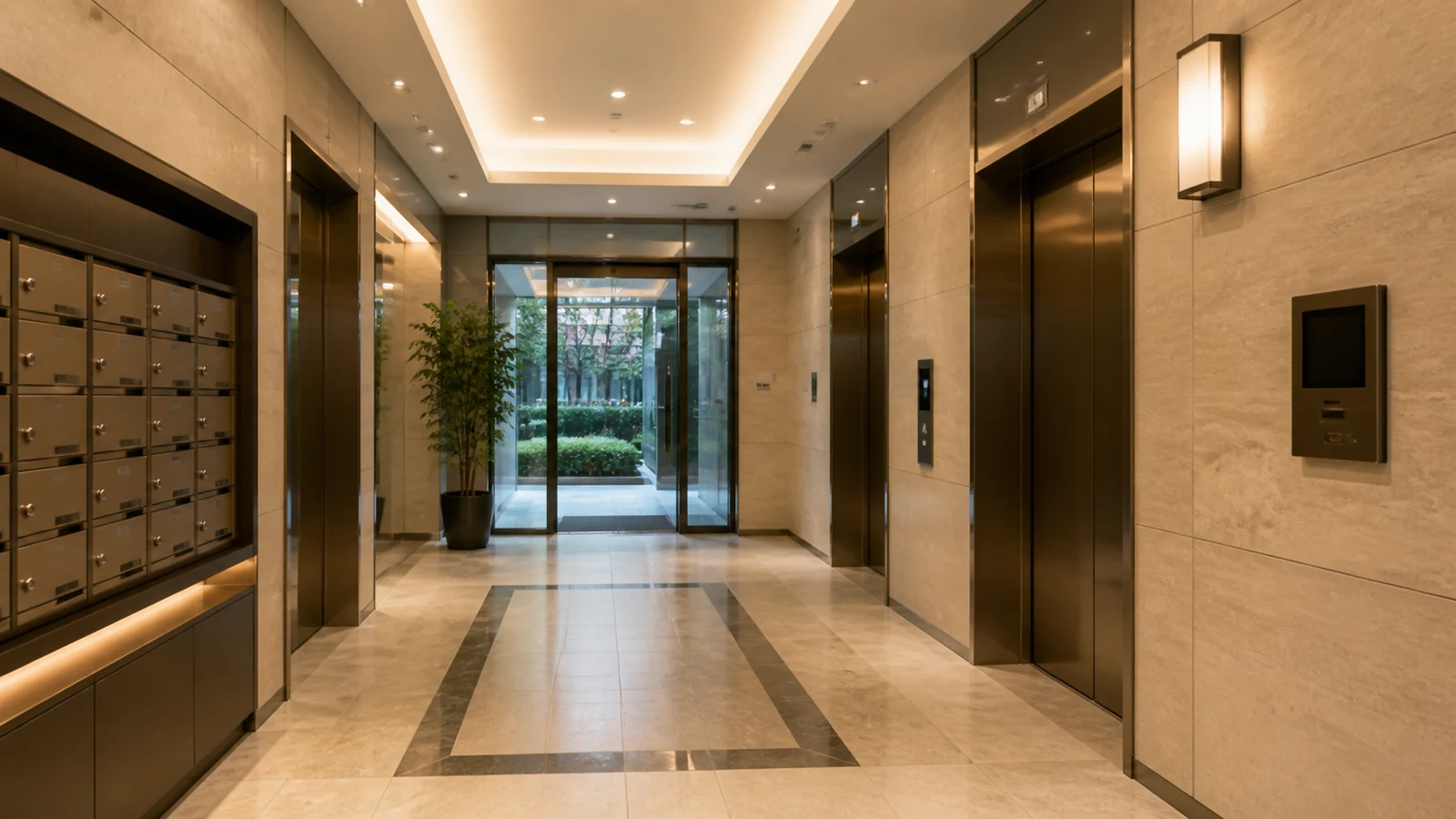
    Imagine you open your mailbox or check the apartment notice board and see a monthly notice. Do not read every line first. Start with the document type: 고지서. Then find the main fee word 관리비, the details phrase 관리비 내역, the payment amount, the payment deadline, and the office contact.

    This is a Korean language lesson, not housing, legal, billing, or payment advice. Real amounts, due dates, bank procedures, and building rules should be confirmed with the responsible office or service provider.

    Slide 2. Key Apartment Management Fee Words

    Text-free illustration for apartment management fee words on BSKorean.
    The visual is text-free; the exact Korean words are in the table below.
    KoreanRomanizationEnglishLevelUse
    관리비gwallibimaintenance fee; management feeBS2Main monthly apartment fee word.
    관리비 내역gwallibi naeyeokmaintenance fee details; management fee statementBS4Line-item details on a management fee notice.
    고지서gojiseopayment notice; bill noticeBS3Bill or payment notice document.
    납부napbupaymentBS3Payment action on notices.
    납부 기한napbu gihanpayment deadline; due dateBS4Due date printed on a bill.
    납부 금액napbu geumaekpayment amountBS5Amount that should be paid.
    연체료yeoncheryolate fee; overdue chargeBS4Late-fee word on payment notices.
    자동이체jadong icheautomatic bank transfer; autopayBS4Autopay or automatic transfer status.
    계좌번호gyejwa beonhoaccount numberBS4Account number shown for transfer payment.
    입금 확인ipgeum hwaginpayment confirmation; deposit confirmationBS4Confirmation after sending money.
    공과금gonggwageumutility billsBS3General utility fee category.
    수도요금sudo yogeumwater billBS2Water utility row.
    전기요금jeongi yogeumelectricity billBS2Electricity utility row.
    난방비nanbangbiheating billBS3Heating fee row.
    관리사무소gwalli samusomanagement officeBS4Office to ask about an apartment notice.

    Slide 3. Scan the Notice in Four Passes

    Text-free illustration for apartment management fee words on BSKorean.
    Use the words to ask a precise question at the management office.
    1. Pass 1: Bill type. Look for 고지서, 관리비, and 관리비 내역. These tell you whether the paper is a bill notice and what kind of fee it covers.
    2. Pass 2: Amount and deadline. Find 납부 금액 and 납부 기한. Do not confuse the amount row with the due date row.
    3. Pass 3: Utility rows. Check 공과금, 수도요금, 전기요금, and 난방비. These words often explain why the total amount changed.
    4. Pass 4: Payment and contact. Look for 납부, 자동이체, 계좌번호, 입금 확인, and 관리사무소.

    Slide 4. Common Notice Mistakes

    Text-free illustration for apartment management fee words on BSKorean.
    Payment words help you avoid mixing amount, deadline, and transfer route.

    The first mistake is mixing the bill and the details. 고지서 is the notice itself. 관리비 내역 means the detailed breakdown. If you only know 관리비, you may still miss the rows that explain the total.

    The second mistake is mixing the due date and the amount. 납부 기한 tells you the deadline. 납부 금액 tells you the amount. 연체료 is the word to notice when a payment is late.

    The third mistake is treating autopay as proof. 자동이체 means automatic transfer or autopay. 입금 확인 means payment confirmation. They are related, but they are not the same word.

    Slide 5. Practice With BSKorean

    Text-free illustration for apartment management fee words on BSKorean.
    Practice the set first, then read a real notice with the same scan order.

    Practice this topic in BSKorean: Read the BSKorean app guide, then open the practice app. Use this exact article set to review the Korean word, romanization, English meaning, and apartment management fee situation together.

    A useful habit is to read the notice in the same order every time: bill type, amount and deadline, utility rows, then payment and contact. That order makes the Korean easier to process when the notice has many numbers.

    Mini Review Table

    If you see…Think…
    관리비This is the main monthly apartment fee word.
    관리비 내역This points to the line-item statement.
    고지서This means a bill or payment notice.
    납부 기한This means the due date.
    납부 금액This means the amount to pay.
    자동이체This means automatic transfer or autopay.
    입금 확인This means payment confirmation.
    관리사무소This is the management office.

    Final Takeaway

    You do not need to translate a whole apartment notice at once. First identify the notice, then find the fee details, amount, deadline, utility rows, payment route, and office contact. These Korean apartment management fee words give you a practical reading order for real notices.

    Related Lessons

    Practice these Korean words in the BSKorean app

    After reading this lesson, continue with the BSKorean practical Korean app guide or open the BSKorean practice app to review words by level and real-life situation.

  • Korean Recycling Words: A Briefing-Style Lesson

    Korean Recycling Words: A Briefing-Style Lesson

    Use this recycling lesson first

    Recycling Korean is important in apartments and shared housing. Ask 분리수거는 어디예요?, “where is recycling?” Then sort by 일반 쓰레기, 음식물 쓰레기, 플라스틱, and 종이.

    Recycling taskKoreanMeaning
    Location분리수거는 어디예요?Where is recycling?
    General waste일반 쓰레기General waste
    Food waste음식물 쓰레기Food waste
    Disposal day오늘 버려도 돼요?Can I throw this away today?

    If a notice is posted, take a photo and ask 이건 어디에 버려요?. Related home lessons: apartment words and laundry room words.

    Korean recycling words guide

    Korean recycling words helps learners practice Korean words in real situations. This BSKorean post keeps the lesson clear, scannable, and connected to app practice.

    Practice in the BSKorean app

    Related lessons

    Briefing Summary

    Korean recycling words are essential when you live in Korea, especially in apartments, studios, dorms, or shared housing. The difficult part is not the idea of recycling. It is reading the right label at the right moment. This briefing follows a five-slide lesson: identify the waste type, choose the correct bag or bin, watch food waste rules, sort recyclables, and handle bulky waste without guessing.

    Download the complete Korean recycling words PPT briefing

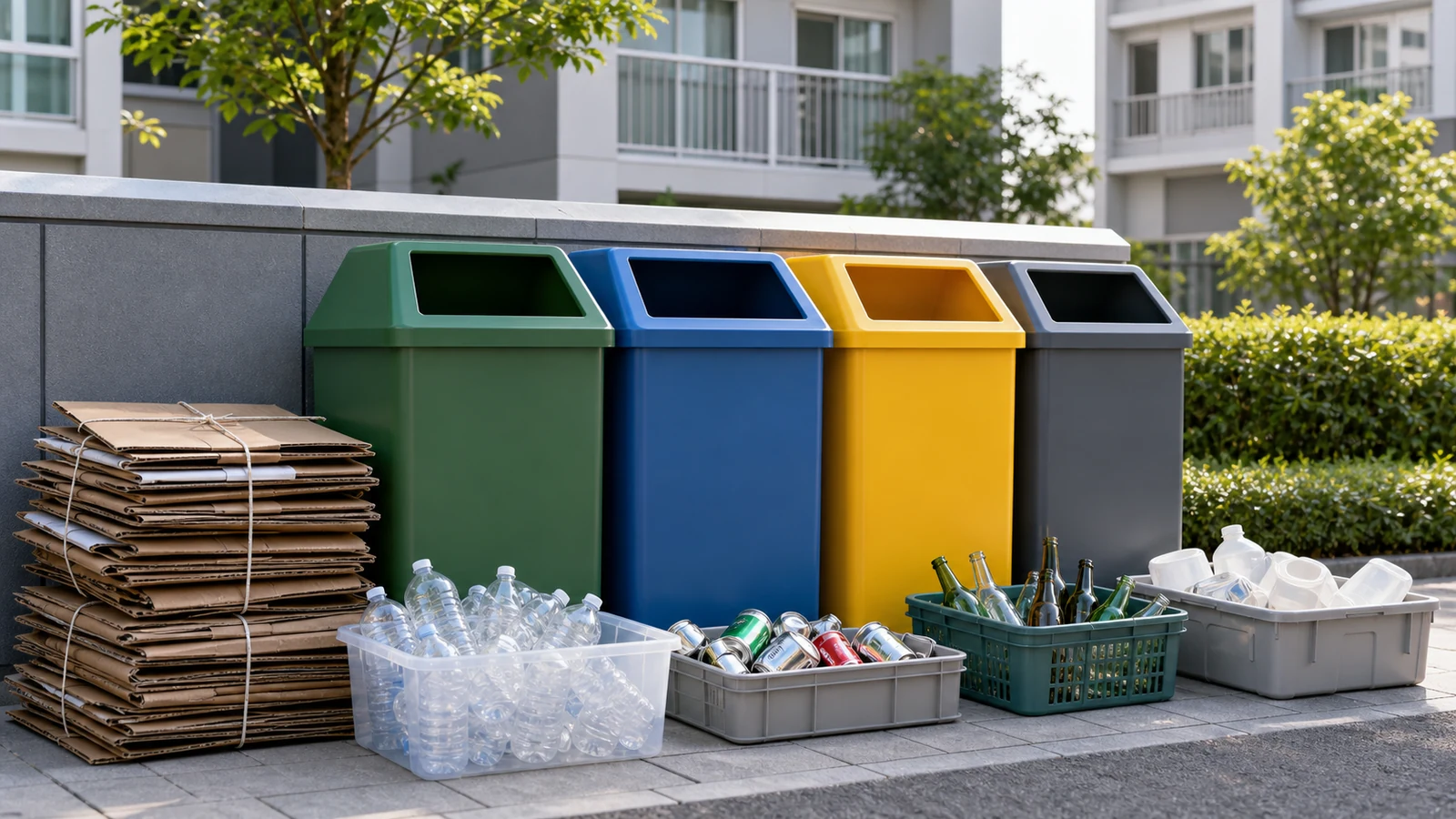
    Text-free illustration for Korean recycling words on BSKorean.
    Slide 1 introduces the daily recycling situation.

    Slide 1. The Situation

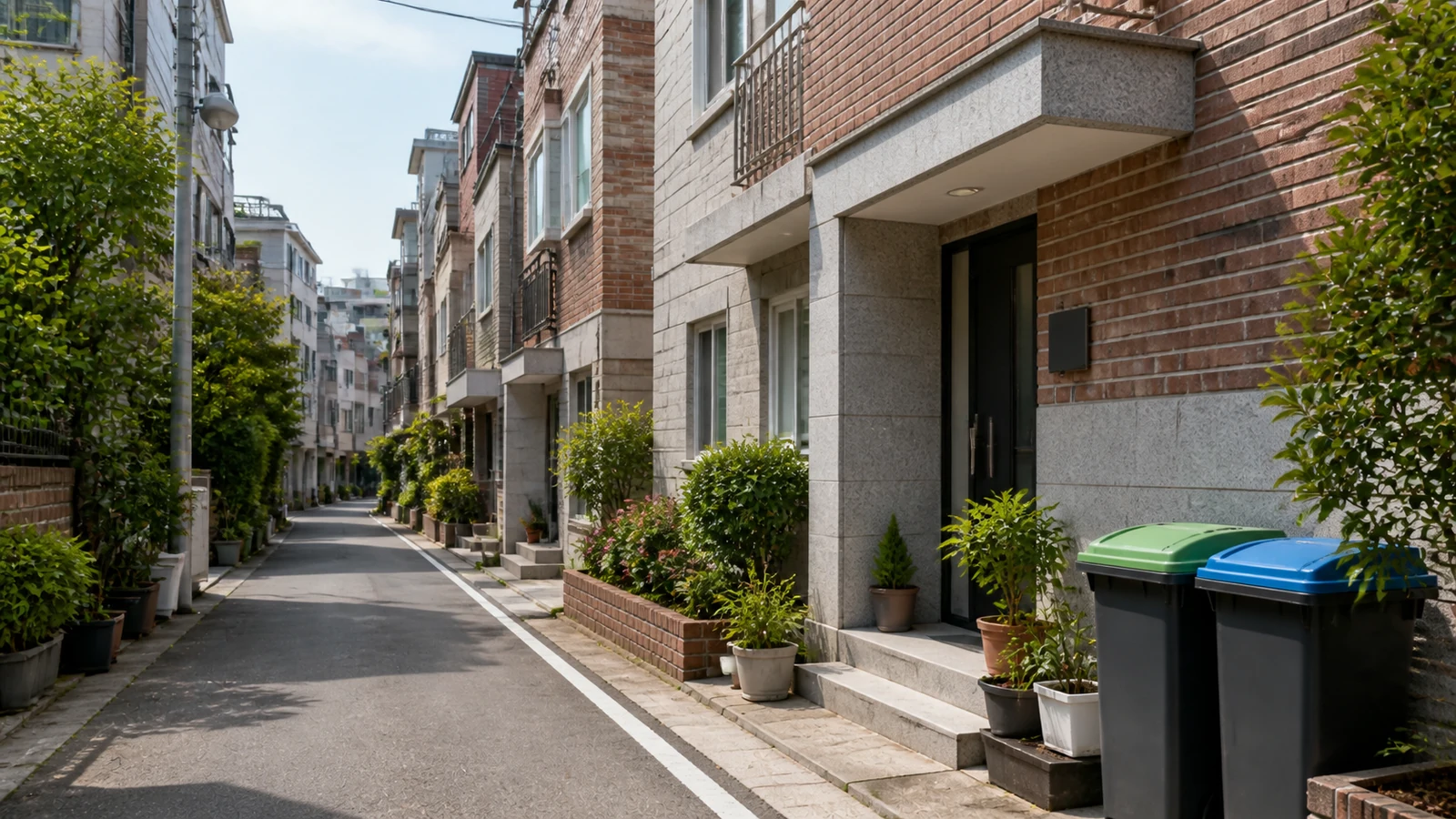
    You are standing at an apartment recycling area with bottles, paper, a small trash bag, and maybe food scraps from dinner. The bins look familiar, but the Korean labels can change your next action. Some items go into 재활용품. Some become 일반쓰레기. Food scraps may need a separate container or bag. Large items like a chair may be 대형폐기물, not normal trash.

    The slide shows a calm sorting area because this lesson is about practical reading. You do not need to understand every recycling notice. First, find the object word. Then look for the disposal action. If you can recognize 분리수거, 쓰레기봉투, 음식물쓰레기, and 분리배출, you can avoid the most common mistakes.

    Slide 2. Key Recycling Words

    The table below gives fifteen Korean recycling words from the Wordbook database. They are grouped around one daily route: name the waste, decide whether it is general trash, food waste, or recycling, then choose the right bag or bin.

    KoreanRomanizationEnglishUsage
    쓰레기sseuregitrashThe general word for waste, but it does not tell you the disposal type.
    생활 폐기물saenghwal pyegimulhousehold wasteA formal term for waste made in daily home life.
    음식물쓰레기eumsikmul sseuregifood wasteUse this for food scraps that go in a separate container or bag.
    일반쓰레기ilban sseuregigeneral wasteThis is non-recyclable waste that usually needs a paid trash bag.
    재활용품jaehwaryongpumrecyclablesThis means items that should go to recycling, not general trash.
    분리수거bulli sugeowaste sortingThis is the everyday word for sorting recycling and waste.
    분리배출bulli baechulseparate disposalA notice-style word meaning you must put items out by type.
    분리수거함bulli sugeohamsorting binLook for this bin area in apartment basements or outside zones.
    쓰레기봉투sseuregi bongtutrash bagThis often means the official paid bag for general waste.
    종이류jongnyupaper itemsUse this label for paper waste, paper bags, boxes, and similar items.
    플라스틱류peullaseutiknyuplastic itemsThis label covers plastic containers, packaging, and similar items.
    페트병peteubyeongplastic bottleA common recycling word for drink bottles made from PET plastic.
    비닐봉지binil bongjiplastic bagThis means a thin plastic bag, often sorted differently from hard plastic.
    대형폐기물daehyeong pyegimulbulky wasteThis is for large items like furniture that need a special process.
    분리배출하다bulli baechulhadato dispose separatelyUse this verb when a notice tells residents to sort before disposal.

    Start with the big category. 쓰레기 is broad, so it is only your first clue. The important question is what kind of trash it is. 일반쓰레기 usually needs an official trash bag. 음식물쓰레기 goes separately. 재활용품 must be sorted into the right bin.

    Next, notice the place word or container word. 분리수거함 tells you where sorted items go. 쓰레기봉투 tells you a bag is required. If a notice says 대형폐기물, do not leave the item beside normal bins. Large waste often needs a report, sticker, fee, or assigned pickup day.

    Slide 3. Reading Formulas

    Recycling Korean becomes easier when you read labels as formulas. Type plus container is the first formula. 플라스틱류 + 분리수거함 means plastic items go into the sorting bin. 종이류 + 접어서 often means paper should be folded or flattened. 페트병 + 라벨 제거 tells you to remove the bottle label.

    The second formula is waste type plus disposal action. 재활용품을 분리배출하세요 means you should dispose of recyclables separately. 음식물쓰레기는 따로 버리세요 means food waste is separate from other trash. In signs, 따로 and 분리 both warn you not to mix items.

    The third formula is exception plus special process. 대형폐기물 is the key warning word. A chair, mattress, desk, or shelf may not belong in the normal trash area. If you see that word, check whether the apartment office, district office, or app requires a pickup request.

    A small reading habit helps here. Do not start with the longest sentence on the sign. Scan for the material word first. Then scan for the action word near it. If you see 종이류, the notice is probably about paper. If you see 플라스틱류 or 페트병, the rule is probably about emptying, separating, or removing a label.

    Slide 4. Read Recycling Korean in 3 Steps

    Step one is to name the item. Ask yourself whether it is paper, plastic, food waste, a plastic bottle, or a large item. Match the item to a word such as 종이류, 플라스틱류, 음식물쓰레기, 페트병, or 대형폐기물. This prevents you from using one general trash idea for everything.

    Step two is to choose the correct container. If the notice says 일반쓰레기, look for the correct 쓰레기봉투. If the label says 재활용품, move to the 분리수거함. If it says 음식물쓰레기, check whether your building uses a food waste bin, card reader, or special bag.

    Step three is to check the special rule. Bottles may need emptying. Paper may need folding. Plastic bags may be collected separately. Large items may need registration. This is where 분리배출 matters. The word does not only mean recycling. It means you must separate the item correctly before putting it out.

    This three-step method also helps when a neighbor or building staff member gives a quick instruction. Listen for the item word first. Then listen for the container or action word. You can ask a short question like 이건 어디에 버려요?, which means “Where do I throw this away?”

    If the answer is too fast, repeat only the key word you heard. For example, say 음식물쓰레기요? or 재활용품이에요? with a questioning tone. This keeps the conversation simple. You are not asking for a full grammar explanation. You are confirming which disposal category controls the next step.

    Slide 5. Mistakes and Practice

    The first mistake is using 쓰레기 for every situation. It is a useful word, but it is too broad. When you read an apartment notice, look for the more exact label. 일반쓰레기, 음식물쓰레기, and 재활용품 lead to different actions.

    The second mistake is putting dirty recyclables directly into the bin. A notice may ask residents to empty, rinse, flatten, or remove labels. Even if those verbs are new, the category words still help. If you see 페트병, check the bottle. If you see 종이류, check whether boxes should be flattened.

    The third mistake is treating 대형폐기물 as normal trash. Large waste rules are strict in many Korean cities. If you are unsure, ask building staff before leaving the item outside. A simple question is enough: 대형폐기물 신고해야 해요? It means “Do I need to report bulky waste?”

    Practice

    Answer these quick recognition questions. 1. Which word means food waste: 음식물쓰레기 or 종이류? 2. Which word means a sorting bin: 분리수거함 or 쓰레기봉투? 3. Which word warns you about large waste: 대형폐기물 or 페트병?

    Mini scenario: you have a plastic drink bottle and a pizza box. The bottle is 페트병, so empty it and check the label. The pizza box may be 종이류 only if it is not too dirty. The answer key is 음식물쓰레기, 분리수거함, and 대형폐기물. The main habit is simple: identify, sort, then dispose.

    Mini Review Table

    If you see…It usually means…What to do
    일반쓰레기Non-recyclable waste.Use the correct trash bag.
    음식물쓰레기Food waste is separate.Use the food waste bin or bag.
    재활용품The item can be recycled.Sort by material.
    분리수거함This is the sorting bin.Choose the matching bin.
    대형폐기물A large item needs special handling.Ask before leaving it outside.

    Final Takeaway

    Korean recycling words are practical because they tell you the next action. Do not stop at 쓰레기. Find the exact type, choose the correct bag or sorting bin, and check for special rules. When the label is unclear, ask one short question before putting the item out.

    Related Lessons

    Practice this topic in BSKorean: Read the BSKorean app guide, then open the practice app and use the words from this lesson.

  • Korean Weather App Words: A Briefing-Style Lesson

    Korean Weather App Words: A Briefing-Style Lesson

    Use this weather app lesson first

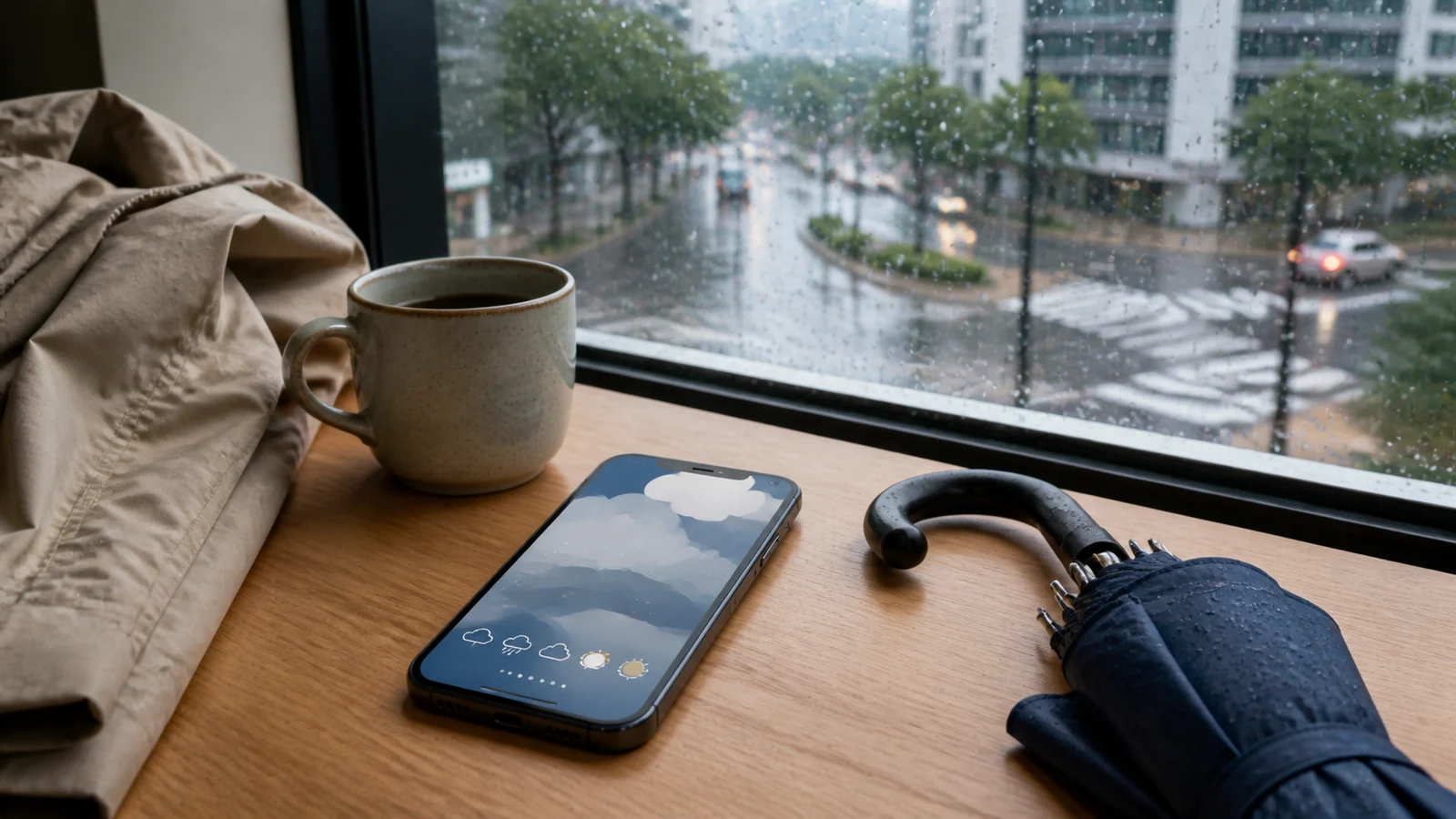
    Korean weather apps use short words. Start with 비가 와요, “it is raining,” 눈이 와요, “it is snowing,” and 미세먼지가 심해요, “the fine dust is bad.”

    Weather need Korean Meaning
    Rain 비가 와요 It is raining.
    Snow 눈이 와요 It is snowing.
    Fine dust 미세먼지가 심해요 The fine dust is bad.
    Umbrella 우산이 필요해요 I need an umbrella.

    For daily planning, also learn 오늘 추워요 and 오늘 더워요. Related outside lessons: convenience store words and bus stop sign vocabulary.

    Korean weather app words guide

    Korean weather app words helps learners practice Korean words in real situations. This BSKorean post keeps the lesson clear, scannable, and connected to app practice.

    Practice in the BSKorean app

    Related lessons

    Briefing Summary

    Korean weather app words help you check the day before you leave home in Korea. A weather screen may look crowded, but most of the useful information comes from a few repeated labels. In this briefing, you will read forecast words, temperature labels, rain words, humidity, fine dust, and the practical umbrella signal. The goal is simple: check the screen, understand the risk, and decide what to carry.

    Download the complete Korean weather app words PPT briefing

    Text-free illustration for Korean weather app words on BSKorean.
    Slide 1 introduces Korean weather app words before leaving home.

    Slide 1. The Situation

    You are about to leave an apartment lobby in Korea. Outside, the pavement is wet, the sky is gray, and people are moving carefully. Before you step out, you check a weather app. You do not need to understand every line. First, find the main weather word, then the temperature, then the rain or air quality signal.

    This is why the lesson starts with a photo briefing. The image shows a real daily decision, not a grammar exercise. A learner checks the phone before choosing a jacket, mask, or umbrella. In Korea, the weather screen often affects small choices: whether to walk, take a bus, carry an umbrella, or avoid outdoor time when fine dust is bad.

    Think of the screen as a checklist. The top area usually gives the general condition. The middle area often gives numbers, such as temperature or rainfall. Lower sections may show air quality, hourly changes, or warnings. If you read the labels in this order, the screen becomes much less stressful.

    Slide 2. Key Weather App Words

    The key words below come from the Bs3001 Wordbook database. Learn them as screen labels first. Many weather apps show a short Korean word beside a number, icon, or warning color.

    Korean Romanization English Usage
    날씨 nalssi weather Main word for weather screens and daily talk.
    일기예보 ilgiyebo weather forecast Use this for future weather information.
    기상정보 gisang jeongbo weather information Formal label for weather data or notices.
    기온 gion air temperature Temperature of the outside air.
    최고기온 choego gion highest temperature The warmest expected temperature.
    최저기온 choejeo gion lowest temperature The coldest expected temperature.
    강수량 gangsuryang rainfall amount How much rain is expected or recorded.
    습도 seupdo humidity How humid the air feels.
    미세먼지 mise meonji fine dust Air quality word often shown in Korea.
    bi rain Simple rain word for icons and forecasts.
    소나기 sonagi shower A short sudden rain shower.
    우산 usan umbrella The practical item to carry when rain is likely.

    Notice the order. The first three words tell you what kind of screen you are reading. The next three words show the temperature range. The last six words help you decide what to do outside. This is more useful than memorizing a long list without a situation.

    When you study the table, say the Korean word first, then the English meaning. Do not start with a full sentence yet. A weather app usually gives you short signals, not conversation. For example, 기온 plus a number is enough to understand the temperature. plus an afternoon time is enough to prepare for rain later.

    The words also group naturally. 날씨, 일기예보, and 기상정보 tell you the type of information. 기온, 최고기온, and 최저기온 tell you the temperature range. , 소나기, and 강수량 tell you how rain may affect your movement.

    Slide 3. Reading Formulas

    Weather app Korean often works like a formula. You see a label, then a number, level, or short result. For example, 현재 기온 means current air temperature. If you see 18도 beside it, you can read the key idea without building a full sentence.

    최고기온 and 최저기온 are also label words. They show the daily high and low. This matters because the current temperature may not tell the whole story. A morning can be cool, but the day may become warm. A night can become much colder than the afternoon.

    For rain, focus on , 소나기, and 강수량. 비 is the simple rain word. 소나기 warns you about a sudden shower. 강수량 gives more detail about the amount of rain. Then check 습도 and 미세먼지. They affect comfort and outdoor plans, even when it is not raining.

    Be careful with English habits. Some learners see one weather icon and skip the Korean label. That works only until the icon is unclear. Korean labels give the precise clue. A cloud icon may feel simple, but 소나기, 강수량, and 미세먼지 each change your plan in a different way.

    Slide 4. Read Weather App in 3 Steps

    Use a three-step routine when the screen feels busy. First, check 기온, 최고기온, and 최저기온. These words help you choose clothes. If the high and low are far apart, prepare for a change during the day.

    Second, look for rain words. If you see , expect rain. If you see 소나기, do not assume the whole day will be wet. It may be short, but it can still catch you outside. If 강수량 looks high, the rain may be heavier or longer.

    Third, check 미세먼지 and decide 우산. Fine dust is not weather in the same way as rain, but it is part of daily life in Korea. If the fine dust level is bad, many people reduce outdoor time. If rain or showers appear, carry an umbrella before leaving.

    This three-step method is useful because it turns reading into action. You are not studying the whole app. You are answering three practical questions. How warm or cold will it be? Will rain interrupt my route? Is the air quality good enough for outdoor time? Once you answer those questions, the Korean screen has done its job.

    Slide 5. Mistakes and Practice

    One common mistake is reading 기온 as body temperature. In a weather app, it means air temperature. Body temperature is 체온, which belongs in a medical situation. Another mistake is checking only the current number and ignoring 최저기온. That can be a problem if you return home late.

    Do not treat 소나기 exactly like ordinary rain. A shower may be brief, but it can arrive suddenly. Also, do not ignore 미세먼지. A clear sky does not always mean clean air. The safest habit is to read the label first, then connect it to one action: jacket, umbrella, mask, or indoor plan.

    Another small mistake is reading 우산 only as a word in a store. In this lesson, it is the action result of the weather check. If the app shows 비 or 소나기, the next question is simple: do you need 우산 today? This keeps the vocabulary tied to real movement.

    Practice

    Try these quick recognition questions before looking at the answers.

    1. If you see 최고기온, are you checking the warmest or coldest point of the day?
    2. If the app says 소나기, should you expect a long rainy season or a sudden shower?
    3. If 미세먼지 is bad, is the main issue rain or air quality?

    Mini scenario: You leave home at 8 a.m. The app shows 최저기온 in the morning, 소나기 in the evening, and bad 미세먼지. A smart choice is to wear layers, carry 우산, and reduce unnecessary outdoor time.

    Answer key: 최고기온 is the warmest point. 소나기 means a sudden shower. 미세먼지 is an air quality issue.

    Mini Review Table

    If you see… It usually means… What to do
    기온 / 최고기온 / 최저기온 The app is showing temperature range. Choose clothes for the whole day.
    비 / 소나기 / 강수량 The app is warning about rain. Carry 우산 or adjust travel plans.
    습도 The air may feel sticky or heavy. Expect discomfort in warm weather.
    미세먼지 The air quality may be poor. Reduce outdoor time if needed.

    Final Takeaway

    Korean weather app words become easier when you read them as decision labels. Start with 날씨 or 일기예보. Check 기온, 최고기온, and 최저기온. Then look for 비, 소나기, 강수량, 습도, and 미세먼지. Finally, decide whether you need 우산 before you leave home.

    Related Lessons

  • Korean ATM Words: A Briefing-Style Lesson

    Korean ATM Words: A Briefing-Style Lesson

    Use this ATM words lesson first

    At a Korean ATM, choose the task first: 현금 인출, 계좌 이체, or 잔액 조회. If you need help, say 현금 인출하고 싶어요, “I want to withdraw cash.”

    ATM task Korean Meaning
    Withdraw 현금 인출하고 싶어요 I want to withdraw cash.
    Transfer 계좌 이체 Bank transfer
    Balance 잔액 조회 Balance inquiry
    Receipt 영수증 주세요 Please give me a receipt.

    When the screen says 비밀번호를 입력하세요, enter it privately and do not show it to anyone. For related money lessons, continue with bank transfer words and bank account opening words.

    Korean ATM words guide

    Korean ATM words helps learners practice Korean words in real situations. This BSKorean post keeps the lesson clear, scannable, and connected to app practice.

    Practice in the BSKorean app

    Related lessons


    .bsk-lesson-table{overflow-x:auto;margin:18px 0 24px}
    .bsk-lesson-table table{width:100%;border-collapse:collapse;table-layout:fixed;font-size:.92rem;line-height:1.45}
    .bsk-lesson-table th,.bsk-lesson-table td{padding:8px 10px;vertical-align:top;word-break:normal;overflow-wrap:break-word}
    .bsk-lesson-table th{white-space:nowrap}
    @media(max-width:640px){.bsk-lesson-table table{min-width:620px;table-layout:auto;font-size:.86rem}.bsk-lesson-table th,.bsk-lesson-table td{padding:7px 8px}}

    Briefing Summary

    Korean ATM words are useful when you need to withdraw cash, check your balance, transfer money, or print a receipt in Korea. This lesson helps you read the most important ATM screen words before you press the final button.

    Korean ATM Words You Should Read First

    An ATM screen in Korea can feel stressful if you only recognize a few words. The screen may ask you to choose a service, enter a PIN, check a fee, or decide whether to print a receipt. You do not need to understand every long sentence. You need to recognize the function words first.

    This briefing-style lesson focuses on the Korean words foreigners are most likely to see when using an ATM in Korea. The goal is simple: read the main action, avoid choosing the wrong menu, and confirm important details before pressing the final button.

    Best for Main skill Study time Practice focus
    Foreign residents, workers, students, and travelers in Korea Reading common ATM screen words 8-10 minutes Withdrawal, deposit, balance, transfer, PIN, fee, receipt

    Slide 1. The Situation

    Text-free illustration for Korean ATM words on BSKorean.

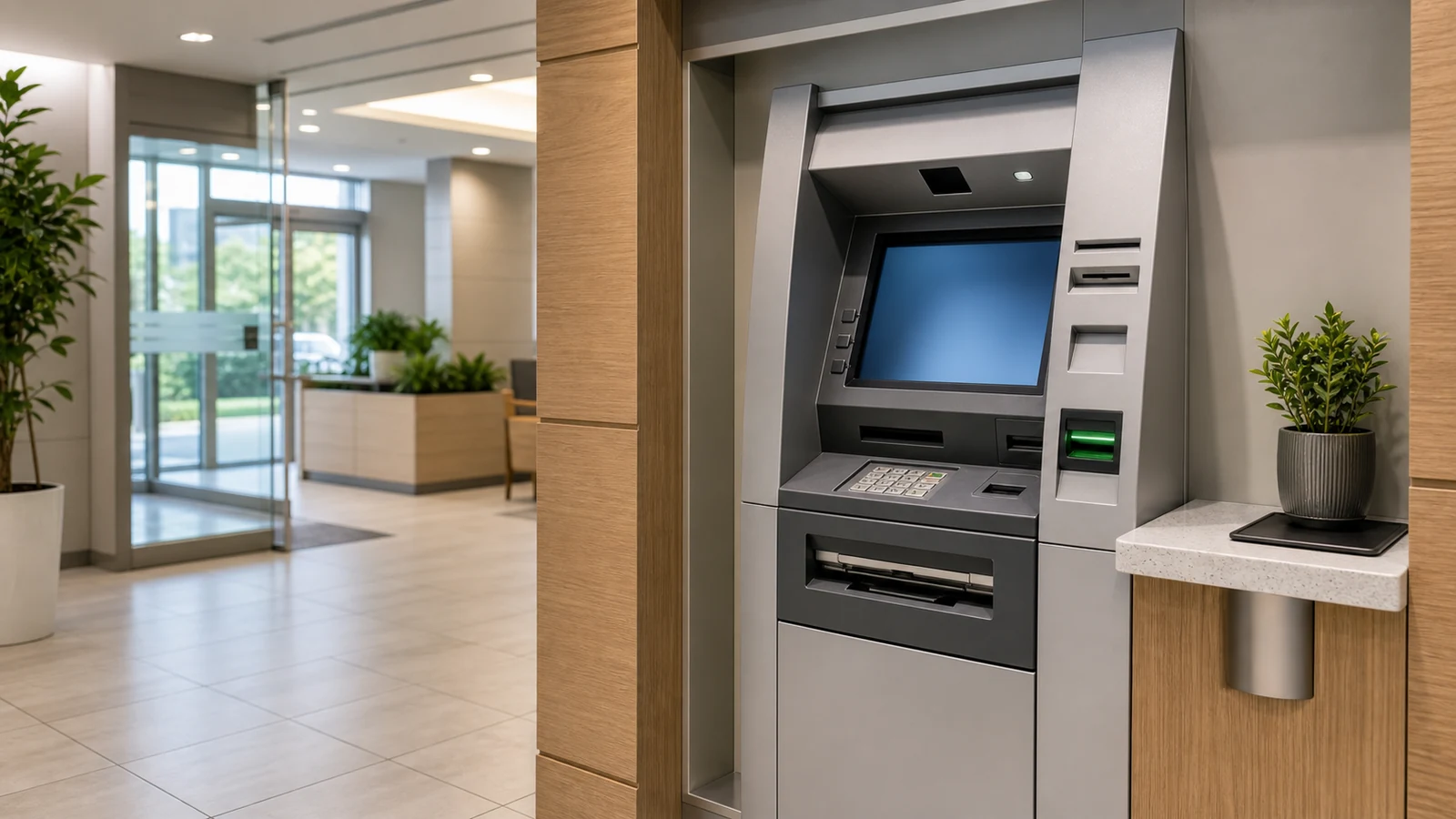
    You are standing in front of an ATM in Korea. The machine shows several buttons, and the person behind you may be waiting. At this moment, speed is useful, but accuracy is more important.

    Start by looking for the Korean words that tell you the action. Is the machine asking about taking money out, putting money in, checking your balance, sending money, entering your PIN, checking a fee, or printing a receipt?

    The slide highlights three words you may see very early on an ATM screen: 출금, 입금, and 잔액. These are not full sentences. They are menu functions. Once you understand them, the screen becomes much easier to read.

    Slide 2. Key ATM Words

    ATM Korean often appears as short labels, not long grammar sentences. Read the words like screen instructions.

    Formula 1: Action word + amount

    출금 금액
    chulgeum geumaek
    withdrawal amount

    If you see 출금, the screen is about taking money out. If the next part shows an amount, check the number carefully before continuing.

    Formula 2: 비밀번호 + 입력

    비밀번호 입력
    bimilbeonho ipnyeok
    enter PIN / enter password

    입력 means input or enter. When it appears with 비밀번호, the machine is asking you to enter your secret number. Do this privately and check the keypad before pressing the next button.

    Formula 3: 수수료 + 확인

    수수료 확인
    susuryo hwagin
    check the fee

    수수료 is important because some ATMs charge extra depending on the bank, time, card, or service. If you see this word before the final confirmation, pause and check the amount.

    Slide 4. Read an ATM Screen in 3 Steps

    Step 1. Find the main action.
    Look first for 출금, 입금, 잔액, or 이체. This tells you what kind of service you are using.

    Step 2. Check the sensitive information.
    If the screen asks for 비밀번호, enter it carefully. If you are transferring money, check the account details. If you are withdrawing cash, check the amount.

    Step 3. Confirm the fee and receipt.
    Before the final button, look for 수수료. After the transaction, the machine may ask about 영수증. If you need proof, choose the receipt option.

    Example screen logic:

    출금 선택 → 비밀번호 입력 → 출금 금액 확인 → 수수료 확인 → 영수증 출력
    chulgeum seontaek → bimilbeonho ipnyeok → chulgeum geumaek hwagin → susuryo hwagin → yeongsujeung chullyeok
    Choose withdrawal → enter PIN → check withdrawal amount → check fee → print receipt

    Slide 5. Mistakes and Practice

    Mistake 1: Confusing 출금 and 입금

    출금 means money comes out of your account. 입금 means money goes into an account. They look similar because both end with , which relates to money, but the direction is different.

    Mistake 2: Thinking 잔액 means the amount you will receive

    잔액 means balance, or money left in the account. It is not the cash amount the ATM will give you. If you want to take cash out, look for 출금 and then check the withdrawal amount.

    Mistake 3: Ignoring 수수료

    수수료 is a fee. It can appear near the final confirmation screen. If the fee is higher than expected, you may want to cancel and use another ATM or another payment method.

    Practice

    1. What does 출금 mean?
    A. deposit / B. withdrawal / C. receipt
    Answer: B. withdrawal. Choose this when you want cash from your account.

    2. Which word should you look for when checking money left in your account?
    Answer: 잔액. It means balance.

    3. What does 비밀번호 입력 mean?
    Answer: Enter PIN or enter password. The machine is asking for your secret number.

    4. You see 수수료 before the final confirmation. What should you do?
    Answer: Check the fee before continuing.

    5. Which word is useful if you need proof of the transaction?
    Answer: 영수증. It means receipt.

    Mini Review Table

    Korean Meaning Where You See It Quick Tip
    출금 withdrawal Main ATM menu Cash comes out.
    입금 deposit Main ATM menu Money goes in.
    잔액 balance Account check screen Money left in the account.
    이체 transfer Banking menu Send money to another account.
    비밀번호 PIN / password Security screen Enter privately.
    수수료 fee Confirmation screen Check before confirming.
    영수증 receipt Final screen or receipt slot Choose it if you need proof.

    Final Takeaway

    When you use an ATM in Korea, do not try to translate the whole screen first. Find the function word. 출금 is withdrawal, 입금 is deposit, 잔액 is balance, and 이체 is transfer. Then check 비밀번호, 수수료, and 영수증 before you finish.

    You can review these words in Korean Learn Korean. They are also useful for future app-based practice because each word connects to a real action on a screen.

    For official Korea travel and daily-life context, check Visit Korea.

    Related Lessons

  • Korean Convenience Store Words for Checkout

    Korean Convenience Store Words for Checkout

    Use this convenience store lesson first

    A Korean convenience store checkout can move quickly, so learn the words you need before you reach the counter. The most useful sentence is 봉투 주세요, “please give me a bag.” If you do not need a bag, answer 괜찮아요.

    Practice these checkout phrases aloud: 봉투 주세요, 영수증 주세요, 교통카드 충전해 주세요, and 따로 계산해 주세요. They help with bags, receipts, transit cards, and separate payment.

    Counter moment Korean phrase Use it when
    Bag 봉투 주세요 You need a bag.
    Receipt 영수증 주세요 You need proof of payment.
    Transport card 교통카드 충전해 주세요 You want to add money to a card.
    Separate bill 따로 계산해 주세요 You and another person will pay separately.

    If the clerk asks 봉투 필요하세요?, they are asking whether you need a bag. A simple 네, 주세요 or 아니요, 괜찮아요 is enough. For similar quick-counter speaking, study cafe phrases and pharmacy cold medicine words.

    Korean convenience store words guide

    Korean convenience store words helps learners practice Korean words in real situations. This BSKorean post keeps the lesson clear, scannable, and connected to app practice.

    Practice in the BSKorean app

    Related lessons

    Korean convenience store words help you understand checkout questions, payment options, bags, receipts, discounts, and quick service phrases in Korea. This briefing-style lesson focuses on words you hear at the counter.

    Korean Convenience Store Words at Checkout

    Text-free illustration for Korean convenience store words on BSKorean.
    Korean convenience store checkout words title slide with a realistic checkout scene

    You put a lunch box, bottled water, and a small snack on the counter at a Korean convenience store. The cashier scans the items quickly and asks, 봉투 필요하세요? Another customer is already waiting behind you. You know this is a simple checkout, but the Korean comes fast.

    This lesson helps you handle that exact moment. You will learn Korean convenience store words for checkout, bags, receipts, membership points, payment, microwave heating, disposable items, and transport card top-ups. The goal is not to memorize a long conversation. The goal is to recognize the action word and answer clearly.

    Download the updated convenience store PPT briefing

    Opening Situation

    Korean convenience stores are useful for travelers, students, workers, and new residents. You can buy meals, drinks, umbrellas, chargers, medicine-like daily items, and sometimes top up a transport card. Many people also use the microwave area after buying a lunch box or instant food.

    The language is usually short. A cashier may not say a full sentence every time. You might hear 봉투요?, 영수증은요?, or 포인트 있으세요? These are not grammar tests. They are checkout signals.

    This matters even more if you work in a service job in Korea. Convenience store checkout language overlaps with cafe, restaurant, pharmacy, mart, and hotel front desk Korean. Words like 계산, 카드, 영수증, 포인트, and 할인 appear in many service situations. When you learn them as action words, you are not only learning one store. You are learning a small service counter system.

    What You Need to Do

    1. Listen for the main checkout word: bag, receipt, points, payment, or heating.
    2. Answer with a short phrase such as 네, 주세요 or 아니요, 괜찮아요.
    3. Choose your payment method clearly.
    4. Ask for microwave heating or disposable items only if you need them.
    5. Use the same words again in cafes, pharmacies, small stores, and service counters.

    Core Vocabulary Table

    Korean Romanization English Level Usage Note
    편의점 pyeonuijeom convenience store Beginner 1 The store itself. Use it for maps, signs, and directions.
    계산 gyesan checkout / payment Beginner 2 Used when paying or asking where to pay.
    봉투 bongtu bag Beginner 2 A shopping bag. It may cost extra.
    영수증 yeongsujeung receipt Beginner 2 Proof of purchase. The cashier may ask if you need it.
    카드 kadeu card Beginner 1 Debit or credit card. Common payment method in Korea.
    현금 hyeongeum cash Beginner 2 Paper money or coins.
    포인트 pointeu points Intermediate 1 Membership or reward points. Not the same as payment.
    할인 harin discount Intermediate 1 Used in promotions, membership benefits, and signs.
    행사 상품 haengsa sangpum promotional item Intermediate 2 Often appears on shelf labels or 1+1 items.
    전자레인지 jeonjareinji microwave Beginner 3 Used for lunch boxes and instant food.
    데워 주세요 dewo juseyo please heat it Beginner 3 Useful when asking staff to heat food.
    일회용품 ilhoe-yongpum disposable items Intermediate 2 Spoons, chopsticks, forks, or straws.
    교통카드 gyotongkadeu transport card Intermediate 1 Transit card for buses and subways.
    충전 chungjeon top-up / recharge Intermediate 1 Used when adding money to a transport card.
    환불 hwanbul refund Advanced 1 More formal service word. Use when asking about returns.

    Action Signal Formula

    Convenience store Korean is easier when you treat each question as an action signal.

    The important point is that the Korean word tells you what decision is being requested. If you hear 봉투, decide whether you need a bag. If you hear 영수증, decide whether you want a receipt. If you hear 포인트, decide whether you have membership points. You do not need to translate every ending while the line is moving.

    Pattern Meaning Example
    N 필요하세요? Do you need N? 봉투 필요하세요?
    N 드릴까요? Shall I give you N? 영수증 드릴까요?
    N 있으세요? Do you have N? 포인트 있으세요?
    N로 할게요 I will use/pay with N 카드로 할게요.
    이거 데워 주세요 Please heat this up 이거 데워 주세요.
    Amount + 충전해 주세요 Please top up this amount 만원 충전해 주세요.

    Real-Life Dialogue

    Dialogue 1: Bag, points, and payment

    Cashier: 봉투 필요하세요?
    Bongtu piryo haseyo?
    Do you need a bag?

    Customer: 네, 하나 주세요.
    Ne, hana juseyo.
    Yes, one please.

    Cashier: 포인트 있으세요?
    Pointeu isseuseyo?
    Do you have membership points?

    Customer: 아니요, 없어요. 카드로 할게요.
    Aniyo, eopseoyo. Kadeuro halgeyo.
    No, I do not. I will pay by card.

    Dialogue 2: Lunch box and receipt

    Customer: 이거 데워 주세요.
    Igeo dewo juseyo.
    Please heat this up.

    Cashier: 네, 잠시만요.
    Ne, jamsimanyo.
    Yes, one moment.

    Cashier: 영수증 드릴까요?
    Yeongsujeung deurilkkayo?
    Would you like a receipt?

    Customer: 아니요, 괜찮아요.
    Aniyo, gwaenchanayo.
    No, that is okay.

    These dialogues are short because real checkout Korean is short. You do not need to explain everything. You only need to answer the current decision.

    Notice that the customer does not answer with long grammar. The customer uses short, polite phrases that fit the situation. This is natural in Korea because the counter is busy and the shared goal is simple: complete the payment, give the needed items, and move on. For beginners, this is good news. You can sound natural with a small number of reliable phrases.

    Common Mistakes

    Common Mistake 1: Thinking 포인트 means payment

    Why it happens: The word sounds like a payment system to many learners.

    Correct understanding: 포인트 usually means membership or reward points. If you do not have them, say 포인트 없어요.

    Common Mistake 2: Answering 봉투 필요하세요? with only 네

    Why it happens: 네 means yes, so learners think it is enough.

    Correct understanding: 네 can work, but 네, 하나 주세요 is clearer. It means “Yes, one please.”

    Common Mistake 3: Waiting for staff to heat food automatically

    Why it happens: In some countries, staff may prepare hot food automatically.

    Correct understanding: If you bought a lunch box and want it heated, say 이거 데워 주세요. Some stores have a self-use microwave area.

    Common Mistake 4: Using long sentences under pressure

    Why it happens: Learners often try to make a complete textbook sentence.

    Correct understanding: Short Korean is normal at checkout. 카드로 할게요, 영수증 괜찮아요, and 포인트 없어요 are natural.

    Mini Quiz

    1. Question 1: What does 봉투 mean?
      Answer: bag.
      Explanation: The cashier may ask 봉투 필요하세요?, meaning “Do you need a bag?”
    2. Question 2: You want to pay by card. What should you say?
      Answer: 카드로 할게요.
      Explanation: N로 할게요 is a natural pattern for choosing a payment method.
    3. Question 3: What does 포인트 있으세요? ask?
      Answer: Do you have membership points?
      Explanation: It is not asking whether you will pay with points in every case. It often means membership points.
    4. Question 4: You do not need a receipt. What can you say?
      Answer: 아니요, 괜찮아요.
      Explanation: This is a polite and short way to decline.
    5. Question 5: How do you ask staff to heat a lunch box?
      Answer: 이거 데워 주세요.
      Explanation: 이거 means “this,” and 데워 주세요 means “please heat it.”

    Review Table

    Korean Meaning Best Situation Beginner Tip
    봉투 bag checkout Answer with 네, 하나 주세요 if you need one.
    영수증 receipt after payment Decline with 아니요, 괜찮아요.
    포인트 membership points cashier question Say 포인트 없어요 if you do not have points.
    카드 card payment Use 카드로 할게요.
    현금 cash payment Use 현금으로 할게요.
    전자레인지 microwave food area Look near lunch boxes or instant food.
    데워 주세요 please heat it lunch box purchase Point to the food and say 이거.
    충전 top-up transport card service Use amount + 충전해 주세요.

    Practice This Set

    Practice this word list in Learn Korean or in the upcoming BS3001 app. Start with Korean to English recognition first. Then practice English to Korean so you can produce short answers at the counter.

    A good practice order is simple. First, recognize the Korean word. Second, choose the English meaning. Third, say one short answer aloud. For example, when you see 영수증, think “receipt,” then practice 아니요, 괜찮아요. When you see 카드, think “card,” then practice 카드로 할게요. This connects vocabulary to real action.

    Practice Convenience Store Words

    For official Korea travel and daily-life context, check Visit Korea.

    Related Lessons

    Conclusion

    Korean convenience store checkout is not one long conversation. It is a series of small choices. Listen for words like 봉투, 영수증, 포인트, 카드, and 전자레인지. Then answer with a short phrase.

    If you can say 네, 하나 주세요, 아니요, 괜찮아요, 카드로 할게요, and 이거 데워 주세요, you can handle most convenience store checkout situations in Korea with much less stress.

    Practice This Lesson

    Review words from this lesson with quiz cards and browser-based review history.

    Practice convenience store words

  • Korean Housing Words: A Briefing-Style Lesson

    Korean Housing Words: A Briefing-Style Lesson

    Use this housing lesson first

    Housing Korean begins with the visit. Say 방을 보고 싶어요, “I want to see the room.” Then confirm 보증금, 월세, 계약 기간, 공과금, and repair rules before you decide.

    Housing task Korean Meaning
    View room 방을 보고 싶어요 I want to see the room.
    Deposit 보증금은 얼마예요? How much is the deposit?
    Contract period 계약 기간은 얼마나 돼요? How long is the contract period?
    Repair 수리해 주세요 Please repair it.

    Take photos of problems before moving in and ask 사진으로 남겨도 돼요?. For more home language, study apartment words and laundry room words.

    Korean housing words guide

    Korean housing words helps learners practice Korean words in real situations. This BSKorean post keeps the lesson clear, scannable, and connected to app practice.

    Practice in the BSKorean app

    Related lessons

    Korean housing words help foreign residents understand rent, deposits, maintenance fees, contracts, addresses, and basic apartment notices in Korea. This lesson focuses on words you may see when looking for housing or reading housing documents.

    Korean Housing Words for Real-Life Documents

    Text-free illustration for Korean housing words on BSKorean.
    Korean housing words title slide with a realistic real estate office consultation scene

    Opening Situation

    You are looking at a Korean housing listing and see 보증금 500만 원 / 월세 50만 원 / 관리비 별도. The room looks fine, but the money words are more important than the photos. If you misunderstand one word, the monthly cost can change a lot.

    This lesson explains Korean housing words as practical rental vocabulary. You will learn how to read deposit, monthly rent, maintenance fees, lease types, real estate office words, contract words, and move-in timing.

    Learning Snapshot

    Level: Beginner
    Best for: New residents, renters, exchange students, housing searchers
    Main skill: Understanding Korean housing listings and rental conversations
    Study time: 8-10 minutes

    This briefing lesson focuses on a real situation rather than a memorized word list. Use the tables, patterns, examples, mistakes, and practice steps together so the Korean words become practical actions.

    Why This Topic Matters

    Housing Korean is high-value because it affects real money and daily life. A cafe mistake may be a wrong drink, but a housing mistake can affect your budget, contract, address registration, or moving plan.

    Korean rentals use terms that may not match housing systems in other countries. 전세, 월세, 보증금, and 관리비 must be read together. A low monthly rent can still require a high deposit, and a cheap-looking listing may exclude maintenance fees.

    Core Vocabulary Table

    Pattern Meaning Example
    보증금 + amount deposit amount 보증금 500만 원
    월세 + amount monthly rent amount 월세 50만 원
    N + 별도 N is separate 관리비 별도
    N + 포함 N is included 인터넷 포함
    Date/time + 입주 move-in timing 즉시 입주

    Patterns help you read new examples without starting from zero. When the noun changes, the structure often stays the same, so you can understand a new sign or question by recognizing the formula.

    Real-Life Sign Example

    원룸 월세
    보증금 500만 원 / 월세 50만 원
    관리비 7만 원 별도
    풀옵션 / 즉시 입주 가능

    Read the money words first. 보증금 is the deposit, 월세 is monthly rent, and 관리비 별도 means the maintenance fee is separate. Then read living-condition words such as 풀옵션 and move-in timing such as 즉시 입주 가능.

    The key is to decide what the Korean is asking you to do. In daily life, the best reading is usually a short action: answer yes, choose a direction, pay with a card, wait for pickup, ask the office, or avoid a restricted area.

    Common Mistakes

    Common Mistake 1: Comparing only monthly rent

    Why it happens: The monthly number is easy to understand, so beginners focus on it first.

    Correct understanding: In Korea, deposit, rent, maintenance fee, and utilities must be compared together.

    Example: 월세 45만 원 with high 관리비 may cost more than 월세 50만 원 with included fees.

    Common Mistake 2: Thinking 관리비 always includes utilities

    Why it happens: In some buildings, management fees include several services, but in others they do not.

    Correct understanding: Ask what is included in 관리비 before signing.

    Example: 관리비에 뭐가 포함돼요? means what is included in the maintenance fee?

    Common Mistake 3: Confusing 전세 with ordinary monthly rent

    Why it happens: Many countries do not have a jeonse-style system.

    Correct understanding: 전세 is based on a large deposit and usually no monthly rent, but contract details matter.

    Example: A listing marked 전세 is not the same as 월세.

    Step-by-Step Practice

    • Step 1. Find the lease type first: 월세, 전세, or another listing label.
    • Step 2. Check the money words: 보증금, 월세, 관리비, 공과금.
    • Step 3. Check what is included or separate: 포함, 별도, 옵션.
    • Step 4. Confirm timing and contract words: 입주, 계약, 계약서, 이사 날짜.

    Practice slowly at first. After a few repetitions, try to reduce the Korean into one practical decision. This is how the vocabulary becomes usable outside a lesson page.

    For one week, choose three words from this lesson whenever you see a similar place in Korea or in a photo. Say the Korean word first, then say the real action in English. For example, do not only say “this word means exit.” Say “출구 tells me where to leave.” That small habit trains you to connect Korean with movement, payment, access, warning, or choice.

    If you are studying outside Korea, use maps, street-view images, apartment listing screenshots, cafe menus, or transportation photos. The goal is not to memorize perfect sentences in isolation. The goal is to recognize the Korean word fast enough to make a simple decision when the situation appears.

    Mini Quiz

    Question 1

    What does 보증금 mean?

    Answer: Deposit.

    Explanation: It is money held during the rental contract.

    Question 2

    What does 관리비 별도 mean?

    Answer: The maintenance fee is separate.

    Explanation: 별도 means separate or not included.

    Question 3

    What does 즉시 입주 가능 mean?

    Answer: Immediate move-in is possible.

    Explanation: 입주 means move in.

    Question 4

    Which word refers to the written rental document?

    Answer: 계약서.

    Explanation: 계약서 is the contract document.

    Review Table

    Korean Meaning Best Situation Beginner Tip
    월세 monthly rent rental listings Check it with deposit and fees.
    보증금 deposit contract money Usually written before monthly rent.
    관리비 maintenance fee monthly building costs Ask what is included.
    전세 jeonse lease Korean housing contracts Not the same as ordinary monthly rent.
    입주 move in moving schedule 즉시 입주 means available now.

    Practice these words again in Korean Learn Korean so you can connect the Korean word to the real situation.

    For official Korea travel and daily-life context, check Visit Korea.

    Related Lessons

    Conclusion

    These Korean words become easier when you read them through the situation. Start with the purpose word, check the detail next to it, and turn the whole expression into a simple action. That habit is more useful than translating every word slowly.

    Download the updated Korean housing words PPT briefing.

  • Korean Apartment Words: A Briefing-Style Lesson

    Korean Apartment Words: A Briefing-Style Lesson

    Use this apartment words lesson first

    Apartment Korean should help before you scroll. Start with 집을 구하고 있어요, “I am looking for a place.” Then check money and contract words: 보증금, 월세, 관리비, and 계약서.

    Apartment need Korean Meaning
    Looking 집을 구하고 있어요 I am looking for a place.
    Deposit 보증금은 얼마예요? How much is the deposit?
    Monthly rent 월세는 얼마예요? How much is the monthly rent?
    Maintenance fee 관리비가 포함돼요? Is the maintenance fee included?

    Before signing, say 계약서를 확인하고 싶어요. For connected home topics, continue with apartment management fee words and housing words.

    Korean apartment words guide

    Korean apartment words helps learners practice Korean words in real situations. This BSKorean post keeps the lesson clear, scannable, and connected to app practice.

    Practice in the BSKorean app

    Related lessons

    Korean apartment words help foreign residents read building notices, find entrances, understand floors and units, and ask basic housing questions in Korea. This briefing-style lesson focuses on apartment vocabulary used in daily life.

    Korean Apartment Words for Building Notices

    Text-free illustration for Korean apartment words on BSKorean.
    Korean apartment words title slide with a realistic apartment lobby scene

    Opening Situation

    You arrive at a Korean apartment complex for the first time. The address says 103동 1204호, the elevator sign shows 지하주차장, and a notice near the entrance says 관리사무소. You know the street address, but the building itself has its own vocabulary.

    This lesson explains Korean apartment words as practical location language. You will learn how Koreans identify building numbers, unit numbers, floors, entrances, parking areas, security offices, parcel rooms, and management offices.

    Learning Snapshot

    Level: Beginner
    Best for: New residents, visitors, delivery users, exchange students
    Main skill: Reading Korean apartment signs, addresses, and notices
    Study time: 8-10 minutes

    This briefing lesson focuses on a real situation rather than a memorized word list. Use the tables, patterns, examples, mistakes, and practice steps together so the Korean words become practical actions.

    Why This Topic Matters

    Apartment complexes in Korea can be large. One complex may have many buildings, several entrances, underground parking levels, separate parcel areas, and shared facilities. A small mistake with or can send you to the wrong building.

    These words matter when you visit a friend, receive delivery food, speak to security, report a repair, or read a notice in the elevator. Apartment Korean is not just address vocabulary. It is daily navigation inside a residential system.

    Core Vocabulary Table

    Pattern Meaning Example
    Number + 동 apartment building number 103동
    Number + 호 unit number 1204호
    Number + 층 floor number 12층
    Place + 입구 entrance to a place 지하주차장 입구
    Place + 안내 information about a place 분리수거장 안내

    Patterns help you read new examples without starting from zero. When the noun changes, the structure often stays the same, so you can understand a new sign or question by recognizing the formula.

    Real-Life Sign Example

    103동 1204호
    공동현관
    관리사무소 문의
    지하주차장 입구

    Read the address first: Building 103, Unit 1204. Then check access words. 공동현관 tells you the shared entrance is controlled. 관리사무소 문의 means ask the management office. 지하주차장 입구 means the entrance to underground parking.

    The key is to decide what the Korean is asking you to do. In daily life, the best reading is usually a short action: answer yes, choose a direction, pay with a card, wait for pickup, ask the office, or avoid a restricted area.

    Common Mistakes

    Common Mistake 1: Confusing 동 in addresses with neighborhood 동

    Why it happens: Korean addresses also use 동 for neighborhoods, so the same word can feel confusing.

    Correct understanding: Inside an apartment complex, 동 usually means building number.

    Example: 101동 means Building 101, not a neighborhood named 101.

    Common Mistake 2: Reading 호 as floor

    Why it happens: Unit numbers often begin with the floor number, such as 1204, so learners guess incorrectly.

    Correct understanding: 호 means unit. The floor may be implied by the first digits, but the word itself is unit.

    Example: 1204호 is Unit 1204, usually on the 12th floor.

    Common Mistake 3: Going to 경비실 for every problem

    Why it happens: Security offices are visible and easier to find than the management office.

    Correct understanding: For administrative issues, fees, official notices, or facility rules, 관리사무소 is usually the correct place.

    Example: A parking direction question may go to 경비실, but a maintenance request may go to 관리사무소.

    Step-by-Step Practice

    • Step 1. Separate the address into 동 and 호.
    • Step 2. Find the correct building entrance before looking for the unit.
    • Step 3. Use 층 only after you are in the correct building or elevator.
    • Step 4. For notices, identify whether the issue belongs to 관리사무소, 경비실, 주차장, or 분리수거장.

    Practice slowly at first. After a few repetitions, try to reduce the Korean into one practical decision. This is how the vocabulary becomes usable outside a lesson page.

    For one week, choose three words from this lesson whenever you see a similar place in Korea or in a photo. Say the Korean word first, then say the real action in English. For example, do not only say “this word means exit.” Say “출구 tells me where to leave.” That small habit trains you to connect Korean with movement, payment, access, warning, or choice.

    If you are studying outside Korea, use maps, street-view images, apartment listing screenshots, cafe menus, or transportation photos. The goal is not to memorize perfect sentences in isolation. The goal is to recognize the Korean word fast enough to make a simple decision when the situation appears.

    Mini Quiz

    Question 1

    What does 104동 mean?

    Answer: Building 104.

    Explanation: In an apartment complex, 동 marks the building.

    Question 2

    What does 805호 mean?

    Answer: Unit 805.

    Explanation: 호 marks the unit number.

    Question 3

    Where would you ask about apartment management notices?

    Answer: 관리사무소.

    Explanation: 관리사무소 is the management office.

    Question 4

    What is 공동현관?

    Answer: The shared secured entrance.

    Explanation: It is the common entrance before the apartment hall or elevator.

    Review Table

    Korean Meaning Best Situation Beginner Tip
    building apartment complex address Find this before the unit.
    unit home or room number Do not confuse it with floor.
    floor elevator and floor signs Use after entering the right building.
    관리사무소 management office notices, fees, repairs For official apartment issues.
    공동현관 shared entrance visitor access May require password or intercom.

    Practice these words again in Korean Learn Korean so you can connect the Korean word to the real situation.

    For official Korea travel and daily-life context, check Visit Korea.

    Related Lessons

    Conclusion

    These Korean words become easier when you read them through the situation. Start with the purpose word, check the detail next to it, and turn the whole expression into a simple action. That habit is more useful than translating every word slowly.

    Download the updated Korean apartment words PPT briefing.

  • Korean Cafe Phrases: A Briefing-Style Lesson

    Korean Cafe Phrases: A Briefing-Style Lesson

    How to order at a Korean cafe

    A Korean cafe order usually follows a clear order: choose the drink, choose hot or iced, choose the size, say whether you will drink in or take out, and then pay. The most useful pattern is 아이스 아메리카노 하나 주세요. It means “One iced Americano, please.” Change the drink name or number to make your own order.

    If the menu is difficult, point to the item and say 이거 하나 주세요. Use 주세요 when asking for something and 감사합니다 after receiving it. If staff speak too quickly, say 천천히 말해 주세요. This phrase also helps in convenience stores, pharmacies, banks, and public offices.

    Small choices that appear on cafe screens

    Choice Korean How to answer
    Hot or iced 뜨거운 거 / 아이스 아이스로 주세요.
    Drink here or take out 매장 / 포장 포장해 주세요.
    Receipt 영수증 영수증 주세요.
    Payment 카드 / 현금 카드로 할게요.

    Mini dialogue

    Staff: 드시고 가세요? Are you drinking here? You: 포장해 주세요. Please make it takeout. Staff: 영수증 필요하세요? Do you need a receipt? You: 괜찮아요. 감사합니다. No, thank you.

    After practicing cafe phrases, continue with convenience store checkout words and restaurant order words. They use many of the same polite request patterns.

    Korean cafe phrases guide

    Korean cafe phrases helps learners practice Korean words in real situations. This BSKorean post keeps the lesson clear, scannable, and connected to app practice.

    Practice in the BSKorean app

    Related lessons

    Korean cafe phrases help you order drinks, choose iced or hot, ask for takeout, pay, and answer simple service questions in Korea. This lesson focuses on short phrases you can use at a real cafe counter.

    Korean Cafe Phrases for Ordering

    Text-free illustration for Korean cafe phrases on BSKorean.
    Korean Cafe Phrases slide showing an adult customer ordering at a Korean cafe counter

    Opening Situation

    You walk into a Korean cafe and order an Americano. The staff asks, 드시고 가세요? Then they ask, 따뜻한 걸로 드릴까요, 아이스로 드릴까요? You know coffee words, but the questions come quickly.

    This lesson teaches Korean cafe phrases as a checkout briefing. You will learn the words that decide the order: here or to go, hot or iced, size, payment, receipt, pickup, and simple polite answers.

    Learning Snapshot

    Level: Beginner
    Best for: Travelers, exchange students, cafe customers, new residents
    Main skill: Ordering and answering common Korean cafe questions
    Study time: 8-10 minutes

    This briefing lesson focuses on a real situation rather than a memorized word list. Use the tables, patterns, examples, mistakes, and practice steps together so the Korean words become practical actions.

    Why This Topic Matters

    Cafe Korean is practical because the same short questions appear again and again. Staff often speak fast because the order flow is routine. Beginners do not need long grammar explanations at the counter; they need a few reliable answers.

    Korean cafes also use self-order kiosks, pickup numbers, and short counter phrases. If you can recognize 포장, 매장, 아이스, and 영수증, you can handle most simple orders with less stress.

    Core Vocabulary Table

    Dialogue 1
    Staff: 주문하시겠어요?
    Customer: 아메리카노 하나 주세요.
    Staff: 따뜻한 걸로 드릴까요, 아이스로 드릴까요?
    Customer: 아이스로 주세요.
    Explanation: The customer answers with the drink first, then chooses the temperature. 아이스로 주세요 is short and natural.

    Dialogue 2
    Staff: 드시고 가세요?
    Customer: 아니요, 포장해 주세요.
    Staff: 영수증 드릴까요?
    Customer: 아니요, 괜찮아요.
    Explanation: 포장해 주세요 means to go. 아니요, 괜찮아요 politely refuses the receipt.

    The key is to decide what the Korean is asking you to do. In daily life, the best reading is usually a short action: answer yes, choose a direction, pay with a card, wait for pickup, ask the office, or avoid a restricted area.

    Common Mistakes

    Common Mistake 1: Translating 매장 as only store

    Why it happens: Dictionary meaning can make learners think 매장 only means a shop location.

    Correct understanding: At a cafe counter, 매장에서 means for here or inside the cafe.

    Example: 매장에서 드실게요? means “Will you have it here?”

    Common Mistake 2: Using 주세요 for every answer

    Why it happens: 주세요 is useful, so beginners overuse it even when a yes/no answer is enough.

    Correct understanding: When refusing a receipt or bag, 아니요, 괜찮아요 is more natural.

    Example: For 영수증 드릴까요?, answer 아니요, 괜찮아요 if you do not need it.

    Common Mistake 3: Missing the pickup system

    Why it happens: Many Korean cafes do not call your name. They use a number, screen, or pager.

    Correct understanding: Watch for 진동벨, 번호, or the pickup counter after payment.

    Example: If staff says 진동벨 받아 주세요, take the pager and wait.

    Step-by-Step Practice

    • Step 1. Listen for the order question: 주문하시겠어요?
    • Step 2. Give the drink and count: 아메리카노 하나 주세요.
    • Step 3. Choose hot, iced, here, or to go with short answers.
    • Step 4. Answer payment and receipt questions simply: 카드로 할게요 / 아니요, 괜찮아요.

    Practice slowly at first. After a few repetitions, try to reduce the Korean into one practical decision. This is how the vocabulary becomes usable outside a lesson page.

    For one week, choose three words from this lesson whenever you see a similar place in Korea or in a photo. Say the Korean word first, then say the real action in English. For example, do not only say “this word means exit.” Say “출구 tells me where to leave.” That small habit trains you to connect Korean with movement, payment, access, warning, or choice.

    If you are studying outside Korea, use maps, street-view images, apartment listing screenshots, cafe menus, or transportation photos. The goal is not to memorize perfect sentences in isolation. The goal is to recognize the Korean word fast enough to make a simple decision when the situation appears.

    Mini Quiz

    Question 1

    You want an iced latte. What should you add to your order?

    Answer: 아이스로 주세요.

    Explanation: 아이스로 주세요 means please make it iced.

    Question 2

    Staff asks 드시고 가세요?. You want takeout. What do you say?

    Answer: 포장해 주세요.

    Explanation: 포장 is the cafe and restaurant word for to go.

    Question 3

    How do you politely refuse a receipt?

    Answer: 아니요, 괜찮아요.

    Explanation: This is a natural short refusal.

    Question 4

    You want no syrup. What pattern do you use?

    Answer: 시럽 빼 주세요.

    Explanation: N 빼 주세요 means please leave out N.

    Review Table

    Korean Meaning Best Situation Beginner Tip
    포장 to go takeaway order Use 포장해 주세요.
    매장 for here eating or drinking inside 매장에서요 is a short answer.
    아이스 iced cold drink option Use 아이스로 주세요.
    영수증 receipt checkout question Refuse with 아니요, 괜찮아요.
    진동벨 pager waiting for pickup Take it and wait for vibration.

    Practice these words again in Korean Learn Korean so you can connect the Korean word to the real situation.

    For official Korea travel and daily-life context, check Visit Korea.

    Related Lessons

    Conclusion

    These Korean words become easier when you read them through the situation. Start with the purpose word, check the detail next to it, and turn the whole expression into a simple action. That habit is more useful than translating every word slowly.

    Download the updated image-based PPT for this lesson.